

It’s painful and awkward when a beloved family member, especially a grandparent, makes fat-shaming comments toward your children. Whether it’s meant as concern or just an outdated mindset, these remarks can do real harm to your child’s self-esteem and body image.
As a parent, it’s essential to respond in a way that protects your child, sets healthy boundaries, and addresses the issue with compassion and clarity. In this guide, we’ll explore how to handle fat-shaming from Grandma (or any relative) while preserving family relationships and creating a body-positive environment for your kids. Here’s my response to a parent who is wondering what to do:
Dear Ginny,
My daughter is on the heavier side. I do my best to help her love herself by telling her how much I love her and that she’s beautiful to me.
The problem is other people. For example, every time we see my mother she mentions my daughter’s weight. Sometimes she does this right in front of my daughter, and sometimes she does it behind her back. It’s usually just small comments, like “still going up, huh?”
A few times my daughter has had a growth spurt that leads to a leaner appearance, and then my mom showers her with compliments that are followed with warnings. “You look great honey, now you just have to keep off that extra weight and you’ll be perfect!”
I have a feeling these comments are not good for my daughter’s self-esteem, but I’m not sure what to do. In every other way, my mother dotes on my daughter and couldn’t be more loving. Is this something I should address with my mom? What should I say?
Signed, Worried Mom
Dear Worried Mom,
This is definitely something you should address, and quickly. Usually when grandparents make comments about a grandchild’s weight they are doing it with the best intentions. But unfortunately weight-based comments really hurt, especially in the grandparent-grandchild relationship. A grandmother who comments on her grandchild’s weight is causing harm, even if that’s not her intent. Family members have an outsize impact on our kids’ self-image and can deeply affect self-worth and self-esteem. Your mom’s comments may come from a well-intentioned place, but they are likely causing harm.
Why it’s a problem when grandparents fat shame grandkids
There are many reasons grandparents should never fat shame their grandkids. Ideally your child’s grandparents provide unconditional love, affection, and acceptance to their grandkids.
While you need to make sure your kids do things like go to bed on time and brush their teeth, grandparents typically don’t have the same responsibilities. Therefore, grandparents are often a source of great solace and comfort for grandkids. They can be essential in building the child’s self-worth, confidence, and self-esteem.
Unfortunately, grandparents like your mom can’t provide this to their grandkids. It sounds like your mom is deep in diet culture and weight stigma, which is resulting in fat-shaming for your daughter. Fat-shaming damages the relationship between your mom and her grandchild. It removes the opportunity for your child to feel safe with her grandparent and adds one more person to the list of people who criticize her for her body.
Grandparents who fat shame their grandkids increase the chance that the grandchild will resort to dangerous and unhelpful weight reduction techniques, which lead to both weight gain and eating disorders. But even if this weren’t true, it’s simply not OK to fat shame anyone, anytime. Every body deserves dignity and respect at any weight.
It is not possible for grandparents to fat shame their grandchild and increase their grandchild’s sense of self-worth and confidence. In fact, fat-shaming grandparents have a devastating impact on both. So it’s time to ask your mom to stop.
How parents can shut down fat shaming grandparents
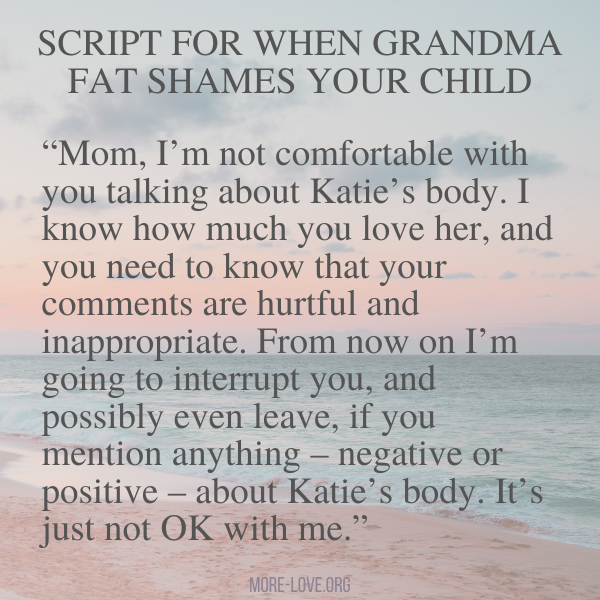
You can start the conversion with your mom immediately. “Mom, I need you to know that I’m not comfortable with you talking about Katie’s body. I know how much you love her, but your comments are hurtful. From now on I’m going to interrupt you, and possibly even leave, if you mention anything – negative or positive – about Katie’s body. It’s just not OK with me.”
This may be really hard for you. It’s very possible that your mom made similar comments about your body, and you have internalized them and believe them on some level. We all live in a fatphobic society, and it takes tremendous energy to overcome our subconscious weight stigma.
Just remember this: weight stigma is morally wrong. Also, it’s been proven to lead to disordered eating and higher body weight. Weight stigma is much more harmful than fat ever was. Fat shaming comments are never, ever helpful, and they must be stopped.
How parents can hold fat shaming boundaries
Once you have given your mom “the speech,” it’s time to hold your boundary without debate. If your mom says something that’s fat shaming, give her one warning. You can try an assertive but polite reminder like “Mom, I’m not comfortable with you talking about Katie’s body. Please stop.”
Your mom might get huffy, hurt, defensive or angry when you do this. It’s hard to change well-worn, deeply-held beliefs. But it’s her responsibility to manage her feelings, not yours, and certainly not your child’s.
As much as we want to make our parents happy with us, we have to put our kids’ mental and physical health first. Your boundaries are not in place because your mom is a bad grandmother, but rather because it’s your responsibility to keep your daughter safe, and that includes protecting her from grandma’s fat shaming.
It’s really hard, but if your mom continues to talk about your daughter’s body, you need to take your child and leave the room. You can simply say something like “Mom, we’re going to leave now. See you later.” This is the key to holding boundaries – we can’t make someone else change, but we can move our feet to show we mean business.
How kids can stop fat shaming in its tracks
In addition to talking to your mom, you can also teach your daughter to be assertive in body shaming situations. Give her a few statements that will help her be assertive when people are rude. “Grandma, when you talk about my body, I feel uncomfortable. Can you please stop?”
Grandma may respond with a defensive “Well, it’s only because I care,” or even “You are incredibly rude – I don’t like how you’re talking to me!” To which your daughter can say “That may be so, but when you talk about my body it makes me uncomfortable, and I’d like you to stop.”
Practice this at home and before visiting Grandma to help your daughter learn that standing up for herself is acceptable and necessary. Being politely assertive will be invaluable for your daughter as she moves forward in life.

Why fat shaming children is a strict NO
Fat shaming is not benign. It causes tremendous harm and is strongly associated with many negative outcomes. When a grandparent fat shames their grandchild the child will feel worse about their body and themself. They will wonder if they need to change their body in order to be loved and accepted in the family. This is unacceptable and should not be tolerated.
Fat shaming correlates with various negative outcomes like negative body image, low self-esteem, depression, anxiety, substance use and suicide. It’s also strongly associated with weight cycling, a known cause of weight gain, binge eating, and eating disorders.
Being fat shamed puts your child in a state of stress, which increases her likelihood of seeking behaviors and substances to reduce her stress and decreases her likelihood of making healthy lifestyle choices.
I know it’s hard, but it’s important to stand up for your daughter and help Grandma see the error in her ways.
Sending Love … Ginny

Ginny Jones is the founder of More-Love.org, and a Parent Coach who helps parents who have kids with eating disorders.
See Our Guide To Parenting A Child With An Eating Disorder
Discover more from More-Love.org
Subscribe to get the latest posts sent to your email.