
Food anxiety is one of the most challenging parts of an eating disorder, not just for your child but for you as a parent trying to help. Watching your child struggle with fear, worry, or avoidance around meals can feel heartbreaking and overwhelming.
You might wonder how to support them without making things worse or triggering more anxiety. This guide offers practical strategies to help you understand food anxiety, respond with empathy, and create a safer, more peaceful environment around eating, so your child can take steps toward healing with your steady support by their side.
Learning how to handle your child’s food anxiety before, during, and after mealtimes will help your child with disordered eating. You can make a huge difference if you learn how to help them work through food anxiety without using disordered eating behaviors.
Studies show that parents have a tremendous impact on kids’ anxiety. And the good news is that you can learn to reliably reduce your kids’ anxiety by acknowledging it and helping them face, rather than avoid fear.
Anxiety and eating disorders
Eating is so natural that it can be hard to understand how it becomes loaded with fear and anxiety.
One way to understand what’s going on it to recognize that anxiety is an involuntary biological response to perceived threats. In our natural environment, humans needed to be alert to life-threatening triggers like predators, enemies, and natural disasters. Today, humans have the same threat response system but it’s responding to psychological, vague threats as if they are imminently life-threatening. For example, anxiety disorders can show up around germs, driving, and leaving the house. And for some people, anxiety affects eating and the perception of food.
Some people develop a fear of food based on their idea of what is healthy and unhealthy. For example, your child might be afraid of eating carbs, sugar, or fat. They may be afraid that eating certain foods will cause weight gain, about which they are deeply anxious due to weight stigma. Other kids develop anxieties based on their sensory experience of eating, from the way food tastes, smells, looks, feels, and smells to the sensations in their stomach of nausea, emptiness or fullness.
In diet culture, our kids are exposed to many fear-based messages about food, eating and weight. For those who are genetically predisposed to developing an eating disorder, these messages drive tremendous anxiety contribute to disordered eating behaviors.

Patti and Ava
That’s what happened with Patti, who consulted with me about her daughter Ava’s eating disorder. “She is absolutely terrified of carbs and often won’t even sit at the table if they’re on it. She just goes into her room and slams the door,” said Patti. “If she does come to the table she just sits there, staring out the window and refusing to eat.”
This is a tough situation to be in. I suspected that Ava felt overwhelmed by her feelings of anxiety about food, and rather than ask Patti for help, she freezes or runs away.
With this in mind, we explored Patti’s feelings about Ava’s food anxiety. Patti told me that when Ava was young she was worried about everything. “I wanted to have compassion for her, but the truth is I couldn’t always handle her worries,” Patti said. “I thought the best thing to do is just ignore it and try to move on with our day, hoping for the best.”
Patti did what a lot of parents do. By avoiding Ava’s anxiety, she taught Ava to try to process her anxiety by herself, which is why she leaves the table when she feels anxious. Without support and guidance, Ava’s food anxiety continued to flourish.
I worked with Patti to help Ava to express her worries in small and big ways. This took effort and practice. Neither of them had experience talking about feelings like fear and anxiety. But pretty quickly, Ava started opening up. She started telling her mom she was afraid of food rather than just running away.
Sometimes she would yell, sometimes she would cry. No matter what, Patti worked on being present with Ava’s anxiety even when it was uncomfortable. Patti’s support allowed Ava to relax at the table and start exploring her food anxiety rather than avoiding it.
How to help your child handle food anxiety
So what’s a parent to do? How can we help a child handle food anxiety?
Our instinct is to try to prevent anxiety from ever happening, but this makes anxiety worse. The fact is that our kids must face situations that make them feel anxious. We can’t prevent that. And when we try, we take away the opportunity for them to build grit and resilience and tolerate feelings of anxiety and stress.
Prevention looks like this: If your child is afraid of fat, you may make low-fat meals. If they reject carbs, you prepare low-carb alternatives. If they’re afraid of restaurants, you stop eating out. These accommodations may seem to help in the short term. But they don’t teach your child to handle their feelings of anxiety and fear. Instead of empowering them to tolerate their fear, accommodations enable them to avoid it.
Avoiding fear feeds fear. The only way out of anxiety is to tolerate fear, over and over, and see that you can survive it. To feel afraid but realize you’re not being chased by a predator, enemy, or natural disaster. When a parent is next to you, holding your hand while you tolerate fear, this gets easier over time.
Your child needs to gradually learn to tolerate their fear of food to recover from an eating disorder. They need to see that they are strong enough to endure our anxiety and be OK on the other side. And you can help.
Prepare yourself first
The key to handling your child’s food anxiety is to be prepared. Expect fear to show up and be prepared to respond without accommodating or trying to prevent anxious feelings. Instead, you want to support your child in feeling their anxiety without using eating disorder behaviors.
Before you can help your child with their food anxiety, it’s important to calm your own nervous system. As mammals, our children seek us for co-regulation. That means that if our emotional state is relatively calm and confident, our children are more likely to be soothed.
You have to calm yourself to calm your child
This is hard. When a child has an eating disorder, all you want is for them to stop whatever they are doing with food and “be normal.” Also, anxiety tends to be annoying. It can be really irritating to be with someone who is afraid of food. But your emotional state is contagious, so managing your child’s anxiety starts with managing your own anxiety.
So how do you soothe yourself so you can soothe your child?
There are lots of options. As a baseline, get enough sleep and practice at least 10-minutes of mindful meditation every day. This will train you to tune into your body and soothe your nervous system.
If your anxiety is high during meals, take a few minutes to ground yourself before feeding your child. Emotions are contagious, so recovery begins with soothing yourself.
This preparation will make a significant impact on your ability to tolerate your child’s anxiety. If you dive in without preparing yourself emotionally, you may exacerbate the anxiety. This is an investment in your child’s recovery. It will also improve your own mental health. It can be draining to parent a child with food anxiety, and you need rest and recovery.
How to calm your child with food anxiety
Parents can reduce anxiety by anticipating it and responding to it effectively. Here’s how:
1. Before a meal beings
Check in meaningfully with your child. Make contact with them however you can, such as:
- Ask them about their day
- Do some yoga poses together
- Go for a gentle walk together
- Throw a ball back and forth
- Massage their hands, back, or shoulders
- Color together
This will help your child and you get in the co-regulation mode. Doing something physical together can help you attune to each other as much as talking does. Once you are co-regulated, it’s more likely that you can help them get on-track if their anxiety flares up.
2. During a meal
You should anticipate and be prepared for anxiety. But avoid allowing anxiety to run the show. It helps to tell your child in advance what you expect from them during meals.
For example, if they have a meal plan, you can expect them to follow it. And maybe you expect them to stay at the table while everyone else is eating.
They will likely complain about anything you ask them to do during meals. Your goal is to compassionately acknowledge their complaints without accommodating them. In other words, don’t let them ditch the meal plan or the table mid-meal. Agreements should be honored even if it’s uncomfortable for them.

3. When they have anxiety during a meal
Your child may do all sorts of things to try and control the meal to accommodate their anxiety. Your goal is to stay steady and acknowledge but not accommodate the anxiety. Here is a great phrase to use during a meal when your child is struggling to eat:
First, acknowledge the anxiety: “I can see that you’re struggling and I know this is hard.”
Next, express trust in them: “And I believe that you can handle this.”
It’s important not to get pulled into an extended conversation about this. Calmly and consistently repeat the phrase rather than engaging with the anxiety.
4. After a meal
If things didn’t go well during a meal, you may need to check in after the meal. You can ask your child what they think went wrong. Time this so that it’s well after the meal itself and well before the next meal.
Example: Breakfast breakdown
Here’s an example of a breakfast that’s gone sideways:
Jamie is pushing her plate away without eating.
Mom: “Hey, what’s up?”
Jamie: “I can’t. I feel sick. I can’t eat. You can’t make me!”
Mom: “I understand, and I know it’s hard to eat when you don’t want to, but I think you can handle it.”
Jamie: “But I can’t!”
Mom: “I can see that you’re upset, but I think you’ve got this.”
Jamie: “It’s not fair.”
Mom: “I understand, but I know you can handle this.”
Jamie begins to eat breakfast. She gags and complains. Mom is compassionate to her daughter’s struggle. She doesn’t remove the food or become upset. Jamie finishes breakfast reluctantly.
Later that afternoon, Mom revisits breakfast:
Mom: “So this morning you had trouble with breakfast. Do you want to talk about it?”
Jamie: “No.”
Mom: “OK, but what I saw is that you had trouble eating breakfast this morning. I sensed that you were feeling anxious and upset. Next time that happens, would you like me to change how I responded to your feelings, or was it OK?”
Jamie: “I guess I just wanted you to take away the plate so I didn’t have to eat anymore.”
Mom: “I totally understand that. You were having a hard time with the food and wanted me to take away your plate. I get it.”
Jamie: “Exactly.”
Mom: “Right. I want you to know that I understand. I know it seems easier for me to just take the plate away, and when I don’t it’s hard for you. Let’s keep talking about how you feel. I know this is hard, but we can handle this.”
Mom has acknowledged Jamie’s feelings without agreeing to change the food plan or try to avoid feelings of anxiety.
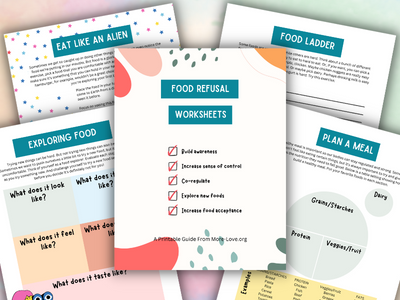
Food Refusal & Picky Eating Printable Worksheets
Give your child the best tools to grow into a confident, calm, resilient eater!
You can help your child with food anxiety
You can expect food anxiety to continue to show up during meals. This is not because your child is stubborn or not committed to being healthy. It’s because anxiety recovery takes time and patience, and food is a major anxiety trigger for your child.
If your child had anxiety about getting on a plane, you would know that going to the airport and getting on a plane will create anxiety for your child. With an eating disorder, every meal can create anxiety. The more you expect it to show up, the better you can prepare yourself for it. Remember that your goal is to handle, not accommodate, your child’s food anxiety.
And, most importantly, take care of yourself and get the care you deserve. Feeding a child with an eating disorder and anxiety is taxing. We can help our kids so much, but we have to make sure we’re getting help for ourselves, too.

Ginny Jones is the founder of More-Love.org, and a Parent Coach who helps parents who have kids with eating disorders.
See Our Parent’s Guide To Eating & Feeding A Child With An Eating Disorder
Discover more from More-Love.org
Subscribe to get the latest posts sent to your email.