

Vicky is feeling really nervous because her 19-year-old Alex (they/them) wants to go back to college after eating disorder treatment. Alex is highly motivated to get back to school and manage their own life, but Vicky feels deeply unsure about exactly how that will work.
“I can’t get over the memory of having to hospitalize them and put them in inpatient treatment last year,” says Vicky. “It was traumatic for all of us, and right now I can’t even imagine feeling good enough to send them back to school even though they say that’s what’s motivating them to recover right now.”
Vicky struggles to balance being a responsible mom with the freedom Alex wants. She wants to get clear about what Alex needs to do to show her that they are ready to go back to college.
I suggested coming up with some goals that will help Vicky feel better about sending Alex so far away again. I recommend using SMART goals for eating disorder recovery, since they are specific and attainable, and there can be no doubt as to whether they are achieved. They’re also motivating because Alex will be able to see a pathway to freedom from parental oversight.
What are SMART goals?
SMART goals are often used in business and education settings to help employees and students set and achieve measurable goals. The key to SMART goals is that they are very specific and work well when you have large goals that you want to break down into smaller steps.
SMART is an acronym that stands for “specific,” “measurable,” “attainable,” “relevant,” and “time-bound.” Every SMART goal features these essential elements to ensure the goal can be reached to satisfy both the child who will take action towards the goal and the parent who wants to see the goal achieved.

⭐⭐⭐⭐⭐
Free Guide: How Parents Can Help A Child With An Eating Disorder
Master the secrets to supporting a child with an eating disorder. Thousands of families like yours are stronger today because of these six vital lessons drawn from lived experience, best practices, and extensive study.
Specific: What is the goal?
The goal should be well-defined, clear, and unambiguous. For example, it’s not enough to say “eat enough.” If the goal is to eat, get specific, like “eat 3 meals and 2 snacks every day.”
Measurable: How will I measure progress?
The goal should have specific criteria that measure progress. For example, if the goal is 3 meals and 2 snacks daily, the child could text a photo of each to their parent or dietitian.
Attainable: Do I have the resources & skills for it?
The goal should be something that is attainable and not impossible. It should be within the child’s capacity to do. In the eating example, the child needs access to food and a smartphone.
Relevant: Why is this goal important?
The goal should be an important step toward self-management. It should matter to you and your child. In the eating example, maintaining regular meals and snacks is a major part of being a competent eater, and thus makes sense as a relevant goal.
Time-Bound: When will I achieve the goal I’ve set?
The goal should have a clearly defined timeline, including a start date and a target date. For example, if they send photos of all three meals and snacks every day for eight weeks, you may set a new SMART goal that gives them less oversight in the next stage.
Why are SMART goals important?
SMART goals are important because they help parents:
- Set clear intentions, not broad or vague goals
- Feel confident about the child’s path to self-management
- Focus on the specific behaviors that support recovery
- Measure progress with specific benchmarks
- Provide sensible objectives that are realistic and achievable
- Avoid the distraction of a long list of goals that is hard to manage
- Be clear about the timeline and next steps if goals are met
SMART goals increase your child’s pursuit of self-management by making your expectations really clear and unambiguous. Your college-age child wants to get out from under parental control, so setting SMART goals gives them a clear path to doing that. These goals communicate that you believe your child can succeed but also gives you the confidence to let them go away to college.
How can SMART goals help with eating disorder recovery?
SMART goals can help with eating disorder recovery, especially for college students, because they help both the child and the parents get what they need. The child wants autonomy and to return to their life back at college. But the parents want assurance that the eating disorder is not active and putting their child in danger.
Vicky was really excited about using SMART goals for Alex. “I feel like this is going to really help us put together a plan that feels good for all of us,” she says. “Alex would much prefer zero controls, and I get that, but I need something to make sure I’m not being reckless or thoughtless when sending them back to school.”
Working on SMART goals
Vicky worked on three SMART goals that she felt were important. Since they are in family therapy and Vicky was unsure how Alex would respond, she brought up the idea during a family therapy session. The therapist was encouraging and supportive of the idea, and Alex didn’t hate it. So the next week Vicky brought in the SMART goals worksheet. Together they worked with the therapist and Alex to make adjustments that felt good for everyone.
“A big deal for Alex was the time-bound aspect, of course,” says Vicky. “Alex just wants to see a path out of being monitored all the time, and I feel like these SMART goals give us all the confidence to move forward. I want Alex to feel independent and free … and I want to be free of the eating disorder, too! This has absolutely taken over our lives, and I can’t wait to move into the next stage and reduce our monitoring.”
This steady and clear approach to eating disorder recovery adds a lot of confidence and security for parents while also showing kids the steps they need to take to reclaim the independence they crave.

SMART goal template & examples
SMART goals for recovery example: eating
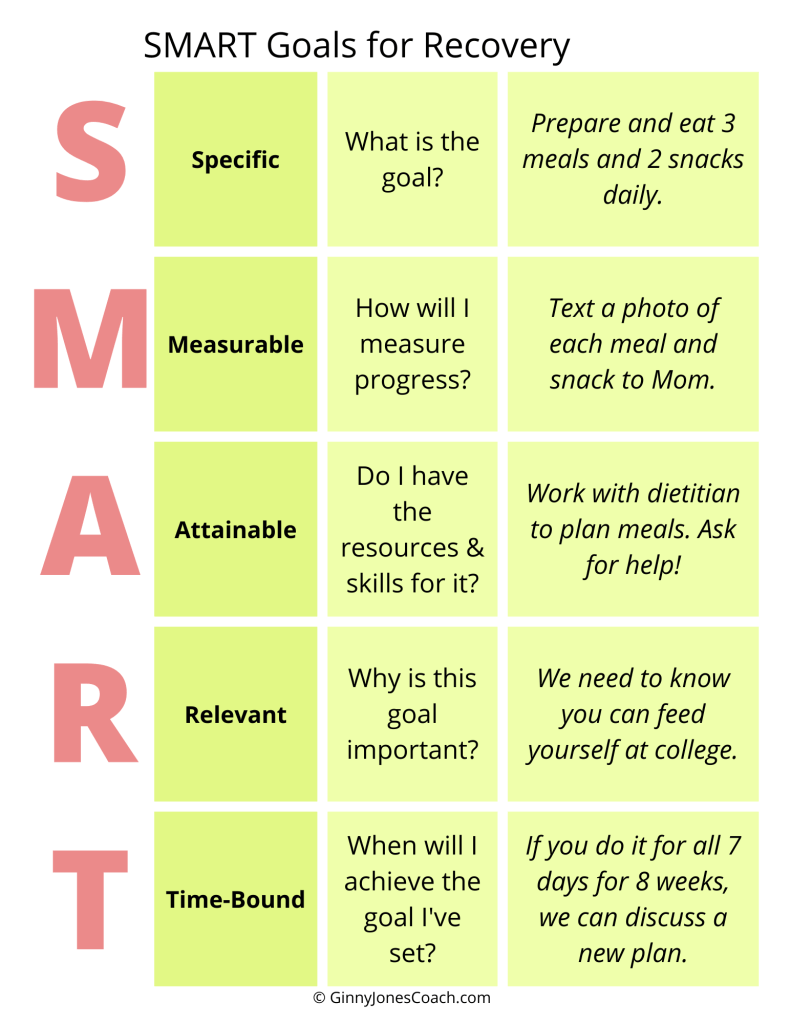
PLEASE NOTE: this is not intended as or delivered as medical advice. Please don’t make choices about your child’s recovery without consulting their treatment team. Make sure your SMART goals are appropriate and make sense in the context of your child’s eating disorder recovery.
SMART goals for recovery example: therapy

Free Template
Click here for a free editable SMART goal template
How to make a SMART goal for eating disorder recovery
Like Vicky, you may be excited about SMART goals and want to dive right in. I get it! I love SMART goals! Please just remember that while Vicky drafted some SMART goals, she checked with her family therapist before introducing them to her child. Depending on your child’s eating disorder recovery status, SMART goals may not be the right approach right now. Check with your child’s eating disorder treatment team before presenting your child with SMART goals.
To make a SMART goal, begin by thinking of your big goal, then breaking it down into behaviors that will get you closer to the goal. With eating disorders, the big goal is “recovery,” but that’s hard to measure and it’s a state of being, not a behavior with measurable steps. If we make recovery the goal, we will struggle to measure and monitor it. Instead, break it down into attainable, measurable, and observable behaviors like:
- Eating regular meals and snacks
- Checking vital signs of health such as heart rate, blood pressure, etc.
- Going to therapy and nutrition appointments
- Getting blind-weighed if appropriate/necessary
Next, write down a few SMART goals that are “specific,” “measurable,” “attainable,” “relevant,” and “time-bound.” If the goal is eating regular meals and snacks, detail how many meals and snacks, and how the goal will be measured. The most common mistake is not being very specific about the goal. The more specific and measurable the goal, the greater your chances of success.
Examples of SMART goals for eating disorder recovery
| Vague Goals | Specific Goals |
| Eat regularly | Text photos of 3 meals and 2 snacks every day |
| Don’t lose weight | Get blind-weighed once every two weeks* |
| Stay healthy | Get your vital signs checked once every two weeks* |
| Take care of yourself | Attend weekly therapy and nutrition sessions |
*the frequency will vary based on your child’s current medical status and is here as an example only. Please consult your child’s treatment team to set goals that make sense for their individual recovery path.
Measuring success
The most motivating eating disorder goals are those that provide a pathway out of being monitored. Show your child the path to self-management by setting multi-stage SMART goals.
For example, if the first goal is for them to attend therapy weekly for 8 weeks, that doesn’t mean you stop all therapy if they reach that goal. Maybe the next goal is that they switch to every 2 weeks for 8 weeks after that, then monthly. A stepped approach will provide the safest structure for recovery
SMART goals should never feel punitive or shameful. The value of providing time-bound goals is so your child knows what will happen when they meet the goal. But you should not say you are disappointed if your child does not achieve the goal by a certain date. That’s why I suggest using consecutive weeks rather than a specific date. Just count the weeks that they do accomplish the goal. If they skip a week, then you start again at 0. Once they do it every week in a row for the number of weeks specified you can celebrate and set a new goal.
⭐⭐⭐⭐⭐
Free Guide: How Parents Can Help A Child With An Eating Disorder
Master the secrets to supporting a child with an eating disorder. Thousands of families like yours are stronger today because of these six vital lessons drawn from lived experience, best practices, and extensive study.
Setting the clock
For example, Alex might text photos of their meals every day for two weeks in a row, then skip a few days during the third week. Alex is not bad for doing this. It’s understandable. However, that resets the clock back to 0. Once Alex texts all meals/snacks for 7 days, that puts the clock at 1. If the goal is 8 weeks, then Alex must text all meals/snacks for 7 days in a row for 8 weeks in a row to meet the goal.
Avoid being flexible or changing the goal, because it will show your child that the goals are open for negotiation and debate. This is a slippery slope that eating disorders love to take advantage of. Instead, maintain clear, compassionate boundaries. It sucks for all of you to start at 0 again. But that’s how you make sure you aren’t accidentally accommodating the eating disorder.
Celebrating success
I checked in with Vicky after Alex had been back at college for a semester. She had been both hopeful and terrified of the return to college. And I’m pretty sure Alex felt many of the same feelings!
Alex struggled a little bit with the transition back to school, which we expected and had prepared for. But after 4 weeks of being inconsistent with their progress, Alex stayed on track and they are almost ready to set new SMART goals that give Alex more freedom and autonomy.
Vicky says that having SMART goals is a huge relief for her. “I just feel like I have some level of insight into what’s going on for them at college. Now I can keep an eye on their health and safety when they’re so far away from me.”
FAQs: SMART goals for eating disorder recovery
Which goal is appropriate when treating anorexia nervosa?
Setting goals when treating anorexia nervosa tend to focus on eating enough food regularly throughout the day, limiting exercise unless safe, and weight restoration. These goals are ideally set with a treatment provider like a therapist, physician, or Registered Dietitian (RD).
What are realistic eating disorder recovery goals?
Setting realistic eating disorder recovery goals is an important part of treatment, and is best done in consultation with an experienced professional. Each eating disorder is different, and circumstances vary greatly. In general, recovery goals should be challenging enough to feel energizing but not so challenging that they feel hopeless or unattainable. Finding the right balance is the key to setting realistic eating disorder recovery goals.
Can SMART goals help with eating disorder recovery?
SMART goals can help with eating disorder recovery because they support appropriate targets without being vague or pushing too hard. Finding the right level of difficulty is key to successful SMART goals in eating disorder recovery.

Ginny Jones is the founder of More-Love.org, and a Parent Coach who helps parents who have kids with eating disorders.
For privacy, names and identifying details have been changed in this article.
See Our Eating Disorder Treatment Guide For Parents
Discover more from More-Love.org
Subscribe to get the latest posts sent to your email.