

Many people who have eating disorders like anorexia, bulimia, binge eating disorder, and ARFID also have ADHD, autism, OCD, and/or PTSD. These conditions are commonly found together and can make treatment harder if they’re not addressed in relationship to each other.
My client Crystal was stunned when, three years into treatment, she found out that her daughter had PTSD and autism that pre-dated the eating disorder symptoms.
“We started treatment three years ago for the eating disorder before we even knew about the PTSD,” says Crystal. “I remember getting so frustrated with my daughter’s treatment team because they kept asking probing questions about trauma and we were convinced that had nothing to do with her eating patterns. I was sure the problem started and ended with her desire to look like an Instagram influencer, but I was wrong.”
Crystal isn’t the only one who’s been led astray by the common misunderstanding that eating disorders are skin-deep. That they’re about an obsession with physical appearance. Of course, negative body image is a major symptom of an eating disorder. But eating disorders don’t only come from the false body ideals presented by the media, otherwise, 100% of people would have eating disorders.
In recent years we’ve come to understand that eating disorders rarely show up alone, and they’re much more than skin-deep. They’re often a complex coping mechanism for other neurobiological conditions and mental disorders. The intersection of conditions like ADHD or autism and an eating disorder must be addressed holistically for treatment to be effective.
Eating disorders can be a coping mechanism
It’s easy to miss the underlying drivers of an eating disorder. Often we’re distracted by the belief that eating disorders are about looking a certain way and meeting societal standards. And of course, that’s a part of it. However, the drive to achieve societal standards can be considered a symptom of the eating disorder. The root cause of the eating disorder may be underlying neurobiological and mental conditions. These conditions make your child sensitive to disordered eating patterns in the first place.
In many cases, eating disorder behaviors are a sort of secondary condition that lies on top of disorders like ADHD, OCD, PTSD, and/or autism.
As a parent who has a child with an eating disorder, you need to understand that it’s possible your child’s disorder goes much deeper than food, eating, and weight, and includes an underlying condition. If you know your child has an eating disorder alongside something like autism or ADHD, ask their treatment team specifically how they are addressing eating behaviors within the context of treating the other condition. They should have a strong answer for you, as these conditions can’t be treated in isolation!
If your child’s only condition right now is an eating disorder, explore whether something else might be driving their symptoms. Ask their treatment team if they’ve been evaluated for ADHD, autism, OCD, and/or PTSD. Both ADHD and autism are chronically underdiagnosed in females, which also happens to be the population at the highest risk of an eating disorder. Finding out if your child has ADHD or autism might not be something you were looking for, but when an eating disorder is present it should be explored.
Obsessive Compulsive Disorder
Obsessive Compulsive Disorder (OCD) falls under Anxiety Disorders, and both Anxiety Disorders and OCD are highly correlated with eating disorders. A research study in 2004 found that 64% of people who have eating disorders also suffer from an anxiety disorder. And up to 41% have OCD in particular. The study also found that 42% developed anxiety disorders in childhood before the eating disorders began. (ADAA)
Some researchers even place eating disorders under the umbrella of OCD rather than stand-alone disorders. This causes some real challenges when treating someone with an eating disorder. This is because the clinician may not be clear about where one disorder ends and the other begins. (IOCDF)

Eating and weight obsessions
Most of us think of OCD as being about obsessively washing hands. But weight and food obsessions, body checking, and eating rituals fall well within the spectrum of OCD. Many people who have eating disorders have obsessive and compulsive thoughts about food and weight.
People who have eating disorders may use restriction, purging, and/or binge eating as a way to manage feelings of anxiety. Anxiety is often described as the persistent sense that something is terribly wrong. Some experience heart palpitations, stomach upset, and trouble breathing. Others faint when facing especially stressful situations. It’s very common to think an anxiety attack is a near-death experience. The physical sensations of fear are as pervasive and terrifying as being chased by a lion.
Working with both OCD and an eating disorder involves a combination of therapies. Most professionals who work with OCD use exposure therapy. They may also use Cognitive Behavioral Therapy (CBT) and/or Dialectical Behavioral Therapy (DBT). Both are highly effective in treating Anxiety Disorders. If your child has OCD they will likely require ongoing mental health support beyond eating disorder recovery.
A program called SPACE is highly effective in reducing symptoms of anxiety, eating issues, and OCD. SPACE teaches parents how to respond more effectively to anxiety. Studies show that teaching parents these skills is as effective as working with the child using CBT.
ADHD
Several studies have found a link between ADHD and eating disorders, particularly bulimia. The working theory on why this happens is that impulsivity is recognized as a trait for both conditions. The treatment for an eating disorder is distinctly different from and may even contradict the treatment for ADHD. This is why both conditions must be considered in treatment.
For example, treatment may begin either with managing the symptoms of ADHD or managing the symptoms of the eating disorder. Often the choice is made based on the experience of the team and the severity of the symptoms. ADHD is frequently missed in girls. Thus, this underlying condition is often missed in female eating disorder treatment.
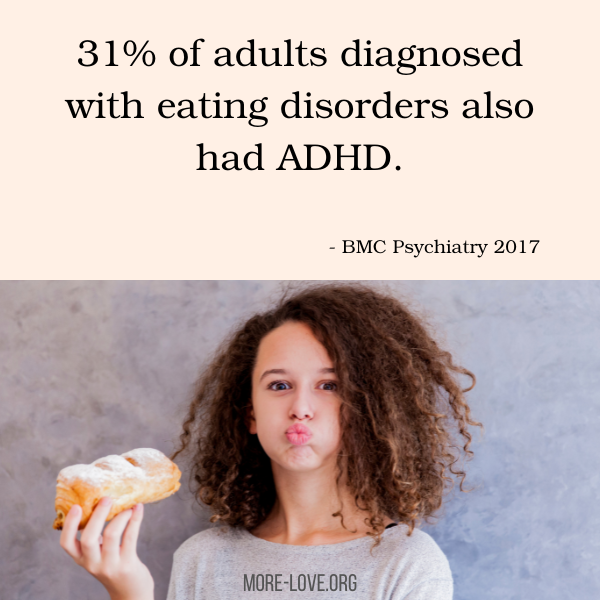
One study found that for girls, ADHD significantly increases the risk of eating disorders. They showed a particular risk of developing bulimia nervosa. Girls with ADHD and an eating disorder had increased rates of mood, anxiety, and disruptive behavior disorders.
Additionally, ADHD traits are highly predictive of the severity of anxiety and depression symptoms, both precursors and companions to eating disorders. The higher the levels of ADHD traits, the more likely a person is to experience severe mental health symptoms. Due to societal biases and misinformation, people with ADHD often don’t receive access to the clinical care they need to cope with their symptoms. Importantly, ADHD isn’t just a childhood condition that people “grow out of,” but persists throughout life.
One of the most commonly reported relationships between ADHD and eating disorders is the issue of eating regularly. ADHD often interferes with planning and regularity. Therefore skipped meals can become a problem, resulting in binge eating later in the day. It can be hard to tease apart the two issues, but doing so can greatly improve treatment efficacy.
Autism
Research has found links between Autism Spectrum Disorder (ASD) and Anorexia Nervosa. (Eating Disorder HOPE) People with autism often exhibit repetitive behaviors and restrictive behaviors and interests. They also can have sensory sensitivities.
Atypical eating behaviors, including limited food preferences and hypersensitivity to texture, are found in 70.4% of children with autism. This figure is so high that it has been suggested that atypical eating behaviors may be used as a diagnostic tool for autism. Feeding problems, such as picky eating, fear of trying new foods, food avoidance, and insistence on specific food presentation are common in youth with autism.
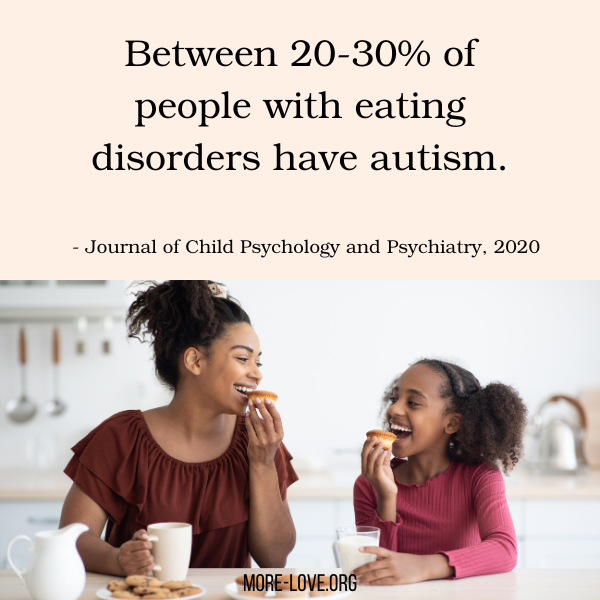
These atypical eating behaviors may explain why between 20-30% of people with eating disorders also have autism or signs of autism. Autism is especially correlated with ARFID (Avoidant Restrictive Food Intake Disorder). There is even a hypothesis that underdiagnosis and subsequent lack of treatment for autism may mean that many girls diagnosed with anorexia have a primary condition of autism.
The diagnostic tests for autism lean heavily towards boys – more than four boys are diagnosed for every one girl. While there may be genetic differences, clinicians are now considering that there is a gender bias in the diagnostics and autistic girls are less likely to be tested and diagnosed. These girls don’t fit the stereotypes or their symptoms are misinterpreted. Additionally, girls may be better at “masking” their autistic traits. Some say that under-diagnosis and subsequent lack of treatment may mean that many girls with anorexia are suffering from ASD.
One symptom of Autism is the ability to hyperfocus. This may translate into extensive rituals around logging calories and body weight as seen in someone who has anorexia. The continued hyperfocus even when other people suggest relaxing food rules can also be seen as a symptom of ASD.
Another symptom of Autism is being highly sensitive. Many people who have ARFID have a strong aversion to specific food textures, smells, and even colors. Some will talk about the discomfort they feel when chewing, swallowing, and digesting food. This could suggest high sensitivity in the mouth, throat, and digestive tract.
These overlapping symptoms can make it hard to tease apart ARFID from anorexia. The term Avoidant/Restrictive Food Intake Disorder (ARFID) is now used to differentiate people who restrict food for non-weight reasons. Meanwhile, anorexia is a disorder in which the active pursuit is low body weight.
The SPACE-ARFID program has been developed specifically to address non-weight-based food restrictions. It’s been found to be highly effective in reducing food and eating anxiety and increasing food and eating flexibility.
Post Traumatic Stress Disorder
People who have eating disorders have a higher rate of childhood trauma compared to the general population. Sexual trauma seems to be particularly linked to eating disorders. Women who have a history of childhood sexual abuse are more likely to have problematic eating behaviors and eating disorders. Trauma includes physical and emotional violence, sexual abuse, emotional neglect, having a serious accident or illness, witnessing a serious accident or illness, and more. A relatively new form of trauma being explored is complex trauma. This is the trauma a child experiences when their attachment needs with caregivers are not adequately and consistently met.
Symptoms of trauma include emotional dysregulation, a negative self-image, and the inability to cope with strong feelings such as anger or sadness. Experts have suggested that people who have a history of trauma may develop eating disorders as a way to cope with their trauma since eating disorder behaviors can be powerful self-soothing and coping mechanisms.

Most of us think of soldiers returning from war when we hear about PTSD. But the disorder is found in 10% of women and 4% of men. The higher prevalence of PTSD in women is likely because they are more likely to experience sexual assault. Such a violation is more likely to cause PTSD than many other types of events. The most common trauma for women is sexual assault or childhood sexual abuse. About 33% of women experience sexual assault during their lives, many before they reach adulthood. (National Center for PTSD)

Trauma rewires the brain
Trauma rewires the brain and nervous system. It results in chronically increased stress hormones and reduces the ability of the brain to communicate with the body. People suffering from PTSD may confuse fear and pain with pleasure. They will commonly push their bodies beyond reasonable boundaries. This includes extreme restriction, binge eating, self-harm, substance abuse, over-exercising, and extreme risk-taking (The Body Keeps the Score). One study found that +33% of individuals who have PTSD are still suffering from the full syndrome a decade later. In other words, it is frequently undiagnosed and undertreated.
It has been suggested that Bulimia Nervosa, in particular, may emerge as a coping method for the pain of PTSD. Women who have anorexia exhibit standard rates of PTSD (10%). However, about 25% of women with Bulimia Nervosa are diagnosed with PTSD. (Eating Disorder HOPE)
If you suspect that one of these diagnoses may be contributing to your child’s eating disorder, ask their treatment team whether they have been assessed. If not, you can request testing for any of these psychological conditions.

Ginny Jones is the founder of More-Love.org, and a Parent Coach who helps parents who have kids with eating disorders.
See Our Parent’s Guide To Mental Health And Eating Disorders
Discover more from More-Love.org
Subscribe to get the latest posts sent to your email.