

Few things are more frightening than knowing your child has an eating disorder and watching them refuse the help they desperately need. Denial, fear of weight gain, or a deep sense of shame can make treatment feel unbearable for them, even when their health is at serious risk.
As a parent, it’s gut-wrenching to feel powerless while your child resists the very thing that could save their life. In this article, we’ll explore why kids and teens often reject eating disorder treatment, what’s really going on beneath the surface, and how you can respond with empathy, firmness, and hope.
Eating disorder treatment refusal
It seems obvious that when a child has an eating disorder they should get treatment, and yet many parents have a kid who refuses to go. You may find yourself in frustrating arguments, going around and around, trying to convince your child to do something that seems so incredibly necessary. You’re desperate to make a change, but forcing treatment on your child is simply not working. What’s going on?
First, many people who have eating disorders don’t think it’s a serious problem. In fact, a symptom of the disorder is a distorted view of what “healthy” is. Therefore, it can be hard for them to actually see that what they are doing is a problem. Trying to convince someone with an eating disorder that their eating disorder is “bad enough” to deserve treatment can be an uphill battle.
Next, eating disorders are coping mechanisms that your child has discovered make them feel better. Even though it may seem terrible to you, the eating disorder is serving a purpose in your child’s life, and they may not be able to tolerate living without it right now. Trying to force a child to give up their coping mechanism without giving them new ones can be counterproductive.

⭐⭐⭐⭐⭐
Free Guide: How Parents Can Help A Child With An Eating Disorder
Master the secrets to supporting a child with an eating disorder. Thousands of families like yours are stronger today because of these six vital lessons drawn from lived experience, best practices, and extensive study.
Finally, you may have accidentally gotten into a power struggle over eating disorder treatment. In a desperate attempt to take good care of their kids, many parents find themselves trapped in power struggles that feel impossible to overcome. You haven’t done anything wrong, but if your child refuses eating disorder treatment, then understanding the power dynamics at play can help you succeed.
Here are seven things parents can do when a child refuses treatment for their eating disorder:
1. Get professional support
Someone with an eating disorder needs support to recover. But of course if your child refuses treatment for their eating disorder, that’s meaningless advice. Keep in mind that a child who refuses treatment for an eating disorder is saying they won’t do it right now, but circumstances change all the time. This isn’t hopeless, and you can make a difference!
The first thing to know is that even if it feels like there is, the truth is that there’s no silver bullet of eating disorder recovery. Each person has a unique recovery story. We’re never stuck with just one option.
If your child absolutely refuses professional support, you can still make progress by getting help for yourself. Parents are essential to and can actually lead eating disorder recovery. That said, most parents need professional support to do this.
If your child won’t go to therapy, you can go to therapy or get coaching to find out what you can do to help them. When a child won’t see a dietitian, you can see a dietitian and get advice about how and what to feed your child with an eating disorder. In other words, even if your child refuses eating disorder treatment right now, that doesn’t mean you’re powerless. Take the action you can right now. It will add up.
2. Set mini-goals
Most parents are anxious for their child to achieve full recovery from an eating disorder. Of course that’s what we want! But often this dream gets in the way of the day-to-day struggle of recovery. Breaking your big goal down into mini-goals will help you maintain motivation and support your child through the ups and downs of treatment.
The biggest benefit of having small goals is that your child might refuse a big idea like TREATMENT but they’re willing to go to a therapy appointment this afternoon. They might refuse a big idea like EAT ALL YOUR FOOD but they’re willing to try one more bite right now.
⭐⭐⭐⭐⭐
Free Guide: How Parents Can Help A Child With An Eating Disorder
Master the secrets to supporting a child with an eating disorder. Thousands of families like yours are stronger today because of these six vital lessons drawn from lived experience, best practices, and extensive study.
In other words, rather than trying to commit your child to a big goal, work with them on getting to small yesses minute by minute, day by day. Eventually, these small yesses will add up and you’ll find yourself surprised by all the progress you’ve made.
Whenever possible, make your goals SMART, an acronym that stands for “specific,” “measurable,” “attainable,” “relevant,” and “time-bound.” SMART goals can help you maintain motivation throughout treatment.
Read more: SMART goals parents can set in eating disorder recovery
3. Don’t engage in debates or power plays
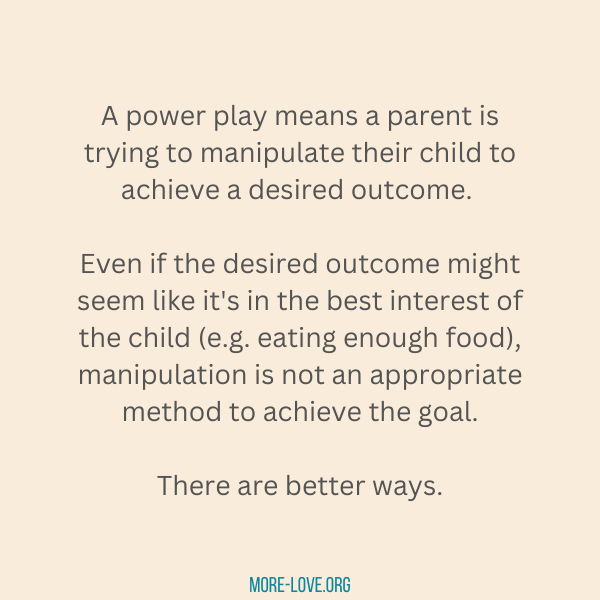
Power struggles are really common when your child has an eating disorder. It’s natural and understandable if you’re desperate to make your child see that they have a problem and accept treatment. However, even when your motivation makes perfect sense, power struggles are counterproductive in eating disorder treatment.
Usually power struggles mean a parent is using methods like dominance, control, negotiation, and manipulation to achieve their goals. Unfortunately, power struggles are counterproductive because they increase disconnection and resistance between you and your child. Kids whose parents use power plays feel powerlessness, inadequate, and frustrated, all of which increase eating disorder symptoms.
Instead of power plays, seek to influence, motivate, and collaborate with your child while holding firm boundaries about what you will and will not do. For example, you can serve food consistently, refuse to change the content, structure, and plan for meals, and consistently show up with a calm, confident approach to feeding your child. This approach is extremely effective, much more so than power plays.
Read More: How to stop nagging and negotiating with your kid who has an eating disorder and How to motivate recovery from an eating disorder
4. Set clear expectations
Most parents think they’re being crystal clear when setting expectations with their kids. However, many of us get stuck in unhelpful power struggles because we’re not communicating our expectations effectively.
Setting good expectations with our kids involves four things:
- Clarity: we must clearly state exactly the behavior we’re asking our child to do. For example, “Please be in the car at 4:30 p.m. on Tuesday to go to your doctor’s appointment.”
- Repetition: we must repeat our expectations and remind our kids that we have them. For example, on Tuesday morning you will remind your child that you expect them in the car at 4:30 p.m. for their doctor’s appointment. Then at 4 p.m. you will give them another reminder. You’ll keep your repeated requests simple, polite and respectful, which will minimize (but not eliminate) pushback.
- Avoid Arguments: avoid arguing about and defending your expectations. For example, imagine it’s 4:30 and your child isn’t in the car. Don’t fall for it when they want to debate whether 4:30 is a reasonable time to leave. Simply repeat your expectation, “I understand you have a different opinion, but I asked you to be in the car at 4:30, and I’d like to get going now.” Remember, keep it simple, polite, and respectful. Your child can’t be more emotionally regulated than you are.
- Review: when our expectations aren’t met, many of us feel disrespected and throw up our hands in despair. Instead, take time to review your behavior. Were you clear? Did you repeat your requests respectfully? Did you avoid arguments? If not, make adjustments in your own behavior next time. If you did all these things, then review the situation with your child simply, respectfully, and non-defensively. “Buddy, I’m curious why it was so hard to get in the car at 4:30 as planned. What can we do next time to make this easier for both of us?” Remember: don’t debate your opinion. Just listen respectfully to your child’s opinions and seek to find a solution you can both agree to.
Setting clear, consistent behavioral expectations with a child in eating disorder recovery is essential and will make a big difference.
Read More: Emotional Regulation And Eating Disorders
5. Hold boundaries around what you will do
Instead of engaging in power plays, set boundaries around your own behavior. Your own beliefs and behavior are within your control. On the other hand, your child’s beliefs and behavior are not within your control. You want to hold your own boundaries while respecting that your child disagrees. Your child doesn’t have to agree with you for you to succeed.
For example, let’s say your child is refusing to go to therapy. She says that therapy is a waste of time and tells you that she will not talk if she goes and it’s a waste of money for you to take her. In response, you argue with her about the value of therapy. Maybe you present evidence that therapy is good and necessary to eating disorder treatment. You might insist that she go to therapy and talk to the therapist if she wants to keep her phone privileges.
While this approach makes perfect common sense, it gets you into power play territory because you’re trying to control your child’s beliefs and behavior in therapy. When you’re dealing with an eating disorder, common sense can backfire dramatically.
Instead, if you believe therapy is necessary and helpful, you simply hold your belief while listening to her say stuff that’s intended to pull you back into a power play. Instead of engaging in arguments, you simply say what you will do.
Imagine it’s the morning before a therapy appointment and she says “Therapy’s stupid. You’re wasting your money.”
You take a deep breath and say “I get it. You don’t like going to therapy. Your appointment today is at 2, and I’ll pick you up from school at 1:30.”
I know, this is completely different from anything you’ve done before. You’re switching from a power play to holding your own boundaries.
Her eyes will spark, because she’s used to the power play dynamic. She wants to have an argument about therapy because sometimes it means she doesn’t have to go. Your daughter feels powerful when she gets to debate you about the value of therapy. She will poke and prod and attempt you to go back to the familiar dance of arguing with her.
But instead you hold steady with your boundary. She gets to have her thoughts and feelings about therapy, and you get to have yours. You will hold your ground and be at school at 1:30, then take her to therapy. That’s what is within your control. Convincing her to like it is not.
You might be thinking this will not work, but science shows this does in fact work. They key is that you are consistent and follow through. Once you set a boundary, you must hold onto it. It may take a few repetitions, but it will work.
Read more: How to set healthy boundaries when your child has an eating disorder
6. Attend family therapy
Your child is the one with an eating disorder, but usually family dynamics are involved in maintaining an eating disorder. It’s nobody’s fault; it’s just how humans work. Understanding how family dynamics affect your child with an eating disorder is one of the most powerful things parents can do to support recovery.
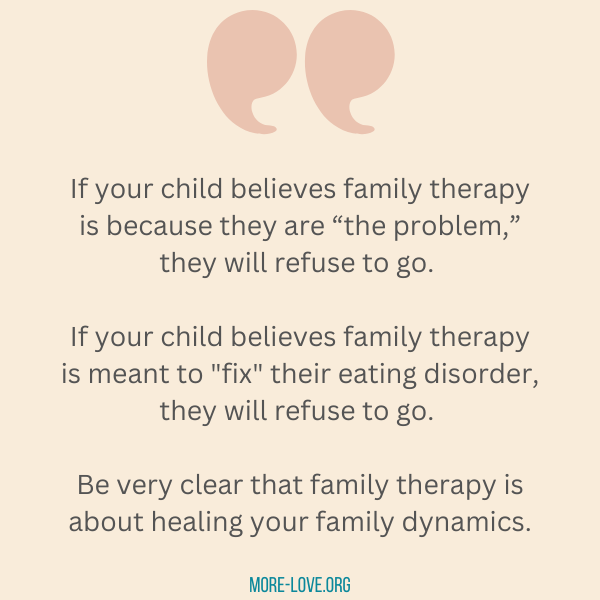
While it’s tempting to approach family therapy with the goal of getting your child to embrace recovery, that can backfire. If your child believes the family therapy is because you think they’re the problem, they will refuse to go. If your child believes the family therapy is meant to “fix” their eating disorder, they will refuse to go. So be very clear that family therapy is about improving your family dynamics. It’s for everyone.
The purpose of family therapy is for you to build a stronger connection with your child, to gain some parenting skills, and to help them express themselves fully to you in a safe space. You will learn new communication skills and work on expressing yourself authoritatively and compassionately while unconditionally accepting your child exactly as they are.
Read more: Family therapy when your child has an eating disorder
7. Enjoy your child
You may think that enjoying time with your child while they refuse to get eating disorder treatment is enabling the eating disorder. But that’s simply not true. Eating disorders are complex, and they take time and patience to treat. While that’s happening, make sure you’re enjoying your child.
Our kids see themselves reflected in our eyes. If all we can see is a problem we need to solve, they feel worse about themselves. A good rule of thumb is that you should balance every negative interaction with your child with five positives. Does that sound like a lot? Well science shows that a 5:1 ratio is the minimum we need to maintain positive relationships. I know this is so hard right now, but keep sight of the fact that your child needs to feel as if you to love and accept them exactly as they are right now.
Most people who have eating disorders can and do recover. Taking the steps outlined above, embracing your potential to change, and improving your parenting techniques will help make that happen. The happy side effect of all of these steps is that your family will become more bonded and stronger in every way. And hopefully, your improved relationship will help your child accept eating disorder treatment.

Ginny Jones is the founder of More-Love.org, and a Parent Coach who helps parents who have kids with eating disorders.
See Our Eating Disorder Treatment Guide For Parents
Discover more from More-Love.org
Subscribe to get the latest posts sent to your email.
What a succinct, to the point and clear article.
Thank you.
Thank you so much! xoxo