
It’s natural to worry about your daughter’s well-being, but when it comes to weight, even the most well-intentioned comments can cause deep harm. If you’re considering talking to your adult daughter about her body, it’s important to pause and reflect on the potential impact of your words.
In a culture steeped in weight stigma and unrealistic beauty standards, conversations about weight often trigger shame, damage trust, and strain parent-child relationships. Below, I respond to a worried mom who wants to do the right thing, helping her take a compassionate, respectful approach that prioritizes emotional safety, body autonomy, and lasting connection over appearance-based concerns.
Dear Ginny,
I really want to talk to my adult daughter about her weight, which keeps going up. When I get together with her, she binge eats a lot of unhealthy food. When she was growing up, she was always on the chubby side, but she dieted a lot and generally kept her weight under control until she got to college. I always taught her to watch her weight, how to count calories, and tried to model healthy behavior. Now she is 28 years old and she’s gained so much weight. I see her eating all sorts of foods like cupcakes, chips, soda, and french fries. What can I do when I see my grown daughter binge eat like that? Can I tell her I’m concerned about her weight? Should I ask her if she has binge eating disorder? How can I help her lose weight without offending her?
Signed, Worried Mom
Dear Worried Mom,
I can understand why you are concerned, and I can hear how much you love your daughter. But she’s an adult. That means a few things. First, she is responsible for her own health now. You can support her, but advice can be tricky. Listen more than you advise. Focus on being curious rather than making recommendations.
Second, as a larger woman, she is absolutely aware of her weight already. A lot of times people think larger people need to be informed of their weight and the dangers of living in a larger body. Trust me on this: she’s heard it all. Any attempt to talk to your daughter about her weight that assumes she’s not aware of her size will infantilize her and inflict weight stigma. It will not help her and it could damage your relationship.
Unpack your assumptions about weight and health
In our culture, we make a lot of assumptions about food and weight, and when a person is larger we tend to blame that on their eating habits, forgetting that almost all people, including thin people, eat a variety of food, including cupcakes, chips, soda, and french fries. The assumptions you make about her weight and eating habits can get in the way of truly caring for your adult daughter and having a positive impact on her health.
First, regarding weight. You say that your child was on the chubby side. It’s hard to live in a larger body in our society. I would imagine that she was criticized for her weight. This might have led her to start dieting and controlling her weight, which might have seemed like a good thing at the time. But actually, this worked against her. Dieting is a risk factor for both weight gain and eating disorders.
In almost all cases (+95%) when a person intentionally loses weight, they will experience weight cycling. They regain all the weight they lost, often plus a little more. Weight cycling creates metabolic changes that can remain indefinitely. In other words, dieting to lose weight creates weight gain in almost all cases.
Dieting is the No. 1 predictor of weight gain and eating disorders.
I’m telling you this because I know that you are very concerned about her health, and I know you want to talk to your daughter about her weight, but focusing on her weight is counterproductive. We live in a society that blames and shames people for their weight.
But true health is not achieved by trying to control weight but by healing a person’s relationship with food and their body. Your job is not to help your daughter to control her weight, but to help her accept and love herself for who she is.
Don’t talk to your daughter if your message is that she needs to lose weight
People like your daughter feel the weight of our society’s blame and shame. The problem may look like it’s the number on the scale, but the real problem is that she’s been blamed and shamed for living in a body that doesn’t fit into narrow societal expectations. I know you want to help your daughter, so I’ll be blunt: if you talk to her about her weight, you will likely make things worse for her health and your relationship.
You mean well, but based on the things you said in your letter, it’s going to be hard for you to have a positive, productive conversation with her about weight right now.
I’d like you to consider your daughter’s eating patterns as if she were a thin person. If your grown daughter were thin, would you worry that she binge eats cake, fries, and other fun foods? Most people eat these foods, but we are conditioned to notice it more and criticize people who are living in larger bodies because we assume that they are larger because of the way they eat.
This is a false assumption. In fact, people who are in larger bodies often consume the same or fewer calories and eat a diet equal to that of many people who are in smaller bodies. A larger body is genetically primed to have a slower metabolism and be more efficient in extracting nutrition. And if a person has dieted, they have further reduced their metabolic rate. These factors are out of your daughter’s control. You cannot change her genes or past weight cycling.
So, really think about how your daughter eats in light of this common bias. Is she really eating “too much” or are you assuming she eats too much because her body is large? Are you sure you are seeing a “binge,” or just your grown daughter in a larger body eating food?
Is it binge eating disorder or just eating?
Binge eating disorder is the most common eating disorder, but it is also terribly misunderstood and frequently mistreated by loved ones, healthcare providers, and even eating disorder treatment providers. This is due to weight stigma and diet culture.
So we want to unpack your assumptions before jumping to the conclusion that she has binge eating disorder. At the same time, if she does have an eating disorder, then your support can help her find healing. Here are the symptoms of binge eating disorder:
- Feeling a sense of being out of control while eating substantial quantities of food
- Skipping meals in an attempt to “make up” for binge eating episodes
- Going on diets and trying new ways to lose weight
- Eating rapidly and/or until uncomfortably full
- Eating in secret due to embarrassment
- Feeling disgusted, ashamed, and guilty about eating

If your adult child has an eating disorder, then she is in a lot of pain. And this pain goes beyond eating. Here are some of the signs of an eating disorder that have nothing to do with eating:
- Avoiding social situations due to fear of being seen as “fat” and/or not wanting to be seen eating
- Exhibiting signs of body shame like hiding her body in large clothing, trying to make her body appear as small as possible in social situations, etc.
- Withdrawing from and avoiding close relationships
- Seeking comfort with behaviors like drinking, gambling, shopping, etc.
If you suspect she may have an eating disorder, consider the following actions:
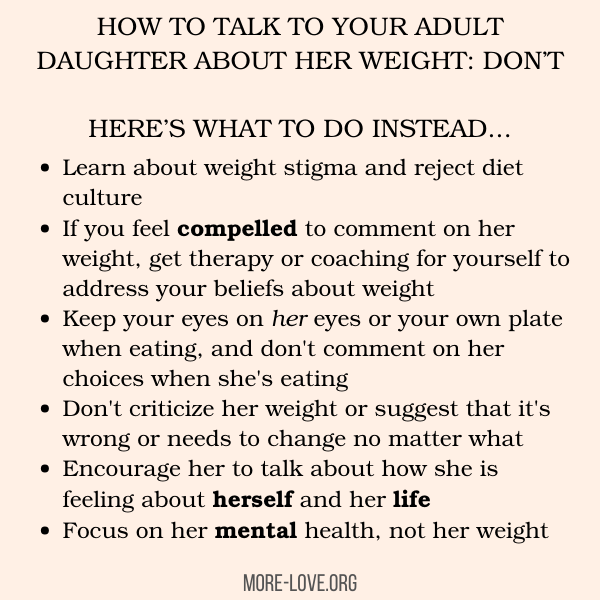
- Learn about weight stigma and reject diet culture
- If you feel compelled to comment on her weight, get therapy or coaching for yourself to address your beliefs about weight
- Keep your eyes on her eyes or your own plate when eating, and don’t comment on her choices when she’s eating
- Don’t criticize her weight or suggest that it’s wrong or needs to change no matter what
- Encourage her to talk about how she is feeling about herself and her life
- Focus on her mental health, not her weight
Your focus should be entirely on how she feels emotionally. Is she happy? Confident? Living in a black hole of shame? Traumatized by years of believing her body is wrong?
Your focus as a mother should be to give her compassion and acceptance and to recognize the stigma she faces living in her body in a society that is cruel to bodies like hers. If she expresses shame and guilt about either her body or the way that she eats, then mention that she may want to seek support from a non-diet dietitian or therapist, who will be able to help her find peace and will recognize and treat an eating disorder if one exists.
It is hard to parent in a culture obsessed with weight and food, but when we learn more about the stigma our kids live in, we are better able to help them find health and healing.
Sending Love … Ginny

Ginny Jones is the founder of More-Love.org, and a Parent Coach who helps parents who have kids with eating disorders.
See Our Guide To Parenting An Adult Child With An Eating Disorder
Discover more from More-Love.org
Subscribe to get the latest posts sent to your email.
I really appreciate the articles here. Eye opening. But I looked through the reference articles and saw nothing about the connection between overweight and health issues. I have read so much about the connection between excess weight and heart health and even cancer. How can we reconcile this?
Thanks so much for your comment — I totally understand the confusion. There’s so much conflicting information out there, especially when it comes to weight and health. I’ve put together some resources on my site that unpack the science behind this — you might find this page, this post, and my science library helpful. I really appreciate you taking the time to think deeply about this. xo