
Posted on Leave a comment

How to help when your college student gets an eating disorder

How to help when your college student gets an eating disorder

When your child heads off to college, you expect new adventures, growth, and independence, but if they develop an eating disorder, it can feel like a sudden and overwhelming crisis. Distance, busy schedules, and the challenges of college life can make it hard to know how to support your student from afar.

This guide is here to help parents understand the unique hurdles of eating disorders during this time and offer practical strategies for staying connected, encouraging treatment, and being a steady source of support, no matter the miles between you.

An eating disorder in college

If your college student has an eating disorder it can be disorienting and terrifying. Eating disorders are most often diagnosed between the ages of 18 and 21 years of age. So it’s not uncommon to find out about them in college.

One of the biggest challenges with college-onset eating disorders is that your child is now a young adult. They often don’t live with you anymore, and even if they do, you cannot force them into medical treatment. Nor can you access their medical records without their written consent.

Some college students will gladly sign paperwork. They will allow their parents to help them with an eating disorder. But others will resist. Either way, parents often feel left out, confused, and frustrated. So what can parents do?

The first thing is to recognize that your child’s eating disorder is serious. It’s not a passing trend or something to be taken lightly. At the same time, recovery will require your child to be engaged and determined in the process. This is when things can get hard.

Often people who are inside of an eating disorder aren’t convinced that they want to recover. It’s quite normal to feel unsure about whether recovery is necessary or worth it. And even if they do want to recover, college activities can compete with recovery. Social and school activities often feel more urgent and important than dealing with an eating disorder.

โญโญโญโญโญ

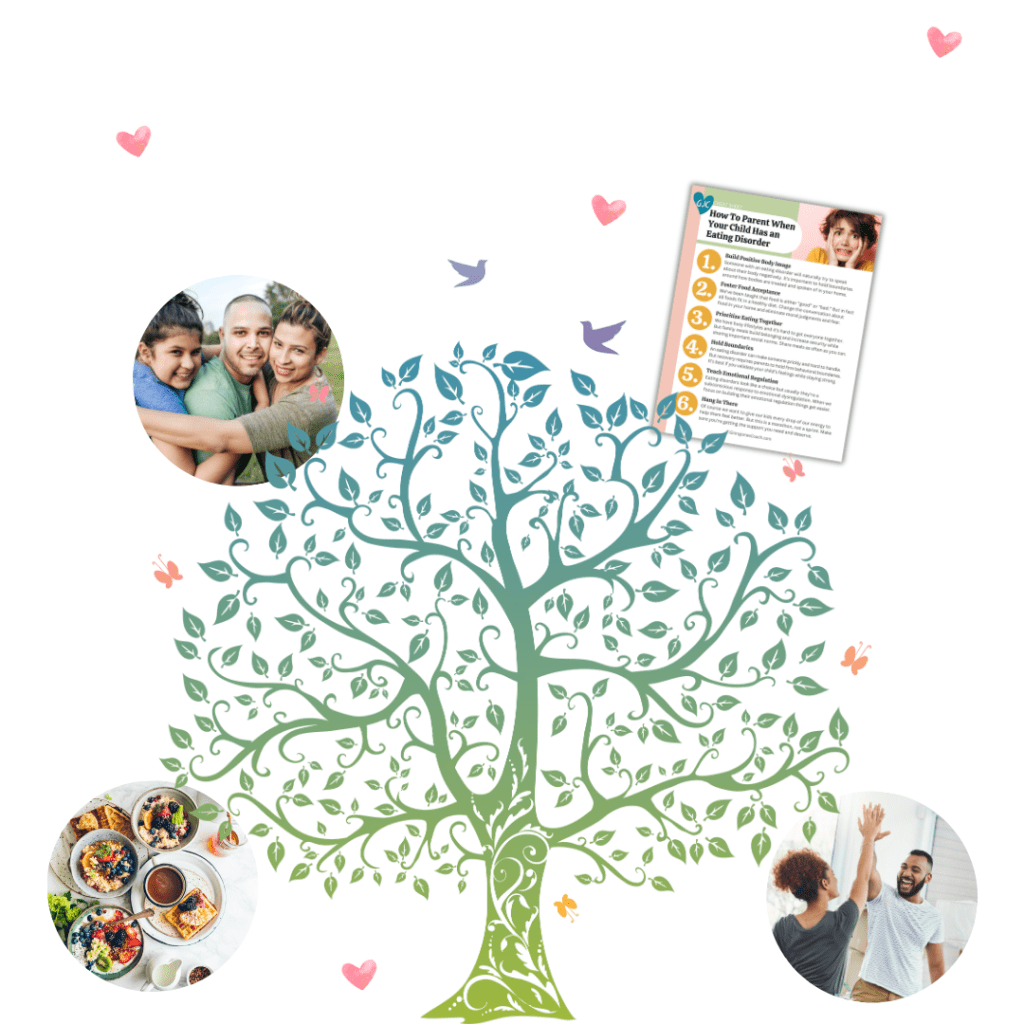
Free Guide: How Parents Can Help A Child With An Eating Disorder

Master the secrets to supporting a child with an eating disorder. Thousands of families like yours are stronger today because of these six vital lessons drawn from lived experience, best practices, andย extensive study.

When you find out your college student has an eating disorder

How you find out that your college student has an eating disorder can make a difference in how you proceed. First things first: if you believe your child is medically unstable and needs immediate medical attention, then your best option is to get yourself there and figure out how to work with the school and your insurance policy to get them the urgent care they need.

If your child has come to you with news that they have an eating disorder, ask about their diagnosis. Congratulate and thank them for being proactive about seeking support, and assure them that you are proud of their bravery. Avoid throwing doubt on the diagnosis or questioning the person who made the diagnosis. For right now, try to keep communication open by asking questions in a positive, respectful tone.

If your child has not been formally diagnosed but has shared that they believe they may have a problem, then support them in seeking help. Let them know that it is courageous to seek help for mental health, and ask how you can support them. In a perfect world, it would be best to seek a diagnosis from a trained eating disorder professional. However, if that’s not an option, the campus health center should be able to help. Most colleges provide both physical and mental healthcare services. Encourage your child to seek care as soon as possible.

If your child has not spoken to you about having an eating disorder but you are seeing signs or have suspicions, you need to tread very carefully. Begin by opening conversations about their general mental health. Ask them how they are coping with the stress of college. Avoid directly challenging them about the way they are eating or their weight. Get them talking to you about stress, then see if you can find out how they are feeling about eating. Let them know that stress can disrupt appetite and eating, and ask whether they think they need any help.

Learn about eating disorders

It’s important for you to learn as much as you can about eating disorders. Although they are relatively common and on the rise in our culture, there is a lot of misinformation about eating disorders. Most people imagine an eating disorder only impacts women and looks like anorexia. But those cases constitute just 10% of eating disorders.

The most common eating disorders are binge eating disorder, bulimia, orthorexia, and a category called Eating Disorder Not Otherwise Specified (EDNOS). With the exception of anorexia, eating disorders are not diagnosed based on body weight. People with eating disorders may be in small, medium, large, or extra-large bodies. And all genders (not just women) get eating disorders.

Eating disorders are mental illnesses. That means the diagnosis criteria is not about weight, but the degree of mental distress.

Eating disorders are maladaptive coping mechanisms that we employ to help us process uncomfortable physical and emotional states. This means they have a reason and a purpose. It may seem like recovery is about learning to eat properly. But in fact recovery from an eating disorder is more about finding out why we need the eating disorder. Once we get to the core issue and treat it, the eating disorder behaviors become unnecessary. This is why eating disorder recovery can be a long, winding path.

Eating disorder treatment options

It’s normal to automatically assume that the treatment for an eating disorder is a residential recovery center. And while that might be helpful for some people, many people recover without going to a facility.

If your child is medically unstable and has been hospitalized, then it is likely they will be recommended to inpatient treatment. In many other cases, the treatment path is less concrete. This is especially true for non-anorexia diagnoses.

Begin by asking your college student what the healthcare professionals recommend in terms of treatment. If they’ve been to the health center on campus, did the doctor, nurse, or therapist recommend a certain treatment? It’s important to take those recommendations seriously and let your child tell you how they feel about them.

You can recommend additional diagnosis, but try to allow your child to feel as if they have a part in the decision. Remember that recovery requires their emotional investment, so it can backfire if you try to force your opinions or attempt to control the situation.

Many people recover from eating disorders with a combination of medical monitoring, therapy, and nutritional counseling. It’s ideal to have people who have a speciality in eating disorders. Unfortunately, most health professionals have limited training and experience in eating disorders beyond anorexia. This is why it’s best to find a specialist if at all possible.

At the very least, you should encourage your child to be in therapy.

Build belonging and emotional safety

People who have eating disorders generally suffer from a sense of low self-worth. This means they don’t see themselves as valuable, and often feel “outside” or “other.”

So an important thing for parents to do is build belonging and safety. You want to remind your child that they are valuable to you and build a sense of emotional safety. Even if you are a single parent to a single child, you can build a sense of family and belonging. Families don’t need to be large to be powerful.

Schedule check-ins when you can talk and physically be together as much as possible. Send care packages, letters, and other reminders that you care. Talk about your shared history and look at photos together. But don’t take the lead. Ask your child to reflect their life story to you. Be prepared. They may have a very different vision of how their childhood was. They may have some pain to share with you. This is normal.

A person who has an eating disorder has a story to tell. And it may be painful for you to hear. But sharing their story and being loved even when they feel bad is very healing. Your acceptance of their life story, without trying to change what they believe happened, will go a long way.

Lots of people who have eating disorders have traumatic injuries. In some cases these may be situations in which they were abused, bullied, or harmed. But trauma also occurs when a child goes through a medical emergency, has a family member die, or parents who divorce. Children can even experience trauma when a new sibling is born or other disruptions that are perfectly normal but disrupt the child’s life. There are many situations that are interpreted as traumatic by the human brain. So if your child brings you traumatic memories, accept them and hold them in safety.

Say this not that

It’s hard for a lot of parents to know what to say. And the options are endless. But here are a few things that parents say to kids and a revised version that is more accepting and safe.

Instead of saying: I just don’t get the problem!

Say: Please help me understand your eating disorder. I’d like to know more.

Instead of saying: you need to get over this!

Say: I know this is hard right now. Tell me what’s working – what makes you feel better when you feel bad?

Instead of saying: you need to stop with the binges!

Say: what’s going on for you when you eat? What are you thinking and feeling? I want to understand.

Instead of saying: you’re going to have to figure this out!

Say: I know you are going to figure this out, but it takes time. It’s OK to be patient with yourself.

Instead of saying: it’s going to be fine!

Say: I know how hard this is for you right now. I’m here for you.

Encourage them to be social

Loneliness and social isolation are significant problems for all people. They underlie many mental and physical health complications, including eating disorders. Going to college is a major life transition, and our kids may need help navigating the social systems on campus.

Your child may or may not like their roommates. Your child may have found a few friends, or even many friends. But if your college student has an eating disorder, you want to be aware of their social life. Lots of people who have eating disorders pull in on themselves and become less social.

Try to help them find social activities, even if it’s just meeting one person for coffee or a walk. Or they may join a formal social activity or club. This can help them build deeper interpersonal connections and a stronger sense of belonging and purpose.

Talk to your child about options, which range from on-campus clubs, teams and programs, to off-campus volunteer opportunities. Even a low-stress job can be grounding and provide a sense of social connection and purpose for a child.

Remember: it’s a mental disorder

The hardest thing to keep in mind is that an eating disorder is a mental disorder. So the treatment may seem like just teaching them to eat food like a “normal person.” But true healing comes from belonging and self-worth.

Learning to support your child’s mental health when they are away at college is a significant challenge. But it’s very doable. Your kid doesn’t need to live in your house for you to positively impact their recovery.

It can feel very hard for parents to support an adult child with an eating disorder, but you can do it!


Ginny Jones is the founder of More-Love.org, and a Parent Coach who helps parents who have kids with eating disorders.


See Our Guide To Parenting An Adult Child With An Eating Disorder

Posted on 19 Comments

Why adult kids don’t come home for the holidays

Why adult kids don't come home for the holidays

Very few parents envision a future in which their adult kids don’t come home for the holidays. In fact, most of us picture a future in which we are surrounded by a loving, happy family of our kids and their kids, multiple generations joyously spending time together on special occasions.

Of course adult kids are meant to build their own adult lives and their own family traditions. So sometimes not coming home for the holidays, while hard, feels absolutely right and natural. You understand what’s going on and it doesn’t feel like they’re rejecting you or seeing you only out of obligation. You’re emotionally close and when you see each other it’s mutually gratifying. On the other hand, if you feel as if they are avoiding you or dislike coming home for the holidays, that is a different situation.

Sadly, many adult children dread coming come for the holidays. If you search on Google, you’ll find lots of advice to help adult children avoid coming home for the holidays. You’ll also find pages of advice for tolerating difficult family gatherings and how to get through family gatherings without losing it. This is so sad for so many parents, and I’m sorry if this is happening with your adult child(ren).

I assume that if you’re reading this article, you’re looking to understand why this happens and what you can do to change things. And please understand that while some things may be hard to read, there’s no blame intended in this article. The fact is that when we want to improve a relationship we can only take responsibility for our role within it. We cannot change the other person, only ourselves. This article is about seeing your responsibility and choosing whether you would like to change your own steps in the relational dance to effect positive change.

The truth about family holidays

The sad truth is that Thanksgiving, Christmas, Hanukkah, Easter, and even birthdays, Mother’s Day and Father’s Day are often stressful family events that adult kids want to avoid spending with parents. You may have noticed that your adult kids are joining you for holidays less frequently. Or you may notice that your adult children seem stressed and unhappy during holiday gatherings.

The first thing to know is that this is more normal that we have been led to believe. The vision of family togetherness that we see in the media rarely reflects the complexity of our own families. Parenting adult children is entirely different from parenting young children, and it can be challenging for parents and adult kids to make the transition.

The next thing to know is that you can make changes in your own behavior that will make your adult child feel more comfortable about sharing holidays with you. This will make them more likely to come home and more likely to enjoy themselves while there.

10 reasons adult kids don’t come home for the holidays:

  1. Pressure to conform to previous versions of themselves
  2. Different political and religious viewpoints
  3. Criticism and judgement of their lifestyle choices (e.g. where they live and how they live)
  4. Criticism about their job/career choices
  5. Dislike of chosen life partner or criticism due to the lack of a life partner
  6. Criticism and judgement of their appearance (e.g. weight, tattoos, hairstyle, clothing, etc.)
  7. Sexual orientation and/or gender is not respected or is expected to stay “in the closet”
  8. Visits home tend to lead to relapses into addictive behaviors for which they are in recovery (e.g. eating disorders, substance abuse, self-harm compulsive shopping, etc.)
  9. Being with family triggers anxiety, depression and even suicidal thoughts
  10. Family members engage in addictive behaviors that the adult child is in recovery for (e.g. smoking, drinking, substance use, dieting, disordered eating, etc.)

What parents can do to make the holidays easier for adult children

Parents can definitely make holidays more joyful for everyone if they recognize some key changes that are within their power to make. Remember that we can’t force other people to change – we only have control over our own behavior. If our adult kids don’t come home for the holidays, it may help to make some changes in how we behave.

As much as we want our family to be close and loving, we cannot force that situation through cajoling, criticizing, or making our children feel guilty enough that they show up even when they don’t want to. We can only create the conditions that will make family holidays less stressful for our adult children and, over time, help them feel truly welcome and loved during family holiday events.

1. Acknowledge your role in the relationship

It’s important to recognize that while your children are adults now, you held tremendous power over them in the formative years of their lives. Recognizing the power dynamics – mainly that you held all the power for many years – is important as you move into an adult relationship with your child. Acknowledging your impact on your child’s development is not about being blamed for who they are as adults. But it is important to see that old power dynamics play a big role in your relationship with an adult child.

If you used punishment, particularly physical punishment, that was a way you had power over your child. Major family disruptions like divorce, moving, or major illness were also situations in which your child was both impacted and powerless. If these things happened in your family, you may consider talking to your adult child and taking responsibility for how your choices impacted them.

This doesn’t necessarily mean you had a true “choice” or did the wrong thing. It just means you acknowledge that what you did impacted your child. If you think your child is looking for an apology for times when they were powerless, give it to them nondefensively. You are not taking the blame (unless it’s warranted). You are taking responsibility as an adult who had the power to change a child’s life.

It’s worth reflecting on your child’s life and considering whether you need to talk about things that happened in the past. Not because you were a bad parent or because your child is stuck in the past. Just because as life progresses, parents, who held the power for so long, often need to revisit old dynamics and address them compassionately and intentionally.

I know this can feel unfair and different from what you got from your own parents. But if you want to have a lifelong relationship with your child. If you want something beyond an obligatory and stressful holiday once per year. This is how you can do it. This is your challenge and your opportunity.

2. Recognize your child as a grown-up

You have known your child through so many growth stages. Most parents cherished the years before 10 years old, when they could play ball or go to the park together. And of course, many parents struggled with the teen years, when they felt irritated and confused by their child’s awkward and tumultuous quest for independence.

But your child is now a grown-up. This is actually the longest period of their life with you. We think in terms of parenting as the first 18 years, but many parent-child relationships extend for more than 50 years.

Don’t let your child’s first 18 years define the rest of the time you have together. You are still and will always be their parent. You are still and will always be the single most important figure in their lives. Even if they say they don’t need you anymore, we all remain our parents’ children in our hearts forever.

Allow your child to be the age they are. Then remember how you felt at that age. Remember how grown up you felt at 20, 30, and 40. Likely your life looked different from your adult child’s, but that’s how life is. You have a child, not a clone. Be curious about who they are today rather than holding onto a previous version of them.

And definitely don’t hold onto the fantasy version of the adults they would become that you understandably nurtured and cherished as all parents do. Celebrate them as they are, and allow them to grow up, decade after decade, gracefully or ungracefully, with the knowledge that they are loved and accepted unconditionally.

3. Remember that they have an adult life and real conflicts

Sometimes adult children use their adult lives as an excuse for why they don’t come home for the holidays. As a parent, you should try to understand how many of their excuses are because of your relationship and how many of them are because of genuine conflicts.

Adult children are typically in the heat of life right when their parents want to see them (and the grandkids!) more often. For example, they may be working a stressful job, trying to keep on top of bills, juggling childcare commitments, parenting, staying in a committed relationship, and coordinating with in-laws, ex-partners, dog-sitters, and more.

Often when an adult child doesn’t come home for the holidays there is a really good reason why it’s too hard or just won’t work this year. Remember in these situations that it’s OK to have holidays on non-holiday dates. For example, Christmas can be any date in December or January (or even July!). The less rigid you are about the date, location, and time, the more likely you are to get your kid to celebrate with you.

If, however, you’re fairly sure that your child is making up excuses because they don’t actually want to see you, then forget about the holiday. Focus instead on rebuilding the relationship and start working towards a different outcome next year.

I know this can seem hard, but pushing for a holiday gathering when your child is angry with you is unlikely to result in a positive, joyful event. It’s more likely to end in tears and anger. Invest time in rebuilding your relationship and understanding why holidays with you are stressful. Then work towards creating conditions that work for your adult child so that next year you have a greater chance of celebrating together.

4. Get to know who your adult child is right now

It’s all too easy for parents and children to slip into a habit of not talking about current interests and passions. It’s much easier to keep the relationship superficial, since it takes less courage to say you’re “fine” rather than talk about the lack of closeness in your relationship.

Likewise, it’s easier for your adult child to say work is “fine” rather than tell you that they are really concerned about recent downsizing efforts and that they actually wish they had gone into a different career. The result of superficial “fine” conversations is that neither person in the relationship feels seen or heard.

Love is almost entirely based on feeling seen and heard.

Most parents are great cheerleaders when things are going well. But how are you when it comes to darkness and difficulty? Having a deep, meaningful relationship with someone means being able to see their darkness, their frustration and anger, without being afraid. It means seeing their whole self – flaws, fears, pettiness and all – and loving it all without fear of what it says about you. If you haven’t practiced sitting with your child in their darkness and accepting their feelings without trying to change them, give that a try.

Love means accepting the darkness as well as the light.

The key to getting to know who your adult child really is right now is to not react negatively or dramatically to information that surprises or upsets you. Adult children have powerful antennae and can sense parental judgement, criticism, and fear in an instant. They may even intentionally bait you to get a negative response. It may seem weird, but it happens.

Coach yourself on being an active listener who does not over- or under-react to your child’s statements. This is a practice that takes time, but it is a huge and worthwhile investment in your relationship.

Adult children can all too easily slip into a pattern with their parents in which they don’t feel seen, known or loved, even when the parents want to see, know, and love them. This is something that most parents need to learn. Take your time, and keep trying. It’s worth it.

5. Understand their recovery process if they’re in one

Does your adult child have an eating disorder, substance abuse, self-harm, depression, anxiety, and any other mental health condition and/or behavioral addiction? If so, you need to be conscious of their recovery process and how it is impacted by family gatherings.

If your child is in the active stages of recovery, which varies but can easily continue for five years or more of abstinence/remission, then you need to monitor the environment carefully and consider whether you need to remove any triggers. Your child’s recovery should be a priority for you and every member of the family. If you can facilitate a safe environment for your adult child’s recovery, they are more likely to continue coming back.

If you’re wondering what makes a safe environment for your child’s recovery, then ask them! Don’t stand on ceremony or pretend that your child doesn’t have any problems. They do. If they are in recovery, they have to watch out for triggers. They may not be able to tell you exactly what you need to do, but that’s OK. Just ask, and then do some research on your own. Talk to your family in advance to try and explain any necessary adjustments to accommodate recovery. Any step is a positive step.

Most people in recovery spend significant time before seeing family members preparing themselves for anticipated triggers.

If your adult child has been in recovery for years or even decades, don’t assume it’s as if the situation never occurred. Most of us who are in recovery will spend our lives learning more about why we encountered struggles, and many of us will experience relapses of anxiety, depression, and our disorders. This doesn’t make us failures, it just makes us perfectly normal. For various reasons, our families can be a source of great stress. The more you can do to help us avoid triggering environments at the holidays, the better.

6. Accept your adult child’s life choices without question

Parents want what’s best for their children. That’s a given. But many of us lose our way as our children grow up. We start to think that our kids’ life choices are a reflection of us as parents. While we certainly have a huge influence over our children, their choices as adults are theirs to own. We can support them and accept them, but we cannot control their choices or take too much credit – either good or bad.

Adult kids who don’t come home for the holidays frequently worry that they haven’t lived up to their parents’ expectations. This is often because parents have explicitly or implicitly let their kids know that they are a disappointment. Many parents criticize their children, both when they’re little and as adults. Many parents also compare children, creating a toxic state of competition. This often comes from a place of wanting your kids to succeed, but beware: it’s the most common reason adult children give for staying away from parents.

What adult children want from their parents is the same as what little children want from their parents. They want to be accepted. You may think there’s no way you can accept your adult child. Maybe they are addicted to drugs or a single parent or a bad driver. Maybe they are too thin or too fat. Perhaps they don’t go to church or do go to church or voted for a candidate you think is the devil. But here’s the thing: acceptance is not the same as approval.

You are allowed to accept your child fully for who they are and still not approve of all their choices. The difference is subtle but critical.

Acceptance is not the same as approval.

It has been said that acceptance is so closely tied to love that it is indistinguishable. If all you are able to do to show love to your child is accept them, that is enough. Parents who accept their children love their children.

Parents who do not accept their children … well, they often have adult kids who do not come home for the holidays. Your adult child – whether they are 25 or 55 – wants to be accepted by you. They want to feel that no matter what they do, you still love them.

Getting adult kids home for the holidays

If you want to see your adult kid this holiday season, keep the above points in mind. Remember that your child has a choice whether or not to see you. Many adult kids don’t come home for the holidays.

This can feel really terrifying, but you have the power to improve your relationship with your child and move towards repair and joy. Even families that have been estranged for years can reunite, but it usually requires the parent to make some important changes like the ones listed above.

I hope you have a wonderful, loving holiday, and that you get to see and enjoy your adult child for many years to come!


Learn effective, compassionate strategies for reconnecting with an estranged adult child. โžœ Read: Coaching Support for Parents With an Estranged Child, a guide for parents who want to rebuild trust and communication.


Ginny Jones is the founder of More-Love.org, and a Parent Coach who helps parents who have kids with eating disorders.

See Our Guide To Parenting An Adult Child With An Eating Disorder

Posted on Leave a comment

How to love your +18 child with an eating disorder

How to love your +18 child with an eating disorder

by Reba Tobia

If your +18 child has an eating disorder, you may have a lot of feelings about it, and you may even wonder how to love them through this. As someone who has been through eating disorder recovery, Iโ€™d like to offer you some insight. Helping an adult child with an eating disorder isnโ€™t easy, but your love can make a world of difference. Iโ€™ve identified three main points that I know will give you clarity, a new understanding, and support.  

First off, give yourself a pat on the back. Youโ€™ve already taken the first step, which is accepting that your child has a problem. Eating disorders are serious, and they are rarely spoken about or understood. By accepting your child’s eating disorder and seeking understanding, youโ€™re already helping. You have chosen to not ignore the facts or sit silently in fear. Instead, you have taken action to understand. Iโ€™m glad youโ€™re here! 

Here are three things that I think everyone should know when they have a loved one who has an eating disorder: 

1. Your child doesnโ€™t know how to help you 

Your +18 child has just been diagnosed with an eating disorder. Hearing this diagnosis can be terrifying and invoke feelings of denial, fear, anger, sadness and pure, utter, confusion. The last thing your child knows how to do is to help you. They are suffering immeasurably. Their focus, right at this moment, is trying to figure out how to un-hear the words, โ€œyou have an eating disorder.โ€ 

In fact, their only goal right now may be to convince you that you donโ€™t need to do anything. That you donโ€™t need to worry. They may also be desperately trying to convince those around them that theyโ€™re โ€œokayโ€ and that โ€œitโ€™s not that bad.โ€ They are not going to be able to vocalize to you what they need, because in reality, they donโ€™t know what they need. 

Words may be hard

I know it would be a lot easier if your loved one came to you and said โ€œIโ€™m suffering, and this is what I need.โ€ I wish that were the case, but itโ€™s rare. Most often, people who have eating disorders ask the opposite of those who love them: donโ€™t pay attention. Donโ€™t look. No need to worry about it. This is because the disorder has become an important part of how they deal with living.

While reading this, you may be feeling extreme frustration; and that is okay. It can be so difficult to know how to help. Itโ€™s hard when the person you love dearly is not able to tell you what they need. This is your opportunity to step up to the plate, to rise to the occasion and educate yourself about eating disorders.

Connect with a therapist or coach who can help you understand, read articles and books, listen to podcasts and attend seminars. Never, for one minute, believe that it is your job to do nothing because your loved one hasnโ€™t โ€œtoldโ€ you what to do. 

You see, the person struggling with this illness may not be able to tell you how to help for a long time. They must grapple with their diagnosis first. With their team, they will learn new information and ways of thinking. Attending groups and therapy sessions will, slowly but surely, help them learn to ask for help. Do not give up on them, and please, remind them how much you love them, every single day. They need to hear it, even if you think they donโ€™t. 

2. Recovery takes time

Most eating disorders are not instantly or easily overcome. It takes time, sometimes lots and lots of time. There is no timeline to healing, and everyoneโ€™s journey is vastly different. Healing from an eating disorder is rarely linear, and requires tremendous patience and endless hope from parents. 

There is no prize for the fastest recovery. And many times a slow recovery is exactly what your adult child needs to be healthy. I understand how hard it can be to watch them struggle. 

Please donโ€™t tell them that they arenโ€™t working โ€œhard enoughโ€ or that theyโ€™re moving โ€œtoo slowly.โ€ Iโ€™m not saying you donโ€™t get to be frustrated – you do! Itโ€™s just better to explore your frustrations with your own supports. Telling your loved one to pick up the pace of recovery wonโ€™t help them recover.

Your childโ€™s body will likely change during the recovery process. But even though some eating disorders are visible, many are not. And most of the time you canโ€™t see an eating disorder any more than you can see recovery. So donโ€™t assume that because your child looks healthy to you that they are fully recovered. 

The real work, the grit, sweat and painful stuff of eating disorder recovery canโ€™t be seen. And it typically happens long after they body appears stable. The mental work is the most challenging, most heart-wrenching work of recovery. It takes time and patience. So please donโ€™t cut off treatment based on how your child appears.ย 

3. Your adult child will change

Eating disorder recovery changes a person in the most beautiful, astonishing and remarkable ways. Maybe you adore the changes you are seeing, and maybe you donโ€™t. In eating disorder recovery your +18 child will grow, find their voice, and figure out who they want to be. 

Itโ€™s possible that the process of doing this will be messy and hard for you. Maybe their new values donโ€™t seem to align with yours. That doesnโ€™t mean theyโ€™re doing it wrong or that you canโ€™t love them. Remember that the person you loved was engaged in an eating disorder, and their recovery will require them to change. 

Recovery often feels like stripping away everything you had and knew. For a long time, your child lived with a mask on. They were hiding under fear, shame and guilt that was wrapped up as an eating disorder. As recovery progresses, this mask is removed, and that person is the person you love. 

Stand up

You may notice that as your loved one recovers, they stand up for what they believe in. They advocate and protect themselves more than ever before. At the same time, they may be more vocal and display more assertive communication skills. 

This is actually part of eating disorder recovery. Your child is learning how to effectively communicate their needs. But that also means telling people when something doesnโ€™t feel good. This is what it means to live recovered – to live without a mask. And it can be a hard adjustment for everyone. 

Yes, your child will change. They will not be the same person you knew when they were in their eating disorder. They will be stronger, braver, more empathetic and sensitive than ever before. They’ll have a beautiful array of coping and communicative skills. Eventually, they will even have a mindful and peaceful relationship with food, which is truly rare. 

Please let them discover who they are and allow them to freely grow. You donโ€™t have to agree with everything they say or do. But you do need to respect this new self they are coming home to. If you can love your +18 child through their eating disorder, they will never forget it.

My own experience

In my case, I can honestly say that my heart has most certainly grown bigger by going through eating disorder recovery. My love for those who support me is deep, and my compassion for others with mental illness is vast. I’m brave, strong, curious, playful, silly. I am love. 

I’m thankful to be at a point in my process where I am grateful that having an eating disorder is a part of my life story. I am proud of who I am. And I am who I am today because of my recovery. I found my heart and purpose in this world.

So hold on and donโ€™t give up. Let your loved one deny, grieve, cry, and fall. And then, watch them grow. 


Reba Tobia, a Massachusetts native, is the creator and founder of The Brave Box, which offers gift boxes for loved ones in recovery. She has been in recovery from an eating disorder for the past 5 years. She is passionate about sharing her story, and reminding others that they are not alone. Visit The Brave Box Website

See Our Guide To Parenting An Adult Child With An Eating Disorder

Posted on 2 Comments

How To Talk To Your Adult Daughter About Her Weight

How to talk to your adult daughter about her weight

Itโ€™s natural to worry about your daughterโ€™s well-being, but when it comes to weight, even the most well-intentioned comments can cause deep harm. If youโ€™re considering talking to your adult daughter about her body, itโ€™s important to pause and reflect on the potential impact of your words.

In a culture steeped in weight stigma and unrealistic beauty standards, conversations about weight often trigger shame, damage trust, and strain parent-child relationships. Below, I respond to a worried mom who wants to do the right thing, helping her take a compassionate, respectful approach that prioritizes emotional safety, body autonomy, and lasting connection over appearance-based concerns.

Dear Ginny, 

I really want to talk to my adult daughter about her weight, which keeps going up. When I get together with her, she binge eats a lot of unhealthy food. When she was growing up, she was always on the chubby side, but she dieted a lot and generally kept her weight under control until she got to college. I always taught her to watch her weight, how to count calories, and tried to model healthy behavior. Now she is 28 years old and she’s gained so much weight. I see her eating all sorts of foods like cupcakes, chips, soda, and french fries. What can I do when I see my grown daughter binge eat like that? Can I tell her I’m concerned about her weight? Should I ask her if she has binge eating disorder? How can I help her lose weight without offending her?

Signed, Worried Mom


Dear Worried Mom,

I can understand why you are concerned, and I can hear how much you love your daughter. But she’s an adult. That means a few things. First, she is responsible for her own health now. You can support her, but advice can be tricky. Listen more than you advise. Focus on being curious rather than making recommendations.

Second, as a larger woman, she is absolutely aware of her weight already. A lot of times people think larger people need to be informed of their weight and the dangers of living in a larger body. Trust me on this: she’s heard it all. Any attempt to talk to your daughter about her weight that assumes she’s not aware of her size will infantilize her and inflict weight stigma. It will not help her and it could damage your relationship.

Unpack your assumptions about weight and health

In our culture, we make a lot of assumptions about food and weight, and when a person is larger we tend to blame that on their eating habits, forgetting that almost all people, including thin people, eat a variety of food, including cupcakes, chips, soda, and french fries. The assumptions you make about her weight and eating habits can get in the way of truly caring for your adult daughter and having a positive impact on her health.

First, regarding weight. You say that your child was on the chubby side. It’s hard to live in a larger body in our society. I would imagine that she was criticized for her weight. This might have led her to start dieting and controlling her weight, which might have seemed like a good thing at the time. But actually, this worked against her. Dieting is a risk factor for both weight gain and eating disorders.

In almost all cases (+95%) when a person intentionally loses weight, they will experience weight cycling. They regain all the weight they lost, often plus a little more. Weight cycling creates metabolic changes that can remain indefinitely. In other words, dieting to lose weight creates weight gain in almost all cases.

Dieting is the No. 1 predictor of weight gain and eating disorders.

I’m telling you this because I know that you are very concerned about her health, and I know you want to talk to your daughter about her weight, but focusing on her weight is counterproductive. We live in a society that blames and shames people for their weight.

But true health is not achieved by trying to control weight but by healing a person’s relationship with food and their body. Your job is not to help your daughter to control her weight, but to help her accept and love herself for who she is.

Don’t talk to your daughter if your message is that she needs to lose weight

People like your daughter feel the weight of our society’s blame and shame. The problem may look like it’s the number on the scale, but the real problem is that she’s been blamed and shamed for living in a body that doesn’t fit into narrow societal expectations. I know you want to help your daughter, so I’ll be blunt: if you talk to her about her weight, you will likely make things worse for her health and your relationship.

You mean well, but based on the things you said in your letter, it’s going to be hard for you to have a positive, productive conversation with her about weight right now.

I’d like you to consider your daughter’s eating patterns as if she were a thin person. If your grown daughter were thin, would you worry that she binge eats cake, fries, and other fun foods? Most people eat these foods, but we are conditioned to notice it more and criticize people who are living in larger bodies because we assume that they are larger because of the way they eat.

This is a false assumption. In fact, people who are in larger bodies often consume the same or fewer calories and eat a diet equal to that of many people who are in smaller bodies. A larger body is genetically primed to have a slower metabolism and be more efficient in extracting nutrition. And if a person has dieted, they have further reduced their metabolic rate. These factors are out of your daughter’s control. You cannot change her genes or past weight cycling.

So, really think about how your daughter eats in light of this common bias. Is she really eating “too much” or are you assuming she eats too much because her body is large? Are you sure you are seeing a “binge,” or just your grown daughter in a larger body eating food?

Is it binge eating disorder or just eating?

Binge eating disorder is the most common eating disorder, but it is also terribly misunderstood and frequently mistreated by loved ones, healthcare providers, and even eating disorder treatment providers. This is due to weight stigma and diet culture.

So we want to unpack your assumptions before jumping to the conclusion that she has binge eating disorder. At the same time, if she does have an eating disorder, then your support can help her find healing. Here are the symptoms of binge eating disorder:

  • Feeling a sense of being out of control while eating substantial quantities of food
  • Skipping meals in an attempt to “make up” for binge eating episodes
  • Going on diets and trying new ways to lose weight
  • Eating rapidly and/or until uncomfortably full
  • Eating in secret due to embarrassment
  • Feeling disgusted, ashamed, and guilty about eating

If your adult child has an eating disorder, then she is in a lot of pain. And this pain goes beyond eating. Here are some of the signs of an eating disorder that have nothing to do with eating:

  • Avoiding social situations due to fear of being seen as “fat” and/or not wanting to be seen eating
  • Exhibiting signs of body shame like hiding her body in large clothing, trying to make her body appear as small as possible in social situations, etc.
  • Withdrawing from and avoiding close relationships
  • Seeking comfort with behaviors like drinking, gambling, shopping, etc.

If you suspect she may have an eating disorder, consider the following actions:

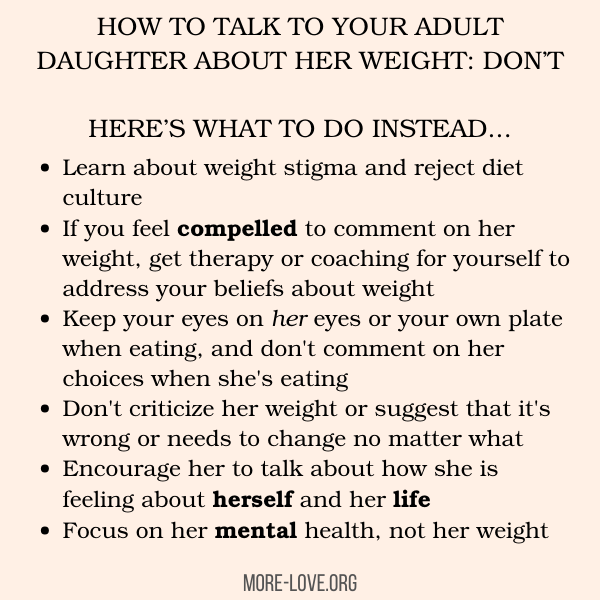
  • Learn about weight stigma and reject diet culture
  • If you feel compelled to comment on her weight, get therapy or coaching for yourself to address your beliefs about weight
  • Keep your eyes on her eyes or your own plate when eating, and don’t comment on her choices when she’s eating
  • Don’t criticize her weight or suggest that it’s wrong or needs to change no matter what
  • Encourage her to talk about how she is feeling about herself and her life
  • Focus on her mental health, not her weight

Your focus should be entirely on how she feels emotionally. Is she happy? Confident? Living in a black hole of shame? Traumatized by years of believing her body is wrong?

How to talk to your adult daughter about her weight

Your focus as a mother should be to give her compassion and acceptance and to recognize the stigma she faces living in her body in a society that is cruel to bodies like hers. If she expresses shame and guilt about either her body or the way that she eats, then mention that she may want to seek support from a non-diet dietitian or therapist, who will be able to help her find peace and will recognize and treat an eating disorder if one exists.

It is hard to parent in a culture obsessed with weight and food, but when we learn more about the stigma our kids live in, we are better able to help them find health and healing.

Sending Love … Ginny


Ginny Jones is the founder of More-Love.org, and a Parent Coach who helps parents who have kids with eating disorders.

See Our Guide To Parenting An Adult Child With An Eating Disorder

Posted on Leave a comment

My adult child hid her eating disorder for years

My adult child hid her eating disorder for years

by Anonymous

I thought I had a strong, well-adjusted child, until I found out that she hid an eating disorder from me for years. I’m still struggling with my guilt that I did not know. I did the best I could; I know this. She got the best care I was able to give. But the fact remains that she was hurting, and I can see that there are signs I missed and steps I could have taken to help her.

Today, I see more clearly the things I could have done differently for my daughter. When I found out about her eating disorder, I was faced with two choices: bury my guilt or examine my role. The funny thing is, burying my guilt, which I did for a while, was actually more painful than shining a bright light on my parenting and allowing my past mistakes to inform my behavior today. I’ve found peace in giving myself compassion even as I learn more about our past and intentionally build our future. I can’t say it’s easy, but I am much happier today than I was when I was trying to avoid looking at my role in my child’s eating disorder.

She was hurting, and I didn’t know what to do. I can say this with self-compassion and without shame because my daughter is still here. There is still time for me to be the parent she needs.

Here are the lessons I’ve learned in hindsight and the things I’m doing to help my adult daughter recover from her eating disorder.

1. Hold her closer

My daughter seemed happy and well-adjusted in elementary school. When she entered puberty, she changed. She seemed angry and secretive and started to pull back from me. The truth of the matter is that I had a lot going on at the time, and I was both hurt and relieved when she seemed to need less of me. I allowed myself to believe that all teenage daughters are “difficult,” which protected me from the hurt I felt every time she lashed out at me or ignored me.

Now I can see that my daughter desperately needed me to be an active parent, but I behaved like a hurt child. I’ve learned that my own parents set the stage for how I handled my daughter during adolescence, and it was with a 10 foot pole! My sweet girl needed me to hold her closer, but I sort of just held my breath, hoping we could emerge intact when she “got through” her teens.

Today my child is an adult, and we did get through her teens. But it came at a cost to her health and our relationship. I can’t go backward and re-do her adolescence or take away her eating disorder, but I am talking to her while she’s recovering, and I know that I can still help her. I’ll keep learning what I can, showing up, asking her questions, and reflecting on my behavior as she navigates eating disorder recovery. I look carefully at my automatic, defensive responses when something she says or does triggers me. And I do the best I can today with what I know now.

2. Listen, don’t lecture

When she was a teenager, my daughter was infuriating to me. She was sometimes sneaky and lied. I knew she was doing something “wrong,” but I didn’t really know what. I spent a lot of time lecturing her about morality and good behavior. She sat silently through my lectures with a smirk, which just enraged me further.

Now I know that my daughter was actually lying and sneaking around – with her eating disorder. Yes, there were other things she was doing, but her most fundamental “crime” as a child was her eating disorder, which she hid with great skill. I’ve learned that people who have eating disorders hide what they are doing, but that doesn’t mean they don’t want to be discovered, especially by their mothers. I didn’t realize this at the time, but by lecturing instead of listening I missed the opportunity to catch the hints she gave me along the way. My lectures just drove the eating disorder deeper into hiding. My child hid her eating disorder because she didn’t know what else to do.

Today I’m learning to listen. I’ll be honest – it’s hard. I feel compelled to give my daughter advice to help her navigate her recovery faster so that she can feel all better. I keep reading about eating disorders, and I really want to give her advice and information about what I’ve learned. But I’ve been practicing mindfulness, and instead of saying everything that comes to mind, I watch thoughts go through my mind and stick to listening instead of lecturing. I am not always successful, but I’ve noticed that the more I listen, the more my daughter relaxes with me, and the more she speaks up about how she feels. I know that her being able to speak to me about her feelings is an excellent sign that she is recovering from her eating disorder.

3. Learn about myself

When my daughter went into teenage rages or sulks, I often shut down emotionally. I just didn’t know how to handle the slamming doors, the tears, and the painful silences. In my family, my own mother ignored us when we “acted up,” and I learned quickly to never express how I felt, especially “bad” feelings like anger. I learned to hide how I felt when I was a child, and so when my own child “acted up,” I didn’t know what else to do than to shut myself down. Sometimes I would yell back or tell her that I didn’t like what she was doing, but more often, in the heat of the moment, I just disappeared inside of myself when she was doing something that made me emotionally uncomfortable. Now I can see that my child did the same thing to me when she hid her eating disorder.

I now know that a mother’s withdrawal from her child’s emotional expression is experienced by the child as abandonment. It feels brutal to me to think that my daughter felt I was abandoning her because of course, that’s not what I was trying to do. I was just doing the best I could and trying to get through the day. And yet, this emotional abandonment impacted her relationship with me and with herself.

Today I’m learning about my own emotional landscape. I’m learning that my defense mechanisms didn’t come out of nowhere, and they impacted my child, whose happiness drives my own happiness. Luckily our children always crave unconditional acceptance from their mothers, and so I still have a chance to be better and to give her what she needs. While she’s in recovery for her eating disorder, I frequently feel emotionally uncomfortable. I desperately want to withdraw and hide. But I’m staying with her, compassionately reminding myself that we can both tolerate feelings, no matter how big and terrifying they seem.

My adult daughter with an eating disorder has been in recovery for a while now, and I am enjoying the new aspects of her personality that are being uncovered. What I thought at first was just an “eating problem” I now see was a problem with her sense of self and her ability to express herself. I’m proud of her, and I’m also proud of myself for being able to face my own fears during this process.

Thank you for your anonymous submission. Keep going – you’re doing great! Sending Love … Ginny

See Our Collection of Eating Disorder Recovery Stories

Posted on Leave a comment

How to parent your adult child with an eating disorder

How to parent your adult child with an eating disorder

It can be hard to figure out how to be a “good” parent when an adult child has an eating disorder. Many parents worry they are not up to the task of supporting an adult child who is in recovery. The good news is that all parents are up to the task. The tough news is that it’s going to take a lot of effort on your part.

Luckily, the only core competency we need as parents is the ability to be curious and learn about parenting. Parents who bring their full intelligence and curiosity to parenting are more effective. They’re also able to play an integral role when an adult child enters recovery from an eating disorder.

Don’t worry about being perfect. Perfect parenting doesn’t exist. All you have to do is keep learning, and keep applying what you learn to the real-life laboratory of parenting. Being a good parent when your child has an eating disorder doesn’t have to be hard!

Here are some ways you can be a good parent when your adult child has an eating disorder:

1. Consider and understand your child’s unique personality and experience

Almost all parents want to be good parents. It can be a real shock to find out they are in trouble and struggling with mental health disorders. An eating disorder can impact parents’ confidence and quickly make them insecure. Every past choice, every action, suddenly seems wrong in hindsight. It’s terrifying to see a child struggle with something as fundamental as eating. It’s normal to be completely confused by your child’s eating disorder.

But don’t stop there! It’s OK to be scared and worried. Now it’s time to turn your fear into action. Being a good parent when your child has an eating disorder starts with learning about eating disorders and your child. Eating disorders are complex and layered. So you need to research the causes of eating disorders and then apply them to your unique child’s temperament and life history.

Get professional help with this. Eating disorders are persistent and respond best to active, professional care combined with parental education and training.

When we approach our children from a place of curiosity, we support them as unique beings who are worthy of our respect and attention. We can help them identify the path they want to take. We can promote independence and self-reliance. All of these things help with eating disorder recovery.

An eating disorder is not a conscious choice or something over which your child has control. Recovery and healing come from self-acceptance. Parents can positively support recovery when they seek to understand and accept their child with an eating disorder.

Gaining a full view of a child’s personality and experience adds context to the eating disorder. It can help parents approach healing with more compassion and empathy.

2. Strive to understand your child’s point of view

Too often, as parents we want to instruct our children in the ways of the world. We believe that our years of experience means that we understand things in a way they cannot. This is true. We do understand things differently – this is what being an independent human being is. Each of us has our own point of view and perspective on life. And for all of us, perception is reality.

When our child is engaging in eating disorder behavior, we can easily perceive that there is no good reason for that behavior. From a parent’s point of view, the child should stop what they are doing and focus on more important things like school and work. But right now, eating, food, and weight are the most important thing to your child. Being a good parent when your adult child has an eating disorder requires that you try to understand that point of view and the reasons behind it.

Rather than try to overcome your child’s arguments about the value of the eating disorder, work to understand your child’s point of view about the eating disorder. Ask questions and set your own opinions aside as you strive to listen without judgment.

Eating disorders don’t come out of nowhere. They are powerful coping mechanisms that developed for good reason. The more we understand the reasons, the better we are able to support more adaptive coping methods.

You may worry that your child will take your lack of judgment as permission to continue the eating disorder. Don’t worry. Listening is not the same as agreeing. Recovery comes from self-acceptance and belonging. Parents who accept and welcome their whole child, flaws, fears, disorders, and all, support true healing.

3. Repair negative exchanges

All of us have negative exchanges with our children. It may surprise (and irritate!) you to know that arguing with us is a big part of our role in our child’s development. When our children argue with us, they are testing boundaries and relationships in the safest way possible. They feel safe with us, and will therefore be more aggressive than they are elsewhere.

Of course, this means that our kids can push our buttons and drive us to say and do things that we really shouldn’t. We get defensive or accusatory, perceiving ourselves as victims, which does not lead to good parenting. This is completely normal, and you are not a bad parent for occasional outbursts.

Parents who have a child with an eating disorder often find their lives turned upside down. They must desperately try to keep everything in balance while the child heals. It’s no surprise that parents snap during arguments with a child who is causing disruption. Being a good parent when your child has an eating disorder means you understand we are not always our best selves when parenting. But you should always repair negative exchanges as soon as possible.

Real-time repair

The best time to repair a relationship is in the midst of an angry exchange. For example, if you notice that you are yelling at your child, getting defensive and threatening punishment, stop your behavior as soon as you can and acknowledge that things are not going well.

Sometimes this means saying something like “Wow, that was not the right thing to say. I’m so sorry. I’m feeling very angry right now, and I just don’t know what to do. Can we talk about this again in a few minutes when I’ve calmed down?”

If you are not able to catch yourself during an argument, it’s OK. You can still go back to your child after a fight and acknowledge that you made a mistake. It’s important here that you take responsibility for your own actions. Don’t say “You pushed me and I snapped!” Instead, say “I got really riled up and lost control. I’m sorry that I said those things to you.”

Remember that you are not a victim, you are a parent. Take responsibility for your feelings. It’s OK.

Repairing negative interactions between yourself and your child is important during eating disorder recovery. A child who has an eating disorder is more sensitive to criticism and may feel especially triggered by parental conflict. As parents we cannot promise never to make mistakes while arguing with our children, but that’s OK.

Repair, it turns out, is very effective at returning a relationship to peace and safety. Repair efforts also show your child the process of acknowledging that emotions are taking over, and taking action to make things right. This can be a very helpful behavior to observe while recovering from an eating disorder.

As you parent your adult child with an eating disorder, please remember that you matter, too. Take good care of yourself in this tough time.


Ginny Jones is the founder of More-Love.org, and a Parent Coach who helps parents who have kids with eating disorders.
See Our Guide To Parenting An Adult Child With An Eating Disorder

Posted on 2 Comments

How to help your adult child with an eating disorder

How to help your adult child with an eating disorder

Watching your adult child struggle with an eating disorder can be heartbreaking and confusing. While they may no longer be under your daily care, your support still matters deeply, and knowing how to offer that support without overstepping is essential.

Eating disorders donโ€™t disappear with age, and many young adults continue to need family involvement in their recovery. In this article, weโ€™ll guide you through compassionate, respectful ways to help your adult child navigate treatment, set healthy boundaries, and feel seen, supported, and empowered on their path to healing.

So much worry

It is never a good time to discover that your child has an eating disorder. But parents can feel a special type of despair and worry when they learn that their adult child has an eating disorder. 

You may have worries like:

  • Is this my fault?
  • Is it too late?
  • Should I have known about this?
  • Why didn’t my child tell me sooner?
  • What does this mean about my child’s future?
  • Can my child ever recover?

All of these worries make a lot of sense. After all, your adult child is facing a major health problem. But there is so much hope, and you have a significant opportunity to help. In fact, there are parents who play a huge role in helping their kids recover – even if their kids are grown up! And yes, people do recover from eating disorders. You can help.

โญโญโญโญโญ

Free Guide: How Parents Can Help A Child With An Eating Disorder

Master the secrets to supporting a child with an eating disorder. Thousands of families like yours are stronger today because of these six vital lessons drawn from lived experience, best practices, andย extensive study.

What you can do if your adult child has an eating disorder

There is no expiration date on parenting. Just because your child is an adult does not mean they don’t need your support. In fact, they need it just as much as ever. But this is a time to take on new opportunities for learning and growing as a parent and a person. If you are up to the challenge, please take it on!

There are many things that are out of your control when your adult child has an eating disorder. But that does not make you powerless. Every parent has incredible influence over their child’s emotional health at any age. For example, we never outgrow the deep, biological desire to be seen, heard, and understood by our parents. This need is programmed into all humans at birth. We want to be seen as worthy and lovable by our parents.

No matter how old they grow or how independent they seem, your child longs for your admiration and respect. We are our kids’ mirrors, and they see themselves reflected in our eyes. No matter what they’re doing, we must always remember that they deserve to see the best reflection of themselves when they’re with us. When we see our kids’ best selves, they have an opportunity of all that is possible for them in life.

Here are the things I recommend parents do when an adult child has an eating disorder:

1. Learn about eating disorders

Eating disorders are biopsychosocial disorders. This means they are based on biological, psychological, and social factors. Your child was likely born with certain genetic features that created fertile soil for an eating disorder. Since we live in diet culture filled with weight stigma, an eating disorder arose as a coping mechanism.

The good news is that you are a vital part of your child’s social environment. Your opinion matters a lot. This is why parents can be instrumental in helping a child recover from an eating disorder.

The more you can learn about eating disorders, the more you will be able to help your child. But here’s a little secret: it’s tempting, but don’t focus too much on food, eating and weight. Eating disorders are mental disorders, which means they are rooted in neurobiology, psychology and behavioral patterns. When you keep in mind that your child is facing distorted thoughts and maladaptive behaviors, you will behave differently than if you think it’s all about the food and weight.

Learn about the triggers that your child may need to avoid during recovery, especially stress. Support them in their recovery by understanding that they likely need to change aspects of how they behave with you and the rest of your family in order to recover. The more you can accept them through recovery, which may be messy, the greater your chance of maintaining a strong relationship beyond recovery.

Learn everything you can so that you better understand what your child is going through. Most people misunderstand eating disorders, so an informed and compassionate parent is incredibly powerful.

2. Let go of what you cannot change

You will not be able to help your adult child heal from an eating disorder if you are living in the past, regretting things you did or did not do. And it also doesn’t help to defend yourself against any thoughts that the past wasn’t perfect. We all have regrets. We all have things we wish we hadn’t done or had done differently. But here we are, right now. You can still make a difference. You’re both still here!

And an eating disorder is likely going to bring up the past for your family. While it’s important to try and understand your child’s eating disorder, don’t get too caught up in a single event, person, or situation that you blame for it. Eating disorders arise based on a combination of factors – it’s never just one thing.

Try to leave your own memory of the past in soft focus and try instead to understand your child’s perspective of the past. What memories do they have, and how can you help them process their childhood? Be curious about their experience rather than trying to insist upon your view of what happened. This is the No. 1 mistake parents make with their adult children: getting defensive about what “really” happened. Perspective is personal, so curiosity is always a better approach than trying to change someone’s mind.

Rather than focusing on the past, consider how you can learn and grow to become the parent your child needs you to be right now.

3. Don’t ignore the pain

Just because you can’t change the past doesn’t mean you ignore the past or refuse to talk about it. It’s very likely that your child will bring up some things about their childhood and your family that they believe contributed to the eating disorder. You can help your child find peace and healing by not being afraid to have hard conversations about pain.

You cannot change the past, but there is some healing to be found in looking at it together with the goal of understanding and soothing old hurts. Pain that is ignored doesn’t go away. And time does not heal wounds. Wounds are healed when they are actively and intentionally cared for, and that includes being willing to look at how the past may still be impacting your child today.

Try to set defensiveness aside and be vulnerable to your child’s unique experience of growing up with you as a parent. If you can face their pain with compassion and stay in your role as their parent, they will be more likely to turn to you for support during their recovery. If you cut them off or ignore their pain, they are unlikely to seek your support.

โญโญโญโญโญ

Free Guide: How Parents Can Help A Child With An Eating Disorder

Master the secrets to supporting a child with an eating disorder. Thousands of families like yours are stronger today because of these six vital lessons drawn from lived experience, best practices, andย extensive study.

4. Work on yourself

Many of us live under the assumption that we only have two options for dealing with the tremendous pressure of being a parent: run ourselves ragged by trying to be perfect, or put our hands in the air (or heads in the sand) and feel powerless to do anything. 

Neither of these approaches will bring you closer to your child. They will not help your adult child who has an eating disorder recover. If you can, get some therapy or coaching. Your child will have to change in order to enter full recovery, so it’s best if you have someone who can help you navigate that change with grace and compassion for everyone.

You don’t have to do a bunch of deep work on the past (unless you want to). A professional can help you navigate the here and now with more compassion and peace. This will help you be a better parent and build a stronger relationship with your child.

5. Let your child be an adult

Your child is an adult. It is time to let go of the idea that you have control over their life. You cannot “fix” your child or make everything better by the sheer force of your will.

Moving back in and feeding your child may not be feasible or preferable for them. Your adult child needs to find a recovery path that makes sense for them.

Be careful about over-investing emotionally and financially in your child’s recovery due to parental guilt. Of course you want to help your child. But you need to navigate this area very thoughtfully due to the emotions involved. Find a trusted professional who can help you navigate this path consciously and thoughtfully.

6. Let your child talk to you about the disorder and recovery

You may be very uncomfortable with your child’s eating disorder. But your ability to hear your child’s pain and listen without judgment will make a huge impact on their recovery. 

Many adults who are in recovery from an eating disorder are eager to talk about their experiences and feelings. They are learning new ways to be with themselves and others. Eating disorder recovery is both exciting and terrifying, and it helps to talk about it with friends and family.

But they often find that other people don’t want to listen. It often feels as if everyone wants to “fix” them or they want them to get better. But many times friends and family find it too scary to hear about what’s really going on. This can leave the person feeling isolated and alone, which can lead to relapse.

It will mean a lot to your adult child if you allow them to talk about their disorder and treatment. Just remember to keep your focus on them and their experience, and process your own feelings about it with someone else.

You can do this!

Parenting an adult child who has an eating disorder is probably not what you thought you would be doing at this stage in your life. But parenting has no end date. You are still one of the (if not the single) most important relationships in your child’s life. This may be a crossroads for your relationship. If you are able to rise up to the challenge, your child, and your relationship, will be stronger for it.

โญโญโญโญโญ

Free Guide: How Parents Can Help A Child With An Eating Disorder

Master the secrets to supporting a child with an eating disorder. Thousands of families like yours are stronger today because of these six vital lessons drawn from lived experience, best practices, andย extensive study.

Here are some more things to consider when thinking about your adult child’s eating disorder:

Heredity

We see genetic similarities in people who have eating disorders. And it’s not uncommon for eating disorders to run in families. Twin studies have discovered that identical twins raised separately may share eating disorder behaviors.

But even if you don’t see anyone in your family tree who has an eating disorder, eating disorders rarely occur all by themselves. They are often accompanied by anxiety disorders, depression, obsessive compulsive disorder, ADHD, autism, and other disorders that involve emotional processing challenges.

Now, look at the tree. Do you see some similarities? Your child’s eating disorder is just one of many ways that people with certain genetic patterns learn to process emotions.

Society

Eating disorders are called “biopsychosocial” disorders, which means they combine biological (genetic), psychological, and social elements.

You simply can’t divorce eating disorders from our society. First, we live in a fatphobic diet culture. The thin body is promoted as “healthy” and “good.” While fatter bodies are considered “lazy” and “stupid.” The weight stigma in our culture is persistent and pervasive. From doctors’ offices to classrooms to sports fields, kids are taught to fear fat.

We also live in a culture that has a fair amount of foodphobia. For example, right now there’s a great deal of fear about sugar and “junk food.” Think of the preschool teacher who insists that kids only bring “healthy” snacks. And even though they come from the best intentions, these fears about food can create an environment in which disordered eating thrives.

There are many issues in our society that could be listed here. But I’ll end with the fact that our society shows very little support for parenting. As a result parents (mostly mothers) are overloaded and exhausted. Many are juggling the societal expectations of being a perfect woman, wife, mother, friend, and adult daughter to ailing parents. And that’s before we get to any career or school work.

American society makes it hard to be a good parent, and kids struggle not because their parents don’t care, but because the social structure and support just aren’t there.

โญโญโญโญโญ

Free Guide: How Parents Can Help A Child With An Eating Disorder

Master the secrets to supporting a child with an eating disorder. Thousands of families like yours are stronger today because of these six vital lessons drawn from lived experience, best practices, andย extensive study.

Family Dynamics

Family dynamics make up a big part of the environment our kids grow up in. The first thing to know is that family dynamics are systems. No single person is responsible for the system. It’s never the case that one parent is perfect and the other parent is terrible. There is always a system at work. This system is driven by the parents’ inborn temperament, childhood experiences, and mental health.

And these things, of course, were influenced by the family dynamics we encountered when we were children. Sometimes you might see a direct link, but we more often see flip-flopping. People who were raised by domineering parents may lack structure and boundaries with their own kids. And people who were emotionally neglected as kids may become overly emotionally involved with their own kids.

And of course if we have a partner/spouse, additional children, in-laws, step-kids, half-siblings, etc., all of them influence family dynamics. Each person in the family plays a role and has an influence.

While we can’t do much to change genetics or society, we can make changes within our family dynamics to support a child who is in recovery from an eating disorder. And that can be your goal. Because your child is an adult and must pursue recovery for themselves, but you can help by improving your relationship with them and the family dynamics so they feel safe and secure when coming home to you.


Ginny Jones is the founder of More-Love.org, and a Parent Coach who helps parents who have kids with eating disorders.

See Our Guide To Parenting An Adult Child With An Eating Disorder