

One of the most emotionally challenging parts of eating disorder recovery, especially for kids and teens, is weight gain. While it’s a critical part of healing the body and brain, it can also trigger deep distress, fear, and resistance. As a parent, watching your child struggle with these changes can be heartbreaking and confusing.
You may wonder what to say, how to respond, and how to support them without reinforcing harmful beliefs. In this article, we’ll guide you through practical, compassionate ways to help your child cope with weight gain during treatment and build the emotional resilience they need for long-term recovery.
On shaky ground
Stephanie’s daughter Nova had been doing well in eating disorder recovery … until she started to gain more weight than she expected and was struggling to cope. “I feel like weight gain has thrown everything off,” says Stephanie. “I’m terrified we’re going straight back to where we started.”
It’s quite common for your child to gain weight in eating disorder recovery, and it’s often difficult to cope with. Regardless of your child’s diagnosis or their current or previous weight, eating disorder treatment can result in weight gain. In fact, for many people, weight gain is a requirement of recovery. Until the brain is nourished consistently it’s very hard to overcome the cognitive distortions that keep an eating disorder alive and well.
But while weight gain is normal and often necessary in eating disorder recovery, it can be undeniably difficult to cope with. Most people who have an eating disorder are terrified of weight gain. And while they may accept weight gain intellectually, at some point they may balk at expected, healthy weight gain in eating disorder recovery. This can slow down or even interrupt treatment and recovery, so it’s important for parents to help as much as they can.
Normalize weight gain in eating disorder recovery
Weight gain is expected in eating disorder recovery, as is a negative reaction and struggling to cope with weight gain. While eating disorders go much deeper than weight, weight stigma and fear of fat are a critical symptom.
When a child gains weight in eating disorder recovery, they may believe the treatment they’re receiving is bad or wrong. These complaints can throw off even the most dedicated parents. During treatment and recovery, your child may repeatedly try on clothes that seem to have become too small overnight. Their reactions to this inevitability may feel out of control and beyond what you would expect.
Your ability to stay calm, confident, and unafraid when your child has these big reactions will make all the difference. Don’t join your child in the fear; allow them to feel the fear in your presence. The more you can emotionally regulate yourself while your child is freaking out, the more safe and secure they will feel. You can’t prevent their fear of weight gain, but you can help them cope by being a calm, steady presence in their life.
Your child’s brain may continue to return to disordered thought patterns about weight for at least a year after they’ve gained the weight they need to gain to recover. But your brain is healthy and adaptable, so work on your own feelings about weight and diet and release any lingering weight stigma you have.
Here are a few tips for parents who are supporting a child who gains weight in eating disorder recovery.
1. Regulate yourself first
You can’t help your child cope with their feelings if you’re emotionally dysregulated. This means that no matter how badly your child is feeling, you need to feel calm, confident, and engaged. This takes practice and effort. If you struggle to stay calm when your child is freaking out, please seek professional support so you can learn to calm your nervous system as quickly as possible. A therapist or parent coach can help you learn to feel your feelings without being triggered and becoming dysregulated when your child is upset.
Make no mistake: almost nothing else will have as big an impact on your child’s health as your ability to be the calm in their storm. Investing in your ability to regulate your emotions will have a significant impact on their lifelong health and well-being.
2. Accept your child’s weight
You may be surprised by how much weight your child gains in eating disorder recovery. You may even be shocked and uncomfortable with it. Some people fluctuate up and down dramatically during eating disorder recovery. You may worry that your child is swinging too far.
We live in a fatphobic society, and your concerns about your child’s weight are understandable under these circumstances. But your concerns will not help your child heal from an eating disorder. It is very important that you accept your child’s body at every size throughout recovery and beyond. Take some time to learn about a non-diet approach to health, which can help put your fears to rest. The health impacts of “too much” weight gain are insignificant compared to the devastating health impacts of an eating disorder.
Your child will sense if you are uncomfortable with their body. Even if you say nothing out loud, they know. This is an unfortunate fact of parenting. But it’s something we can work on. Notice every time you have a negative thought about your child’s weight, and change your mind.
Practice: first thought/second thought
You will probably have negative thoughts about your child’s body size. When that happens, notice the thought, and then change your mind.
For example, your first thought might be about how they look: “She looks bad in those shorts!” Notice that thought, and replace it with something positive about how your child feels. “I’m so glad she’s feeling strong and healthy.” Alternatively, replace it with something positive about what their body does. “Her body is getting stronger every day.” This takes practice, but it’s essential in helping your child heal.
3. Trust your child’s body
Someone who has an eating disorder has learned to ignore feelings of hunger and satiety. An eating disorder requires a disconnection from the instinct to feed and move the body in healthy ways.
Eating disorder recovery includes reconnecting the mind and body. It involves building mind-body communication pathways. Someone in recovery must learn to trust a body that they have previously determined to be untrustworthy. This is hard.
Intuitive eating can be very helpful, but it is an advanced concept. Intuitive eating requires listening to the body and giving it what it needs. This is something that takes time to develop, especially for someone with an eating disorder.
As your child learns to trust their body, you can help by trusting their body. This goes against the cultural messages that tell us bodies must be controlled. However, controlling their body led to an eating disorder for your child. It’s time to try something different.
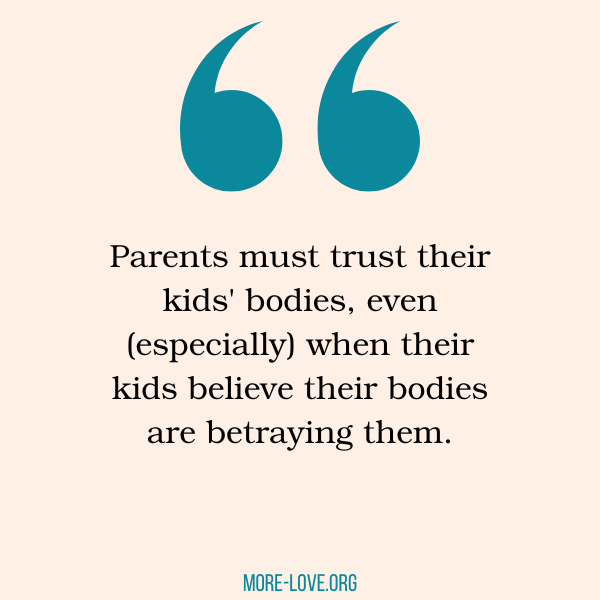
Parents must trust their kids’ bodies, even (especially) when their kids believe their bodies are betraying them. We must trust even when we are scared that our kids will get “too fat.” We can’t know whether they will fully recover, but we can trust that their bodies will try to survive.
Body trust-building statements
Here are some trust-building statements to say out loud to yourself, other family members, and your child:
- If we listen to our bodies, they find balance.
- Our bodies are naturally self-regulating.
- It takes time to tune into how our bodies feel and what they want, and we’re working on it.
- We were born knowing how to eat, when to eat, how much to eat, and what to eat. Sometimes our thoughts get in the way of this inborn knowledge. But, with practice, we can reconnect with our intuitive body wisdom.
4. Validate feelings of anger, fear, and sadness while holding boundaries and treatment plans
While eating disorders are about much more than food and body size, food and body size are massive triggers for someone who has an eating disorder. When bodies gain weight in recovery, alarm bells ring. Eating disorders tell us that weight gain is very, very wrong. Your child will have to face weight gain to succeed in recovery. It’s not easy, since our society insists that weight gain is always bad. Be patient, and be prepared for messiness.

Your child may rage and scream. They may cry and mourn. The body has become your child’s expression of self-worth. As their body changes, your child may feel worthless and unlovable.
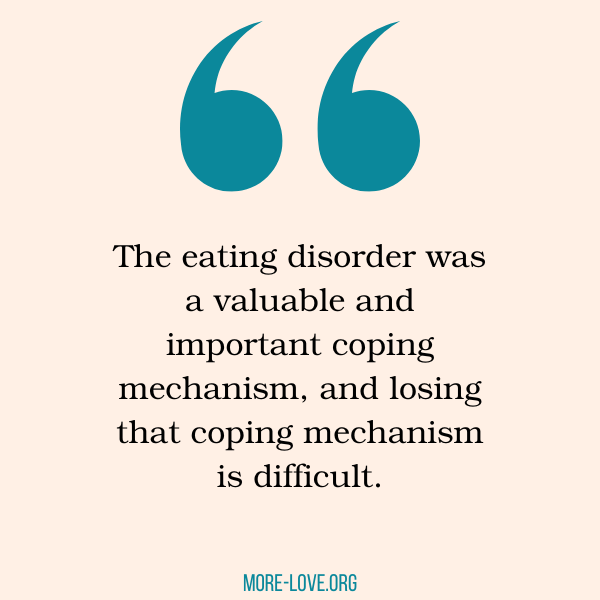
These feelings are not over-dramatized or exaggerated. Your child is truly hurting and mourning the loss of the eating disorder’s role in their life. The eating disorder was a valuable and important coping mechanism, and losing that coping mechanism is difficult. We can have compassion for our child’s struggles to adapt to life without an eating disorder even as we hold boundaries around eating disorder behavior.
It is hard to see our children suffer. It is hard not to want them to calm down and stop feeling angry and sad. But our children must receive the space they need to express the very real panic, fear, and despair that comes with losing an eating disorder and gaining weight.
When the fallout comes, and it may come all day, every day for a while, take a deep breath and remember that it’s real, and it needs space.
Feel the feelings
When your child gains weight during eating disorder recovery, they will have a lot of feelings. Don’t try to minimize their pain. Don’t try to take it away or tell them it’s overblown. Listen to your child every time they want to talk about this. Let the pain come. It will pass. Help your child feel their feelings. The best thing a parent can do is to be present and supportive of their child’s feelings. Your ability to tolerate feelings will help your child learn to tolerate feelings.
Stephanie was relieved to realize how normal Nova’s reaction was. “I’m still scared, but now I feel like I know what I can do to help her. And I’m going to talk to her eating disorder treatment team to see if there’s anything in particular they want us to work on at home.”
Navigating eating disorder recovery is challenging, but Stephanie’s got the right attitude, and she’s doing great!

Ginny Jones is the founder of More-Love.org, and a Parent Coach who helps parents who have kids with eating disorders.
See Our Eating Disorder Treatment Guide For Parents
Discover more from More-Love.org
Subscribe to get the latest posts sent to your email.
My 15 yr old spent the better part of 2020 in recovery and weight restoration and then went into long term treatment for some other issues. She gained weight in treatment but seemed ok and was using self affirmation. Tonight she got her school physical and I didn’t think to ask them not to divulge her weight and it she had gained another 6-7 lbs. she was devastated and started crying. I want to say the right things. My heart just breaks for her. Life is not a number on the scale.
That’s so hard – I’m really sorry. You’re right that life is not a number on a scale. I hope you and your daughter find peace. xoxo