

Posted on 2 Comments

How to handle it when your child refuses to get eating disorder treatment

How to handle it when your child refuses to get eating disorder treatment

Few things are more frightening than knowing your child has an eating disorder and watching them refuse the help they desperately need. Denial, fear of weight gain, or a deep sense of shame can make treatment feel unbearable for them, even when their health is at serious risk.

As a parent, itโ€™s gut-wrenching to feel powerless while your child resists the very thing that could save their life. In this article, weโ€™ll explore why kids and teens often reject eating disorder treatment, whatโ€™s really going on beneath the surface, and how you can respond with empathy, firmness, and hope.

Eating disorder treatment refusal

It seems obvious that when a child has an eating disorder they should get treatment, and yet many parents have a kid who refuses to go. You may find yourself in frustrating arguments, going around and around, trying to convince your child to do something that seems so incredibly necessary. You’re desperate to make a change, but forcing treatment on your child is simply not working. What’s going on?

First, many people who have eating disorders don’t think it’s a serious problem. In fact, a symptom of the disorder is a distorted view of what “healthy” is. Therefore, it can be hard for them to actually see that what they are doing is a problem. Trying to convince someone with an eating disorder that their eating disorder is “bad enough” to deserve treatment can be an uphill battle.

Next, eating disorders are coping mechanisms that your child has discovered make them feel better. Even though it may seem terrible to you, the eating disorder is serving a purpose in your child’s life, and they may not be able to tolerate living without it right now. Trying to force a child to give up their coping mechanism without giving them new ones can be counterproductive.
โญโญโญโญโญ

Free Guide: How Parents Can Help A Child With An Eating Disorder

Master the secrets to supporting a child with an eating disorder. Thousands of families like yours are stronger today because of these six vital lessons drawn from lived experience, best practices, andย extensive study.

Finally, you may have accidentally gotten into a power struggle over eating disorder treatment. In a desperate attempt to take good care of their kids, many parents find themselves trapped in power struggles that feel impossible to overcome. You haven’t done anything wrong, but if your child refuses eating disorder treatment, then understanding the power dynamics at play can help you succeed.

Here are seven things parents can do when a child refuses treatment for their eating disorder:

1. Get professional support

Someone with an eating disorder needs support to recover. But of course if your child refuses treatment for their eating disorder, that’s meaningless advice. Keep in mind that a child who refuses treatment for an eating disorder is saying they won’t do it right now, but circumstances change all the time. This isn’t hopeless, and you can make a difference!

The first thing to know is that even if it feels like there is, the truth is that there’s no silver bullet of eating disorder recovery. Each person has a unique recovery story. We’re never stuck with just one option.

If your child absolutely refuses professional support, you can still make progress by getting help for yourself. Parents are essential to and can actually lead eating disorder recovery. That said, most parents need professional support to do this.

If your child won’t go to therapy, you can go to therapy or get coaching to find out what you can do to help them. When a child won’t see a dietitian, you can see a dietitian and get advice about how and what to feed your child with an eating disorder. In other words, even if your child refuses eating disorder treatment right now, that doesn’t mean you’re powerless. Take the action you can right now. It will add up.

2. Set mini-goals

Most parents are anxious for their child to achieve full recovery from an eating disorder. Of course that’s what we want! But often this dream gets in the way of the day-to-day struggle of recovery. Breaking your big goal down into mini-goals will help you maintain motivation and support your child through the ups and downs of treatment.

The biggest benefit of having small goals is that your child might refuse a big idea like TREATMENT but they’re willing to go to a therapy appointment this afternoon. They might refuse a big idea like EAT ALL YOUR FOOD but they’re willing to try one more bite right now.

โญโญโญโญโญ

Free Guide: How Parents Can Help A Child With An Eating Disorder

Master the secrets to supporting a child with an eating disorder. Thousands of families like yours are stronger today because of these six vital lessons drawn from lived experience, best practices, andย extensive study.

In other words, rather than trying to commit your child to a big goal, work with them on getting to small yesses minute by minute, day by day. Eventually, these small yesses will add up and you’ll find yourself surprised by all the progress you’ve made.

Whenever possible, make your goals SMART, an acronym that stands for โ€œspecific,โ€ โ€œmeasurable,โ€ โ€œattainable,โ€ โ€œrelevant,โ€ and โ€œtime-bound.โ€ SMART goals can help you maintain motivation throughout treatment.

Read more: SMART goals parents can set in eating disorder recovery

3. Don’t engage in debates or power plays

Power struggles are really common when your child has an eating disorder. It’s natural and understandable if you’re desperate to make your child see that they have a problem and accept treatment. However, even when your motivation makes perfect sense, power struggles are counterproductive in eating disorder treatment.

Usually power struggles mean a parent is using methods like dominance, control, negotiation, and manipulation to achieve their goals. Unfortunately, power struggles are counterproductive because they increase disconnection and resistance between you and your child. Kids whose parents use power plays feel powerlessness, inadequate, and frustrated, all of which increase eating disorder symptoms.

Instead of power plays, seek to influence, motivate, and collaborate with your child while holding firm boundaries about what you will and will not do. For example, you can serve food consistently, refuse to change the content, structure, and plan for meals, and consistently show up with a calm, confident approach to feeding your child. This approach is extremely effective, much more so than power plays.

Read More: How to stop nagging and negotiating with your kid who has an eating disorder and How to motivate recovery from an eating disorder
How to handle it when your teen refuses to get eating disorder treatment

4. Set clear expectations

Most parents think theyโ€™re being crystal clear when setting expectations with their kids. However, many of us get stuck in unhelpful power struggles because weโ€™re not communicating our expectations effectively. 

Setting good expectations with our kids involves four things: 

  1. Clarity: we must clearly state exactly the behavior weโ€™re asking our child to do. For example, “Please be in the car at 4:30 p.m. on Tuesday to go to your doctorโ€™s appointment.”
  2. Repetition: we must repeat our expectations and remind our kids that we have them. For example, on Tuesday morning you will remind your child that you expect them in the car at 4:30 p.m. for their doctorโ€™s appointment. Then at 4 p.m. you will give them another reminder. You’ll keep your repeated requests simple, polite and respectful, which will minimize (but not eliminate) pushback.
  3. Avoid Arguments: avoid arguing about and defending your expectations. For example, imagine itโ€™s 4:30 and your child isnโ€™t in the car. Donโ€™t fall for it when they want to debate whether 4:30 is a reasonable time to leave. Simply repeat your expectation, โ€œI understand you have a different opinion, but I asked you to be in the car at 4:30, and I’d like to get going now.โ€ Remember, keep it simple, polite, and respectful. Your child can’t be more emotionally regulated than you are.
  4. Review: when our expectations arenโ€™t met, many of us feel disrespected and throw up our hands in despair. Instead, take time to review your behavior. Were you clear? Did you repeat your requests respectfully? Did you avoid arguments? If not, make adjustments in your own behavior next time. If you did all these things, then review the situation with your child simply, respectfully, and non-defensively. โ€œBuddy, Iโ€™m curious why it was so hard to get in the car at 4:30 as planned. What can we do next time to make this easier for both of us?โ€ Remember: donโ€™t debate your opinion. Just listen respectfully to your childโ€™s opinions and seek to find a solution you can both agree to.

Setting clear, consistent behavioral expectations with a child in eating disorder recovery is essential and will make a big difference.

Read More: Emotional Regulation And Eating Disorders

5. Hold boundaries around what you will do

Instead of engaging in power plays, set boundaries around your own behavior. Your own beliefs and behavior are within your control. On the other hand, your child’s beliefs and behavior are not within your control. You want to hold your own boundaries while respecting that your child disagrees. Your child doesn’t have to agree with you for you to succeed.

For example, let’s say your child is refusing to go to therapy. She says that therapy is a waste of time and tells you that she will not talk if she goes and it’s a waste of money for you to take her. In response, you argue with her about the value of therapy. Maybe you present evidence that therapy is good and necessary to eating disorder treatment. You might insist that she go to therapy and talk to the therapist if she wants to keep her phone privileges.

While this approach makes perfect common sense, it gets you into power play territory because you’re trying to control your child’s beliefs and behavior in therapy. When you’re dealing with an eating disorder, common sense can backfire dramatically.

Instead, if you believe therapy is necessary and helpful, you simply hold your belief while listening to her say stuff that’s intended to pull you back into a power play. Instead of engaging in arguments, you simply say what you will do.

Imagine it’s the morning before a therapy appointment and she says “Therapy’s stupid. You’re wasting your money.”

You take a deep breath and say “I get it. You don’t like going to therapy. Your appointment today is at 2, and I’ll pick you up from school at 1:30.”

I know, this is completely different from anything you’ve done before. You’re switching from a power play to holding your own boundaries.

Her eyes will spark, because she’s used to the power play dynamic. She wants to have an argument about therapy because sometimes it means she doesn’t have to go. Your daughter feels powerful when she gets to debate you about the value of therapy. She will poke and prod and attempt you to go back to the familiar dance of arguing with her.

But instead you hold steady with your boundary. She gets to have her thoughts and feelings about therapy, and you get to have yours. You will hold your ground and be at school at 1:30, then take her to therapy. That’s what is within your control. Convincing her to like it is not.

You might be thinking this will not work, but science shows this does in fact work. They key is that you are consistent and follow through. Once you set a boundary, you must hold onto it. It may take a few repetitions, but it will work.

Read more: How to set healthy boundaries when your child has an eating disorder

6. Attend family therapy

Your child is the one with an eating disorder, but usually family dynamics are involved in maintaining an eating disorder. It’s nobody’s fault; it’s just how humans work. Understanding how family dynamics affect your child with an eating disorder is one of the most powerful things parents can do to support recovery.

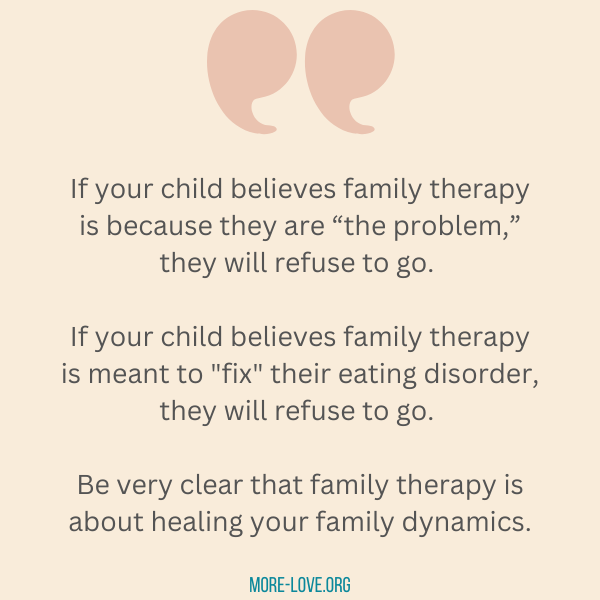
While it’s tempting to approach family therapy with the goal of getting your child to embrace recovery, that can backfire. If your child believes the family therapy is because you think they’re the problem, they will refuse to go. If your child believes the family therapy is meant to “fix” their eating disorder, they will refuse to go. So be very clear that family therapy is about improving your family dynamics. It’s for everyone.
How to handle it when your teen refuses to get eating disorder treatment

The purpose of family therapy is for you to build a stronger connection with your child, to gain some parenting skills, and to help them express themselves fully to you in a safe space. You will learn new communication skills and work on expressing yourself authoritatively and compassionately while unconditionally accepting your child exactly as they are.

Read more: Family therapy when your child has an eating disorder

7. Enjoy your child

You may think that enjoying time with your child while they refuse to get eating disorder treatment is enabling the eating disorder. But that’s simply not true. Eating disorders are complex, and they take time and patience to treat. While that’s happening, make sure you’re enjoying your child.

Our kids see themselves reflected in our eyes. If all we can see is a problem we need to solve, they feel worse about themselves. A good rule of thumb is that you should balance every negative interaction with your child with five positives. Does that sound like a lot? Well science shows that a 5:1 ratio is the minimum we need to maintain positive relationships. I know this is so hard right now, but keep sight of the fact that your child needs to feel as if you to love and accept them exactly as they are right now.

Most people who have eating disorders can and do recover. Taking the steps outlined above, embracing your potential to change, and improving your parenting techniques will help make that happen. The happy side effect of all of these steps is that your family will become more bonded and stronger in every way. And hopefully, your improved relationship will help your child accept eating disorder treatment.


Ginny Jones is the founder of More-Love.org, and a Parent Coach who helps parents who have kids with eating disorders.

See Our Eating Disorder Treatment Guide For Parents


Posted on Leave a comment

How to handle crying over food in eating disorder recovery

How to handle crying over food in eating disorder recovery

Crying over food is a deeply emotional and common experience during eating disorder recovery. Food can carry intense feelings like fear, shame, grief, or frustration, and these emotions can sometimes feel overwhelming.

Understanding how to respond with patience and compassion, both for yourself and your child, is essential for supporting healing. In this guide, weโ€™ll explore why tears around food happen, what they mean in the recovery journey, and practical ways to handle these moments with care and kindness.

Emotional storms in eating disorder recovery

Many parents who have a child with an eating disorder feel buffeted by constant emotional storms, which may include yelling, crying, and arguments over food. Emotional distress is a natural part of having an eating disorder, because food and eating have become stressful and anxiety-producing.

When your child cries about food, it’s a symptom of their eating disorder. When you can see crying over food as part of the eating disorder, you’re more likely to feel as if there’s something you can do about it. And there is! If your child is crying over food during eating disorder recovery, then it’s just as important to manage the tears as it is to manage feeding them. Emotional skills are at the heart of effective eating disorder recovery, and parents are the best people to teach emotional regulation to their kids who are struggling.

Why does my child cry over food?

Crying, yelling, and arguing over food may see to come out of nowhere when your child has an eating disorder. You might be thinking that it’s going to be a good meal, and then suddenly everything seems to fall apart. Your child’s emotional storms may seem bizarre and unpredictable. But look deeper and you’ll learn that these storms are your child’s way of asking you for help. Yes, they’re uncomfortable. Of course we would rather our children come to us with polite and well-worded requests for help. But that’s not typically how it goes.

A child who has an eating disorder will ask for help not with words but behaviors. And sometimes the most difficult and off-putting behaviors are the most important ones to handle.

โญโญโญโญโญ

Free Guide: How Parents Can Help A Child With An Eating Disorder

Master the secrets to supporting a child with an eating disorder. Thousands of families like yours are stronger today because of these six vital lessons drawn from lived experience, best practices, andย extensive study.

Emotional storms pass when you meet your child’s emotional needs. The good news is that any parent can learn how to provide emotional care even if it doesn’t feel natural. Here are six things to do when an emotional storm comes along:

1. Don’t freak out

The first thing you need to do for a child who starts an emotional storm is to stop your instinctual first response. You may actually be “emotion-phobic,” and feel physically repelled by a child who starts crying, yelling or arguing with you. Your first instinct may be to yell back, roll your eyes, or just leave the room.

But your child has very real needs for emotional connection. Emotional needs are just as life-critical as our need for air, food and water. Recognize that you are freaking out, remind yourself that this isn’t your fault but you still need to do the work, and focus on giving them what they need right now.

Regulate your own emotions so that you can stay steady. Our kids tune into how we feel, so the more regulated and calm we remain, the better our chances of influencing our kids to calm down.

2. Forget about time

It’s not unusual for parents to feel exhausted by their child’s emotional needs. One thought that might come up for you is how ridiculous it is that they’re crying over food, and you may think that you don’t have time to do this for them all the time. OK. That’s a valid fear for you.

Now take a breath and remember that your child is in the process of healing from a terrible, self-destructive disorder. Crying over food is a typical eating disorder symptom. It’s just as important to respond well to their crying as it is to serve them food. They need you to work through your aversions and show up for them when they cry over food during eating disorder recovery. Rest assured that your time investment and attention to their emotional care is absolutely worthwhile.

Also remember that emotional storms don’t last forever. Most emotional storms, when addressed compassionately, can be resolved in less than an hour. As your child heals and you get better at weathering these storms together, they may pass in just a few minutes. Like anything new, it’s going to take practice. Take a deep breath and just be here now. Go minute by minute if you need to, but stay with them and regulate your own emotions as much as possible.

3. Make it about your child, not you

It’s not unusual to feel very angry, overwhelmed, or irritated when a child starts crying over food when they have an eating disorder. But you have to set that aside. Dig deep. You child needs you, and this is part of your job as their parent. Make this moment about their needs.

How to handle crying over food in eating disorder recovery

An emotional storm is not the time for you to talk about how your child’s behavior makes you feel. Don’t ask them what you should do, what you were supposed to do, or any other questions that indicate you feel victimized by their emotions. During an emotional storm, your child needs you to be solely focused on their needs. This is not because your needs don’t matter (they absolutely do), but it’s all about timing, and this is not the time.

If you find yourself panicked and either lashing out or biting your tongue through every emotional storm, then please see a coach or therapist to help you with your very natural and real feelings of frustration. Your feelings are valid, and a qualified therapist can help you get your needs for self-expression met while still giving your child the emotional care they need during eating disorder recovery.

4. Reflect, don’t defend

When your child says something during an emotional storm, don’t debate, deny or judge what they said. Those responses are all defensive, which means you are defending against your child’s need for emotional connection. To them, it feels as if you have erected a wall between the two of you. Their continued yelling, arguing, or crying is an attempt to break the wall down.

Instead of getting defensive, reflect on what they say. This is how we show our kids that we hear and understand them, and it is what our children crave most from us. You will know this is working when the volume goes down.

This takes a lot of practice. Most of the time when we get defensive we genuinely don’t see ourselves as being defensive. You may not realize this, but denying that you are being defensive is actually being defensive. Listen to your child. If they rage even louder at you after you say something, then there is a good chance you said something to defend yourself against their emotional experience.

Remember that emotional storms pass when you meet your child’s emotional needs. So take a deep breath, and listen to what your child says. Reflect back to them what you heard so that they know you are listening.

โญโญโญโญโญ

Free Guide: How Parents Can Help A Child With An Eating Disorder

Master the secrets to supporting a child with an eating disorder. Thousands of families like yours are stronger today because of these six vital lessons drawn from lived experience, best practices, andย extensive study.

5. Slow down

Sometimes parents attempt to solve their kids’ problems as quickly as possible, but if we try to move too quickly to resolve the problem, we will not meet our child’s emotional needs. Remember that whatever they are raging about is a cover for their actual need to feel emotionally connected with you.

If they are arguing with you about the stupidity of their meal plan, don’t tell them that’s just how it is and they need to get over it. Encourage them to talk about what the expectations of the meal plan means to them. You don’t need to change the meal plan! Just listen and understand what your child is saying about it.

If they are crying because they hate green beans, don’t tell them that green beans are healthy and delicious. Instead, help them use their feelings about green beans as a way to connect with you and feel heard and seen by you. You don’t need to take the green beans away or never cook green beans again! Just listen and understand what your child is saying about them.

Don’t say “it will all be fine.” Say “I can see it feels really bad for you right now,” and let them keep talking about it. This is how we build emotional connection. The result is that our children feel truly seen and understood by us, which is every child’s deepest wish.

This is hard. Remember that your child’s need for emotional connection is normal and natural, and within your power to give. It may not be easy, but you can learn to give them what they need to thrive. Be patient with yourself, and get the support you need to learn these skills.

But why so many?

If you are still wondering why your child with an eating disorder has so many emotional storms, here are a few things to consider:

1. Emotional care is a fundamental human need

All humans are hard-wired to seek emotional care as well as physical care from their parents. In fact, an infant sees no difference between emotional and physical care. Infants who are raised with only physical care and zero emotional care do not flourish. They suffer tremendously from lack of emotional nurturing. This is a biological adaptation based on the fact that we are social animals and thrive in groups. Emotional caregiving is how we bond with our group and remain safe and alive.

Your child’s emotional storms are an attempt to gain emotional caregiving. Rather than seeing it as a failure on their part of yours, see it as an opportunity to help them.

2. Some humans need more emotional care than others

Some people have a greater need for emotional intimacy than others. If your child has an eating disorder, then there is a good chance that they fall in the category of “Highly Sensitive People,” a trait that can been observed in the very first year of life. These children have a highly sensitive nervous system that can pick up on emotions in a way that seems supernatural to most people. It is not uncommon for parents who themselves have normal or low emotional sensitivity to have a child who baffles them with high sensitivity traits. This mismatch is not anyone’s fault but must be addressed during eating disorder treatment.

Highly Sensitive Child + Eating Disorders Printable Parent Guide

Highly Sensitive Child + Eating Disorders Printable Parent Guide

  • Understand high sensitivity and eating issues
  • Improve mealtimes and reduce stress
  • Increase your child’s coping skills

A child who has a lot of emotional storms during eating disorder treatment is showing that they need more emotional care. That care may look different than what you thought it meant to care for someone. It might look different than the care you’ve given to your other children or the care you received as a child. But it’s worth investigating the cause, the need, and learning new skills to support your child emotionally.

3. It’s not your fault

Very few parents intentionally neglect their children’s emotional needs. Most of the time the trouble lies in a misunderstanding of a child’s needs because they function differently than you do. When your child has an emotional storm, it’s hard not to feel personally attacked and defensive, especially if they are criticizing your parenting. You may be tempted to withdraw because it feels so hateful when you did (and are doing) your very best.

But please understand that this is not about whether you did your best. This is simply about the fact that you did your very best, and now there is more to be done. Emotions and eating disorders are linked, and this is your opportunity to help. Our children never lose their need to be seen and understood by their parents, and people who have eating disorders are likely to continue getting stuck in self-destructive behaviors as long as they feel emotionally under-nourished.


Ginny Jones is the founder of More-Love.org, and a Parent Coach who helps parents who have kids with eating disorders.

See Our Guide to Emotions And Eating Disorders

Posted on Leave a comment

How to handle your child getting angry in eating disorder recovery

How to handle your child getting angry in eating disorder recovery

Anger is a common and often misunderstood part of eating disorder recovery, especially for children and teens. As your child works through the emotional and physical challenges of healing, intense feelings like anger, frustration, and defiance may surface.

These reactions can be alarming for parents, but theyโ€™re not a sign of failure; they’re a signal that your child is grappling with deep pain and fear. In this article, weโ€™ll explore why anger shows up during recovery, how to respond with calm and compassion, and strategies to maintain connection while setting healthy boundaries that support your childโ€™s healing journey.

What “recovery anger” looks like

If your child has an eating disorder, it’s very possible that they feel angry while recovering. Most parents do everything they can to support their children, and they do not anticipate the anger that often comes with recovery. Anger during eating disorder recovery can look like:

  • Yelling at you
  • Refusing to go places and do things with you
  • Mumbling curses under their breath
  • Angry looks and smirks
  • Talking about you with disdain to other people
  • Criticizing you

Almost all parents have done the absolute best job they possibly can in raising their child to be whole, confident and strong. When a child has an eating disorder, it can feel like a slap in the face after all the effort you have put into parenting.

And yet, here it is. And it means there is work to be done.

Why your child gets angry when recovering from an eating disorder

Many people who have eating disorders use eating disorder behaviors as a way to go around, avoid, or completely ignore uncomfortable feelings. Instead of processing emotions in a healthy manner, eating disorder behaviors help take feelings underground. This results in a build-up of negative emotions for which they have no skills (other than maladaptive ones like restricting, bingeing and purging) to process.

This is why it can be very normal for your child to feel angry when recovering from an eating disorder. It’s often a sign that they are feeling feelings. Anger is one of the most common feelings, and is typically easier to access and express than more complicated emotions like despair, fear, loneliness, distrust, and languishing.

During eating disorder recovery, your child must learn new skills to process their complex feelings in healthy, adaptive ways. These skills are easy to comprehend on an intellectual level, but they are very difficult to practice, and even more difficult to integrate into everyday behavior.

Getting angry can be a good sign

Recovering from an eating disorder requires your child to practice processing feelings like anger in real-time. Because they have incomplete coping tools for doing this, it feels raw and terrifying when anger comes up. At the same time, parents, siblings and other loved ones experience a person who was fairly pleasant and easy-going transform into one who seems irrationally angry.

This is a critical moment in recovery. When your child stops hiding their feelings and allows socially unattractive emotions such as anger to arise, it means they are healing. But it’s also very unpleasant to be on the receiving end of this anger. It’s hard to watch your child who has an eating disorder tap into all their rage and anger.

Your child may feel very sorry. But they actually need to be unapologetic about having feelings, including anger. They know this is hard for you, but they also need you to be able to tolerate their anger as they heal. They need a safe space in which to exercise their new tools for feeling feelings in real-time, which includes feeling anger and other “unacceptable” feelings.

Setting boundaries

You can set boundaries around angry behavior, but be careful not to set boundaries around feelings. Parents can and should help children untangle, label, and feel their feelings. This is a critical parenting skill that can be learned. However, it’s fine to set boundaries around behaviors like:

  • Name-calling
  • Swearing
  • Hitting and physical violence
  • Self-harm

You can tell your child that when these things happen you will call a time out and address the behavior. But you will always return to the feelings that drove the behavior, and you understand that it’s hard to learn how to process feelings, and you’re there to help them do it safely. Make sure you follow through and always go back to have the difficult conversations that need to happen about difficult emotions.

It will get harder before it gets easier

Difficult emotions may be hard for you to see, especially since many people who have eating disorders seem pretty easy-going and agreeable. People who have eating disorders often anticipate others’ emotions and are sensitive to socially-acceptable behavior. Many mold their emotional expression to fit others’ needs.

You may not have noticed how much was remaining unsaid about how your child felt and what they sensed on an hourly basis. There’s a good chance they have been hiding a lot from you.

You may have never asked them to repress their emotions, but many times kids behave in ways that they believe will protect their loved ones from dangerous emotions like anger. Your child may have intuited that you couldn’t handle their anger, and thus found ways to work around it and hide it from you. There’s no need to blame yourself, but it’s important to know that your child has been experiencing you in this way.

When a person begins to recover, they have to stop protecting their parents from their feelings. They have to start allowing their anger, frustration, jealousy, hurt, pettiness, cowardice, and all other negative emotions to surface without a buffer. It’s intense for you. It’s intense for them. But if they shut this down, they risk their recovery.

This is why your child feeling angry when recovering from an eating disorder is both normal and difficult.

Here are four ways parents can deal with a child who is expressing a lot of anger while in the eating disorder recovery process:

1. Don’t take it personally

No matter what your child says, you need to try and remember that you should not take their words personally. They may say awful, nasty things. And some of them may be true. But if you take their words personally, you will shut them down immediately.

Your child is learning to process in new ways, without their eating disorder behavior. They need you to be stronger than their words right now so that they can learn on their own how to do this without turning to restricting, binging, and purging. This is really not about you. It’s about them learning to do new things.

2. Don’t get defensive

Your child will probably call into question things you have done, things you said you would do, and things you didn’t do. They will do this a lot. It will hurt. But remember that this is not about roasting you on a spit. This is actually your child testing out ways to communicate without their disorder. It’s messy. It can hurt. It’s often a sign of healing.

Please don’t get defensive and tell them that something didn’t happen or that something had to happen the way it did. The “thing” is not the point. They are testing out the idea that someone who loves them can tolerate their pain. They want to feel held and accepted with their pain. Take a deep breath and ignore your deep desire to defend yourself.

3. Acknowledge and accept anger

Your child has anger. The only way they knew to process anger before was to make their body suffer. Now they are trying to learn to process anger in healthy ways. When they are processing anger with you, the best thing you can do is acknowledge and accept the anger without judgment.

Listen. Acknowledge what is said (acknowledgment is not the same as agreement). Validate them and tell them their feelings are important. Apologize if you did something wrong. Let them know that you wish they never had to suffer this pain, but that you believe they can handle it. Tell them you are here for them no matter what they say or do. Let them cry. Let them mourn. Let them rage. Feeling feelings, including anger, is important and healthy.

4. Let it be

It’s going to be uncomfortable. It’s going to downright suck. You’re going to make mistakes and mess up in this process. Your child might say terrible things to you. But all you need to do is remember that each time your child brings up anger, it is part of eating disorder recovery. Your only job is to let it be. Allow their anger to exist in the world.

Many parents believe our job is to make pain and anger go away for our kids. We think we are supposed to fix things for them and make them better. But our children need us to just let their pain and anger exist in nature. Just like thorns on a rosebush, anger does not make them ugly. It is natural and part of all of us. Our children need to know they can be loved with their anger. They need to know this in order to recover. Just let it be.

A parents’ job during recovery is undeniably difficult. Emotions and eating disorders are linked, and recovery requires new emotional skills. As a child learns new skills, their parents need to learn how to handle emotions, too. This is hard. Please get the support you need to be the parent your child needs during this time. Don’t be afraid to reach out for help.


Ginny Jones is the founder of More-Love.org, and a Parent Coach who helps parents who have kids with eating disorders.

See Our Guide to Emotions And Eating Disorders

Posted on Leave a comment

How to respond when your child gains weight in eating disorder recovery

How to respond when your child gains weight in eating disorder recovery

Weight gain during eating disorder recovery is not only expected, itโ€™s often a life-saving sign of healing. But for many parents, seeing their childโ€™s body change can stir up worry, fear, or uncertainty about whatโ€™s โ€œnormal.โ€ And your child, most likely, is freaking out.

How you respond in these moments matters deeply. Your words and actions can either reinforce body shame or help your child feel safe, supported, and loved. In this article, weโ€™ll guide you through how to respond with compassion, avoid unintentionally harmful comments, and stay focused on what truly matters: your childโ€™s health, recovery, and self-worth.

Recovery weight gain

If your child is in eating disorder recovery, you may be noticing they are gaining weight. Sometimes you are prepared and even desperately want this. If your child has been dangerously weight suppressed, then, of course, you want them to gain weight. But for many parents who have kids in recovery, there comes a time when they worry their child is now “swinging the other way” or “going too far” in recovery.

That’s what happened to Kari and Ian. Their daughter Bailey is in recovery for anorexia. After hospitalization, she went into residential treatment. She did well, and Kari and Ian implemented Family-Based Treatment (FBT) while Bailey gradually stepped down from full residential to lower levels of care.

“I read all these stories about kids not recovering, so I feel really lucky that it seems like the treatment worked really well for Bailey,” says Kari. “But the truth is that now I’m a bit worried. Bailey’s weight has passed the point of where she was before the eating disorder. Her doctor seems a little concerned, but her therapist and nutritionist assure me that this is how it should be. I’m pretty confused and just want to do the right thing.”

Restriction and eating disorders

Almost all eating disorders begin with dietary restriction. A child can be anywhere on the weight spectrum when they start the cycle of an eating disorder. Due to a cascade of physiological factors, the restriction can beget more restriction. For many others, it leads to a restrict-binge cycle. Either way, the body and brain are not receiving the nutrition they need to maintain “homeostasis” or a steady weight.

Once in the cycle of most eating disorders, the person may become increasingly food- and weight-oriented. They find themselves thinking about eating or not eating many times per day. They may plan exactly how to avoid eating or what to eat next. Rules and restrictions take over their lives, leaving little room for anything else.

Most eating disorders begin with a diet. Whether your child remains in the restrictive phase (anorexia), or cycle between restrict-binge (binge eating disorder) or restrict-binge-purge (bulimia), restriction is a core behavior. 

Multi-layered disorders

While this is happening, most* bodies respond by slowing down the metabolism to meet the unstable access to food. The body does not like weight loss or unstable food supplies, so it triggers a famine response in which the body becomes extremely efficient with every nutrient and calorie it receives. This is why most efforts to lose weight result in regain, often with some extra pounds to protect against the next famine.

*In people with anorexia, their bodies may go into hyper-metabolism, which can remain a symptom for many months following weight restoration.

Why is my child gaining weight?

This effect can also happen with an eating disorder. Even after recovery, the body can continue to run slowly and hold onto calories and nutrition in an attempt to avoid the deadly impact of famine. Many people accept that they carry extra pounds in eating disorder recovery simply because their eating disorder triggered their body’s famine response.

While this can be challenging in our anti-fat society, it’s a necessary part of recovery for many people.

If your child is gaining weight during recovery from an eating disorder, it is because weight gain is a natural and physiological natural response to the restriction they endured. Your childโ€™s weight during recovery may fluctuate wildly as the body recovers a new state of homeostasis.

How much weight will my child gain during recovery?

Weight gain during recovery depends on how big of a factor weight was in your child’s eating disorder, how long your child has struggled with an eating disorder, his or her individual metabolism, the total weight lost and gained throughout the eating disorder, the number of weight cycles, and more. These factors will combine to make each recovery journey unique.

Because most eating disorders involve restriction, recovery often includes weight gain. Recovering bodies need to return to a natural weight and will likely add pounds in response to the restriction endured during the eating disorder. It is impossible to estimate your childโ€™s recovered weight, especially since it may take years for your childโ€™s body to settle into a new โ€œnormal.โ€

What you must know is that once recovered, no number on the scale will ever measure your childโ€™s health. Full recovery from the eating disorder, not body weight, will dictate your childโ€™s health and the likelihood of a successful, meaningful, and joyful life.

It can be uncomfortable

The good news is that your childโ€™s weight, with proper eating disorder treatment, will eventually stabilize. The bad news is that your childโ€™s new weight may make you uncomfortable. This is why you need to work on your own biases about body weight and food restriction.

  • Do you believe low body weight is a sign of health?
  • Do you believe that your child can only be happy and successful in life if his or her body meets a narrow societal standard of body size?

These are the questions that Kari and Ian had to consider as Bailey gained weight.

“Our primary goal, of course, is for her to be mentally healthy,” says Kari. “Of course, we don’t want the eating disorder coming back, so we’re going to be vigilant about not allowing restriction and dieting anymore. We’ve gotten rid of all our diet foods and are careful about how we talk about food and weight now. But the truth is that we still struggle with the idea of gaining weight. I guess it was just so ingrained in us, as kids of the 80s, that thin is best. I’ve been watching my weight my whole life. This is a major shift for us.”

This makes so much sense. Weight gain is a challenging issue in our society. When a family faces an eating disorder, our cultural weight biases become critically important. We have to evaluate how and where they seep into our beliefs and thoughts and work to overturn them.

That’s what Kari and Ian are working on now. “I can see that we still have a lot of work to do about our own weight biases,” says Kari. “We’re working to understand weight science and accept our own bodies and Bailey’s. It’s not easy, but her life and health are worth it to us!”

Is it ever too much?

Now that you understand that weight gain is a natural and healthy part of eating disorder recovery let’s just consider if there is such a thing as “too much.” I believe that most of the time weight gain makes sense during recovery, but since an eating disorder can swing between restriction and binge eating, weight gain can sometimes (not always!) be a sign of an ongoing eating disorder.

Unless your child’s doctor is an eating disorder specialist, I take any concerns they have about weight gain with a grain of salt. Unfortunately, our healthcare system has a lot of weight stigma, and most doctors don’t understand eating disorders. On the other hand, I would do a quick check-in with your child’s dietitian and therapist.

What I would ask the dietitian:

  • Are you still focusing on a weight gain goal?
  • Is the current weight gain unexpected?
  • Are we on track to guiding our child toward an Intuitive Eating approach?
  • Do you have any concerns about my child’s weight gain?

What I would ask the therapist:

  • Do you see signs of reduced or increased food obsession and compulsion?
  • Do you believe my child is still actively in an eating disorder?
  • What skills are you teaching that we can reinforce at home to support recovery?

Kari and Ian took these questions to Bailey’s therapist and nutritionist, and they felt greatly relieved. “Both of them explained in detail the signs of recovery that they were observing and what they were still looking for,” says Kari. “They were confident that Bailey’s weight would even out over time and that any gain at this point is not a sign of a new or different eating disorder. I feel so relieved, but we still have work to do on our own feelings about her recovered body. I know this is for us to work on and has nothing to do with her. So we’re working on it!”


Ginny Jones is the founder of More-Love.org, and a Parent Coach who helps parents who have kids with eating disorders.

For privacy, names and identifying details have been changed in this article.

See Our Eating Disorder Treatment Guide For Parents

Posted on Leave a comment

Why moralizing food can fuel eating disorders and how to stop

Why moralizing food can fuel eating disorders and how to stop

In our culture, itโ€™s common to label foods as โ€œgoodโ€ or โ€œbad,โ€ creating a moral framework around eating that can unintentionally contribute to disordered eating behaviors. When food is tied to notions of virtue or failure, it can lead to guilt, shame, and anxiety, key triggers for eating disorders.

This rigid way of thinking about food fosters unhealthy relationships, especially in children and teens who are still developing their sense of self and body image. In this article, weโ€™ll explore why moralizing food is harmful, how it fuels eating disorders, and practical strategies parents and caregivers can use to promote a balanced, compassionate approach to eating.

Not a moral issue

When we label foods as “good” or “bad,” we naturally label the people who eat them as “good” or “bad.”

But food is not how we should define a human being. It’s discriminatory to judge a person’s value based on what they eat. And it often fails to take into account issues like:

  • Income: not everyone has the money to invest in purchasing and preparing foods that are considered “healthy.”
  • Access: not everyone has access to farmer’s markets, organic produce, and other foods that are considered “healthy.”
  • Sexism: eating a “healthy” diet is considered necessary for a woman to signal her femininity. Meanwhile men are discouraged from appearing too feminine by eating foods like salads.
  • Racism: the foods that we have been told are “healthy” tend to be foods associated primarily with white people.

Images promoting food morality are everywhere. We frequently see primarily white, thin, attractive people eating fruits, vegetables and other foods that are considered virtuous. Conversely, the people who are shown eating high-fat, fast-food are typically of color and size.

The lies diet culture tells us

Diet culture asserts that if we eat only “good” foods, we will be happier and more successful. It tells us that our food choices are either “good” or “bad.” Under this restrictive ideology we are constantly at risk of failure.

Diet culture says that health is equal to weight. And that the way to achieve low weight is to eat less, and to only eat “good” food. But weight is largely genetic and environmental. In other words, it is largely out of our control. Additionally, no single food choice will make or break our health. In fact, balanced nutrition is a “nice-to-have,” not an essential element of health.

Essential elements of health:

  • Physical safety: having shelter, warmth, and meeting basic food needs
  • Emotional safety: feeling loved, belonging to a community, having social support
  • Environmental safety: not being at risk of flood, fire, violence, and other environmental traumas
  • Body respect: not being at risk of being marginalized for factors that are out of your control. These include skin color, weight, height, sex, gender, religion, physical or mental ability, sexuality, etc.

These are all complex societal factors that affect health. But we are told that our health rests entirely on our own shoulders. We are told that being healthy means being thin (it’s not). And that getting thin is possible for every body (it’s not). We internalize these beliefs and turn them into our moral compass.

Social eating

Food is frequently presented as a moral choice. And yet most social events are based on eating foods that have been labeled “bad.

Isn’t it interesting that we meet for coffee, breakfast, lunch, brunch, a drink, dinner, pizza, tacos, takeout, etc. And yet according to diet culture these activities are “bad.”

This presents a conundrum. When we are alone, we must be virtuous in our food choices. But when we are in a group, we should enjoy the foods that we have been told to restrict.

To deal with this complication, we typically discuss our diets during these social gatherings. We’ll talk about how we’re “being bad,” or will “make up for it” later with exercise or not eating. We try to perform goodness by not eating “too much” or choosing something “guilt-free” from the menu. Socialized food morality is pervasive and often goes unnoticed.

The morality of food

We are living in a time of dangerous morality surrounding food. We are surrounded by images and headlines defining what is good and what is bad. People who have eating disorders internalize food as the pathway to being “good.” They determine that in order to be a “good person,” they must eat the right food. And not eat the wrong food. By focusing our energy on improving our diets, we believe we are improving our selves.

But food is not a moral issue. It’s just food.

This is the core of orthorexia, an eating disorder based on the desire to eat only “good” foods. People who have orthorexia will refuse to eat food that does not fit a rigid definition of “healthy.” They’ll eat only “good” food even if it means they skip social events or make others uncomfortable.

People who have eating disorders find statements regarding the moral integrity of foods very triggering. Most have some degree of perfectionism. Their eating disorder behaviors typically begin with a well-researched diet or eating plan. They want to stay on the “good” side of morality. Dieting can transform all to easily into an eating disorder. Eating disorders can be very hard to overcome. This is why not making food a moral issue is so important.

When we have an eating disorder, we devote our growth, our passion, and our moral compass to ensuring we meet the dietary morality. This comes at the expense of devoting ourselves to emotional growth and development. As long as we focus on food, we stall our emotional maturation and development. We sacrifice the development of our selves for the morality of the food we put in our bodies.

Life without food morality

Let’s stop talking about the food people put in their bodies. We can focus instead on what they do with their souls. Instead of food morality, let’s focus on the truly important moral issues, including:

  • How we treat ourselves – how do we soothe ourselves and develop ourselves?
  • Our treatment of the people we love – how do we show them we love them every day?
  • How we learn – do we have processes in place for learning new skills in personal and professional development? Are we focusing on our emotional growth and development?
  • How we treat other people – do we accept them for who they are? Do we support them in their own personal development outside of food and body goals?
  • Our treatment of people who have marginalized identities such as people who:
    • Are not white and/or have a different skin color than our own
    • Are in lower socio-economic classes
    • Have a larger body size/high weight
    • Are mentally or physically disabled
    • Not cis-gender: e.g. non-binary, transgender
    • Are female
    • Are not heterosexual
    • Have different political ideologies

How we treat other people, particularly those people who are in marginalized identities, is a moral issue. But food is not a moral issue. Let’s free ourselves of diet culture’s food morality and build our true morality. This is especially true when you are eating or feeding someone with an eating disorder.


Ginny Jones is the founder of More-Love.org, and a Parent Coach who helps parents who have kids with eating disorders.

See Our Parent’s Guide To Eating & Feeding A Child With An Eating Disorder

Posted on Leave a comment

When you have a child with an eating disorder, your family can help by learning attuned eating

by Tracy Brown, RD

If your child who has an eating disorder is seeing a nutritionist, then there is a good chance (I hope!) that the nutritionist is teaching some form of Intuitive Eating or Attuned Eating. One powerful way that the whole family can help your child recover is to learn these techniques, which can positively transform anyone’s relationship with food and will benefit the whole family.

Whether you call it Intuitive Eating or Attuned Eating, the idea is that we want to learn to pay attention to what is happening in our bodies, emotionally and mentally. When a child has an eating disorder, she or he is not attuned to her or his bodily needs.

Attuned Eating means that you are:

  • Tuning into how my body feels
  • Paying attention to which hungers are emotional vs. those that are physical
  • Honoring all types of hunger with awareness and conscious attention
  • Recognizing that sometimes we’re going to eat for emotional reasons, and that’s OK
  • Respect the body when it feels physical hunger, and feed it nourishing food on demand
  • Noticing how the body feels as you are eating
  • Thinking about levels of fullness, and how you feel emotionally and physically when you are full or over-full
  • Knowing that sometimes food has a memory associated with it that drives us to overeat or undereat. By noticing the memory, we can begin to untangle the memory from the food.

Someone who has an eating disorder has disassociated themselves from their bodily and emotional needs. Attuned eating is a way to re-integrate what the body, mind, and soul need on a daily basis.

For example, if we start craving a soda every day, what does that actually mean? Is there something beyond the nutrition that soda is providing? If I want a soda every day, why is that? What am I looking for from soda? Does it signify having fun? Do I really like the taste of the soda and the way it makes my body feel, or am I looking for a way to have more fun, more sweetness, more pop in my life?

When we eat in an attuned manner, we can recognize when our bodies need nourishment, and we can also recognize that sometimes we want, and will eat food for reasons other than physical nourishment. This doesn’t mean that it’s wrong to eat for emotional needs, we just want to pay attention, because our hungers can tell us amazing information about our lives.

You can’t do this incorrectly. Just get curious about why you want to eat certain things. Stop all the judgment about what, when, where and why you SHOULD eat, and just tune into how you feel while eating.


tracy brown rd

Tracy Brown, RD, is a nutrition therapist, registered licensed dietitian and attuned eating coach. She established her private practice in 2006 in in both north and central Florida and now in Naples, FL. She specializes in the treatment of eating disorders and disordered eating in children, teens, and adults. She teaches Intuitive Eating and works with people in person, individually and in groups, online and via phone.

Posted on 5 Comments

The strange but necessary questions to ask before sending a child to residential for eating disorders

The strange but necessary questions to ask before sending a child to residential for eating disorders

Deciding whether to send your child to a residential eating disorder treatment center is one of the hardest choices a parent can face, and the standard questions arenโ€™t always enough.

While itโ€™s important to ask about credentials, therapy types, and meal plans, the most meaningful insights often come from the strange, uncomfortable, and overlooked questionsโ€”the ones that get to the heart of whether a program will truly meet your childโ€™s emotional, psychological, and relational needs.

In this guide, weโ€™ll walk you through the unexpected but essential questions that can reveal how a center operates, how it treats families, and whether itโ€™s the right environment for your childโ€™s recovery, not just on paper, but in practice.

Interview with John Levitt, PhD

I often get calls from parents asking me about how to get their child into a (usually inpatient or residential) eating disorder treatment program, but I almost never get calls from parents who want to know how they can avoid sending their child to a treatment center.

I think many parents assume that a treatment center is the only option for their child, but that’s often just not the case. There are definitely times when an inpatient or residential treatment center is the best option for their childโ€™s eating disorder recovery, but it’s important to know that the potential costs for sending oneโ€™s child to a treatment center (financially, personally, and socially) are possibly very high — and relapse rates can also be very high as well!

Treatment centers are run by good people who are generally doing good work. That said, treatment centers are businesses, and you as parents are the consumers. Don’t be afraid to be a smart consumer. Ask a lot of questions. Ensure you understand what you are getting into. That is, make sure you know what you will be paying for and what outcome(s) you can expect. Parents should become the experts on what they are โ€œbuyingโ€ before taking the leap to send their child anywhere!

First, it’s important to know what treatment centers can – and can’t – do. Treatment centers are places where your child can stabilize his or her eating disorder symptoms. Their weight will hopefully improve and likely stabilize and their eating disorder symptoms will likely be reduced or even eliminated completely while they are staying at the treatment center.   Associated symptoms of depression and anxiety and so forth are also likely to improve.

That said, when they get home, they are faced with the same life stressors and conditions that may have at least bred the eating disorder, or minimally, were associated with the eating disorder prior to going to going to treatment!   Once home, this is where the true treatment begins. Your child needs to learn to live with a sense of self-worth and self-efficacy that is enduring and resilient across people, places, and situations — and they often won’t find that in a treatment center. You just can’t practice all of the requirements of life in a controlled setting. Full treatment does not happen in a program, it happens in life.

I recommend that parents ask treatment centers a variety of questions such as: how long does it usually take to stabilize a childโ€™s eating disorder(s) (including issues related to mood etc.), how will the treatment center ensure that you, the parent(s), are an essential part of the treatment, and how will the treatment center prepare your child, and the parents, for the childโ€™s return home — ensuring the maintenance of their treatment gains.   In addition, even at admission or pre-admission, parents should ask about what will be needed upon the childโ€™s return home; after completing that treatment. That is, what will your child need following their stay at the center? You should not receive vague answers to any of these questions because they are critical to efforts to achieve full recovery.

I understand how frustrating it can be to have a child who has an eating disorder at home. I understand the desire to send the child โ€œawayโ€ to get better because you just don’t know what else to do. But I would be very judicious about sending oneโ€™s child away. As long as your child is going to return home to the parent, that parent is going to need to get his/her own tools and support to continue the healing process.

Parents need to be educated, supported and trained to support their children in healing from an eating disorder. Some treatment centers build that into their programs. Ask them about it.  Make sure that they will involve you and make up your mind to be involved!

Also, don’t be afraid to ask about the costs involved. Many eating disorder treatment (e.g., residential) centers are running 60 days. That’s a long time for your child to be away from home and away from school. It’s can also be about $60,000 plus. That doesn’t take into account post-center treatment. That can be equivalent to your child’s college tuition.

I donโ€™t want to discourage parents from using inpatient or residential treatment centers. I just want parents to understand what is involved in some types of treatments, carefully review the alternatives, if any, and enter treatment with realistic expectations and get their questions answered! It’s important for parents to be really clear about what is realistic to expect.


Screen Shot 2017-04-21 at 9.27.21 PM

John L Levitt, PhD, CEDS, FAED, FIAEDP, is the co-editor of the book, Self-Harm Behavior and Eating Disorders: Dynamics, Assessment, and Treatment, and was on the Editorial Board of Eating Disorders: The Journal of Treatment and Prevention Email: levittj@aol.com Phone: (847) 370-1995

See Our Eating Disorder Treatment Guide For Parents

Posted on Leave a comment

A service dog for your child with an eating disorder

A service dog for your child with an eating disorder

Have you thought about getting your child with an eating disorder an emotional service dog? This can be a great idea, especially for dog lovers! Dogs provide unconditional love and affection as well as powerful emotional regulation assistance. That said, it’s important to think through the idea carefully. Dogs are our best friends because they become deeply emotionally attached to their humans. Getting a dog is a serious commitment, especially if you’re asking the dog to provide your child with emotional support.

Before getting a service dog during eating disorder recovery

If you’re looking for a dog that will actively support your child’s emotional health, it will require daily training and effort. Keep in mind that getting a standard family dog is great, but without emotional service training, the dog may have little to no impact on your child’s emotional health. To maximize the power of their bond, you child should be the one training and caring for the dog. If your child is not interested in having a dog or is incapable of caring for it and working with a trainer, you may want to reconsider.

Even if you are 100% sure your child with an eating disorder wants and can care for the dog, it’s still important that everyone in the household is onboard. If someone in the family is allergic to or intolerant of dogs, then come up with another idea. Make it clear that if the family agrees to get a dog, there is no going back. Having a dog is a commitment for that dog’s life.

Finally, consider finances. Dogs require training, vet care, food, toys, bedding, and other accessories. It’s difficult to anticipate vet expenses, and they can get pricey. If your family is on a tight budget right now, you may want to think carefully about whether adding the expense of having a dog is the best choice.

โญโญโญโญโญ

Free Guide: How Parents Can Help A Child With An Eating Disorder

Master the secrets to supporting a child with an eating disorder. Thousands of families like yours are stronger today because of these six vital lessons drawn from lived experience, best practices, andย extensive study.

Training a service dog for eating disorder recovery

All dogs are wonderful, but if you’re looking for a trained service dog, that typically involves training. In fact, training a dog to provide support and service can take anywhere from six months to two years, and then needs to be maintained consistently. Far from being an impediment to the decision, the structure and requirements for training a service dog in eating disorder recovery may be a benefit to your child’s treatment.

Of course your child’s treatment team should weigh in, but for many people, having their focus on training a dog rather than ruminating and obsessing over their eating disorder thoughts can be very helpful. In fact, focusing on their furry friend’s needs and learning the emotional regulation skills necessary to train a service dog can be invaluable to eating disorder treatment.

Training a therapy dog varies depending on the dog’s breed, temperament, and the tasks it’s expected to perform. Generally, the training process lasts between 6 months to 2 years, with ongoing maintenance. It involves various components such as socialization, obedience training, and learning specific tasks that aid in providing comfort to your child. These tasks range from keeping calm in noisy environments to gentle, responsive interaction when your child is stressed.

The importance of consistent and comprehensive training cannot be overstated since it is essential in preparing therapy dogs to competently handle the responsibility of offering comfort and support to your child when they need it.

What is an emotional support animal (ESA)?

In most cases, the technical term for this sort of dog is an “emotional support animal” or ESA. Generally an ESA has much less training than what’s called an “assistance animal,” which includes guide dogs for people who are blind, signal dogs for people who are deaf, and service dogs, which alert people who have seizures and other conditions.

In contrast to the more formal designation of assistance animals, any dog can be called an ESA. If you need the dog to be formally recognized as an ESA, for example if you need to be able to travel with the dog or need landlord approval for owning a dog, you’ll need the following:

  1. Get an official diagnosis from a licensed mental healthcare provider
  2. Request an emotional support animal (ESA) prescription. This is typically a letter from your provider that states you need an emotional support animal.
  3. Keep the prescription/letter on-hand in housing and travel situations.

Keep in mind that if this dog is providing emotional support for your child with an eating disorder, it is taxing work. Getting proper training for the dog and your child is essential to maintaining workplace safety for the dog. It’s worth it, because a happy, secure dog will be able to better support your child’s emotional needs.

Service dog for your child with an eating disorder

Dogs as emotional support companions

There is significant evidence that dogs are excellent emotional support companions. This is important in eating disorder recovery, because eating disorders are complicated emotional disorders, and they require a multi-pronged emotionally intelligent approach. While professional support and family support go a long way, a dog or other beloved pet may make all the difference in the moment-to-moment recovery moments.

A relationship with a dog can build a safe connection. This connection can cause a release of oxytocin, which positively impacts emotional security. Interaction with a dog can also lower cortisol (stress) levels. These combined actions make connecting with a dog deeply healing for a person who is in recovery from an eating disorder.

Listen to this Podcast for more: Oxytocin, dogs, & pets in General as attachment figures, Therapist Uncensored episode 95

Dogs offer companionship, reduce anxiety and loneliness, increase self-esteem, and improve overall mood.[1] Dogs have also been shown to increase the following behaviors, which reduce depression and anxiety:

  • Physical activity
  • Time spent outdoors
  • Sense of agency and autonomy

Studies have even shown that a single 12-minute visit from a dog among hospitalized patients with advanced heart failure produced small but significant health improvement.[2]

Care guidelines

A dog can be a great way to give your child a sense of agency and accomplishment. But to do this you really need to set up clear expectations about the dog before you get it. Vague expectations will have a double negative effect. First, you will get frustrated and resentful if your child fails to take care of the dog. Second, you child will feel ashamed of themselves and frustrated with you for not being clear in advance. These are not great outcomes, especially on top of an eating disorder. So clarity going into the dog process is key to success. At a minimum, your child should commit to the following caregiving tasks:

  • Maintaining a clean water bowl
  • Feeding the dog 1-2 times per day
  • Walking the dog at least twice per day

Feeding may be as simple as putting a cup of kibble in a bowl. But some dogs have digestive problems, which may require a special diet. In such cases, your child may need to prepare simple foods for the dog, such as boiled chicken and rice. You won’t know these details until you live with the dog, so it’s best to be prepared for all possibilities.

โญโญโญโญโญ

Free Guide: How Parents Can Help A Child With An Eating Disorder

Master the secrets to supporting a child with an eating disorder. Thousands of families like yours are stronger today because of these six vital lessons drawn from lived experience, best practices, andย extensive study.

Additional dog care requirements

Your child will also need to clean up after the dog. This means daily poop-duty. There’s also the likelihood of random vomiting, diarrhea, and peeing-in-the-house accidents. These are unpleasant but expected aspects of dog ownership that your child should be aware of and agree to handle.

Grooming varies based on the type of dog you get. If the dog is going to be inside your home, you should require your child to bathe the dog every few weeks and brush it daily. These duties may increase if the dog is prone to shedding.

Some dogs develop barking or other bad habits that your child will need to address through research and training. Almost every negative habit can be addressed. But it will require your child to learn some new skills. This can actually be a great thing for a child who is in recovery for an eating disorder.

Create a care plan for the dog before you bring it home. Set this up as a contract between you and your child. Print out the care plan and have your child sign and date it to affirm the care they will provide the dog. Importantly, do not step in and take over the care for your child’s dog unless they become physically incapable or specifically abdicate responsibility. Remember that your child’s care of the dog will translate to a deeper bond between the two of them. You also don’t want to step in because it remove the benefits of agency and feeling useful that come from caring for an animal.

Picking a dog

You may be interested in a particular breed of dog or you may want to adopt a rescue dog. Many children/teens respond very positively to the idea of rescuing a dog that has been abandoned.

While almost everyone thinks they want a puppy, the reality is that puppies require a great deal of care. This will not work well in a busy family with multiple commitments, especially if everyone is gone all day. Instead of a puppy, consider adopting a fully-grown 2-5 year old (or even older) dog. You can work with a trainer who can help you select an older dog that they can train.

Benefits of getting an older dog for eating disorder recovery:

  1. You avoid the puppy years, which, though adorable, are also very disruptive. Just like having a baby, having a puppy includes frequent bathroom accidents and hyperactivity. Puppies need training for basic skills like house training, walking on a leash, behaving well around other dogs and children, etc.
  2. You can observe the dog’s personality and behavior as it will be for most of its life. Puppies are bundles of energy. It’s only after they hit about two years old that they achieve the steady personality you can expect.
  3. You can observe whether your child has a connection with a particular dog’s personality. Dogs are just like people – they all have a unique personality. You want to find a dog that will fit into your child’s (and your) life.
  4. Chances are good that your child will leave home soon. Adopting an older dog means that your child gets the benefit of having an animal. But you aren’t left taking care of it for a decade after your child leaves home.

Other considerations when choosing a dog

In addition to the type and age of the dog you get, you should also take into consideration some other key concepts:

  1. Size: remember that puppies grow into full-sized dogs. If you live in a smaller home or apartment, take your dog’s size into account and consider whether they will (literally) fit into your life. If you travel frequently or move every few years, remember that it is generally easier to have smaller dogs. Larger dogs are more expensive to feed, travel with, and can be harder to board. Rental properties also often have size limits on dogs.
  2. Energy: different dogs have different energy requirements. Realistically consider how much time and energy your child can devote to exercising your dog, and choose accordingly. Older dogs generally need less exercise than younger ones, and smaller dogs generally need less exercise than larger ones. Dogs tend to get into trouble – such as digging through trash cans, barking all day, and chewing expensive furniture – when they are under-exercised.
  3. Intelligence: most people assume they want a very intelligent dog, but remember that most highly-intelligent dogs require mental stimulation in addition to physical exercise. Working dogs like Australian Shepherds, Huskies, and Border Collies may develop negative behaviors if they don’t get the stimulation they need to avoid boredom.
  4. Health: some purebreds have a tendency to develop certain health conditions. Whenever possible, become aware of the weaknesses of your breed before making your choice. Also be sure to check the credentials and breeding history of your breeder.
  5. Grooming: some dogs require specialized grooming and care. For example, Pugs, Maltese, ShiTzus, and others require regular grooming that can get expensive if you don’t learn to do it yourself.
  6. “Aggressive” breeds: there is quite a bit of bias against some of the dog breeds that are considered “aggressive.” These include Pit Bulls, Rottweilers, German Shepherds, and Dobermans. While these dogs can all be wonderful companions, you should know that it may be harder to board, groom, and get dog walkers and other caregivers for your pet. These breeds are also more likely to be prohibited in rental homes and apartments.

Top emotional support dog breeds

Most dogs are naturally adaptable and likely to bond well with your child. However, there are certain dog breeds that are particularly likely to provide the deep emotional connection that will support your child’s recovery from an eating disorder. The following ten dog breeds are commonly considered to be the best temperamental fits for emotional support:

  1. Labrador Retriever
  2. German Shepherd
  3. Poodles
  4. Yorkshire terrier
  5. Beagle
  6. Corgie
  7. Pug
  8. Cavalier King Charles Spaniel
  9. Pomeranian
  10. Golden Retriever

Just a reminder on the point we previously made, many of these dog breeds are high-energy in the first 2-5 years and can add significant stress to your household.

Labrador Retrievers, for example, are wonderful dogs, but there are a lot of them in the shelters and adoption system due to their high-energy, sometimes destructive behavior in the first few years. This holds true for almost all of the dogs listed here and mixes, such as Goldendoodles and Labradoodles. They are wonderful dogs, but if you do choose a puppy, be prepared to invest significant time and energy in training and exercising them.

Bonding

Once you have selected a dog, help your child bond with the dog by insisting upon the care plan. Try to avoid stepping in to take care of the dog.

Caring for the dog, even when it is inconvenient, is part of your child’s therapy plan. Caring for an animal provides a sense of ownership and agency. Your child will benefit from sticking to the care plan.

Support your child in building their bond with the dog. Support their interest in training ideas, grooming lessons, and even getting the dog certified to be a therapy dog. Doing this will mean the dog can visit sick people in the hospital or elder-care facilities.

Of course, if all your child wants to do it lie around petting the dog or taking selfies with the dog, that’s OK, too!


Ginny Jones is the founder of More-Love.org, and a Parent Coach who helps parents who have kids with eating disorders.

See Our Eating Disorder Treatment Guide For Parents

images

For information about dogs available for adoption, what to think about before adopting, and more, visit Petfinder.com


References

[1] Dhruv S. Kazi, Who Is Rescuing Whom? Dog Ownership and Cardiovascular Health, Circulation: Cardiovascular Quality and Outcomes, Oct 2019

[2] Cole KM, Gawlinski A, Steers N, Kotlerman J. Animal-assisted therapy in patients hospitalized with heart failure, American Journal of Critical Care, 2007

Posted on Leave a comment

How To Use Yoga for Eating Disorder Recovery: Crocodile Pose Supports Healing

How To Use Yoga for Eating Disorder Recovery: Crocodile Pose Supports Healing

People with eating disorders often find it helpful to do yoga poses like crocodile. Yoga can be a soothing eating disorder treatment that you can do in the comfort of your own home. It’s effective because eating disorder symptoms often include a dissociation of mind and body, and yoga brings them together. Your child should have a number of tools available for managing anxiety, and one of those tools may be a few simple yoga poses that can help ground and center your child.

Yoga has been shown to be an excellent auxiliary treatment for eating disorder recovery. Many people with eating disorders disconnect their minds from their bodies. They learn to ignore our body’s natural communication, needs, and desires. Yoga can be a great way to gradually reconnect the mind-body signals.

As a parent, having a few simple yoga moves to do with your child while they are in recovery can be a great way to help them make the mind-body connection. It’s also a great way for you to connect with your child, which is so critical to the healing process.

Makarasana, or Crocodile Pose, helps to facilitate diaphragmatic breathing (also known as belly breathing) by immobilizing the chest. When you engage in “belly breathing” you facilitate a relaxation response in the body, which makes this pose excellent during times of stress and anxiety. This may also be a great pre-meal pose to help your child get grounded before going to the table.

Here’s how to do it:

1) Lie on your belly and rest your forehead on your hands.
2) Mindfully breathe into your belly.
3) Stay here anywhere from 30 secs to 5 minutes.

Pretty easy, huh? You can even do this while sitting at a table or desk. Build your toolbox of coping behaviors throughout eating disorder treatment to support your child into recovery.


Ginny Jones is the founder of More-Love.org, and a Parent Coach who helps parents who have kids with eating disorders.

See Our Eating Disorder Treatment Guide For Parents

Posted on Leave a comment

How to use art therapy for eating disorders: a guide for parents

How to use art therapy for eating disorders: a guide for parents

Art therapy is frequently used in treating eating disorders because it’s a great way to help people express their feelings. Most people who have eating disorders repress dark feelings like sadness, anger, frustration, and jealousy. But these feelings are all a natural part of being human.

In recovery, a person must learn how to process these negative feelings without using their eating disorder behaviors to cope. Art therapy is one way to help people who have eating disorders tap into these deep unexpressed feelings.

When a child is struggling with an eating disorder, they are also struggling with self-worth, emotional instability, depression, moodiness, and anxiety set amongst generalized adolescent angst. As a parent, it can be very challenging to handle all of those feelings and contain them.

But the good news is that we don’t have to contain our children’s feelings. We just need to help them find healthy ways of expressing their feelings, while simultaneously seeking professional support as needed. But, of course, professional support is limited – we are the ones who actually live with our teenagers day-to-day, seeing their ups and downs, and struggling to find equilibrium in the face of constantly changing emotional states.

Art therapy toolbox for parents

There are professionals who are trained and experienced in giving kids art therapy. Of course this does not replace those important and trained professionals. But parents don’t have to be therapists or artists to support kids in recovery. Instead, we just need to build a toolbox of things we can do with our kids to support them in feeling and expressing their emotions.

And while many parenting toolboxes are virtual and have more to do with mental exercises, this time you get to create a physical toolbox of art supplies. Here are some things you want to have on hand … maybe you have some of these left over from your kids’ childhood!

  • Paper, canvas, wooden boxes, cardboard shapes
  • Pens, pencils, markers, paint, glue, paintbrushes
  • Felt, buttons, sequins, glitter, fur, googly eyes
  • Collage images (e.g. words, nature, shapes) from magazines

Whether your toolbox is simple or elaborate isn’t as important as the fact that you have art supplies ready to go.

Dive in

Even if neither of you is artistic, the act of putting color on paper can be very therapeutic. When tested with cancer patients undergoing chemotherapy, weekly art sessions improved depression. In other studies, making art has been proven to provide a sense of control to patients with mental illness. Making art helps our kids with self-expression while enhancing coping skills, reducing stress, and boosting self-confidence.

Art therapy doesn’t have to be stuffy or skilled. Even the most basic art skills can become a powerful form of self-expression. Remember when your kids were small and you would pull out the craft box for them? Reinstate that activity, perhaps once a week, and just sit down with your children and some paper, colored pencils, paints, and anything else you have. Work side by side.

This doesn’t have to be “heavy” or “therapeutic” – just enjoy the act of making art together. You don’t have to talk about eating, not eating, anxiety or depression. Just be creative and enjoy each others’ company for a little while.

Dealing with big emotions

One word of warning: if your child is currently in a bad place emotionally, don’t be surprised if they create art that expresses their negative emotions. In fact, this is absolutely healthy. Your child is using art as it is meant to be used – to express emotions that are hard to communicate using words. Your child might also be using their art as a way to test whether you can handle the full expression of their emotions. Hint: handle it! This is an essential part of healing.

Many teens find that art and writing are great ways to both express themselves and find out whether anyone (especially their parents) is paying attention to their emotional distress and can actually handle their needs.

This is a tough place to be. When you love your child, you do not want to come face to face with the ugly demons they feel inside. But remember that we all feel ugly demons sometimes, and most of the time artistic expression is not a cause for alarm. Art therapy is helpful in treating eating disorders exactly because it helps people get in touch with their feelings.

It is important that you do not express alarm at what your child creates. Instead, talk to your child about how the art makes them feel, and what they are trying to express with the art. Help them talk about their feelings.

If you are concerned, or if it appears your child is in deep distress and/or traumatized, consider sharing the artwork with your child’s eating disorder treatment team so they can help your child process the pain they are feeling.


Ginny Jones is the founder of More-Love.org, and a Parent Coach who helps parents who have kids with eating disorders.

See Our Eating Disorder Treatment Guide For Parents

Posted on Leave a comment

How to give your child with an eating disorder emotional first aid

How to give your child with an eating disorder emotional first aid

When your child is struggling with an eating disorder, emotional support is just as crucial as medical care. Providing emotional first aid, immediate, compassionate responses to your childโ€™s feelings and behaviors, can help soothe distress, reduce anxiety, and strengthen your childโ€™s sense of safety during moments of crisis.

Many parents feel unsure about how to respond effectively when their child experiences intense emotions related to their eating disorder. This guide will help you learn practical, loving strategies to offer emotional first aid that supports your childโ€™s healing journey and fosters connection, trust, and resilience.

Emotional hygiene

We all know to teach our kids to brush their teeth twice per day. But most of us don’t know to teach our kids to feel their feelings when they arise (rather than repress them).

Emotional first aid

We all know to give our child a band aid when they are bleeding. But most of us don’t know how to give emotional first aid when they’re crying, angry, or upset.

If you have a child who is struggling with body hate, disordered eating, or eating disorders (or any mental health condition), they need help with emotional hygiene and emotional first aid. Parents are in an excellent position to provide this support.

Here are some key points to consider as you teach your child emotional hygiene and emotional first aid:

How to practice emotional hygiene

These are the regular practices you should do to help your child learn emotional hygiene.

1. Feel feelings

Take time every day to tune into your child’s feelings. Ask them how they are feeling, especially when they appear agitated and upset.

It’s important to learn to feel feelings without resistance or repression. Most of us were raised in families that encouraged emotional repression, but repression causes chronic stress, which has serious health consequences.

Instead, parents should learn to help their kids feel feelings naturally and without resistance. This includes the difficult feelings like anger, shame, sadness, and envy.

The most important thing parents can do is recognize that there is nothing wrong with having these feelings. They are perfectly normal and adaptive. The problems come when we repress them, which can create a cascading effect of mental health and physical health consequences.

2. Build connections

Build an emotional connection with your child every day. Make sure that you connect with them in a meaningful, loving way at least once.

Feeling as if we belong is a fundamental element of emotional and physical health. Chronic loneliness is as dangerous for your child’s health as cigarettes.

Help your child feel connected to you, your family, and his or her friends. Be intentional about building a sense of individual connection and community connection.

3. Ask for feedback

Ask your child for feedback every once in a while. Encourage them to talk to you about how you make them feel. Ask them to let you know what they need from you.

A lot of parents feel trapped by parenthood. Most of us feel as if everyone else knows what to do, but we don’t. The isolation that parents feel is real, and it’s also toxic. We just can’t be great parents when we feel as if we’re doing everything wrong. Luckily, there is an authority on parenting that we may not have thought about: our kids.

Part of being mentally healthy is knowing you have the power to change things that aren’t working for you. When we allow our kids to give us feedback, we empower them to pursue mental health.

It can be hard to hear feedback from our kids. All of us want desperately to be good parents. Remind yourself that you and your child need to practice the feedback loop. So far, it’s probably been mostly one-way. You tell your child what to do, they say they don’t want to, and you tell them to do it anyway.

When you open things up and start to listen to them, it may be overly-harsh. Help them understand that you’re trying your best. Try to listen to feedback without interrupting or correcting. Then try to act on some of their feedback.

How to give emotional first aid

Parents can help their kids by practicing emotional first aid. This means responding to a child’s emotional emergencies in a loving, compassionate manner. Some symptoms of an emotional emergency include:

  • Crying
  • Yelling
  • Throwing a tantrum
  • Stonewalling (ignoring you)
  • Whining
  • Being mean to a sibling, parent, or friend
  • Eating disorder behaviors
  • Substance use/abuse
  • Self-harm behaviors

When your child “acts up” or is upset, pull out your emotional first aid kid and get to work!

1. Accept the feelings

Unfortunately, when a child need emotional first aid, it’s often very uncomfortable for us. When they have an emotional emergency, our instinct is to shut them down, tell them to quiet down, or ignore them.

But these actions tell our child that we don’t accept their feelings. And when parents don’t accept kids’ feelings, the child interprets that to mean that we don’t accept them as people. You might not like this idea, but it’s true.

When your child has an emotional emergency, take a deep breath. Remind yourself that their behavior is a signal that they need first aid. Try to open your heart and respond calmly and confidently.

Let the feelings happen without impediments. Tell your child that you accept their feelings and are here to listen to them. This may seem counter-intuitive, but the faster you can fully accept your child when they are throwing a tantrum, the faster the tantrum will recede.

2. Validate the feelings

Your child needs to know that you accept the feelings no matter what they are. So make sure you have covered the first step in this process, first.

Next, you can help your child define their feelings. This means helping them describe how they feel and validating their feelings to help them process how they are feeling.

Here’s an example of the process:

Parent: Can you tell me how you’re feeling right now?

Child: Angry!

Parent: OK. I hear you. You feel angry. Do you want to tell me more?

Child: I hate that Mary ignored me today!

Parent: I know it’s so hard to feel ignored.

Child: Yes, and she’s stupid!

Parent: When people reject us, it’s normal to feel angry and ignored. I understand.

Keep talking with your child, and validate each of their feeling statements with a comment that lets them know you heard what they said. Don’t try to edit them or change their mind. Just give them validation for their feelings.

3. Help them move on

If you have followed the process above, then your child is probably calming down a little bit. Don’t be alarmed if this comes in waves. They may go from yelling to crying to nodding in agreement with you. It’s all part of emotional first aid.

Once your child seems calmer, you can add some ideas for moving on. For example, you might say: is there anything I can do to help you right now? Or: Is there anything you want to do about this?

Neither of these questions tells your child what to do or how to feel, but it helps signal that once the feelings are felt, we can consider whether we want to take any further action.

Help your child brainstorm what might make them feel better after an emotional emergency. Some ideas include:

  • Take a nap
  • Take a walk
  • Zone out watching TV
  • Take a shower or bath
  • Call a friend
  • Have some tea

All of these are acceptable responses to an emotional emergency. They are adaptive methods of moving on from having feelings. Remember that emotions and eating disorders are linked, so providing emotional care can help a person recover.

Dr. Guy Winch TED Talk

Dr. Guy Winch presented an excellent TED Talk based on the idea that if we learn, and if we teach our children emotional hygiene and emotional first aid, we will be more successful, happier, live with fewer illnesses and enjoy a longer life expectancy.

In his TED Talk he said:

“We all know how to practice physical health … but what do we know about how to maintain our psychological health? Nothing. What do we do to teach our children about emotional hygiene? Nothing.”

“How is it we spend more time taking care of our teeth than we do our minds?”

“Why is it that our physical health is so much more important to us than our psychological health?”

“It is time we close the gap between our physical and our psychological health.”


Ginny Jones is the founder of More-Love.org, and a Parent Coach who helps parents who have kids with eating disorders.

See Our Guide to Emotions And Eating Disorders

Posted on 1 Comment

How to respond (and what not to say) when your teenager is angry

How to respond (and what not to say) when your teenager is angry

Teenage anger can feel overwhelming and challenging for parents, but how you respond can make all the difference in maintaining connection and trust. When your teenager lashes out, itโ€™s natural to want to fix the situation quickly, but certain responses can escalate conflict or push your teen further away.

Learning what to sayโ€”and what to avoidโ€”during these intense moments can help you support your teenโ€™s emotional growth while keeping communication open. In this guide, weโ€™ll explore effective strategies for responding to teenage anger with empathy, patience, and respect, helping you navigate these tough conversations with confidence.

Living with a bomb

Living with a teenager can feel like you’re constantly waiting for a bomb to explode. Their anger may last hours, days or even months. Though you are a parent, and you love your kid, you are also a human being who is wired with mirror neurons. This means that living in the face of anger can really drag you down because you will mirror the anger right back unless you learn to manage it with compassion.

When your teenager is angry, you might be tempted to say things like:

  • There’s no need to be angry, Sweetie. It will all be OK.
  • Why are you so angry all the time? It’s really upsetting!
  • Your anger is contagious! You’re making us all crazy!

It’s OK if you have said these things in the past – you’re human. But it’s also likely that you have noticed that such statements are not very effective at getting your teenager to change angry behavior. It’s not as if when you say these things your teenager turns around and says “You know what, Mom, you’re right! I’m going to stop being angry right now.”

Instead, there’s a good chance that your teenager gets even angrier, and responds either by turning their anger on you or walking out of the room, avoiding any further contact. Either action fosters separation, not connection.

When you have a child with an eating disorder like anorexia, bulimia or binge eating disorder, anger management is an important part of healing, but not in the way you might think. It’s not that you want the anger to go away. You never want to suggest that your child should not FEEL anger. Instead, you want to help your child feel the anger in a more productive way. A lot of times this means understanding that anger is a common mask used to hide truer, deeper feelings that are very uncomfortable to feel.

By taking a look at this “Anger Iceberg,” you might recognize some of the deep feelings that your teenager is attempting to mask with anger – and with his or her eating disorder. Many people with eating disorders attempt to protect themselves from feelings like hurt, envy, insecurity, and loneliness.

So, when you want to talk to your child about his or her anger, don’t try to take the anger away. Instead, observe your teen carefully and identify some of the feelings the anger is masking.

Here’s What To Say

If your teen is in the midst of an angry explosion, set boundaries about how that anger is expressed (i.e. no physical violence, hitting walls, slamming things, or throwing things), but don’t try to stop the feeling itself. You can handle it. It will pass.

When the explosion has passed (it always does), regroup with your child and honor and accept the anger.

  • I understand that you got really angry earlier, and I want you to know that I heard how upset you were. It’s so frustrating when <say something about the situation that sparked the anger>. I feel angry about stuff like that, too.

Important: Do not say that the anger hurts you. Remember that the anger was just a mask for deeper feelings, and feelings deserve to be felt. You are responsible for helping your child learn to process feelings in a safe, healthy way.

Next, take things a bit deeper. For example:

  • I noticed that this happened shortly after you got your Algebra test back. Do you want to talk about how you felt when you got your score?
  • I get the feeling that the anger you felt might have something to do with the fact that Jenny and Kim have been leaving you out of things – is that true?
  • Tomorrow is the big recital. Sometimes when we act like we are angry, we are actually feeling nervous, or something else uncomfortable. Is it possible that you’re feeling anxious about the recital?

This attempt to discuss deeper feelings may or may not result in a discussion. Many teenagers, especially boys, are not going to open up to you about this. And many girls will turn your attempt to talk into a whole new fight. Both of these are attempts to NOT FEEL their true feelings.

But it’s OK if those things happen. The point is not for you to have a great conversation. The point is for you to say that there is a potential for an Anger Iceberg, and that you are willing and able to accept all of their feelings – whatever they are.

Emotions and eating disorders are linked, so this is not a one-time conversation. This is a conversation that you can have many times with your child to gradually teach him or her how to start looking more deeply at their feelings – both expressed and unexpressed – and to help them see that feelings are not to be feared.


Ginny Jones is the founder of More-Love.org, and a Parent Coach who helps parents who have kids with eating disorders.

See Our Guide to Emotions And Eating Disorders