Posted on 2 Comments

When your child is dropped by their eating disorder dietitian

When your child is dropped by their eating disorder dietitian

Sometimes a person who has an eating disorder is dropped or discharged from the care of a Registered Dietitian (RD). Parents may wonder why this happens and whether such behavior is ethical given how fragile their child is.

It’s undoubtedly hard for parents to hear their child has been discharged. If your child is under 18, you may be the one who the dietitian informs that they are terminating treatment. In this case, you will likely get the reasoning directly from them. But if your child is over 18, thereโ€™s a good chance that you will get the news second-hand. Your child will tell you their version of why they’ve been dropped or discharged by their eating disorder dietitian.

In either case, the news can be shocking, bewildering, and painful.

Graceโ€™s story

Thatโ€™s what happened to Grace*, a client of mine whose daughter Casey* is 19 years old and has bulimia. โ€œWeโ€™ve had a terrible week because on Monday Caseyโ€™s dietitian dropped her,โ€ she said, shaking her head in dismay. โ€œWhy would a person do that? Casey is getting worse – sheโ€™s in terrible danger. So why would her dietitian, who has been working with her for over a year, drop her right now?โ€

Grace was in tremendous pain. Casey had spent the week raging against her dietitian and her whole care team. Caseyโ€™s eating disorder symptoms, which were already getting worse, ramped up to levels Grace hadnโ€™t seen before. Her daughter was medically in danger, but because she is over 18, Grace had limited options. 

Things had been getting worse for Casey for a while. But knowing she was seeing a dietitian in person every week helped Grace feel a bit more secure. โ€œI admit that those weekly sessions gave me hope,โ€ she said. โ€œAt least I knew that Casey was being monitored and talking to someone who could help her.โ€ 

โ€œI donโ€™t know what weโ€™re going to do now,โ€ she said. โ€œIโ€™m really at the end of my rope. And Iโ€™m so angry with the dietitian for putting us in this situation.โ€ 

I completely understand Graceโ€™s feelings. As we talked, we tried to understand what being dropped by the dietitian during eating disorder recovery meant for them.

Trying to find out whatโ€™s going on

I had a pretty good idea that what was going on is that Graceโ€™s daughterโ€™s dietitian had hit a point in treatment at which it felt medically and ethically unsafe to continue treating Grace in outpatient treatment. 

There had been months of weekly dietitian meetings and continued signs of medical instability. It sounded as if the dietitian had hit the point at which her training and expertise were at their limit. But itโ€™s never simple, so I reached out to Leslie Schilling, MA, RDN, CEDS-S. Schilling runs a private nutrition therapy and wellness coaching business. She is also a supervisor for other dietitians working with eating disorders. 

โ€œEnding treatment with a client is such a nuanced situation,โ€ says Schilling. โ€œI work really hard to avoid discharging a person from my care. Because I know how difficult it is, and it may feel like abandonment.โ€

โ€œThat said, there are times, particularly in a situation in which the person clearly needs a higher level of care, that I may have them sign a form or agreement acknowledging that I have recommended a higher level of care and they are choosing to continue working at this level of care instead,โ€ she says.

โ€œMany people donโ€™t realize that dietitians provide a service called medical nutrition therapy. This includes some medical components like reviewing lab values, food-drug interactions, and systems assessments,โ€ says Schilling. โ€œAnd, if we see someone who is extremely medically compromised and needs to be in inpatient care, we could be at risk if we continue to treat them.โ€

Why does it happen?

There can be many reasons a person may be dropped by their eating disorder dietitian. Here are the most common reasons: 

1. Lack of specialty

Sometimes a dietitian will start working with someone without realizing how serious their eating disorder is. Maybe when they started the eating disorder was not recognized or disclosed. But then the RD realizes the person has an eating disorder. If the RD is not an eating disorder specialist, then they would probably refer the client to someone who is qualified to treat them. 

2. No team

If a dietitian is working with someone who has an eating disorder alone, they may decide that they cannot continue without the addition of a team. This is typically a medical doctor, therapist, and possibly a psychiatrist. If a client refuses to work with a team, the dietitian may need to make some difficult decisions about the ethics of continuing care alone.

โ€œIn most cases when supporting someone with an eating disorder, I do not recommend that a dietitian work alone – you really need a complete care team,โ€ says Schilling. โ€œI am not a therapist, and I canโ€™t work on certain aspects of the eating disorder the way a therapist can. I also canโ€™t admit someone to a hospital with a low glucose level, although I can read that in their lab work. Working without a team is not a good idea when weโ€™re dealing with an active eating disorder.โ€

3. Personal reasons

Sometimes a professional will begin working with someone and then need to disengage for personal reasons. This could be for family reasons like pregnancy or elder care, moving to a new practice or out of state, retiring, or a number of other situations. 

In these cases, the dietitian rarely leaves their client hanging and will typically give their client plenty of notice and provide them with referrals to other professionals. Sometimes emergencies or illnesses mean a dietitian must end treatment abruptly. While not ideal, these situations are sometimes unavoidable. This is one of the reasons why eating disorder dietitians prefer to work with a team.

4. Ethical issues

There are cases in which a dietitian must make an ethical determination about care. โ€œAt a certain point, a dietitian may need to evaluate whether their client needs a higher level of care, particularly if they are medically compromised,โ€ says Schilling.

โ€œSometimes there are other things that take priority over seeing the dietitian, like acute mental health concerns or stabilizing someone medically. Iโ€™ve often stepped back while other members offer more support until the client becomes stable enough to resume nutrition therapy,โ€ she says. 

Schilling says this situation usually begins with the dietitian exploring the issue with the patientโ€™s treatment team, and then talking to the client about recommending a higher level of care. โ€œIf the client really wants to keep working with me, or doesnโ€™t feel safe entering a higher level of care, then Iโ€™ll use a form or waiver that clearly states my recommendation and the clientโ€™s preference to continue working together despite my recommendation,โ€ she says.ย 

She says this is important since dietitians provide medical nutrition therapy and may be at risk of liability. โ€œIf we recommend a higher level of care and the client refuses to sign the waiver, then we will still give options and referrals. This is a tricky situation that would need to be discussed with the dietitianโ€™s professional supervisor if they have one and the patientโ€™s treatment before discharging from care. This isnโ€™t a decision a dietitian would make hastily.โ€

Thinking it through

Schilling, who supervises eating disorder dietitians in addition to treating eating disorder clients in her practice, says that itโ€™s rare that a client would be let go without extensive conversations, attempts to make progress, and referrals to other professionals or a higher level of care.

When Grace started to think about it, we were able to deduce that this is likely what happened with her daughter Casey. Casey’s entire team has been recommending a higher level of care for months, in fact almost since they started working together. Caseyโ€™s dietitian introduced a treatment contract over six months ago, which is a way that a dietitian tries to establish treatment milestones and move a client forward in their recovery.

Grace told me that Casey complained bitterly about the contract. And while we donโ€™t know if Casey was offered a waiver to continue care under the dietitian, itโ€™s very likely that the dietitian hit an ethical issue in treating Casey.

Grace says Casey complains that her team is pressuring her into a higher level of care, and Grace herself has been desperately trying to get Casey to enter inpatient treatment.

In fact, thatโ€™s a big part of the work weโ€™re doing together. Iโ€™ve been coaching Grace to build influence in their relationship and have more effective conversations about Caseyโ€™s eating disorder and treatment.

Next steps

With a bit of clarity, Grace understands the dietitianโ€™s choice. โ€œI still hate it,โ€ Grace says. โ€œIt puts me in a really bad place.โ€ 

Grace is going to have some tough conversations with Casey. Based on our understanding of why the RD released Casey from her care, we can guess that Casey is severely medically compromised. 

Grace needs to get really clear with Casey about how eating disorder treatment needs to proceed. There is no easy solution here because of Caseyโ€™s age. But Grace is not willing to give up. โ€œIโ€™m fighting for my daughterโ€™s life right now,โ€ she says courageously. โ€œIโ€™m going to figure out how to get her the help she needs.โ€


Ginny Jones is the founder of More-Love.org, and a Parent Coach who helps parents who have kids with eating disorders.

For privacy, names and identifying details have been changed in this article.

See Our Eating Disorder Treatment Guide For Parents

Posted on Leave a comment

Affirmations for eating with an eating disorder

Affirmations for eating with an eating disorder

Eating can be really hard when you have an eating disorder, but affirmations can help. Eating disorders are mental illnesses, which means that we need to change our thoughts and beliefs in order to recover. This is where affirmations come in. Affirmations can help us replace our disordered thoughts with healthy thoughts. Over time, this can change the pattern of our thinking and support recovery.

Common thoughts and beliefs that drive eating disorders are:

  • If I eat too much Iโ€™ll feel sick and/or gain weight
  • I canโ€™t eat food/carbs/sugar etc.
  • Exercise is required to โ€œburn offโ€ food calories
  • There are some foods that are good and some that are bad
  • I canโ€™t trust my body to make healthy choices for me
  • I’m not hungry
  • That’s too much food for me right now

These thoughts all make sense because we live in diet culture, which perpetuates them all the time. But we can overcome these false beliefs and thoughts with affirmations that counteract the eating disorder thoughts and lead us towards health and recovery.

Having an eating disorder can make it really hard to eat regularly and trust your body to be healthy. Recovery doesnโ€™t happen with affirmations alone, but parents can support recovery by teaching their kids eating disorder recovery affirmations. Here are nine affirmations you can teach your child who has an eating disorder:

1. My body needs food every day no matter what I do

My body needs food. And itโ€™s not just that I need food when I exercise. I need food even if all I do all day is sit on the couch. My brain, lungs, heart, and every organ in my body need food every single day just to exist. My body needs me to eat food every day. Food is the best, most essential, and healthy thing my body needs.

2. All foods are good foods

Even though there is a lot of misleading information about food out there, I know that all foods are good foods. Unless it’s moldy or expired, all food is clean. It’s not better to eat a salad instead of a burger if what I really want is a burger. What I eat should be based on what my body wants and needs, not what someone else has told me is โ€œhealthyโ€ or โ€œgood.โ€ Right now I need to trust my dietitian and my parents to help me make the right choices for my body. Over time, I’ll learn to listen to my body, which will guide me to eat exactly what I need every day. 

3. I can be afraid to eat and choose to eat anyway

Eating is scary for me right now. It makes sense – I mean, I have an eating disorder! But just because Iโ€™m afraid to eat doesnโ€™t mean that I wonโ€™t eat. From now on I’m going to feel my fear and eat anyway. Trying to get rid of my fear will never work, but showing my fear that I can eat even when I’m afraid of it will help me feel stronger every day. Fear gets to exist in my mind, but I will not allow it to drive my decisions or put my health at risk.

4. I never need to burn off my food with exercise

My mind thinks that every time I eat, I need to work it off with exercise. And that thought keeps coming up for me, but I know itโ€™s not true. Exercise is healthy as long as it’s not being used as a punishment or way to purge what I’ve eaten. Right now I need to take a break from exercising while I recover, but that doesn’t mean I need to eat less because I’m not exercising. I can’t wait until I’m exercising before I eat more food. That’s just not how bodies work. Exercise is not the price we pay for eating.

5. My body is perfectly capable of digesting food

A lot of times I feel as if I wonโ€™t be able to handle the food I eat. I worry that Iโ€™ll gain weight, that Iโ€™ll vomit, that Iโ€™ll feel nauseous, and that Iโ€™ve eaten the wrong thing or too much. All of these worries show up in my head, but thatโ€™s OK. Iโ€™m still going to eat with the knowledge that my body can digest so many things. Sure, if my doctor has diagnosed an allergy I wonโ€™t eat those things, but otherwise, Iโ€™m going to follow my dietitianโ€™s and parents’ advice about what to eat and how much.

6. I can’t really trust my hunger and fullness cues right now, but I will if I keep eating

Right now my hunger and fullness cues are all over the place. With my eating disorder, I put my mind in charge of my body, and itโ€™s kind of messed with my bodyโ€™s natural signals. But thatโ€™s OK. I know that if I keep practicing and eating what my dietitian and parents tell me is good for me then I will slowly rebuild my brain-body connection. Over time, Iโ€™ll relearn how to listen to my body and will be able to eat intuitively, without fear, and according to my appetite.

7. My body does not need to be oppressed to be good enough

For whatever reason, I decided that my mind needs to take control of what my body needed. Iโ€™ve been treating my bodyโ€™s signals like theyโ€™re naughty children who need to be dominated and controlled. But I donโ€™t want to do that anymore. I’ve become a dictator, an oppressor! I want to treat my body with the respect and dignity it deserves. My body is strong and wants me to be healthy. My body doesn’t need to be a certain weight or shape to be good enough. It’s already good enough. Over time I will learn to listen to my body, but right now I’m going to stop oppressing it with food rules.

8. Counting calories may feel safe to me right now, but itโ€™s not a healthy way to live

Iโ€™ve become a master of calorie counting. It happens automatically for me every time I eat or think about food. But this catalog of calorie counts is not making me healthier. It’s part of my eating disorder. Every time I start to count calories Iโ€™m going to ask my brain to stop doing that. I mean, I understand that my brain thinks counting calories will keep me safe, but Iโ€™m not buying it anymore.

9. Just because I donโ€™t want to eat doesnโ€™t mean I shouldnโ€™t eat

Right now it makes sense that I donโ€™t want to eat most of the time – I have an eating disorder! And eating has become a huge hassle and drama in my life. But I know that if I eat what and when Iโ€™m supposed to, Iโ€™ll recover from this eating disorder and wonโ€™t need to force myself anymore. So Iโ€™m going to keep remembering that even though I donโ€™t want to eat most of the time, Iโ€™m going to do it anyway. My body really needs food, and Iโ€™m tired of my eating disorder hurting my health and controlling my life.

These affirmations should help your child gain confidence in eating disorder recovery. Recovery takes time, but repeating these affirmations supports the process of building new beliefs and thoughts.ย Feeding a child with an eating disorder is hard, but your approach can make all the difference.


Ginny Jones is the founder of More-Love.org, and a Parent Coach who helps parents who have kids with eating disorders.

See Our Parent’s Guide To Eating & Feeding A Child With An Eating Disorder

Posted on Leave a comment

9 ways to accidentally sabotage your kids’ relationship with food

9 ways to accidentally sabotage your kids' relationship with food

As a parent, you want the best for your childโ€™s health and happiness, especially when it comes to food. But sometimes, even with the best intentions, certain habits or words can unintentionally create struggles around eating and body image. This guide will help you spot common pitfalls that might be quietly undermining your childโ€™s relationship with food, so you can make small changes that foster a positive, healthy mindset instead.

Parents can accidentally hurt kids’ relationship with food

If you want to raise a child who is free from food issues, then itโ€™s time to stop sabotaging their relationship with food. Eating disorders are on the rise, and disordered eating is so common that itโ€™s considered normal. 

But true health is found when a person eats according to their preferences and appetite and knows that their body weight will settle into the range it wants to be. This range is often not the same as the range our society deems acceptable or desirable, which is why food and eating have become so fraught. 

Parents who want to raise healthy kids who are free from food issues and eating disorders have to work hard to counterbalance the cultural misinformation about food and eating, which is driven by the $72 billion diet industry. 

But the effort is well worth it. Kids who are raised with food freedom and body peace are healthier and happier. 

Here are nine ways you may accidentally be sabotaging your kidsโ€™ relationship with food:

1. Describe food as good or bad

Kids have a simplistic way of responding to parental guidance. When you set up a hierarchy of food, they assume that if they eat/crave good foods then they (as a person) are good. But if they eat/crave bad foods then they (as a person) are bad. This sets them up for a complicated and disordered relationship with food and poor self-worth.

Instead of doing this, make all food choices morally neutral.

2. Talk about other people’s food choices

When you talk about what other people eat as either good or bad, you’re telling your child what you believe is acceptable and unacceptable. They will automatically apply your opinions about other people’s eating behavior to themselves and believe they can show you their goodness (or badness) through food behaviors.

Instead of doing this, keep your eyes on your own plate and donโ€™t talk about other peopleโ€™s food choices.

It is completely false that weight is as simple as calories in/calories out. Many people who are smaller eat more calories than people who are larger. Bodies have vastly different metabolic processes, and bodies are naturally diverse in weight. When parents perpetuate the myth that weight is within a person’s control, they set a child up for restriction, which causes harm.

Instead of doing this, tell kids that all bodies are unique, and we should never make assumptions about people based on their weight.

4. Reward good behavior with dessert

Dessert should be available based on your preferences, your kids’ preferences, and lots of other factors. But it shouldn’t be given or restricted based on a child’s behavior. Children are not animals. We have much more complex neural structures, and simple food-based reward systems quickly go awry.

Instead of doing this, offer dessert as often as you feel makes sense, regardless of your kidsโ€™ behavior.

5. Punish bad behavior by canceling dessert

When parents use food as a punishment, kids suffer. Food should be given according to preference and appetite, not behavior. Withholding food for bad behavior can have long-lasting impacts on a child’s relationship with food.

Instead of doing this, talk to your child about any behavior you donโ€™t like, but donโ€™t link it to food in any way.

6. Praise kids for making “good choices”

Kids should choose food based on what tastes good, what they want in the moment, and what is available to them. When we moralize the food they choose, we set them up to see food as a reward or punishment, good or bad. Kids who are given a full range of choices will naturally cover their nutritional needs and settle into a healthy weight for their unique body.

Instead of doing this, talk about how food tastes and how much you enjoy sharing food with them.

7. Tell kids they need to limit sugar, carbs, or any other food type

When we restrict food, the most common outcome is binge eating that food. Kids who are not allowed to eat sugar will binge eat sugar. Same with carbs and other foods that are tasty and restricted. Parents who allow all foods notice that their kids rarely (if ever) binge eat because they trust they can always have more.

Instead of doing this, offer a wide variety of foods regularly.

8. Make kids eat their vegetables before they eat anything else

Making kids eat vegetables before they eat anything else is a form of parental control. While parents should be in charge of the options available to their kids, they should not dictate which foods go in their kids’ bodies or in which order they eat it. Dangerous power struggles are much more likely in families where food is controlled.

Instead of doing this, let your child choose the order in which they eat their food.

9. Tell kids their future health is based on what they eat

Telling kids that their health is directly tied to what they eat is factually wrong and harmful. The greatest impacts on mortality and health are genes and environment, neither of which is within a person’s control. Specific food choices have no direct connection to health, but a positive relationship with food is linked to better health.

Instead of doing this, provide your child with an emotionally connected home environment that will support their physical and mental health for life. 

The 1 way to raise a child who is free from food issues

The best way to raise a child who is free from food issues is to trust kids to feed themselves the right mix of food based on what you offer them and gain weight according to their unique body’s blueprint. 

Our culture wants to prescribe a one-size-fits-all meal plan and moralize about good and bad foods. But that ends up being controlling and unhelpful. Trust the body and the appetite to make the right choices for your childโ€™s unique circumstances. 

Our culture also likes to prescribe a narrow weight range for every single body. This is despite the fact that we know that body diversity is natural and expected in any population. We see body diversity even when everyone eats the same things. 

Feeding kids who are free from eating disorders and food issues can be challenging in our culture. Trust your childโ€™s body to grow according to its unique blueprint, and avoid any food restriction or moralization. 


Ginny Jones is the founder of More-Love.org, and a Parent Coach who helps parents who have kids with eating disorders.

See Our Parent’s Guide To Eating & Feeding A Child With An Eating Disorder

Posted on 1 Comment

How to avoid power struggles over food

How to avoid power struggles over food

Mealtimes can quickly turn into battlegrounds when kids resist eating or push back on whatโ€™s offered. These power struggles over food leave everyone feeling frustrated and exhausted. But it doesnโ€™t have to be this way. This guide will help you understand why these battles happen and share simple strategies to create calmer, more cooperative mealtimesโ€”so food becomes a source of connection, not conflict.

Avoid power struggles over food

Many parents wonder how they can avoid power struggles over food. Feeding and eating have become very tense in our culture. Food is often restricted, moralized, and made “super,” making it very hard for parents to know what they should do.

The good news is that feeding doesn’t have to be complicated, but it does need to be important. What do I mean by that? I mean that you should prioritize feeding your children as an essential part of caring for them. But feeding should be about connection, not correction. And it should be about being together, not being perfect or eating perfectly (since there’s no such thing!).

Eating and feeding are intimate forms of communication between parent and child. When a child is rejecting food, avoiding eating with others, or eating alone, that can be troublesome and even dangerous. So it’s important for parents to “own” meals. To take responsibility for feeding their kids and prioritize connection and loving communication during meals.

When parents step into their authority by choosing the times and format of meals, they show that feeding and eating are an important part of their role as parents. Feeding our children thoughtfully and with respect is an important part of parenting and showing them our love and care.

Here’s how to avoid power struggles over food:

Note: for each point, I’ve added a brief description of how this works for one family that’s doing it.

1. Have family meals

Make meals an important part of daily life. Food is the first way we show our children we are attentive to them, and feeding serves as an important bonding experience for both parent and child. Don’t let this drop away as they grow up. Eating together should be a family priority, and should be taken very seriously.

What this looks like for Allison’s family: We have busy schedules but we always make time to eat dinner together. We avoid planning meetings, events, and calls from 6:30-7:30. Sometimes we have to eat earlier, sometimes later. But whatever our day brings, we prioritize getting together for dinner.

2. Serve food you know your child will like

Don’t be a short-order cook who makes individual meals for each person. But do make sure that there is always something you are sure each person will eat. Good options include bread and butter, tortillas, a bowl of fruit, baby carrots, etc.

What this looks like for Allison’s family: I’m a creative cook, and I enjoy trying new recipes. But I always make sure there is at least one dish for everyone on the table. For our family, everyone likes tortillas and cheese, so I’ll put that on the table in case the meal I’ve prepared isn’t appealing. I also keep a bowl of fruit on the table just in case.

3. Let everyone serve themselves

Family-style meals provide individual autonomy and choice. This allows each person to feel cared for, in community with the family, and responsible for their own choices. This can eliminate harmful food-based power struggles since everyone is in charge of themselves.

What this looks like for Allison’s family: We eat at the table and I serve everything family style. This way everyone feels as if they are in charge of their own plate, which seems to reduce tensions. Sometimes my kids actually ask me to put a plate together for them, which is fine. But our default is that they get to make their own choices.

4. Keep your eyes on your own plate

Don’t watch what your child is eating or make comments about their choices. Let them eat what they like and how much they like at each meal. Put them in charge of their own nutrition, and empower them to know their body best.

What this looks like for Allison’s family: I was raised in a family where every bite was monitored and I felt bad for either eating too much or not finishing what was on my plate. So that feels pretty natural to me. But I’ve found that since I stopped doing that with my own kids, they seem more relaxed, and I’ve noticed that there’s a lot less waste and grumbling as a result. And they’re even more adventurous, which really surprised me.

5. Keep the conversation light, bright, and polite

Don’t make the table the only place where parent-child conversations take place. Make space for difficult conversations about homework, tests, and other concerns away from the table. During meals, keep the conversation positive and strive to make each person feel seen, heard, understood, and loved. This is a time for connection, not correction.

What this looks like for Allison’s family: We used to spend most of our time at meals managing the household, making sure everything got done and setting up our schedule for the next day. Now we save that for after dinner, and instead, we focus on being together and laughing and sharing stories during dinner. It’s so much more pleasant and I notice the kids linger around the table now instead of rushing to get back to their phones. We end up spending a lot more time together, and it’s much more high-quality.

Feeding without drama

Remember that what parents repeatedly do matters more than what they say. Often parents think they need to instruct children about how to eat and what to eat. But it’s more important to show them that food is important. That our bodies deserve respect and kindness. And, most importantly, that food is something to be enjoyed and savored together.

How you feel about your child matters. If you worry about your child’s eating, they will sense it. This is particularly true if you believe they eat “too much” or only “unhealthy” food. Before you sit down to a meal together, find a space inside of yourself that trusts and believes in your child’s autonomy and ability to eat in a way that serves them. Yes, this requires a leap of faith, but no more so than the leap of faith it takes us to send them off to school or teach them to drive. Autonomy is essential to raising a self-sufficient, healthy person.

What you prioritize matters. When you prioritize feeding and eating as something to be honored and treated with respect, you set your child up for a healthy relationship with food for life.

Family meals are a great place to show your values to your kids. This is where you can show them that you value connection, community, and eating. It’s where you can show them you value respect, autonomy, and togetherness. The family meal offers amazing opportunities for parenting.

Meals should be a place where everyone feels safe and cared for. When that happens, you are more likely to avoid power struggles over food.


This advice is based on interpersonal neurobiology and attachment theory. The particular feeding method outlined is called the Ellyn Satter Divison of Responsibility, an evidence-based approach to feeding that is shown to prevent eating issues, power struggles, and food battles. Feeding a child with an eating disorder is challenging, but you can do it!


Ginny Jones is the founder of More-Love.org, and a Parent Coach who helps parents who have kids with eating disorders.

See Our Parent’s Guide To Eating & Feeding A Child With An Eating Disorder

Posted on Leave a comment

How to use journal prompts with a child in eating disorder recovery

How to use journal prompts with a child in eating disorder recovery

Journaling can be a powerful tool for children recovering from eating disorders. It offers a safe space to explore complicated feelings, reflect on progress, and build self-awareness, without pressure or judgment. But as a parent, you might wonder how to introduce journaling in a way that feels helpful, not overwhelming, and how to choose prompts that truly support your childโ€™s healing journey. This parent guide will walk you through how to use thoughtful journal prompts to encourage your childโ€™s emotional expression, foster insight, and strengthen their path to recovery.

Why you should journal with your child in eating disorder recovery

Often when a child has an eating disorder they are sent to therapy and treated as a person with a problem. And it’s true that your child is the one who has the problem of an eating disorder. But eating disorders don’t come out of nowhere. Your child developed their disorder within your family system. And they will recover into your family system. So it makes sense to work on the system, not just the eating disorder.

When the family system heals and becomes stronger, the child’s chances of recovery improve.

Family therapy is a great way to improve your family system. But not all families are able to make it work. Luckily, family therapy isn’t the only path forward. If it’s not an option or isn’t working well for your family, or if you want to enhance family therapy at home, you can work directly with your child to build your connection.

These journal prompts for eating disorder recovery are a way for one parent to work with the child to get closer and build a safe relationship. And it is within safe relationships that eating disorder recovery takes hold.

Journaling has consistently been shown to improve mood, support emotional development, and reduce symptoms of depression, anxiety and many other psychological disruptions. As your child goes through eating disorder treatment, you can journal together at home.

Benefits of journaling together

Here are some benefits of journaling with your child in eating disorder recovery:

1. It’s a way for you to participate in recovery

Often when a child enters recovery, parents feel out of the loop and afraid of getting involved or making things worse. But there are things parents can do to improve recovery chances, and journaling together is a great option.

2. It’s a great way to build emotional literacy

A key element of recovery is building emotional literacy. These journal prompts for eating disorder recovery will help you learn to talk about and process emotions together. This will enhance your child’s recovery process and improve the whole family system.

3. It’s a powerful way to learn body positivity

We live in a culture that is cruel to bodies. To recover, we need to expose the dangerous messages we have received about food and bodies. Journaling together can help you both learn to spot fatphobia and build body positivity.

How to use the journal prompts for eating disorder recovery

Here are some ideas for using these journal prompts to build the connection between you and your child.

1. Set aside a specific day and time

Select a regular day and time to journal together. Try to avoid skipping or rescheduling this time. Part of the value is the consistency, so really commit to a schedule.

2. Keep the bar low

Once per week for 10 minutes can be a good starting point. It’s a low bar, and you’re both more likely to put effort into it if the time is short. Set a timer for 10 minutes when you begin. Of course you may both decide to go longer, but if your child wants to stop at 10 minutes, let them.

3. Do the work

Read the writing prompt, then take a few minutes to write your answers separately on a piece of paper. Then switch the paper and read each others’ answers. Talk about the answers you each wrote, sharing as much as you can. This should feel like a stretch for both of you, but the more you practice, the easier it will be.

4. Stay in your parent role

We all have multiple parts of ourselves. These range from the strong, secure, confident parent to a hurt child who is still healing from old wounds, and many other selves in between. It may be tempting for you to work on these prompts from your child self. Please keep your parent role in the forefront while you are working with your child. Your child is not an appropriate audience for your younger selves. Staying in your parent role is not about repressing yourself, but rather about putting your parent role in the driver’s seat so you can accomplish your goals. If this is hard for you, please seek support from a therapist or coach.

Set ground rules for journaling together

Before you begin journaling together, make sure that you set some ground rules for how you will communicate during this time.

1. Be respectful

It’s important that you each have the opportunity to be honest and vulnerable. So have a rule that you will be respectful of each others’ opinions, thoughts, and feelings. If you disagree about something, that’s all right. Just don’t insist that their way is “wrong” and your way is “right.” The goal is to connect and share with each other, not dominate and control.

2. Don’t be defensive

One of the things that’s sure to happen is that your child will write and/or say something that hurts you. But defensiveness will start a fight. So instead take a deep breath and remember that your goal is connection. Here are some good responses when you’re tempted to get defensive:

  • That sounds really hard. I’m sorry that happened to you.
  • I’m really sorry I said that to you. It was wrong.
  • I wish that I could go back and change that for you.
  • It sounds like I let you down there, and I’m going to work on myself to avoid doing that again.
  • I know that it didn’t do things right back then, but I’m here, and I’m learning to do better.

3. Take a time-out if you need to

If the conversation goes sideways or either of you is feeling anxious, short of breath, or overwhelmed, take a time-out. There’s nothing wrong with saying “I can see that we’re both getting really upset, would you like to take a time-out?” Try as much as possible to let your child take the lead.

Journal prompts

Here are some journal prompts that you can use with your child in eating disorder recovery:

Journal prompt #1

Lots of people in our society believe that there are “good” and “bad” bodies. But all bodies are inherently good and worthy of our love and respect. Whether a body is black, brown, or white; able or disabled; fat or thin; female, male, or nonbinary; all bodies are worthy of respect. How does reading that make you feel? Do you believe that all bodies are inherently good? How would believing that your body is good regardless of these characteristics change how you treat it?

Journal prompt #2

It’s common in our society to try and push down and hide our feelings. This is especially true when they are negative. For example, you may feel it’s wrong to feel or express anger, frustration, fear, jealousy, or sadness. But human beings are emotional beings. We feel negative and positive feelings all day. It’s normal and healthy to feel feelings. And repressing our feelings because we don’t think they are “good” can actually hurt our health. Do you notice that you restrict or repress your negative feelings when they show up during the day? Why do you think you do that? How would believing that you can feel all your feelings without restricting them change how you behave?

Journal prompt #3

Our greatest fear as humans is that we are not loved or lovable. Often when we get mad at our loved ones or shut them out of our lives, what we’re feeling is afraid that we won’t/can’t get the love we want. How does reading that make you feel? Can you think of a time when you responded with anger or aggression when in fact you were afraid that you aren’t good enough or lovable? What would you like the people who love you to do when they think you might be afraid of being unlovable? How can they respond to show you they love you no matter what you do?

Journal prompt #4

It’s very common for people who love each other to try and protect the other person from negative feelings. We subconsciously believe that if we tell them what we really think, they will not be able to handle our honesty. So we walk on eggshells around each other, avoiding spiky conversations. But this means that we don’t share our true selves. When you really think about eggshells, they crunch, but they can’t hurt us. So why are we so afraid of stepping on them? When do you walk on eggshells with your loved ones? When did you learn that you need to hide how you feel to try and protect the people you love? What would you like your parent/child to know about you?

Journal prompt #5

In our culture we have been told there is a strong connection between eating “right” and being “good.” We often believe that people who eat kale salads are morally superior and healthier than people who eat “junk food.” But our obsession with good and bad foods is a major contributor to disordered eating and it’s actually hurting our health. The healthiest diet is one that makes you feel physically satisfied, and it can include all types of foods ranging from salad to ice cream, lentils to french fries. How does reading that make you feel? Do you think you have ever used how and what you eat as a way to indicate that you are “good?” What would it mean to you if you allowed all foods into your life and stopped believing that some foods are “good” and others are “bad?”


If you would like to see the data supporting the statements about weight and health, please visit our research library.


Ginny Jones is the founder of More-Love.org, and a Parent Coach who helps parents who have kids with eating disorders.

See Our Eating Disorder Treatment Guide For Parents

Posted on Leave a comment

How to handle your child’s food anxiety when they have an eating disorder

How to handle your child's food anxiety when they have an eating disorder

Food anxiety is one of the most challenging parts of an eating disorder, not just for your child but for you as a parent trying to help. Watching your child struggle with fear, worry, or avoidance around meals can feel heartbreaking and overwhelming.

You might wonder how to support them without making things worse or triggering more anxiety. This guide offers practical strategies to help you understand food anxiety, respond with empathy, and create a safer, more peaceful environment around eating, so your child can take steps toward healing with your steady support by their side.

Learning how to handle your child’s food anxiety before, during, and after mealtimes will help your child with disordered eating. You can make a huge difference if you learn how to help them work through food anxiety without using disordered eating behaviors.

Studies show that parents have a tremendous impact on kids’ anxiety. And the good news is that you can learn to reliably reduce your kidsโ€™ anxiety by acknowledging it and helping them face, rather than avoid fear.

Anxiety and eating disorders

Eating is so natural that it can be hard to understand how it becomes loaded with fear and anxiety.

One way to understand what’s going on it to recognize that anxiety is an involuntary biological response to perceived threats. In our natural environment, humans needed to be alert to life-threatening triggers like predators, enemies, and natural disasters. Today, humans have the same threat response system but it’s responding to psychological, vague threats as if they are imminently life-threatening. For example, anxiety disorders can show up around germs, driving, and leaving the house. And for some people, anxiety affects eating and the perception of food.

Some people develop a fear of food based on their idea of what is healthy and unhealthy. For example, your child might be afraid of eating carbs, sugar, or fat. They may be afraid that eating certain foods will cause weight gain, about which they are deeply anxious due to weight stigma. Other kids develop anxieties based on their sensory experience of eating, from the way food tastes, smells, looks, feels, and smells to the sensations in their stomach of nausea, emptiness or fullness.

In diet culture, our kids are exposed to many fear-based messages about food, eating and weight. For those who are genetically predisposed to developing an eating disorder, these messages drive tremendous anxiety contribute to disordered eating behaviors.

How to handle your child's food anxiety

Patti and Ava

That’s what happened with Patti, who consulted with me about her daughter Ava’s eating disorder. “She is absolutely terrified of carbs and often won’t even sit at the table if they’re on it. She just goes into her room and slams the door,” said Patti. “If she does come to the table she just sits there, staring out the window and refusing to eat.”

This is a tough situation to be in. I suspected that Ava felt overwhelmed by her feelings of anxiety about food, and rather than ask Patti for help, she freezes or runs away.

With this in mind, we explored Patti’s feelings about Ava’s food anxiety. Patti told me that when Ava was young she was worried about everything. “I wanted to have compassion for her, but the truth is I couldn’t always handle her worries,” Patti said. “I thought the best thing to do is just ignore it and try to move on with our day, hoping for the best.”

Patti did what a lot of parents do. By avoiding Ava’s anxiety, she taught Ava to try to process her anxiety by herself, which is why she leaves the table when she feels anxious. Without support and guidance, Ava’s food anxiety continued to flourish.

I worked with Patti to help Ava to express her worries in small and big ways. This took effort and practice. Neither of them had experience talking about feelings like fear and anxiety. But pretty quickly, Ava started opening up. She started telling her mom she was afraid of food rather than just running away.

Sometimes she would yell, sometimes she would cry. No matter what, Patti worked on being present with Ava’s anxiety even when it was uncomfortable. Patti’s support allowed Ava to relax at the table and start exploring her food anxiety rather than avoiding it.

How to help your child handle food anxiety

So whatโ€™s a parent to do? How can we help a child handle food anxiety?

Our instinct is to try to prevent anxiety from ever happening, but this makes anxiety worse. The fact is that our kids must face situations that make them feel anxious. We can’t prevent that. And when we try, we take away the opportunity for them to build grit and resilience and tolerate feelings of anxiety and stress.

Prevention looks like this: If your child is afraid of fat, you may make low-fat meals. If they reject carbs, you prepare low-carb alternatives. If they’re afraid of restaurants, you stop eating out. These accommodations may seem to help in the short term. But they don’t teach your child to handle their feelings of anxiety and fear. Instead of empowering them to tolerate their fear, accommodations enable them to avoid it.

Avoiding fear feeds fear. The only way out of anxiety is to tolerate fear, over and over, and see that you can survive it. To feel afraid but realize you’re not being chased by a predator, enemy, or natural disaster. When a parent is next to you, holding your hand while you tolerate fear, this gets easier over time.

Your child needs to gradually learn to tolerate their fear of food to recover from an eating disorder. They need to see that they are strong enough to endure our anxiety and be OK on the other side. And you can help.

Prepare yourself first

The key to handling your child’s food anxiety is to be prepared. Expect fear to show up and be prepared to respond without accommodating or trying to prevent anxious feelings. Instead, you want to support your child in feeling their anxiety without using eating disorder behaviors.

Before you can help your child with their food anxiety, itโ€™s important to calm your own nervous system. As mammals, our children seek us for co-regulation. That means that if our emotional state is relatively calm and confident, our children are more likely to be soothed.

You have to calm yourself to calm your child

This is hard. When a child has an eating disorder, all you want is for them to stop whatever they are doing with food and โ€œbe normal.โ€ Also, anxiety tends to be annoying. It can be really irritating to be with someone who is afraid of food. But your emotional state is contagious, so managing your child’s anxiety starts with managing your own anxiety.

So how do you soothe yourself so you can soothe your child?

There are lots of options. As a baseline, get enough sleep and practice at least 10-minutes of mindful meditation every day. This will train you to tune into your body and soothe your nervous system.

If your anxiety is high during meals, take a few minutes to ground yourself before feeding your child. Emotions are contagious, so recovery begins with soothing yourself.

This preparation will make a significant impact on your ability to tolerate your child’s anxiety. If you dive in without preparing yourself emotionally, you may exacerbate the anxiety. This is an investment in your childโ€™s recovery. It will also improve your own mental health. It can be draining to parent a child with food anxiety, and you need rest and recovery.

How to calm your child with food anxiety

Parents can reduce anxiety by anticipating it and responding to it effectively. Here’s how:

1. Before a meal beings

Check in meaningfully with your child. Make contact with them however you can, such as:

  • Ask them about their day
  • Do some yoga poses together
  • Go for a gentle walk together
  • Throw a ball back and forth
  • Massage their hands, back, or shoulders
  • Color together

This will help your child and you get in the co-regulation mode. Doing something physical together can help you attune to each other as much as talking does. Once you are co-regulated, it’s more likely that you can help them get on-track if their anxiety flares up.

2. During a meal

You should anticipate and be prepared for anxiety. But avoid allowing anxiety to run the show. It helps to tell your child in advance what you expect from them during meals.

For example, if they have a meal plan, you can expect them to follow it. And maybe you expect them to stay at the table while everyone else is eating.

They will likely complain about anything you ask them to do during meals. Your goal is to compassionately acknowledge their complaints without accommodating them. In other words, don’t let them ditch the meal plan or the table mid-meal. Agreements should be honored even if it’s uncomfortable for them.

3. When they have anxiety during a meal

Your child may do all sorts of things to try and control the meal to accommodate their anxiety. Your goal is to stay steady and acknowledge but not accommodate the anxiety. Here is a great phrase to use during a meal when your child is struggling to eat:

First, acknowledge the anxiety: “I can see that you’re struggling and I know this is hard.”

Next, express trust in them: “And I believe that you can handle this.”

It’s important not to get pulled into an extended conversation about this. Calmly and consistently repeat the phrase rather than engaging with the anxiety.

4. After a meal

If things didn’t go well during a meal, you may need to check in after the meal. You can ask your child what they think went wrong. Time this so that it’s well after the meal itself and well before the next meal.

Example: Breakfast breakdown

Hereโ€™s an example of a breakfast thatโ€™s gone sideways:

Jamie is pushing her plate away without eating.

Mom: โ€œHey, what’s up?โ€

Jamie: โ€œI canโ€™t. I feel sick. I can’t eat. You can’t make me!โ€

Mom: โ€œI understand, and I know itโ€™s hard to eat when you donโ€™t want to, but I think you can handle it.โ€

Jamie: โ€œBut I canโ€™t!โ€

Mom: โ€œI can see that you’re upset, but I think you’ve got this.โ€

Jamie: โ€œItโ€™s not fair.โ€

Mom: โ€œI understand, but I know you can handle this.โ€

Jamie begins to eat breakfast. She gags and complains. Mom is compassionate to her daughter’s struggle. She doesn’t remove the food or become upset. Jamie finishes breakfast reluctantly.

Later that afternoon, Mom revisits breakfast:

Mom: โ€œSo this morning you had trouble with breakfast. Do you want to talk about it?โ€

Jamie: โ€œNo.โ€

Mom: โ€œOK, but what I saw is that you had trouble eating breakfast this morning. I sensed that you were feeling anxious and upset. Next time that happens, would you like me to change how I responded to your feelings, or was it OK?”

Jamie: โ€œI guess I just wanted you to take away the plate so I didn’t have to eat anymore.โ€

Mom: โ€œI totally understand that. You were having a hard time with the food and wanted me to take away your plate. I get it.”

Jamie: โ€œExactly.โ€

Mom: “Right. I want you to know that I understand. I know it seems easier for me to just take the plate away, and when I don’t it’s hard for you. Let’s keep talking about how you feel. I know this is hard, but we can handle this.”

Mom has acknowledged Jamieโ€™s feelings without agreeing to change the food plan or try to avoid feelings of anxiety.

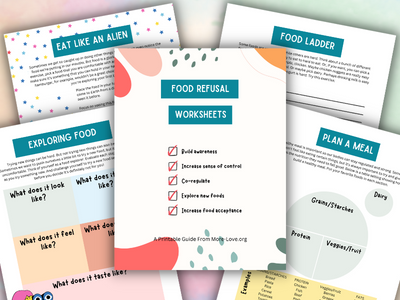
Food Refusal & Picky Eating Printable Worksheets

Give your child the best tools to grow into a confident, calm, resilient eater!

You can help your child with food anxiety

You can expect food anxiety to continue to show up during meals. This is not because your child is stubborn or not committed to being healthy. Itโ€™s because anxiety recovery takes time and patience, and food is a major anxiety trigger for your child.

If your child had anxiety about getting on a plane, you would know that going to the airport and getting on a plane will create anxiety for your child. With an eating disorder, every meal can create anxiety. The more you expect it to show up, the better you can prepare yourself for it. Remember that your goal is to handle, not accommodate, your child’s food anxiety.

And, most importantly, take care of yourself and get the care you deserve. Feeding a child with an eating disorder and anxiety is taxing. We can help our kids so much, but we have to make sure weโ€™re getting help for ourselves, too.


Ginny Jones is the founder of More-Love.org, and a Parent Coach who helps parents who have kids with eating disorders.

See Our Parent’s Guide To Eating & Feeding A Child With An Eating Disorder

Posted on 6 Comments

Real, Painful Examples Of Parents Food Shaming And How To Stop

Real, painful examples of parents food shaming and how to stop

Many parents donโ€™t realize just how harmful food shaming can be to a childโ€™s relationship with food and their own body. Often, food shaming happens automatically, without intention or awareness, but its impact can be deeply damaging. No child should ever feel ashamed of what, how, or how much they eat.

Because shame is unequivocally unhealthy, parents who want to raise healthy, confident kids need to find ways to support without judgment. This parent guide will help you recognize food shaming, understand its effects, and learn compassionate strategies to stop it, so you can nurture a positive, peaceful relationship between your child and food.

Common food-shaming comments parents should avoid using are usually one of two main types:

  • How much someone is eating (e.g. “too much”)
  • What specifically someone is eating (e.g. “only sugar,” “all carbs,” “junk food”)

Examples of food shaming

I ran an informal survey on Instagram and asked people for examples of how their parents food-shamed them. The results were sad, but not surprising. Here are some examples of childhood food-shaming experiences:

  • When I was 9, my mom gave me a teacup and a teacup saucer and told me all of my meals should either fit in the teacup or on the plate. I was nine years old.
  • When I was your age I only ate salads.
  • I think you’ve had enough brownies/cake /cookies/peanut butter/crackers.
  • The problem with kids today is that they eat so much more than we did.
  • Anytime I wanted to eat ANYTHING my dad would say “oh you don’t want that!”
  • At your size, you really need to stop eating that kind of food.
  • Really? You’re eating that much?
  • Really? You’re getting more?
  • You know where that goes.
  • You weigh how much? And you’re eating THAT?
  • I was deceitful for saying I planned on splitting my Panda Express and then mom threw the whole meal in the trash.
  • When they shamed their own food choices and body shape. I learned to do the same.
  • You can’t possibly be hungry.
  • My mom used the Bible (Adam and Eve) to shame me when I was sneaking maraschino cherries from the fridge because I loved them so much.
  • A moment on your lips, a lifetime on your hips.
  • That’s a lot of food you have on your plate!
  • Your prom dress would look better if you lost 10 lbs.
  • I know you love to stuff your face.
  • Your brother can order four-cheese pasta, but not you.
  • I suggested we make brownies. They said I think about food “too much” and should see a therapist.

What parents should do instead of food shaming

Decades of nutrition science have taught us that parents should take responsibility for serving food at regular intervals, eating with kids as often as possible, and maintaining a positive emotional environment during mealtimes. Exactly what food you serve is far less important than the emotional environment in which you serve food.

Parents should put food on the table and invite kids to join them in eating. But kids should be responsible for what and how much they choose to put in their bodies unless they are being treated for a serious medical condition. And kids should never, ever feel ashamed for what or how much they choose to eat. It’s simply not healthy.

When we follow a non-diet approach to health, we can raise happy, healthy kids who are free from shame.

Shame is not healthy

Parents who food shame their kids often think they are trying to improve health, but shame itself is damaging to health. Shame can have a significant negative impact and is associated with eating disorders, substance abuse, and many behavioral addictions.

What is shame? Shame is often used as an umbrella term to indicate a variety of emotions ranging from embarrassment to searing mortification. It happens when an individual feels they are at risk of being excluded from a critical social group. It is especially dangerous in family groups, which are essential to a child’s health, safety, and well-being. Unlike guilt, which is feeling bad about an action, shame is feeling bad about who you are as a person.

Belonging to social groups, particularly a family group, is critical to human health. Therefore, feeling shame within one’s family group can be devastating. shame is associated with low self-esteem, hostility, and psychological distress. This is particularly true of body-based shame.

Also, shaming people for behaviors backfires. For example, being shamed for drinking increases problem behaviors for someone who has alcoholism. Many people who are shamed by their parents for what and how much they eat find themselves binge eating or eating uncontrollably in response.

How food shaming hurts kids

We can see this reflected in our survey. Respondents reported that parental food shaming encouraged them to develop problems with binge eating.

  • I started to not want to eat in front of them, which led to my binge eating disorder. Internalized fatphobia, food labeling, and guilt around food in general was the norm. I don’t think I’ll ever have a healthy relationship with food thanks to their hypervigilance.
  • I binge eat a lot. Alone, in the dark. Even now that I’m an adult with a supportive partner.
  • I started bingeing in secret so they couldn’t shame me.
  • Binge eater, secret eater, emotional eater.

For others, parental food shaming led to severe restriction and a full-blown eating disorder.

  • I saw them food shaming my sisters so I decided to survive on rice and Diet Coke.
  • Developed bulimia and binge eating disorder and struggled with it for 15 years.
  • Being food-shamed led me to a long road of restriction instead of trusting my body.
  • I struggled with an eating disorder for 8 years.
  • I developed an eating disorder which eventually led to psychiatric hospitalization.
  • Food shaming was a big reason for my eating disorders.

Most of all, respondents say that parental food shaming led to an unhealthy relationship with food.

  • I’m now 31 and still associate food with shame, love, anxiety, and worthlessness.
  • I still feel the need to tell people why I”m eating certain food when I’m eating.

What to do if you have food shamed your kids

If you recognize that you have been food-shaming your kids, then take a deep breath. It can be surprising to hear that something you did with the best intentions was harmful. And the good news is that you can make amends to your child. While you can’t erase what is already done, you can attempt to repair the damage.

The best way to get started and help your child be truly healthy is to learn about a non-diet approach to health, own up to your mistakes, and move forward confident that you are doing your very best.

Once you understand why food shaming is not healthy, explore how you can shift the way you talk about food in your household. As you shift your language about food, you can begin repairing your relationship with any children who have been exposed to food shaming. The key is to open a conversation without getting defensive or critical of your child. It’s hard to get vulnerable, but it can have a huge impact on your child.

Before you begin, here are a few ground rules for a conversation about food shaming:

  • Understand that food shaming is not helpful and is in fact harmful
  • Recognize that your child’s body is their own, and they get to decide what food they eat (not you)
  • Learn about the harmful diet culture messages we’ve learned that say food is good or bad and that we must be thin to be healthy
Are you food shaming your child? It's time to stop!

An apology script if you’ve food shamed your child

Once you are ready, you can open a conversation with your child. Here’s an outline for how to approach this:

  • Acknowledge that food shaming was a mistake on your part.
  • Say that you are going to work on not food shaming in the future.
  • Ask your child to tell you in the future if they believe you are food shaming.
  • Do not get defensive when your child responds. You made a mistake, and you must own that mistake. Donโ€™t defend yourself. Just say you will try to do better.
  • Donโ€™t get into a debate about nutritional content, caloric values, weight, diet, etc.
  • Conduct more research and, if necessary, consult with a non-diet dietician so that you can learn about how to prevent eating disorders by learning about weight and diets.

Why do parents use food shaming?

Food-shaming comments typically stem from diet culture, which generally promotes the idea that people who eat certain ways are either “good” or “bad.” These beliefs have been intentionally created by the diet industry, which has a basic template for marketing its diet programs.

Marketing Campaigns That Sell Diet Programs & Products All Say:

  1. People who lose weight are good and healthy
  2. Eating “the right way” will result in weight loss
  3. This program makes it easy by eliminating ____________ (calories, fat, carbs, sugar, etc.)

These marketing messages have been promoted by the diet industry to great success. And we tend to believe them, even though they simply are not true. Weight loss is not effective or healthy. But the weight loss industry has thrived nonetheless and created a culture of parents that instinctually use food shaming without realizing the harm it causes.

The intention of food shaming is typically to help the child. But the impact of food shaming is to humiliate the child and make them feel ashamed of their appetite and desires. Simply put: there’s nothing healthy about food shaming.

Feeding a child with an eating disorder is tough. Learning to stop vilifying food and shaming people for eating what they enjoy takes time. Just keep trying! Showing up is half the battle.

Eating disorders and parental food shaming

Many people who have/had eating disorders recall being food-shamed by their parents. These people had parents who truly wanted to help their kids. But we live in a society that, egged on by the powerful diet and food industries, tells us that food is either “good” or “bad.” This message is everywhere, and it’s incorrect.

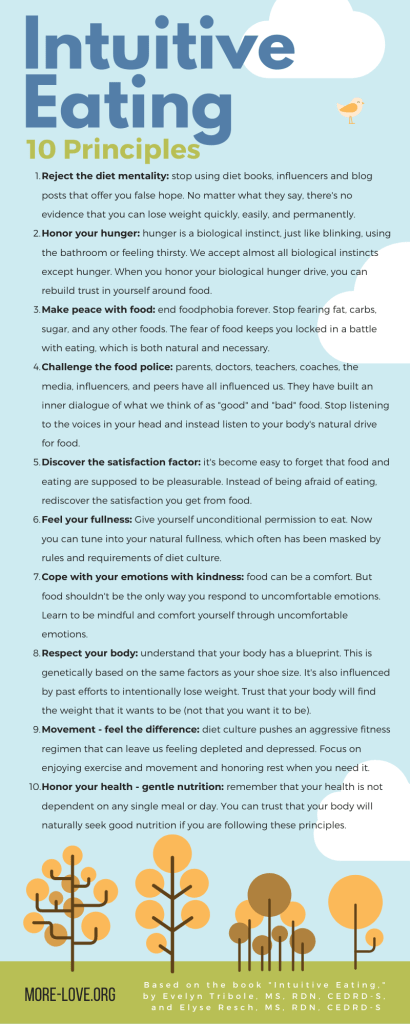
There is significant research demonstrating that Intuitive Eating, a method of eating without following “food rules” but rather focusing on hunger and appetite cues, is the healthiest approach for the body and mind. An intuitive approach to eating with zero weight goals or expected weight outcomes is protective against eating disorders, the second most deadly mental disorder.

That is why we implore parents to never food shame their kids. That means:

  • Don’t label food good or bad
  • Don’t make moral judgments about food
  • Pay attention to your child’s hunger, not caloric counts or other external measures 
  • Be aware that food is more than fuel – it is also comfort (and thatโ€™s OK)
  • Don’t recommend against eating for fear of weight gain
  • Don’t assume your child needs to eat less or weigh less 

Ginny Jones is the founder of More-Love.org, and a Parent Coach who helps parents who have kids with eating disorders.

See Our Parent’s Guide To Eating & Feeding A Child With An Eating Disorder

Posted on 8 Comments

How to use clinical hypnotherapy with troublesome eating disorders

How to use clinical hypnotherapy with troublesome eating disorders

by Bonnie Killip, Master Clinical & Medical Hypnotherapist 

Have you ever wondered if hypnotherapy can help with eating disorder recovery? If traditional eating disorder recovery is not progressing, it may be worthwhile considering hypnotherapy as a treatment option.

As a Dietitian and clinical and medical hypnotherapist, often my consults start with addressing peopleโ€™s questions, concerns, and often skepticism around what hypnosis is. Let’s start by clearing up the common misconceptions. 

Hypnotherapy is not a trick nor is it mind control and it is also much more than meditation or relaxation.

Full disclosure: Iโ€™ve been one of the skeptics 

Until a few years ago hypnosis was not a part of my life. It wasnโ€™t even on my radar. A no-nonsense biomedical scientist, I was only interested in evidence and randomized controlled trials (RCTs). 

I did not believe in using personal stories or anecdotal evidence. I believed in nothing that lacked piles of peer-reviewed literature and meta-analyses. 

In fact, if Iโ€™d even heard the word hypnosis, Iโ€™d have most likely tuned it out. Now, I cannot imagine my life without what hypnosis has brought and continues to bring to my world both personally and professionally. Actually, I can, but Iโ€™d rather not!

After 15 years of living with anorexia nervosa, clinical hypnotherapy not only saved my life – it gave me a life. 

And thatโ€™s no longer the most interesting part of my story. Because I now work daily with others who have fallen out of touch with their inner guidance. These people are in positions where all else has failed and theyโ€™ve all but resigned themselves to their eating disorders. To live a life of attempting to maintain pseudo-physical health while never being entirely well.ย 

โญโญโญโญโญ

Free Guide: How Parents Can Help A Child With An Eating Disorder

Master the secrets to supporting a child with an eating disorder. Thousands of families like yours are stronger today because of these six vital lessons drawn from lived experience, best practices, andย extensive study.

Hypnotherapy for eating disorder recovery

I now have the daily privilege of facilitating people of all ages and life circumstances. I work with all types, from anxious and confused 10-year-olds to perfectionist and overachieving 16-year-olds, to successful 65 year CEOs and 87-year-olds. All of them want to begin the part of their lives where they are finally free to be themselves. 

I have both personally experienced and seen first-hand how hypnotherapy can help with eating disorder recovery.

Clinical and medical hypnotherapy offers a direct means by which we can bring about change in an area a person could not change through education, willpower, threats, or motivation alone. The profoundness of what this means in terms of someoneโ€™s day-to-day experience of life is high. Because information and knowledge is only part of the picture. It is not until we can put this into practice that we can experience the true benefits. 

Clinical and medical hypnotherapy is an effective eating disorder treatment because it:

  1. Treats the non-logical brain. Eating disorders are non-logical, so it can help to treat them on that level.
  2. Rewires neural pathways. Eating disorders can create rigid neural pathways that need to be loosened in order to recover.
  3. Feel good now. Recovery typically feels like chaos, so any method of feeling good during the process helps.

How does hypnotherapy work for an eating disorder?

Hypnotherapy is individually tailored to each person. It can be a powerful way to change beliefs and disruptive behaviors. The focus is on building the skills people need to function at their best versus rehashing past trauma or searching for a cause.

In hypnotherapy, a person is empowered to work on an unconscious and conscious level to change beliefs and behaviors that are interfering with their life. For example, if a person is afraid of food, we would work on decreasing the fear response both subconsciously and consciously. By experiencing the fear and moving through it in the safety of hypnotherapy, the person acquires confidence and fear patterns are reduced or eliminated over time. 

This works because the brain cannot tell the difference between an imagined scenario and a scenario that is taking place in the physical world. While it could take months of careful psychotherapy to get a person to face a fear food at the dinner table, we can face the imagined fear food in hypnotherapy rather quickly.

If a person is struggling with binge eating and/or purging behaviors, we could explore the unconscious fears underlying those behaviors. We would practice facing them in a safe, secure environment. 

The actual practice of hypnotherapy may include: 

  • Trance induction (direct or indirect)
  • Suggestion
  • Metaphor
  • Conversational hypnosis
  • Neurolinguistic programming

Hypnotherapy is specifically outcome-focused. We precisely target exactly what it is a person wants to change and then go about bringing about that change.  

Here is some more detailed information about the benefits of hypnotherapy:

1. Treating the non-logical brain

An eating disorder is not a logical problem.

Ask anyone with an eating disorder if they are choosing to feel those feelings or do those behaviours. I can guarantee theyโ€™re not. There are powerful emotions driving them to not eat, to binge, to over-exercise or whatever it is for them.

If the eating disorder was something you could fix through logic, information and understanding youโ€™d have done so.

Clinical hypnotherapy offers a means by which we can re-establish rapport with the unconscious mind. In more science-y terms, we work with our autonomic nervous system. The goal is to restore back to what your body has known how to do all along before the outside world made you question the innate wisdom of your body.ย 

Clinical hypnotherapy for eating disorder recovery

Weโ€™ve all had the experience of being children, and as children, we had no problem connecting to our bodies’ messages. And we have no problem communicating this. As a baby, we donโ€™t think โ€œIโ€™m hungry but I can see mum is tired and busy at the moment, so Iโ€™ll just waitโ€. Nope, we scream and yell until we get that need met! 

Reconnecting with our bodies

If we want to be a successful adult, we have to at some point move on and meet those fundamental human needs for ourselves. If we do not, we become disconnected from the signals our body is sending. The body may even stop sending signals. Because, after all, โ€œwhat is the point of telling her to eat if she will not do it, anyway?โ€

When we get out of the way, our body is free to do what it has evolved to do. It will steer us towards health naturally and without our micromanagement. You donโ€™t have to think about when and how quickly you want your heart to beat or your lungs to breathe, do you? There are things your unconscious knows how to do much better and with much more ease than your conscious mind. 

2. Rewiring neural pathways

Hypnosis offers a direct means of altering neural networks and neural rewiring.  

When it comes down to it, this is the crux of eating disorder recovery, and it’s why hypnotherapy can help. 

At some point, recovery becomes recovered. And recovered is an entirely fresh way of not just behaving but also, crucially, of thinking and feeling.

The behaviors of an eating disorder often begin as a coping strategy. They are compensation or an attempt to meet a need (to be healthy, good, more confident, or better liked. But with time it turns from conscious choices into unconscious patterns. Hence why it is a disorder. Because the thoughts, feelings, and behaviors are no longer under the conscious volition of the person. 

The eating disorder then persists at an unconscious or habit level because neurons that fire together wire together. 

In recovery we change the structure, not just the function, of the mind. And there are many ways in which we can do this. Exposure therapy and cognitive behavioral therapy are the most well-known treatments. But hypnosis often offers a means of changing the structure more quickly and safely than either of these. 

Bypassing the habits of an eating disorder

Hypnotherapy bypasses the need for the involvement of the conscious mind. It goes right to where the issue is being maintained: the unconscious mind. The eating disorder thrives not in our prefrontal cortex but in our lower brain areas such as the amygdala. 

When I was sick Iโ€™d been told by so many therapists and doctors that my brain had changed because of the illness. That Iโ€™d been sick so long it most likely wasnโ€™t possible that I could ever fix the damage or recover. What I know now is that the very fact that my mind changed to accommodate the illness meant it was more than possible for it to change back. It could even improve and rewire in all the ways it needed to to be not just free of the illness, but healthier than ever before.

 I just needed the means by which to do this. It turned out clinical hypnotherapy helped me recover from my eating disorder. 

3. Feel good now

Take a moment to answer this question:

If your child could feel great or good about eating, would they have a problem eating?   

The answer is always a resounding yes. And this is why recovery can be so hard for loved ones to understand. It may be hard to imagine, but choosing recovery from an eating disorder is choosing chaos and pain. 

To everyone outside of the disorder, recovery is short-term chaos with long-term rewards. But the person in the disorder doesnโ€™t feel like the chaos will ever end. It feels like you are choosing indeterminate chaos and pain with no guarantee that it will have been worth it. 

The resistance to the chaos and pain is why recovery can go on and on and on for many people. I know this was my experience until I did eventually find the help that could help. And a lot of this has to do with the fact that it never feels good. If there are no wins, we lose heart, back down, and find ourselves back in old behaviors.  

How motivated, inspired, and excited are you to jump into shark-infested water just because someone tells you the island on the other side is incredible? Not much, I imagine. And thatโ€™s what it feels like for someone with an eating disorder. Eating feels unsafe, and we are asking them to do it 6 times a day as though it is nothing. Therefore, the way to truly help someone is not by focusing on all that is wrong. Instead, we must increasingly allow them to experience wins that show how recovery is worth it.

Achieve a relaxed, calm state

In hypnosis, we experience eating in a relaxed and calm state. We support the circumstances and situations which in their everyday eating disorder state of consciousness produce extreme anxiety and panic. This teaches the nervous system that they can get through these things safely and feel less panic when eating.

The power of hypnosis is that our minds produce exactly the same response whether we are in a dangerous situation in real life or we imagine being in a dangerous situation on the inside of our minds. Take a moment to imagine biting into a juicy lemon to get a sense of what I mean here. If you really imagine it, you will salivate and maybe make a scrunched-up face.    

Take-home message

We donโ€™t know all there is to know about the intricacies of eating disorders. But we know enough to know that education, shame, and blame do not heal. 

We know that eating disorders are on the rise. And even our gold-standard treatments often fail those who seek to recover. 

If youโ€™ve tried one eating disorder treatment path and it hasnโ€™t worked, it may be time to expand and experiment with other options. Keep in mind that clinical hypnotherapy is an option. Itโ€™s a viable tool that I believe will only become more widely used as we improve our understanding of the human mind and what truly drives our behaviors. 

Thanks, Mom!

I could never capture in words just how thankful I am that my mum looked outside the box of what was offered to us for years and years and booked me into that first hypnotherapy session. 

Kids are great hypnotic subjects because they enter a hypnotic trance easily. They go farther and get a lot done when they get to be the creators of their destiny. I truly believe that building rapport with our unconscious mind is one of the greatest determining factors in how far we go in life. To re-establish this at a young age if it is lost or teetering on the verge of being swamped from ever-increasing messages from the outside world over what to eat, how to look, think, feel, and do, is inconceivably valuable.

Clinical hypnotherapy with a licensed professional offers a safe and controlled environment in which your child or yourself can try out fresh ways of being, something we often donโ€™t otherwise get in the day-to-day rush of life.   

Eating disorders are complex, but please do not let complexity lead to undertreatment.


Bonnie Killip Fuelling Success

Bonnie Killip is an Accredited Practising Dietitian (APD), Master Clinical and Medical Hypnotherapist, and Master Neurolinguistic Programming Practitioner. She offers practical and usable nutrition education for those in recovery from eating issues. As a clinical and medical hypnotherapist, she can help kids reconnect with their inner guidance and develop the internal skills and resources to set them up for a life of emotional regulation, self-love, resilience, and happiness. Website: Fuelling Success

See Our Eating Disorder Treatment Guide For Parents

Posted on Leave a comment

All the great reasons for Intuitive Eating for eating disorders

All the great reasons for Intuitive Eating plus eating disorders

New research is shining a hopeful light on Intuitive Eating as a helpful approach for eating disorders. A 2020 study found that teens who practice Intuitive Eating tend to have better mental health and healthier eating habits as adults. Yet, most kids today are not being raised with these principles. Instead, our culture largely embraces non-intuitive eating, favoring restrictive diets that ignore the natural signals of the body. Understanding and encouraging Intuitive Eating could be a game-changer for supporting our childrenโ€™s long-term well-being and eating disorder recovery.

Study finds Intuitive Eating beneficial for health

Researchers with the University of Minnesota School of Public Health studied people who ate intuitively as teenagers. They found that teens who scored higher on an Intuitive Eating scale were less likely to experience depression and disordered eating as adults. Specifically, the study found that teens who used Intuitive Eating had:

  • Fewer depressive symptoms
  • Higher self-esteem
  • Lower body dissatisfaction
  • Fewer unhealthy weight control behaviors (e.g. fasting, skipping meals)
  • Lower rates of extreme weight control behaviors (e.g. eating disorder behaviors)
  • Less chance of binge eating (71%)

The data applied both to teens who scored higher in Intuitive Eating at the beginning of the study and those who became more intuitive over the course of the study.

The authors concluded that Intuitive Eating in adolescence predicts better psychological and behavioral health across a range of outcomes. They also suggest that Intuitive Eating may be a positive intervention for people who are at risk of or have eating disorders. This is based on the findings that teens who used Intuitive Eating were 74% less likely to develop Binge Eating Disorder.

Treating eating disorders

This is the latest in numerous scientific articles that have found value in using the principles of Intuitive Eating. The approach appears to help treat eating disorders. This is important, because eating disorders and disordered eating are both on the rise. And both can have lifelong mental and physical health impacts.

NOTE: Intuitive eating is considered helpful in the latter stages of eating disorder recovery. But it may not be appropriate for your child in early recovery, especially if weight restoration is necessary. Please check with your child’s RD for insight on how to integrate intuitive eating.

Intuitive Eating is most likely effective because it counter-balances diet culture messages. These messages say that we can and should control our body weight. Diet culture has grown on the wings of the diet industry. The diet industry exploded from $10 billion in annual revenue in 1985 to almost $70 billion in 2012.

In that time, human body weights have not gone down, but eating disorders and disordered eating have increased. Sadly, diet company profit goals play a huge role in our lives. This is despite zero evidence that their programs are effective, safe, or improve health outcomes.

Intuitive Eating may help parents treat eating disorders because it actively works against the diet culture promoted by the diet industry. It specifically teaches people to recognize and reject diet culture. Diet culture marketing says we can lose weight fast and keep it off for life. But Intuitive Eating teaches us to listen to and trust our own bodies.

What is Intuitive Eating?

Intuitive Eating was introduced by Evelyn Tribole, MS, RDN, CEDRD-S, and Elyse Resch, MS, RDN, CEDRD-S in 1995. Their bestselling book, Intuitive Eating: A Revolutionary Anti-Diet Approach is now in its fourth edition. Intuitive Eating is defined as rejecting restrictive diet patterns and instead eating according to feelings of hunger and fullness.

The authors define Intuitive Eating as following these 10 principles:

10 principles of Intuitive Eating

  1. Reject the diet mentality: stop using diet books, influencers and blog posts that offer you false hope. No matter what they say, there’s no evidence that you can lose weight quickly, easily, and permanently.
  2. Honor your hunger: hunger is a biological instinct, just like blinking, using the bathroom or feeling thirsty. We accept almost all biological instincts except hunger. When you honor your biological hunger drive, you can rebuild trust in yourself around food.
  3. Make peace with food: end foodphobia forever. Stop fearing fat, carbs, sugar, and any other foods. The fear of food keeps you locked in a battle with eating, which is both natural and necessary.
  4. Challenge the food police: parents, doctors, teachers, coaches, the media, influencers, and peers have all influenced us. They have built an inner dialogue of what we think of as “good” and “bad” food. Stop listening to the voices in your head and instead listen to your body’s natural drive for food.
  5. Discover the satisfaction factor: it’s become easy to forget that food and eating are supposed to be pleasurable. Instead of being afraid of eating, rediscover the satisfaction you get from food.
  6. Feel your fullness: Give yourself unconditional permission to eat. Now you can tune into your natural fullness, which often has been masked by rules and requirements of diet culture.
  7. Cope with your emotions with kindness: food can be a comfort. But food shouldn’t be the only way you respond to uncomfortable emotions. Learn to be mindful and comfort yourself through uncomfortable emotions.
  8. Respect your body: understand that your body has a blueprint. This is genetically based on the same factors as your shoe size. It’s also influenced by past efforts to intentionally lose weight. Trust that your body will find the weight that it wants to be (not that you want it to be).
  9. Movement – feel the difference: diet culture pushes an aggressive fitness regimen that can leave us feeling depleted and depressed. Focus on enjoying exercise and movement and honoring rest when you need it.
  10. Honor your health – gentle nutrition: remember that your health is not dependent on any single meal or day. You can trust that your body will naturally seek good nutrition if you are following these principles.

What it’s not

The rise of Intuitive Eating and the many studies showing the health impacts of Intuitive Eating have led to many people claiming their diet is Intuitive Eating even when it clearly is not. Here are some common ways that Intuitive Eating is being used to sell and promote dieting:

Claim: Intuitive Eating will help you lose weight

Truth: weight loss is never the goal of Intuitive Eating. Anything or anyone that promotes Intuitive Eating as a weight loss method is definitively not actually using Intuitive Eating.

Claim: Intuitive Eating just means eat when you’re hungry and stop when you’re full and you won’t gain weight

Truth: Intuitive Eating is more complex than this. And there is never a goal of controlling weight or avoiding weight gain. That’s diet mentality and therefore not Intuitive Eating.

Claim: Intuitive Eating means you never eat when you aren’t hungry

Truth: many times you will need to feed yourself mindfully before you get hungry to accommodate your schedule. This doesn’t go against Intuitive Eating framework, but is commonly incorrectly presented as the reason why Intuitive Eating is not a realistic lifestyle.

Claim: Intuitive Eating is about eating whatever you want, so it’s not healthy

Truth: Intuitive Eating has been shown to result in better health across many dimensions because it removes food rules and lets the body drive eating patterns. Contrary to popular belief (i.e. diet culture), a body will naturally select a wide range of foods to fit its nutritional needs.

There are many false claims about Intuitive Eating. The best thing is to read the book or find a trained dietitian to make sure you get the correct approach rather than one of the many false approaches.

Diet culture is bad for health

Diet culture has worked hard to convince us that we can’t trust our bodies. Every diet message preaches that our bodies need to be controlled, and our urges for food, rest, and pleasure, need to be eliminated. This is the opposite of Intuitive Eating, and it may be why it can help prevent eating disorders.

Diets restrict food and pleasure, and they all promise that it’s easy and fun to take weight off and keep it off for life. But the data consistently shows that lasting intentional weight loss is virtually impossible for 90-95% of people.

Today’s diets intentionally avoid focusing on how the body looks, saying instead that the main goal of dieting is increased health. But the data don’t support the idea that diets are good for our health. In fact, diets are proven to increase cortisol and decrease metabolism. They have not demonstrated any health improvements. Finally, the most common outcome of intentional weight loss is weight cycling, which is recognized as bad for our health.

In other words, there is no evidence that diets are effective at anything other than reducing our health.

How parents can teach their kids healthy eating

Parents who want healthy kids now have even more evidence that Intuitive Eating is a solid approach to food and eating. Rather than try to control our bodies and force a particular diet, we should follow our intuition and trust our bodies.

Parents can help their kids learn Intuitive Eating by:

  1. Stop dieting
  2. Don’t allow kids to diet
  3. Learn Intuitive Eating for yourself
  4. Talk about the Intuitive Eating principles as a family
  5. Recognize diet culture and talk about its impact as a family
  6. Encourage your child(ren) to listen to their bodies, honor their hunger and fullness, and avoid food restrictions not based on allergies or serious medical conditions (“obesity” doesn’t count)
  7. Learn emotional literacy and work with your child(ren) to talk about feelings freely
  8. Move together in ways that feel good and make you all happy

Parenting a child with an eating disorder is challenging, but parents can make a huge impact on kids’ lifelong health. When we teach our kids Intuitive Eating, we can help prevent eating disorders and other mental health conditions.


Ginny Jones is the founder of More-Love.org, and a Parent Coach who helps parents who have kids with eating disorders.

See Our Guide To Parenting A Child With An Eating Disorder

10 Principles of Intuitive Eating Infographic
Posted on Leave a comment

How to Help When Your Child Overeats: A Parentโ€™s Essential Guide

How to Help When Your Child Overeats: A Parentโ€™s Essential Guide

Itโ€™s completely natural for parents to worry when they see their child eating a lot at times. But one of the most important things to understand is that, for the vast majority of kids, there really isnโ€™t such a thing as โ€œovereating.โ€ Except in very rare medical cases, children eat to meet genuine physical or emotional needs. Eating is a normal, healthy way we take care of ourselves, both body and mind, and itโ€™s best not to pathologize a childโ€™s desire to eat.

Instead of reacting with fear or judgment, try to gently explore what might be driving your childโ€™s hunger. Are they physically hungry? Then offering food is the loving, appropriate response. Are they tired, anxious, or stressed? Sometimes a snack, along with rest or comfort, is exactly what they need. Or maybe your child feels lonely or upsetโ€”sometimes what looks like hunger is actually a need for emotional connection, a hug, or your focused attention alongside nourishment. Food often becomes a stand-in for all kinds of needs.

The best approach is to feed your childโ€™s hunger without criticism, while also being curious about whether thereโ€™s another kind of hunger beneath the surface. Itโ€™s also important to pause and ask yourself: how do I really know my child is โ€œovereatingโ€? What does โ€œnormalโ€ eating look like?

Our cultural ideas about food and weight can be complicated and confusing, so itโ€™s worth reflecting on how much your own experiences and beliefs might influence what you see. Think of hunger the way you think of other basic needs like needing to breathe, blink, or use the bathroom, something natural that deserves respect and care. While hunger can be complicated in our society, honoring it calmly and without judgment is a powerful first step toward helping your child develop a healthy relationship with food.

In this parent guide, weโ€™ll share three simple but powerful questions you can ask when youโ€™re concerned your child is overeating. These questions will help you tune into their real needs and respond with kindness and clarity.

1. Is my child hungry?

You may think you know how much food your child needs. But your child’s nutritional needs may vary widely from day to day. They may also be different from your own. You may think your child overeats when they are in fact feeding their body appropriately.

If you are someone who controls your own food intake in order to control your weight, you are likely under-eating based on your biological needs. This means you are familiar with a constant hunger and believe that is normal and healthy.

You should know that under-eating is no better than overeating. They both signal a lack of connection with the body’s hunger and fullness cues.

The best relationships with food and body are those in which the person trusts their body and recognizes hunger and fullness cues. This allows them to know when they are physically hungry and also when they have had enough. The sooner you help your child recognize and honor their hunger and fullness cues, the better off they will be.

Teach Intuitive Eating

Teach your child Intuitive Eating. This is a process that honors the body’s ability to eat (and stop eating) based on biological needs. To accomplish true Intuitive Eating, you must accept that your child’s body may not be the size that you wish it would be. It will be the size that it wants to be. Bodies come in a broad range of sizes. When we try to control a body’s weight by restricting food, we set it up for binge eating and poor health.

You can’t turn off a person’s hunger cues without also turning off their fullness cues. This means that if you teach your child to eat less than their appetite, they will learn to ignore hunger cues. At the same time, they will lose their ability to recognize that they have had enough. This is the endless cycle of under-eating and overeating that many people find themselves trapped in. The alternative is that your child learns to ignore hunger cues so completely that they develop anorexia. Neither is a good outcome for your child.

It may take some time to relearn hunger and satiety cues. There’s really no rush. Just trust your child’s body and believe that with your guidance, they will make healthy choices for their unique body.

2. Is my child tired?

Expand your thinking about “hunger” to encompass all feelings of physical and emotional need. Hunger is our very first drive after birth, and it is what supports the survival of our species. There is nothing wrong with hunger – it is healthy and adaptive. Parents should teach their child to notice and listen to physical needs like being tired or needing physical affection. Without this, the child may assume all hunger is food-based.

This doesn’t mean that when your child says they are hungry you tell them to go take a nap. Instead, get curious about what your child’s hunger is telling you. Pay attention to when they say they are hungry and the types of food they are hungering for.

Think about whether they are getting enough sleep or if there are physical disruptions causing stress in their life. Perhaps you have a new infant, an out of town visitor, or the beginning of a new job or school year. All of these can disrupt your child’s sense of physical safety. The solution is not to never have changes. Instead, pay attention to your child and recognize that sometimes food hunger is a mask for a physical sleep or safety need.

Talk about hunger

If you suspect your child may be reacting to a physical sleep or safety need with food hunger, begin by honoring the hunger with a snack. This shows your child that you take their hunger seriously. Once you have given the snack, ask your child how they are feeling in their body. Ask if they are tired, tense, or achy. Try protecting sleep times in your house so that your child gets plenty of rest and relaxation.

Remember that it’s very difficult for a child to separate exactly what they hunger for. It’s often up to the parent to pay attention to the physical conditions and respond accordingly. Feeling hungry varies greatly from body to body. Some people feel it in their gut. Some feel a rumbling. Others feel an emptiness or a tingling. Others feel it in their throats or elsewhere in their bodies.

Help your child tune into their body to identify where the hunger is, and what type of hunger it is (food, physical, or emotional).

Next, talk to your child about their physical sleep and safety needs. Make sure you are feeding their hunger for rest, relaxation, and physical safety. Be aware of physical disruptions and how they can lead to a hunger that needs attention. And always be willing to serve a snack with a side dish of attention and thoughtful conversation about what’s going on in your child’s life.

Over time, your child will learn to distinguish food hunger from other physical and emotional hungers. A child who you think overeats may not be getting their needs met. With your help, they can recognize the difference and nourish themselves with what they need to thrive.

3. Is my child lonely?

Most people it very difficult to separate their body from their mind. This means that often when they hunger for an emotional need, such as attention, affection, and affirmation, they assume it is food hunger. This can become a cycle. If the child doesn’t get their emotional hungers met, they may find that food becomes their greatest comfort.

As a parent, you want to be your child’s comfort. Caloric nourishment is the first form of comfort we give our child. Food can help us connect with them emotionally throughout their lives. Emotional eating has gotten a bad rap, but it’s quite normal for healthy people to sometimes combine emotional care with a snack, a cup of hot chocolate, or a bowl of soup.

Most of our children need more attention, affection, and emotional first aid than we think they do. A child who doesn’t get their emotional needs met will likely learn to repress their emotional needs and turn to coping mechanisms to feel better. In a worst-case scenario, a child may turn to coping behaviors like self-harm, substance abuse, shoplifting, or eating disorders to soothe their emotional disruptions.

This is why it’s so important for parents who worry that a child overeats to pay attention to emotional caregiving. Don’t deny food if your child says they are hungry, but serve it with a side of conversation, compassion, and attention.

Give more love

Give your child more love along with food. Talk to them about how they can get their emotional needs met. For example, do they want to go for a walk with you? Snuggle on the couch? Do they want you to make them a cup of tea in a special mug? Serve them the mac and cheese you made them when they were little? Our kids grow up fast, but they often need us to treat them like children when they’re emotionally vulnerable.

Over time, you can help your child get their emotional needs met without food. But remember that food and eating are not typically a problem for a child who is getting their physical and emotional needs met.

Feeding your child

Sometimes food hunger can be better understood with more structure. A child who you think overeats may benefit from structured meal times and family time. A structured food plan can help the whole family better understand hunger cues and eat in a way that is healthy for both their body and their mind. Feeding your child doesn’t have to be complicated, but it is important.


Ginny Jones is the founder of More-Love.org, and a Parent Coach who helps parents who have kids with eating disorders.

See Our Parent’s Guide To Eating & Feeding A Child With An Eating Disorder

Posted on Leave a comment

Why Emotional Repression Is The Silent Gateway To Eating Disorders

Why Emotional Repression Is The Silent Gateway To Eating Disorders

Emotions are a natural and essential part of being human, yet many people learn early on to push feelings aside instead of expressing them openly. This habit of emotional repression, bottling up or ignoring difficult emotions, can quietly set the stage for serious struggles, including eating disorders.

When emotions go unaddressed, they often find other ways to surface, and for some, disordered eating becomes a way to cope or regain control. Understanding this silent gateway is a crucial step toward healing and prevention, helping both parents and individuals recognize the deeper emotional roots behind eating disorders.

For the first time in history, our kids are experiencing higher levels of stress and anxiety than we as parents did. They worry about everything, from their bodies and school performance to social standing, politics, and climate change.

This constant anxiety is hurting their ability to feel good about themselves, impacting their health in profound ways. In this parent guide, weโ€™ll explore why emotional repression acts as a silent gateway to eating disorders and share practical ways parents can help their children learn to process, not repress, their emotions. Understanding this connection is a crucial step toward supporting your childโ€™s emotional well-being and preventing eating disorders before they take hold.

Cortisol and chronic stress

Cortisol, known as the stress hormone, is linked to many health issues, but the good news is that understanding how stress affects our kids can help us support their long-term well-being. While many of us focus on whether our children are eating enough fruits and vegetables, itโ€™s often cortisol, caused by chronic stress and unprocessed anxiety, that has the biggest impact on their future health.

Rather than worrying about weight, focusing on managing stress and anxiety can truly make a difference in their longevity and overall wellness because it leads to lower levels of cortisol. One of the main sources of ongoing stress is repressed emotions. Interestingly, holding in emotions actually takes more energy than feeling and processing them as they arise.

Imagine trying to keep a beach ball submerged underwater while swimmingโ€”it requires constant effort. But if you simply let the beach ball float alongside you, swimming becomes much easier and more natural. By helping children learn to acknowledge and express their feelings, we can lighten their emotional load and empower them to navigate life with greater ease and resilience.

How most parents respond to negative emotions

Most of us were raised to repress and downplay our emotions. We did this especially with negative emotions like anger, fear, and hurt. If we are female, we were taught by well-meaning parents, teachers, peers, and religious leaders that girls should be sweet, kind, and easygoing. We were taught in ways explicit and implicit that being loud, angry, and fearful is unattractive. And we learned that being attractive is essential to being a good girl. If we are male, we were taught that being sad and afraid is unacceptable.

As a result of this thorough training, most of us unconsciously train our own children in the same way. When she cries, we wipe her tears and tell her everything is fine. We shush her and tell her to quiet down and come back when she can control herself. When she tells us she is afraid, we dismiss her fears as irrational and tell her there’s nothing to worry about.

Almost none of us know that what we can and should actually do is allow our children to have all of their emotions, feelings and anxieties. What almost none of us know how to do is accept our kids’ emotions gracefully and without fear.

It’s not just parents – our society hates emotions

It should be said that most of us are not great at processing emotions. This is through no fault of our own – it’s hard to feel feelings when you have been taught to repress them your whole life.

But even if a parent is an excellent emotional processor who fully accepts their child’s emotions, our kids still live in a society that discourages negative emotions.

Even if we do everything to the best of our ability, our society will still teach our kids to play a closely defined gender role when it comes to emotions. Those who rebel and refuse to meet the standards of emotional repression are often ostracized and bullied.

Emotional repression and eating disorders

It’s no surprise, nor is it debatable that human beings of any gender are born with the ability and the freedom to fully express and process their emotions. It’s also not a secret that over time, because they are driven to pursue parental and societal love and acceptance, our kids learn to feel guilt and shame every time they feel a negative emotion. They learn to believe that negative emotions much be repressed because they are “not allowed” or “not appropriate.”

This is a very bad thing, because emotions are physical as much as mental. They never fail to exist – they only go underground, where, trapped, they wreak havoc on our bodies and minds.

Think of the beach ball that you’re trying to keep underwater. It takes tremendous energy to keep it down, and inevitably, every once in a while it explodes out of the water, and then we must scramble to get it back down again. The process is exhausting and endless, because no matter how hard we try, the ball will never stay underwater peacefully. It will fight for freedom.

Emotional repression is the perfect gateway for eating disorders. Keeping our emotions underground becomes easier if we find ways to numb and disconnect from our emotions. One of the best ways to do this is through coping mechanisms like eating disorders, self-harm, and addiction.

Eating disorders feel good

Something few parents who have kids who have eating disorders realize is that eating disorders feel good!

Eating disorders may look dangerous, but the person who has an eating disorder may find it to be an effective way to find peace from the emotional turmoil that is always roiling beneath the surface. Eating disorders are the way some people manage live in a world that requires us to repress our emotions.

Even if they know intellectually that eating disorders are unhealthy, and even if they feel shame over them because they believe they are “stupid” or “disgusting,” a person’s eating disorder still makes them feel better in the short term. Eating disorders may look like monsters, but they feel like the ultimate caregiver.

The path to healing from an eating disorder

Emotional repression can contribute to eating disorders. This is why the path to healing from an eating disorder is an emotional one. Most people who have eating disorders must relearn what it means to feel emotions. They have hidden and repressed them for so long that they must slowly, gradually, rebuild our connection with their emotions.

The path to full emotional health requires us to actually feel. Sometimes for the first time in years or even decades. Feeling for the first time after an eating disorder is excruciating. Many people reach for their eating disorder behaviors again and again. Not because they want to. But because of the terror of facing their negative emotions without their preferred numbing agent.

When we have repressed our emotions and used our eating disorders to avoid feeling feelings, recovery means feeling again. And this unleashes physical sensations of panic similar to what we would feel if we were being chased by a tiger. I am not exaggerating. It’s really, really scary. Feeling feelings after an eating disorder is terrifying. But it is necessary in order to heal.

Over time, it gets easier. Once we learn to feel our emotions in a healthy, regular way, we no longer need to numb them away. We start to realize that trying to keep the beach ball underwater was an unnecessary use of our time, energy, and intellect. When we start swimming alongside the beach ball, we free up space, and the eating disorder is no longer necessary.

How parents can help

Parents can help their children recover from an eating disorder by first learning to better process their own emotions. Emotional regulation is something few of us learned in childhood, and almost all parents need more of it. Also, our kids develop healthy emotional regulation when they first co-regulate with their parents’ calm, confident nervous system.

The best and fastest way to do this is to work with a qualified therapist or coach. They can help you learn to regulate yourself and co-regulate with your child.

Next, parents can help their kids recover by accepting and allowing their kids to experience all emotions in eating disorder recovery. Learn emotional first aid. When your kids’ fear, anxiety, anger, and other negative emotions arise, let them. Don’t try to stop them. Be there, as steady as a rock. Allow your child’s emotions to surround you without fear of being swept away. It’s exhausting to do this work for your child. And it takes practice, but there is nobody who can do it better than you. It is, quite possibly, the greatest gift any of us can give to our children.


Ginny Jones is the founder of More-Love.org, and a Parent Coach who helps parents who have kids with eating disorders.

See Our Guide to Emotions And Eating Disorders

Posted on Leave a comment

How to feed a child who is overeating and addicted to food

How to feed a child who is overeating and addicted to food

by Alexandra Raymond, RDN

As a parent, you want your child to grow up happy. You want him or her to make (overall) smart decisions and be successful. You probably also want your child to grow up โ€œhealthy.โ€

The pressure to raise healthy kids

There is no denying that health and wellness are at the forefront of our minds. We are constantly bombarded by health and wellness information and trends. Celebrities are talking about it. Friends and family are talking about it. Doctors are talking about it.

Weโ€™re encouraged to eat certain foods and stay away from others. Weโ€™re told that certain foods โ€œspeed up metabolism,โ€ while others โ€œslow it down.โ€ We have detoxes and juice cleanses pushed on us. And it seems if you donโ€™t try to follow some of these food trends, youโ€™re doing something wrong. Food and diet culture is huge! After all, the diet industry is worth almost $70 billion.

Because of the pressure society puts on us to be โ€œhealthy,โ€ many parents worry about their childโ€™s eating habits. Whether he/she is eating too much of one food and not enough of another. Parents worry their child is gaining โ€œtoo muchโ€ weight. Or even worry their child might be โ€œaddictedโ€ to food. And who could blame these parents. They are constantly made to feel they arenโ€™t โ€œgood enoughโ€ as a parent if they arenโ€™t making sure their kids are eating perfectly.

Impossible food standards

Iโ€™ve found that many parents become hyper-aware about what their child is eating. Especially if they feel like their child is eating โ€œtoo muchโ€ and their child lives in a larger body. Hyper-awareness surrounding foods may include:

  • making comments about good foods and bad foods,
  • commenting on the amount of food a child is eating,
  • comments on weight, and
  • asking a child to eat certain foods before other foods (veggies before dessert), etc.

I completely understand why a parent may do this because of the ridiculous amount of pressure they feel to raise โ€œhealthyโ€ families. But, unfortunately, this often backfires. Iโ€™ve found this hyper-awareness surrounding food causes children to become more obsessed with their bodies, begin dieting at an earlier age, and possibly sneak/hide food from their parents, especially those foods they consider to be โ€œjunk foods.โ€ (PS: I personally donโ€™t use the words โ€œjunk foodsโ€ with my clients because I believe all foods should be placed on the same playing field. โ€œGoodโ€ food / โ€œbadโ€ food language is often harmful for people of all ages).

Overeating and addiction

In my office, I often hear parents’ concerns about children โ€œovereatingโ€ or being โ€œaddictedโ€ to certain foods. In these situations, as hard as it might be, I ask parents to do their best in avoiding comments and to continue to allow their child to self-regulate.

Itโ€™s important we donโ€™t think of any foods as โ€œbadโ€ or โ€œaddictiveโ€ but instead recognize food as a substance like oxygen and water. You most likely don’t worry about your child overconsuming either of those, and food is equally natural and necessary.

First, children are the most intuitive eaters out there. More often than not, your child is actually not โ€œovereating,โ€ but is fueling his/her body with the nutrients he/she needs. We need to be careful and avoid pathologizing certain eating patterns, to avoid the possibility of a child internalizing that guilt and shame.

Second, food is not an addictive substance and we have research that shows this. People may feel addicted to certain foods if they have been deprived of eating them. For example, you tell yourself youโ€™re not going to have sweets. Maybe you donโ€™t eat sweets for a few days or even weeks or months. But, eventually, youโ€™ll be presented with the opportunity to eat sweets again. The moment you eat sweets, itโ€™s totally possible you may feel like you canโ€™t stop.

But this isnโ€™t because youโ€™re โ€œaddictedโ€ to sugar. It’s because you have been physically and emotionally deprived from sugar. This same thing happens with kids. Itโ€™s important we allow kids to have a wide variety of foods.

How to feed a child

You may be thinking, but what if my child needs to eat healthier? Or what if I feel like my child is eating too much? How can I promote balanced and nutritious eating without triggering negative body image or food thoughts?

Here are my tips:

1. Feed their appetite: Appetites vary for many different reasons for different people and in different stages of life. Sometimes children will feel more hungry and eat more food than “normal” for no apparent reason. On the flip side, sometimes children wonโ€™t feel hungry at all and will eat way less than โ€œnormal.โ€ Itโ€™s important to let your child eat how much or how little they want according to their individual hunger cues, not an arbitrary perception of what they “should” eat. This will help them to stay more in tune with their hunger and fullness signals and support long-term health.

*There is one caveat. If you notice your child is eating significantly less and cutting out foods they previously used to love, this definitely is a concern. Please talk to a health care provider about this.

2. Have a wide variety of foods available: I recommend having a wide variety of foods in your kitchen for your child to eat. You can present these different foods during snack time. For example, you may want to consider putting out some food for when your child gets home from school. The key here is allowing your child to choose what he/she is in the mood for. So whether they choose animal crackers, chips with guacamole, or carrots with hummus, itโ€™s their choice.

3. Monitor emotional changes: If you notice a change in your childโ€™s eating or weight, I recommend you consider whether you notice a change in their emotions. Is your child more withdrawn than usual? Is he/she stressing about things they may not normally stress about? Are they hanging out with friends less? Are they exhibiting increased anxiety around food? Sometimes a change in eating and weight is a sign that something else is happening. I recommend avoiding commenting on food/weight and instead ask them about feelings. If your child is happy and acting as they always do, then weight gain is typically not a concern.

4. Talk less, model more: Children learn how to eat from the adults in their lives. They also learn how to either appreciate or criticize their bodies. Do your best to eat a wide variety of foods along with your child. This includes meat, fish, veggies, fruit, dessert, fried foods, grains, and dairy products. Also, please be mindful about the negative comments made about your body or someone elseโ€™s. Negative body comments are easily internalized by children. Itโ€™s important to model body appreciation and respect. You can do this by talking about how much your body does for you and by being compassionate toward the physical aspects you may not like about your body.


Alex is a Registered Dietitian at the private practice Courage to Nourish in Howard County and College Park, Maryland. Alexโ€™s goal is to assist her clients in discovering a life-long healthy relationship with food and their bodies. Alex is a proud and passionate anti-diet and Health At Every Size ยฉ advocate. Outside of counseling clients, Alex enjoys cooking (especially Italian foods), journaling, hiking and exploring Washington, DC. Website

See Our Parent’s Guide To Eating & Feeding A Child With An Eating Disorder

Posted on Leave a comment

Best Care Packages For Someone In Eating Disorder Recovery

Best care packages for someone in eating disorder recovery

Supporting a loved one through eating disorder recovery can feel overwhelming, but thoughtful care packages can offer comfort, encouragement, and practical support along the way. The best care packages combine items that nurture both the body and mind, helping your loved one feel seen, cared for, and understood during challenging moments.

A care package is a great way to show someone in eating disorder treatment that you care about them. Receiving a care package will help make their stay in residential treatment just a little bit brighter. Eating disorder treatment is hard to go through. A care package is a great way to connect with your child, partner, friend, or loved one. Itโ€™s a wonderful reminder that you support their recovery and are cheering them on.

Whether youโ€™re looking for soothing self-care products, empowering books, or healthy snacks, this guide will help you put together meaningful care packages that promote healing, hope, and resilience.

Why send a care package to someone who has an eating disorder?

An eating disorder is a serious illness. However, unlike other illnesses like a broken arm or even cancer, most people donโ€™t really understand eating disorders. Like all mental illnesses, eating disorders carry an unnecessary stigma, which can make it hard for friends, family, and loved ones to know how to respond.

People who have eating disorders can feel lonely and isolated. They may feel ashamed or guilty about their illness. But just like anyone who is facing a medical challenge, friends, family, and loved ones can really help by showing up, talking, and helping to care for someone who has an eating disorder.

Sending a care package is a great way to show support for someone who has an eating disorder. Whether the person is in treatment at a care facility or at home, itโ€™s a loving, wonderful way to show that you care.

โญโญโญโญโญ

Free Guide: How Parents Can Help A Child With An Eating Disorder

Master the secrets to supporting a child with an eating disorder. Thousands of families like yours are stronger today because of these six vital lessons drawn from lived experience, best practices, andย extensive study.

Sending a care package to an eating disorder treatment center

Eating disorder treatment facilities are a place where eating disorder recovery takes place in a managed care setting. These facilities make an effort to make the living conditions home-like. But just like any situation when youโ€™re away from home, it can feel a bit institutional, and itโ€™s nice to receive packages.

If youโ€™re thinking of sending a care package to a person in an eating disorder treatment facility, itโ€™s a good idea to call the facility and ask about their policies first. Unfortunately, not all facilities accept care packages, and many will check the package before it is given to the person in care. Itโ€™s best to know what you can and cannot do before you start putting a care package together.

But if you can send a care package, then I recommend that you do. Everyone Iโ€™ve spoken to who received a care package during eating disorder treatment was grateful and appreciated the thought and care. A care package is a great way for family members, loved ones, and friends to connect with a person while they are recovering from an eating disorder. They are a great way to remind someone that you are thinking about them, love them, and support their recovery.

Great care package ideas for eating disorder recovery

I asked people who have been in eating disorder treatment what they want. Hereโ€™s what they said:

Art/Craft Supplies

  • Sketchbook/Pads of art paper
  • Gel pens
  • Markers
  • Watercolors
  • Colored pencils
  • Coloring books
  • Macrame yarn/thread/string
  • Knitting/crochet/embroidery supplies

Boredom/Anxiety Management

  • Word searches/Crossword puzzles
  • Puzzles
  • Fidget spinners
  • Silly putty/slime/play dough
  • Stress ball
  • Slinky
  • Rubik cube

Comfort

  • Fuzzy/soft/cute socks
  • Slippers
  • Bath/shower bombs
  • Lotion
  • Lip balm
  • Aromatherapy necklace
eating disorder recovery care package

Just like home

  • High-quality pillowcase
  • Stuffed animals
  • Cozy blanket
  • Fairy lights
  • Small succulent plant

Writing

Personal

  • Letters, postcards, and cards
    • Avoid requests to โ€œhurry homeโ€ or โ€œget better soon.โ€ Instead focus on messages like โ€œIโ€™m proud of you,โ€ โ€œIโ€™m rooting for you,โ€ etc. Funny and corny are good choices, too!
    • Avoid images of food or bodies, which may be triggering.
  • Photos of loved ones, pets, and favorite places
    • Avoid images of the person in recovery. Remember that they may be sensitive to their appearance.
  • Personalized pillow or blanket. For example, add a custom quote or favorite petโ€™s face.
  • Paint/design a personalized inspirational message
  • A souvenir from a favorite place you have traveled together. For example, a miniature Eiffel Tower, London Bridge, snowglobe, etc.

Restricted Items

  • Food and drink items are typically restricted.
  • Each treatment center may have items that they do not allow residents to receive. Itโ€™s a good idea to check with the treatment center before sending a care package to ensure delivery.

โญโญโญโญโญ

Free Guide: How Parents Can Help A Child With An Eating Disorder

Master the secrets to supporting a child with an eating disorder. Thousands of families like yours are stronger today because of these six vital lessons drawn from lived experience, best practices, andย extensive study.

Wrapping and delivery

One of the best parts of getting a package in the mail is unwrapping it! Itโ€™s so exciting to get a gift! Therefore, here are some ideas for getting creative:

  • Wrap the gift in gift wrap with a bow
  • Add confetti or glitter to an envelope
  • Add stickers on the outside of the envelope or package
  • Find a pop-up card, card with googly-eyes, or a singing card
  • Use a map of a favorite place, like Disneyland, London, or your home neighborhood, as wrapping paper
  • Use sheet music of a favorite song as wrapping paper
  • Enclose a personal voice recording or recording of a favorite song
  • Have a cousin, niece or nephew draw a picture on the wrapping paper

What to write in a card to someone who has an eating disorder

Once you have planned everything for the gift or care package, the final touch is a card or note. But what can you say to a person who has an eating disorder? And are there things you should not say? Here are some ideas for what to write in a card:

  • Iโ€™m thinking of you and canโ€™t wait to see you again!
  • Iโ€™ll always remember when you/we โ€ฆ
  • Weโ€™re all behind you and support you
  • I believe in you
  • This is hard, and Iโ€™m so sorry
  • Iโ€™m here for you
  • Call or write to me anytime
  • Iโ€™m so proud of you
  • Weโ€™re looking forward to having you back home when youโ€™re ready
  • Canโ€™t wait to watch Riverdale with you for the thousandth time!

These may be obvious, but here are a few things not to say in a card to a person who has an eating disorder:

  • Canโ€™t wait to eat cake with you again!
  • I wish you werenโ€™t there
  • Itโ€™s ridiculous that youโ€™re there
  • Hope they arenโ€™t being too mean โ€“ haha
  • Weโ€™re having tons of fun without you
  • I found someone else to do things with
  • I started a new diet and lost a ton of weight
  • So much has happened since you left

What to expect

Eating disorder treatment is extremely difficult. A person in an eating disorder treatment facility is being treated for a very serious illness. They are likely not happy to be there, and are often grumpy, irritable, and frustrated with what is being asked of them in treatment. 

Therefore, even if you send an amazing, perfect care package to them. Even if you wrap it delightfully and find the ideal card to let them know youโ€™re thinking about them and care about them. They still might feel grumpy, irritable, and frustrated. 

Itโ€™s important to keep your expectations realistic. The most perfect care package in eating disorder recovery canโ€™t counteract the stress of undergoing treatment. Try not to take it personally if the person you love isnโ€™t able to thank you in a way that makes you feel good. Instead, remind yourself that the gift you send is part of an ongoing relationship, and it means a lot that you thought to do it, so thank you!

โญโญโญโญโญ

Free Guide: How Parents Can Help A Child With An Eating Disorder

Master the secrets to supporting a child with an eating disorder. Thousands of families like yours are stronger today because of these six vital lessons drawn from lived experience, best practices, andย extensive study.

Understanding eating disorders

A care package is a wonderful way to show someone that you care. But the greatest gift you can give a person in recovery is your understanding and acceptance. Our society is very uncomfortable with eating disorders. It can feel very lonely to have an eating disorder even though they are fairly common.

Disordered eating is common

Recent estimates say eating disorders impact about 10% of the population. But disordered eating, which is a milder but still serious form, is very common. Estimates put it at up to 80% of the population. Above all, knowing that disordered eating is common can help you be more understanding of your loved one.

Disordered eating is societally driven

There are many factors that contribute to an eating disorder. But we cannot ignore the fact that our diet culture drives many of the behaviors and drivers of eating disorders. Therefore, understanding the societal drivers of eating disorders can help you be more compassionate towards your loved one.

Eating disorders heal in community

While eating disorders are often treated privately and in eating disorder treatment centers, the healing takes place in the community. Every person needs to eat, and eating is a part of our social fabric. When neighbors, friends, and loved ones understand eating disorders, they are less likely to make unintentionally hurtful comments. In other words, when communities commit to understanding eating disorders, they are healthier for everyone.

Whether itโ€™s your child, a friend, or a loved one, learning about eating disorders will help them recover. Your understanding and compassion will go a long way to creating the community they need to thrive!


Ginny Jones is the founder of More-Love.org, and a Parent Coach who helps parents who have kids with eating disorders.

See Our Eating Disorder Treatment Guide For Parents

Posted on Leave a comment

Why emotional withdrawal is a big red flag for eating disorders and what you can do

Why emotional withdrawal is a big red flag for eating disorders and what you can do

When a child begins to pull away emotionally, becoming distant, irritable, or shut down, itโ€™s easy to chalk it up to stress, adolescence, or a bad mood. But emotional withdrawal can be one of the earliest and most overlooked warning signs of an eating disorder.

Long before food behaviors become obvious, many kids retreat inward, hiding their struggles in silence and shame. As a parent, noticing this shift is crucial. This guide will help you recognize the emotional red flags, understand why they matter, and take supportive steps to gently reconnect and guide your child toward healing.

Emotional withdrawal as a warning sign of eating disorders

Have you noticed that your child has become emotionally withdrawn? Are they spending less time with you, and not sharing their life with you? When a child is emotionally withdrawn, it is often a sign that their parents need to learn some new parenting skills. Emotional withdrawal in the parent-child relationship can be a red flag for eating disorders and other dangerous behaviors.

The most powerful emotional shield our children utilize when they are suffering is emotional withdrawal. They may withdraw slowly or abruptly. The overall goal of the withdrawal is to protect themselves from perceived danger in their relationship with us, their parents.

How does a child emotionally withdraw?

A child can become emotionally withdrawn using many different barriers, including:

  • Physical isolation (e.g. always in a different room, behind a closed door, etc.)
  • Emotional isolation (not sharing emotional intimacy with family members)
  • Over-committing to outside interests such as friends, activities, and school
  • Angry outbursts, verbal attacks, and abuse
  • Stonewalling and being uncommunicative
  • Sarcasm, eye rolling, slammed doors, etc.
  • Crying
  • Hiding behind electronic screens (e.g. social media, gaming, etc.)
  • Saying “I’m fine” when it’s obvious they are not fine

Withdrawal is a very common tactic used by children who are experiencing emotional disruption. This includes when they have or are developing an eating disorder. A child who is protected by withdrawal is less likely to be “caught.” Thus the eating disorder is at lower risk of exposure.

Why withdraw?

Withdrawal is an emotional tactic used by people who are afraid they will not get their needs met in their most important relationships. Rather than confronting this fear, they shut down and pull away from the people who love them. Emotional withdrawal is the execution of the thought “I’ll dump you before you can dump me.” The person who is withdrawing desperately wants connection. But they are deeply convinced that the person from whom they are withdrawing is unable to love them completely as-is. They may be afraid that:

  • If you knew the real me (all of me), you wouldn’t love me
  • You don’t really love me
  • You don’t understand or respect me

It is important for parents to understand this. Typically when a child withdraws, the parent experiences the withdrawal as a rejection. But in fact withdrawal is a desperate cry for attention.

Many times when our kids withdraw from a relationship with us, we feel the sting of rejection. We think things like:

  • My child doesn’t respect me
  • My child doesn’t need me anymore
  • If my child wanted me around, they would treat me differently
  • I can’t do anything right with my child
  • My child gets everything they need from their friends

Unfortunately, this causes us to withdraw from our kids, which creates a self-perpetuating loop

  • The child is afraid their parent won’t understand, so they withdraw.
  • The parent feels rejected, so they withdraw or begin clinging.
  • The child feels justified in believing their parent can’t understand them or meet their needs.

The result is that the child and parent both end up feeling unloved, hurt, abandoned, and uncared for. It’s deeply painful for both sides.

When withdrawal gets dangerous

There is a difference between healthy independence and emotional withdrawal. Our children seek healthy independence by gradually doing more and more on their own without seeking our prior opinion or approval. Healthy independent children do not feel ashamed of what they are doing and are not avoiding talking to their parents about these activities. In most cases, healthy independent children will share their explorations into independence in at least general terms with their parents.

When a child is withdrawing, they often have a sense of shame and sneaking while doing things outside of their parent’s view. This is especially true of a child who is exploring eating disorder behaviors, self-harm behaviors, drug and alcohol use, shoplifting, and promiscuous sexual activity.

They feel uneasy while doing these things because they believe that their parents would not approve or could not understand. These activities provide short-term relief for their suffering. And the only way they can see to continue pursuing is to erect a wall between themselves and their parents.

Not all kids who withdraw are doing the dangerous things listed above. But withdrawal from the family is a requirement for most people who engage in these behaviors. This is why withdrawal should be taken very seriously.

Reconnecting after withdrawal

Emotional withdrawal erodes the trust and security that underlies a healthy relationship. Our children require a connection with us in order to feel safe and secure as independent individuals. All kids long to feel loved, cared about, respected, and valued by their parents. When a child withdraws, it is usually a sign that they need their parents to learn some new parenting skills. 

If you sense that your child is withdrawing, take some time to think critically about the withdrawal patterns. Consider and write down:

  • What behaviors am I noticing that suggest my child is withdrawing from me?
  • How do I know that this is withdrawal and not healthy independence?
  • How is my child most often relating to me, and how is it different from 6 months ago?
  • Has anything changed in our family lately that may explain the withdrawal?
  • Has anything changed in my child’s life lately that may explain the withdrawal?
  • How am I responding to my child’s withdrawal? Am I doing things like crying, walking away, yelling, etc.?
  • How does my child’s withdrawal make me feel?
  • Are there times when my child is more open to me? When is my child least open to me? What patterns are there in the withdrawal behavior?
  • What are we fighting about most? OR What is the “elephant in the room” that we are avoiding?

Getting help when a child emotionally withdraws

When a child is emotionally withdrawn, parents struggle. Everything is harder. If possible, find a therapist, counselor, coach, friend, or partner who can help. You need to talk and process your feelings about your child’s emotional withdrawal.

Your feelings are valid and important. Your feelings need space and you need to heal. Look especially closely at your reactive emotions to your child’s withdrawal. It hurts. Be there for yourself and care for your deep, vulnerable, primary emotions that are being hurt by your child’s withdrawal.

Process all of this with another adult before you address it with your child. The best way for you to help your child is to recognize that withdrawal is not a rejection of you, but an invitation to find another way of relating to your child. This situation requires you to tap into your parent side instead of your childlike, reactionary side. Your child needs you to be strong and stable for them.

What your child needs to hear

Your child needs to hear things like:

  • I value your opinion
  • I respect you
  • I am willing to talk about hard things with you
  • I care about you
  • I’m not going to get critical like I have been in the past
  • I’m going to stay right here. I’m not going to leave you like I have been doing when things get hard
  • I’m going to hang in here and fight for our relationship
  • I’m going to interrupt our pattern of withdrawal from each other

It may take a while for this to work. You are trying to break a pattern to which you have both become accustomed. It’s scary to get vulnerable after withdrawal. As parents, we need to keep showing up in a soft yet strong way. We need to continually show our child that we are fighting for our relationship with them. We have to prove – with anti-withdrawal behavior – that we are committed to them no matter what they say or do. Over time, we can replace the withdrawal cycle with supportive, loving, and nurturing parenting.

Getting help with withdrawal

It is often very difficult and sometimes impossible for a parent to reconnect with a withdrawn child without help. Don’t hesitate to seek professional support from a therapist, counselor, or coach. You should definitely seek professional help in the following cases:

  • Your child refuses to engage with you and keeps you at arm’s length.
  • You learn your child was or is currently engaging in dangerous behaviors. This may include an eating disorder, drug and alcohol use, shoplifting, self-harm, etc.
  • You suspect your child was or may be engaging in dangerous behaviors. These may include an eating disorder, drug and alcohol use, shoplifting, self-harm, etc.
  • You are unable to engage with your child without yelling, crying, shutting down and/or leaving during difficult conversations.
  • After engaging with your child, you feel like you acted like a child.

An emotionally withdrawn child is harder to parent and harder to love. Emotions are linked to eating disorders, so emotional withdrawal can be considered both a risk factor and a symptom.


Ginny Jones is the founder of More-Love.org, and a Parent Coach who helps parents who have kids with eating disorders.

See Our Guide to Emotions And Eating Disorders

Posted on 2 Comments

How to help your child cope with weight gain in eating disorder treatment

How to help your child cope with weight gain in eating disorder treatment

One of the most emotionally challenging parts of eating disorder recovery, especially for kids and teens, is weight gain. While itโ€™s a critical part of healing the body and brain, it can also trigger deep distress, fear, and resistance. As a parent, watching your child struggle with these changes can be heartbreaking and confusing.

You may wonder what to say, how to respond, and how to support them without reinforcing harmful beliefs. In this article, weโ€™ll guide you through practical, compassionate ways to help your child cope with weight gain during treatment and build the emotional resilience they need for long-term recovery.

On shaky ground

Stephanie’s daughter Nova had been doing well in eating disorder recovery … until she started to gain more weight than she expected and was struggling to cope. “I feel like weight gain has thrown everything off,” says Stephanie. “I’m terrified we’re going straight back to where we started.”

It’s quite common for your child to gain weight in eating disorder recovery, and it’s often difficult to cope with. Regardless of your child’s diagnosis or their current or previous weight, eating disorder treatment can result in weight gain. In fact, for many people, weight gain is a requirement of recovery. Until the brain is nourished consistently it’s very hard to overcome the cognitive distortions that keep an eating disorder alive and well.

But while weight gain is normal and often necessary in eating disorder recovery, it can be undeniably difficult to cope with. Most people who have an eating disorder are terrified of weight gain. And while they may accept weight gain intellectually, at some point they may balk at expected, healthy weight gain in eating disorder recovery. This can slow down or even interrupt treatment and recovery, so it’s important for parents to help as much as they can.

Normalize weight gain in eating disorder recovery

Weight gain is expected in eating disorder recovery, as is a negative reaction and struggling to cope with weight gain. While eating disorders go much deeper than weight, weight stigma and fear of fat are a critical symptom.

When a child gains weight in eating disorder recovery, they may believe the treatment they’re receiving is bad or wrong. These complaints can throw off even the most dedicated parents. During treatment and recovery, your child may repeatedly try on clothes that seem to have become too small overnight. Their reactions to this inevitability may feel out of control and beyond what you would expect.

Your ability to stay calm, confident, and unafraid when your child has these big reactions will make all the difference. Don’t join your child in the fear; allow them to feel the fear in your presence. The more you can emotionally regulate yourself while your child is freaking out, the more safe and secure they will feel. You can’t prevent their fear of weight gain, but you can help them cope by being a calm, steady presence in their life.

Your child’s brain may continue to return to disordered thought patterns about weight for at least a year after they’ve gained the weight they need to gain to recover. But your brain is healthy and adaptable, so work on your own feelings about weight and diet and release any lingering weight stigma you have.

Here are a few tips for parents who are supporting a child who gains weight in eating disorder recovery.

1. Regulate yourself first

You can’t help your child cope with their feelings if you’re emotionally dysregulated. This means that no matter how badly your child is feeling, you need to feel calm, confident, and engaged. This takes practice and effort. If you struggle to stay calm when your child is freaking out, please seek professional support so you can learn to calm your nervous system as quickly as possible. A therapist or parent coach can help you learn to feel your feelings without being triggered and becoming dysregulated when your child is upset.

Make no mistake: almost nothing else will have as big an impact on your child’s health as your ability to be the calm in their storm. Investing in your ability to regulate your emotions will have a significant impact on their lifelong health and well-being.

2. Accept your child’s weight

You may be surprised by how much weight your child gains in eating disorder recovery. You may even be shocked and uncomfortable with it. Some people fluctuate up and down dramatically during eating disorder recovery. You may worry that your child is swinging too far.

We live in a fatphobic society, and your concerns about your child’s weight are understandable under these circumstances. But your concerns will not help your child heal from an eating disorder. It is very important that you accept your child’s body at every size throughout recovery and beyond. Take some time to learn about a non-diet approach to health, which can help put your fears to rest. The health impacts of “too much” weight gain are insignificant compared to the devastating health impacts of an eating disorder.

Your child will sense if you are uncomfortable with their body. Even if you say nothing out loud, they know. This is an unfortunate fact of parenting. But it’s something we can work on. Notice every time you have a negative thought about your child’s weight, and change your mind.

Practice: first thought/second thought

You will probably have negative thoughts about your child’s body size. When that happens, notice the thought, and then change your mind.

For example, your first thought might be about how they look: โ€œShe looks bad in those shorts!โ€ Notice that thought, and replace it with something positive about how your child feels. โ€œIโ€™m so glad sheโ€™s feeling strong and healthy.โ€ Alternatively, replace it with something positive about what their body does. “Her body is getting stronger every day.” This takes practice, but it’s essential in helping your child heal.

3. Trust your child’s body

Someone who has an eating disorder has learned to ignore feelings of hunger and satiety. An eating disorder requires a disconnection from the instinct to feed and move the body in healthy ways.

Eating disorder recovery includes reconnecting the mind and body. It involves building mind-body communication pathways. Someone in recovery must learn to trust a body that they have previously determined to be untrustworthy. This is hard.

Intuitive eating can be very helpful, but it is an advanced concept. Intuitive eating requires listening to the body and giving it what it needs. This is something that takes time to develop, especially for someone with an eating disorder.

As your child learns to trust their body, you can help by trusting their body. This goes against the cultural messages that tell us bodies must be controlled. However, controlling their body led to an eating disorder for your child. It’s time to try something different.

Parents must trust their kids’ bodies, even (especially) when their kids believe their bodies are betraying them. We must trust even when we are scared that our kids will get “too fat.” We can’t know whether they will fully recover, but we can trust that their bodies will try to survive.

How to help your child cope with weight gain in eating disorder recovery

Body trust-building statements

Here are some trust-building statements to say out loud to yourself, other family members, and your child:

  • If we listen to our bodies, they find balance.
  • Our bodies are naturally self-regulating.
  • It takes time to tune into how our bodies feel and what they want, and we’re working on it.
  • We were born knowing how to eat, when to eat, how much to eat, and what to eat. Sometimes our thoughts get in the way of this inborn knowledge. But, with practice, we can reconnect with our intuitive body wisdom.

4. Validate feelings of anger, fear, and sadness while holding boundaries and treatment plans

While eating disorders are about much more than food and body size, food and body size are massive triggers for someone who has an eating disorder. When bodies gain weight in recovery, alarm bells ring. Eating disorders tell us that weight gain is very, very wrong. Your child will have to face weight gain to succeed in recovery. It’s not easy, since our society insists that weight gain is always bad. Be patient, and be prepared for messiness.

Your child may rage and scream. They may cry and mourn. The body has become your child’s expression of self-worth. As their body changes, your child may feel worthless and unlovable.

These feelings are not over-dramatized or exaggerated. Your child is truly hurting and mourning the loss of the eating disorderโ€™s role in their life. The eating disorder was a valuable and important coping mechanism, and losing that coping mechanism is difficult. We can have compassion for our child’s struggles to adapt to life without an eating disorder even as we hold boundaries around eating disorder behavior.

It is hard to see our children suffer. It is hard not to want them to calm down and stop feeling angry and sad. But our children must receive the space they need to express the very real panic, fear, and despair that comes with losing an eating disorder and gaining weight.

When the fallout comes, and it may come all day, every day for a while, take a deep breath and remember that it’s real, and it needs space.

How to help your child cope with weight gain in eating disorder recovery

Feel the feelings

When your child gains weight during eating disorder recovery, they will have a lot of feelings. Don’t try to minimize their pain. Don’t try to take it away or tell them it’s overblown. Listen to your child every time they want to talk about this. Let the pain come. It will pass. Help your child feel their feelings. The best thing a parent can do is to be present and supportive of their childโ€™s feelings. Your ability to tolerate feelings will help your child learn to tolerate feelings.

Stephanie was relieved to realize how normal Nova’s reaction was. “I’m still scared, but now I feel like I know what I can do to help her. And I’m going to talk to her eating disorder treatment team to see if there’s anything in particular they want us to work on at home.”

Navigating eating disorder recovery is challenging, but Stephanie’s got the right attitude, and she’s doing great!


Ginny Jones is the founder of More-Love.org, and a Parent Coach who helps parents who have kids with eating disorders.

See Our Eating Disorder Treatment Guide For Parents