
Posted on Leave a comment

How A Family Systems Eating Disorder Approach Offers Hope

How A Family Systems Eating Disorder Approach Offers Hope

When a child or teen is struggling with an eating disorder, itโ€™s natural for parents to focus all their energy on helping their child recover. But eating disorders donโ€™t occur in isolation; they exist within a larger family system that also needs attention, support, and healing. This is where a family systems approach to eating disorder treatment becomes essential, addressing not just the individual, but the entire family dynamic that influences recovery.

While parents donโ€™t cause eating disorders, the family environment can play a significant role in either sustaining or disrupting disordered behaviors. Understanding and treating the family system is a powerful and essential step toward lasting recovery.

Why the Family System Matters in Eating Disorder Treatment

An eating disorder may reside in one individual, but it inevitably impacts everyone in the household. From disrupted mealtimes to strained relationships and constant tension, the disorder affects how the entire family functions. It often becomes the silent or not-so-silent centerpiece of daily life, influencing everything from holidays to homework to the way siblings interact.

Many children, teens, and adults in eating disorder treatment live with families, making it impossible to ignore the role that family dynamics play in either promoting healing or reinforcing illness. As time goes on, the eating disorder doesnโ€™t just reflect the family system; it actively reshapes it. Arguments increase, roles become entrenched, and stress can run high. To promote sustainable recovery, the entire familyโ€”not just the childโ€”must be part of the healing process through a family systems approach to eating disorder treatment.

What Is a Family System?

Human beings are social creatures designed to live in family groups. A family system is an interconnected ecosystem of thoughts, feelings, behaviors, and relationships. When functioning well, this system helps each member thrive emotionally and relationally. But when something like an eating disorder enters the mix, the system is disrupted.

Think of it like a garden. If one plant becomes sick, simply treating that plant without addressing the soil, water, and sunlight it receives wonโ€™t result in long-term health. Similarly, treating a childโ€™s eating disorder in isolation without considering the family system they return to can limit progress and even lead to relapse. This is why a family systems approach to eating disorder treatment is so vital: it addresses the environment, not just the symptoms.

Family Patterns to Watch For

When a child is diagnosed with an eating disorder, several relational patterns in the family system can become obstacles to recovery. These patterns first appear as adaptive strategies, but over time, they may do more harm than good.

One common pattern involves relational triangles where family members take on specific roles such as the hero, the villain, and the victim. These roles keep everyone stuck in repetitive dynamics, and the child with the eating disorder often ends up cast as the victim or the problem. This pattern make it difficult for anyone in the family to grow or change, and it can stall recovery by reducing the childโ€™s identity to their illness.

Another pattern is codependency and over-accommodation. Many parents, understandably, become highly focused on caregiving when their child is sick. However, without guidance, this can lead to unhealthy dynamics. Bending every rule to avoid conflict around food may seem helpful in the short term, but it can reinforce disordered behaviors. These patterns can create resentment among siblings, increase parental burnout, and maintain the eating disorder rather than disrupt it.

Finally, low emotional literacy and regulation can be a major barrier to eating disorder recovery. Emotional awareness and the ability to manage feelings are crucial for recovery. While therapists can teach children these skills, they are most powerfully learned and reinforced at home. If the family system lacks emotional tools or healthy ways of handling stress, it becomes harder for the child to practice and internalize the tools theyโ€™re learning in therapy. This is another area where a family systems approach to eating disorder treatment plays a key role: it enhances emotional development for the whole family, not just the child.

The Role of Parent Coaching in Treatment

Residential and outpatient treatment provide vital support for children with eating disorders, but these programs often overlook a key element: teaching the parents to emotionally evolve with their child. Thatโ€™s where parent coaching comes in.

Supporting eating disorder recovery isnโ€™t just about learning how to feed your child or monitor symptoms. Itโ€™s about transforming the family system to better support emotional co-regulation, identity development, and a sense of belonging. When parents engage in coaching, they learn how to show up with compassion and confidence instead of fear. They gain the skills to disrupt harmful dynamics, navigate setbacks, and build stronger relationshipsโ€”not just with the child in treatment, but with all family members.

Without this support, itโ€™s common for the child to become the โ€œidentified patient,โ€ carrying the weight of all the familyโ€™s struggles. This creates isolation for them and prevents the family from doing its own emotional work. Parent coaching can prevent this by turning the focus back to connection, understanding, and growth for everyone.

Integrating a family systems approach to eating disorder means the entire household becomes a foundation for healing.

What Parents Can Do with a Parent Coach

Working with a parent coach gives you tools to support your childโ€™s recovery while also nurturing your familyโ€™s well-being. One of the first things a coach can help with is establishing boundaries, expectations, and consequences that are recovery-supportive. This means setting clear guidelines that help your child feel both safe and respected. As these boundaries take shape, trust and psychological safety also begin to grow, creating an environment where your child feels emotionally secure.

In this safe space, active listening, empathy, and nonjudgmental communication become key tools. A coach will guide you in slowing down and listening more deeply, helping you respond to your child from a place of understanding rather than fear. This shift in communication helps reduce shame and defensiveness, fostering a sense of connection that is essential for healing.

Another vital part of parent coaching is helping you understand whatโ€™s really going on beneath the eating disorder. Many factors can contribute to disordered eating: perfectionism, trauma, anxiety, and family stress, among others. By identifying these layers, a coach can help you evaluate and improve the family system as a whole. Youโ€™ll begin to see how family culture, habits, and behaviors may be impacting your childโ€™s progress, and start making adjustments that support recovery.

Additional Benefits of a Family System Parent Coach

Coaching also equips parents to respond with compassion and confidence during difficult moments. Youโ€™ll learn strategies to regulate your own emotional responses, model calm behavior, and avoid reinforcing unhelpful patterns. These new tools are especially helpful when dealing with setbacks, pauses in recovery, or events like vacations, summer camp, or the transition to college, all of which can destabilize progress if not approached with care.

Your coach will also help you build healthy habits as a family. This includes creating routines around eating, sleeping, moving, playing, and connecting. These shared experiences promote emotional safety and help the entire family function better together. Throughout the process, youโ€™ll develop a culture of curiosity and a growth mindset, where challenges are met with openness rather than fear.

Finally, one of the most important aspects of parent coaching is learning how to care for yourself. Supporting a child in recovery is emotionally demanding, and itโ€™s easy to neglect your own needs. A parent coach can help you recognize your stress, set boundaries, and practice self-compassion. When you tend to your own emotional well-being, youโ€™re better equipped to support your child and model resilience. This individualized support is central to a family systems approach to eating disorder treatment, ensuring long-term growth and healing for every member of the family.

Final Thoughts

An eating disorder is not just a childโ€™s problem. It is a family challenge. And when the entire family system is supported, healing becomes not only possible but sustainable. By engaging in parent coaching and working to shift your family dynamics, you help create an environment where recovery can take root and flourish.

Your love, your effort, and your willingness to grow alongside your child matter deeply. You donโ€™t have to do it alone. With support, you can transform your family system into one that nurtures health, resilience, and connection for your child, and for everyone under your roof. That is the heart of a family systems approach to eating disorder treatmentโ€”healing the whole so the individual can truly thrive.


Ginny Jones is the founder of More-Love.org, and a Parent Coach who helps parents who have kids with eating disorders.

Posted on

How to set boundaries with grandparents about weight and eating habits

How to set boundaries with grandparents about weight and eating habits

Setting boundaries with grandparents who make negative or inappropriate comments about weight and eating habits can be a challenging task. However, it is essential to handle these situations assertively, as they can have a lasting impact on our children’s body image and relationship with food.

Katieโ€™s story

Katieโ€™s mother-in-law frequently mentions her son Liamโ€™s rounded stomach. She makes it sound as if itโ€™s a sweet joke, but everyone can feel the tension in the room when it happens. Itโ€™s not a sweet joke, but a compulsive expression of her weight stigma. Unfortunately but not surprisingly, Liam feels worse about his body each time he sees his grandmother.ย 

Of course Liam feels bad. Because regardless of the intention or exactly how the comments are phrased, they send the message that Liamโ€™s stomach is something his grandmother is observing and thinking about. These comments imply that Liamโ€™s stomach’s appearance is part of his grandmother’s love and acceptance for him. Katie knows itโ€™s her and her wifeโ€™s responsibility to change this narrative for their children, but it feels impossible! 

โ€œMy wifeโ€™s mother is stubborn and completely stuck in diet culture,โ€ says Katie. โ€œWeโ€™ve tried and tried, but nothing shifts this pattern. I feel like the only option is to go no-contact, and thatโ€™s not what we want to do, because there are positive aspects to the relationship despite all the body-based comments.โ€

When grandparents make inappropriate comments about our children’s weight or eating habits, many of us may feel frozen, unsure of how to respond. While this reaction is understandable, we do have to address these harmful practices. But that doesnโ€™t necessarily mean we have to go no-contact. It might be better for everyone if you become more assertive about enforcing your familyโ€™s boundaries.

Brodyโ€™s story

Brodyโ€™s dad has always made it a practice to scrutinize and comment on people’s food choices. โ€œI think heโ€™s so obsessed with his own eating and weight that it spills out onto everyone else,โ€ says Brody. โ€œI barely escaped his food-negative parenting practices, and I donโ€™t want my daughter Miriam to have to do the same.โ€ 

When Brody tells his dad to stop talking about food, he dismisses the objections by claiming he is not being critical, just stating the facts. โ€œHe thinks itโ€™s OK to talk about peopleโ€™s plates because itโ€™s supposedly a simple observation, but thereโ€™s so much more going on,โ€ says Brody. Like most people, Brody can sense that his fatherโ€™s comments about eating habits are not driven by simple observation, but judgment and fear of weight gain. 

It’s important to recognize how a grandparentโ€™s behavior affects your children. By placing emphasis on what and how they eat, Brodyโ€™s dad is teaching his grandkids that his opinion of their food choices and eating habits matter and is intertwined with how he feels about them. Such comments teach kids that love involves being judged on something as personal and intimate as dietary preferences. Grandparentsโ€™ opinions are powerful, and shape our kidsโ€™ understanding of love and acceptance.

Why setting boundaries with grandparents is so hard

Setting boundaries about what our grandparents can say about weight and eating around their grandkids can be challenging because despite being parents ourselves, we are still our parents’ children. This means that while we raise our own kids, we may simultaneously strive to please our parents and make them proud of us.

This desire for parental approval is natural and normal, as we all crave affection and admiration from our parents. However, when it comes to establishing our children’s body boundaries, it can backfire. In an attempt to maintain harmony or be dutiful children, we may allow our parents to say or do things with our kids that we wish they wouldn’t.

Remember that you have permission to prioritize being your child’s parent over being your parents’ child. Although this transition can be difficult, it is necessary for the sake of our children’s mental health.

How to set boundaries with grandparents about weight and eating habits

It is essential to communicate to your parents that comments about your child’s body or eating habits are unwelcome, especially within your child’s earshot. This applies to both positive and negative comments since focusing on our children’s appearance and eating habits reinforces an external perspective (what others think) rather than an internal one (what they think).

Setting boundaries with grandparents regarding how they talk about weight and eating around your children is absolutely necessary.

The most crucial aspect of establishing boundaries is to understand that you are solely responsible for enforcing them. No one else will uphold your boundaries since they are personal to you. However, just because others may not remember or respect your boundaries does not mean you are powerless. It means that you must take action.

“Boundaries are not dependent on whether the other person does what you ask. They’re really dependent on whether you follow your own boundary and do what you say you’re going to do.”

Lori Gottlieb, MFT

For example, Michelleโ€™s mother continuously brings up Eva’s weight loss out of concern for her health. While Michelle understands that her mother worries about Eva, her weight-based chatter makes everyone uncomfortable and self-conscious. Michelle is well-informed about her child’s weight and health, and is receiving support from professionals for eating disorder treatment. Her mother’s comments, far from helping, are doing more harm than good, so it is time to set a boundary. 

This process typically involves three stages:

The first occurrence: State your request.

“Hey, Mom. Please refrain from discussing Evaโ€™s body. Let me update you on the vacation plans we’re making for this summer…”

If it happens again: Repeat your request, emphasizing the boundary.

“Mom, as I mentioned earlier, it is important to me that you avoid commenting on Evaโ€™s body. I understand your concern, but this is really important to me. If you mention her body again, we will have to leave.”

If it persists further: Enforce your boundary.

“Mom, I love you dearly, and our time together is valuable. However, despite my previous request, you continue to discuss Evaโ€™s body. Therefore, we will have to leave. I will speak to you later. Goodbye!”

I understand that this may sound challenging or even impossible. Setting boundaries can be difficult, especially if you have spent your life prioritizing your parents’ wishes. Nonetheless, now that you are a parent yourself, your primary responsibility lies in safeguarding your children’s mental health.

Learning to establish boundaries with grandparents is among the most challenging tasks we face, especially if we’re parenting a child with an eating disorder. However, it is highly rewarding, particularly because our children observe and learn from everything we do. By setting respectful boundaries with loved ones, we equip our children with an essential lifelong skill that nurtures their well-being and mental health.


Ginny Jones is the founder of More-Love.org, and a Parent Coach who helps parents who have kids with eating disorders.

See Our Guide To Parenting A Child With An Eating Disorder

Posted on

How to handle mood swings in eating disorder recovery

How to handle mood swings in eating disorder recovery

Melanie feels worn out. Her teenage daughter Kimmy has an eating disorder, but thatโ€™s not even the biggest challenge right now. โ€œWhat weโ€™re really struggling with,โ€ says Melanie, โ€œare the endless mood swings. Sheโ€™s up and down constantly, either yelling at me and getting in my face or slamming doors and shutting down alone in her room for hours. Iโ€™ve tried everything, and I feel like Iโ€™m out of options. What am I supposed to do with her when she gets like this? Will it ever stop?โ€

Weโ€™ve all heard about teenagers whose moods change constantly. Many of us assume itโ€™s a natural phase that we must simply endure. We might think โ€œall teens do this, so I guess I just have to wait it out.โ€ But this thought is almost always followed by deep sadness and maybe even anger. You might think to yourself: โ€œI hate this! I donโ€™t deserve to be treated like this!โ€ย 

And youโ€™re right! You donโ€™t deserve to be treated badly. And at the same time itโ€™s normal for teens to have big mood swings and occasionally lose their temper or emotionally withdraw. The challenge is that massive, constant mood swings are a sign of extreme distress and often accompany dangerous mental health conditions like eating disorders. This means that while mood swings are normal during adolescence, extreme mood swings that damage your family are a symptom of mental disorder and need treatment.ย 

Mood swings and an eating disorder

Chronic mood swings mean your child is struggling with near-constant emotional dysregulation. They almost never feel calm, confident, and curious. Instead, theyโ€™re either highly activated, either by positive emotions like joy and excitement, or by negative emotions like anger and fear. Or theyโ€™re disengaged and withdrawn, typically based on emotions like sadness and despair. 

Itโ€™s physically and emotionally draining to be emotionally dysregulated, like treading water with no shore in sight. Itโ€™s very hard to recover from an eating disorder if youโ€™re experiencing massive daily mood swings.

Melanieโ€™s daughter Kimmy needs her help learning how to regulate her emotions rather than being taken over by them. Working on this skill will help Kimmy feel better and improve her chances of recovering from her eating disorder. The goal is for Kimmy to go through normal adolescent mood swings, but at a lower intensity and frequency, which will indicate a greater sense of wellbeing.  

Our goal is to raise adults who yes, have big feelings sometimes, but are able to manage their emotions and behavior even when they have big feelings.

How to respond to mood swings

Melanie feels terrible because when Kimmy yells, Melanie tries not to, but often yells back. And when Kimmy bursts into tears, sometimes Melanie does, too. โ€œI feel completely taken over by her moods and emotions,โ€ she says. โ€œItโ€™s so embarrassing, as if I have no self control.โ€

Itโ€™s quite normal to respond to a child in this much distress with your own feelings of distress. Of course itโ€™s upsetting raising a child who is explosive and frequently drives you to either yelling or sobbing. Itโ€™s very hard to stay sturdy in the face of a raging kid. All of us can feel blown off course when our kids are in the thick of a powerful emotional storm. 

But luckily, there are things we can do to prepare for and manage the aftermath of our kidsโ€™ mood swings. That doesnโ€™t mean we can stop big emotions from happening, but we can reduce the damage and lower the intensity of future experiences. We canโ€™t stop our kids from having big feelings, but what we do when those big feelings show up makes a big difference.

We can help our kids build emotional regulation skills, which will allow them to process their emotions more adaptively and without causing harm. With practice, even the most volatile people can improve their emotional regulation skills and decrease the fallout from their big emotions. 

Steps to build emotional regulation skills

Hereโ€™s what you can do to navigate your childโ€™s big mood swings during eating disorder recovery: 

1. Check the weather

Emotional storms can seem like they come from nowhere, but usually we can map out a few reliable triggers. The more triggers you know about, the greater your chance of reducing them before the storm hits. This doesnโ€™t mean eliminating big emotions, but helping your child experience them safely.ย 

2. Know what you can doโ€”and what you canโ€™t

When your child is raging, you can control your response, but you canโ€™t control how they feel. This is really important and really hard to remember in the heat of the moment. But the more you focus on managing your own feelings and behavior, the better you can withstand the strong winds of your childโ€™s feelings. This will reduce the stormโ€™s intensity, because fighting back or trying to control your childโ€™s emotions typically increases their intensity.ย 

3. Regulate yourself

You canโ€™t ask your child to regulate their emotions if youโ€™re not able to regulate your own. Most of us need some help learning how to calm ourselves down when our kids are having an emotional storm. So reach out for support from someone who understands how hard this is and wonโ€™t judge you. You deserve support, and the more support you get, the better youโ€™ll be able to support your child.

4. Co-regulate

If you sense that your child is getting emotionally dysregulated, take steps to co-regulate with them. This doesnโ€™t mean saying โ€œcalm downโ€ (which never works) but rather validating their experience of distress and using your calm, regulated nervous system to model safety and security. With practice, you can head off many storms before they gain intensity.ย 

5. Hold your boundaries

You canโ€™t control your childโ€™s feelings or even their behavior when theyโ€™re in an emotional storm, but you can remove yourself from harmโ€™s way if necessary. This is especially true if your child is being verbally or physically abusive. Itโ€™s OK to protect yourself from harm, and it will actually protect your child from harm, since hurting a parent increases shame, which reduces emotional regulation and increases intensity.ย 

6. Regroup afterwards

First, take some time to reflect on the storm with another adult who you can trust not to blame you or your child for what happened. You want to review the emotional triggers and make sense of what happened. Next, find time to calmly and compassionately review the events with your child and discuss how you can work together to manage future emotional storms. As for punishments, if your child broke curfew, you can move the curfew back for a limited amount of time. If they damaged something, ask them to repair or cover the cost of replacement. These are natural consequences and are directly related to the events, but you want to avoid punishments that are disconnected from the events that took place, as they rarely make a positive impact.

Making progress

Supporting a child with an eating disorder when they have big mood swings is challenging. Itโ€™s not something most of us can do gracefully or naturally at first. But with practice, Melanie slowly made progress with Kimmy. โ€œIt was so hard at firstโ€”it felt like juggling,โ€ she says. โ€œI felt like I had to keep my eyes on so many moving parts, but with practice it became more natural and now itโ€™s almost automatic sometimes.โ€

Kimmy is still dealing with a lot of ups and downs, and sheโ€™s working through eating disorder recovery, but having her momโ€™s support is making a difference. โ€œThe other day she apologized for how she behaved a few months ago,โ€ says Melanie. โ€œAnd though she doesnโ€™t know exactly what Iโ€™ve done to change things, she was aware that something about what I was doing seemed to be helping her calm down a little faster. She actually thanked me! I finally feel hopeful again.โ€


Ginny Jones is the founder of More-Love.org, and a Parent Coach who helps parents who have kids with eating disorders.

See Our Guide For Parenting a Teenager With An Eating Disorder

Posted on Leave a comment

Think twice! Punishment, rewards, and boundaries for an eating disorder

How to use punishment, rewards, and boundaries for an eating disorder

Bridget and Tom are struggling to figure out how to support their child Lex without enabling her. โ€œWeโ€™ve tried punishment, rewards, and boundaries,โ€ says Bridget. โ€œBut nothing seems to be working. The eating disorder isnโ€™t budging. In fact itโ€™s getting worse, and weโ€™re getting so burned out. What can we do?โ€

I get it. When parents are using punishments and rewards, they’re trying to motivate a child to recover. But while punishment and rewards are commonly-used parenting techniques, they tend to fail with an eating disorder for various reasons. Many parents try to establish boundaries instead, but because they misunderstand what boundaries are (and what they are not!), this can backfire, too. 

Behaviorally based discipline methods such as consequences, bribes, punishment, time-outs, and shaming only fuel relational and eating issues.

Nourished: Connection, Food, and Caring for Our Kids (And Everyone Else We Love) by Deborah MacNamara PhD

The only way to motivate someone to recover from an eating disorder is to increase your connection with them and simultaneously build their autonomy and identity, and punishments and rewards directly interfere with that. Meanwhile, boundaries are how parents avoid enabling or accommodating eating disorder behaviors. But not all boundaries are the same and understanding what does and doesn’t work makes all the difference.

Using punishment to deter eating disorder behaviors

A large portion of parenting advice has historically been based on punishing the behavior we donโ€™t want our child to do. Since punishment feels pretty harsh to most of us, modern parents prefer the word โ€œconsequences.โ€ Whether you call it punishment or consequence, the idea is something like this: if you donโ€™t get off your phone, Iโ€™ll take it away for a week. Using punishments to teach a child makes perfect sense intuitively. After all, if you do something and receive negative feedback for it, shouldnโ€™t that mean you wonโ€™t do it again? 

But unfortunately we know with certainty that as much as this approach makes intuitive sense, it is not actually effective parenting. Punishment is strongly associated with defiance, opposition, rebellion, and giving up. 

Punishment does not motivate kids to do the things we want them to do. Instead, it teaches them to avoid getting caught doing it. That’s why punishment can backfire when it comes to an eating disorder. The last thing we want is for a child to take their eating disorder underground where it becomes invisible. If we canโ€™t see the eating disorder behaviors, we have almost no hope of motivating a child to change their behavior. 

There are a few limited situations in which you might use consequences/punishment for eating disorder behavior, but I would be very, very careful about this. Punishing a child for using a coping behavior (even one that is dangerous) is misguided at best, harmful at worst. And keep in mind that negative words, criticism, and judgment are just as punishing as physical consequences.

๐Ÿ”Ž Bottom line about using punishment with an eating disorder: be extremely cautious!

Using rewards to incentivize eating disorder recovery behaviors

The opposite of punishing negative behavior is rewarding positive behavior. This approach to parenting is also well-established. The idea is that rather than focusing on what you want your child to stop doing (e.g. restricting, binge eating, purging), you focus on what you want them to start doing (e.g. eating regular meals, going to therapy, etc.). And instead of punishing the behavior you want to stop, you reward the behavior you want to start. This is how most animal training works: when my dog sits, I give him a treat. 

This makes sense, and there is some good evidence for focusing on rewards rather than punishments. However, it can have unfortunate consequences in eating disorder treatment and recovery. Because while rewarding behavior makes intuitive sense, in humans it tends to reduce intrinsic motivation, or the desire to make behavior change for oneself vs. for external reasons. 

When parents reward a child for doing something, they can accidentally reduce their childโ€™s intrinsic motivation to keep doing it. Getting a reward for taking positive action can, unfortunately, reduce a personโ€™s perceived autonomy, or the idea that they are doing the action for themselves vs. someone else or exclusively to gain a reward.

This doesnโ€™t mean you canโ€™t ever reward your child for taking positive steps towards recovery. You just want to make sure youโ€™re keeping in mind that their autonomous drive can be negatively impacted by doing so. To motivate recovery, you want to reinforce their sense of independence and agency at all times. Just like punishment, when your child has an eating disorder you must use rewards intentionally and with forethought.

๐Ÿ”Ž Bottom line about using rewards with an eating disorder: be extremely cautious!

Setting boundaries when your child has an eating disorder

The difference between punishment, rewards, and boundaries is mainly about who is taking action. When you punish or reward your child for an action they took, itโ€™s about their behavior. When you set a boundary, itโ€™s about your own behavior. 

For example, you may be in a situation in which your child is often yelling at you, which upsets you. You could either punish a child who yells at you or reward a child who speaks calmly. But this keeps the focus entirely on their behavior. On the other hand, boundaries mean that you tell your child during a calm moment that you don’t like being yelled at and are going to change the way you respond when it happens. Then when you are being yelled at, you tell them that you donโ€™t like being yelled at. If they continue, you tell them that you donโ€™t like being yelled at and are going to walk away. Finally, you follow through and consistently act on your boundary every time you are yelled at.

The focus is all about you. “I don’t like being yelled at” is very different from “stop yelling at me.” And “I’m going to walk away” is very different from “Why do you always yell at me? You’re so mean!” A boundary does not ask your child to change anything, do anything, or feel anything. It doesn’t make the child responsible for how you feel. It focuses entirely on what you like, dislike, and will do for yourself.

Focus on boundaries

This is the area you want to focus on most when your child has an eating disorder. Because short of force-feeding a child, which is rarely but indeed sometimes medically necessary, you canโ€™t really control eating behavior. And even if you do, in the process you might damage your child’s sense of agency and their intrinsic motivation to recover. 

However, you can decide what you will do when your child refuses to eat, binge eats, or purges. How will you respond? What boundaries will you set about your own behavior? How will you make sure you aren’t enabling or accommodating the eating disorder? And to be clear, your boundaries should not feel like punishments or rewards. They should be clearly explained in advance and carried through without judgment or criticism. 

Clear boundaries about parental behavior is how parents can be supportive without enabling the eating disorder. Itโ€™s a tricky balance, but itโ€™s possible. 

๐Ÿ”Ž Bottom line about using boundaries with an eating disorder: a good idea, but get some training!


Articles to help you set boundaries


Checking in with Bridget and Tom

Bridget and Tom have agreed that punishments and rewards are not working to help Lex. And while they tried boundaries, they see now that their boundaries have actually been another form of punishment and reward. โ€œI didnโ€™t really see the difference between focusing on our behavior vs. focusing on what Lex is doing,โ€ says Bridget. โ€œIn hindsight, I can see that our boundaries didnโ€™t work because we were still trying to control her. Controlling myself, Iโ€™ve discovered, is actually even harder!โ€

I get it! When you switch the focus from changing your child to changing yourself, you realize how hard it is to build new patterns of behavior. Families all have patterns that unconsciously drive and support our behavior. Parenting a child with an eating disorder is about both supporting the child in getting treatment and also changing any parental behaviors that may be accommodating the eating disorder.

Bridget and Tom are working hard to disrupt their unconscious patterns and intentionally build parent-focused boundaries. “I’m already seeing a difference in how our household operates,” says Bridget. “And there are a lot of ways I can see we’ve been accommodating the eating disorder. Lex has resisted most of the changes we’ve made, but I’ve been surprised to notice that she ultimately accepts our boundaries. I think she feels more secure with our boundaries in place. I’m noticing small but important changes in her behavior now that we’re focusing on what we’re doing.”


Ginny Jones is the founder of More-Love.org, and a Parent Coach who helps parents who have kids with eating disorders.

For privacy, names and identifying details have been changed in this article.

See Our Guide To Parenting A Child With An Eating Disorder

Posted on Leave a comment

Are You Enabling Your Childโ€™s Eating Disorder? How to Support Recovery Without Reinforcing Fear

Am I enabling my childโ€™s eating disorder?

We are often afraid to talk about how parents may enable an eating disorder. One reason is because we unconsciously believe that if a parent is โ€œenabling,โ€ they are therefore at fault or responsible for the eating disorder. So I need to start by clearly stating that parents are not responsible for a childโ€™s eating disorder, and, by the way, the person who has the eating disorder isnโ€™t at fault either.

โœด๏ธ As a parent myself, I prefer the less-fraught word “accommodating” to “enabling.” But since you are more likely to have heard and understand the word enabling, that’s the word I’ll use in this article. Please just take good care of yourself, and remember that you’re a great parent, as evidenced by the fact that you’re reading this right now!

Understanding Enabling vs. Supporting

Support means guiding a child to build resilience and cope with discomfort in healthy, constructive ways. It involves listening, validating their feelings, and encouraging them to take steps, however small, toward growth and recovery. In contrast, enabling can unintentionally shield a child from necessary emotional growth by preventing them from experiencing and managing distress.

For example, consistently allowing a child to avoid meals or social situations may offer temporary relief but ultimately strengthens the eating disorderโ€™s hold. True support empowers a child to confront challenges with confidence, fostering long-term healing rather than short-term comfort or avoidance.

Are You Enabling?

OK, so we know that parents are not at fault for eating disorders, and now you want to know whether you are enabling your childโ€™s eating disorder. And the short answer is that yes, you probably are. But remember, this isnโ€™t because youโ€™re bad! Itโ€™s because eating disorders cause a lot of distress for your child, and enabling is just a way that parents try to reduce distress. Enabling has a nasty reputation, but itโ€™s really just a natural thing parents do to help their kids avoid distress. 

Letโ€™s say your child is afraid of getting in an elevator because a man is inside yelling into his cell phone while loosely holding onto two big, growling dogs. Your child is afraid, and you understand, so you turn around and walk up a short flight of stairs to get to your destination. No problem. It makes sense, and it was easy to do. 

But letโ€™s just imagine that after you do that one time, your child says they donโ€™t want to go in any elevators, even if there isnโ€™t a yelling man with growling dogs inside. Whenever you encounter an elevator with your child, they want to take the stairs. And you find it irritating (and tiring!), but you also see how scared your child gets when faced with an elevator and you donโ€™t want to make them feel scared, so you avoid the elevator.

How Avoidance Can Escalate Anxiety

Soon your child starts to sweat and shake even thinking about an elevator. So when you enter a building, you donโ€™t even walk towards the elevator shaft. No matter how many flights there are to climb, you find the stairwell and trudge up the stairs with your child. After all, you donโ€™t want your child to be upset. Sometimes you try to convince them that itโ€™s safe, but nothing seems to work. In fact, getting on an elevator with your child now feels impossible. You cannot imagine them doing it. You keep taking the stairs with them.

The first experience with the man and the dogs in the elevator was a reasonable decision to protect your child from a scary situation. But continuing to avoid elevators, while it makes perfect sense and feels like the most loving, kind thing to do, is enabling your childโ€™s anxiety. 

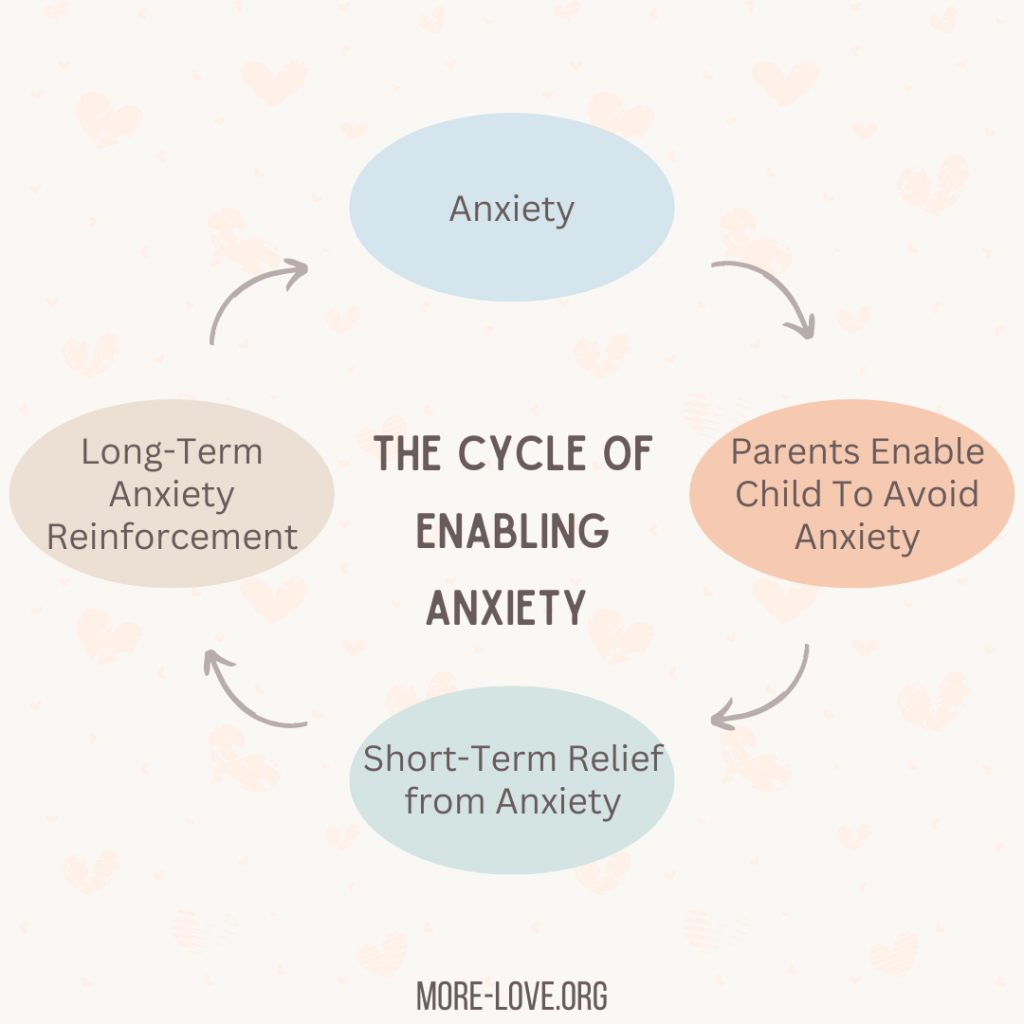
enable child avoid anxiety eating disorder

Avoidance of anxiety increases anxiety

Avoidance feels like a natural way to protect our kids from anxiety. After all, itโ€™s heartbreaking to see them struggle. But research shows that when we consistently allow children to dodge situations that make them anxious, we may actually be reinforcing the fear rather than helping them overcome it. Over time, this can increase anxiety instead of easing it.

Studies have found that avoidance can trap kids (and adults) in a cycle where they never get the chance to learn that they can handle difficult feelings or situations. By gently encouraging our children to face challenges, with support and compassion, we give them the opportunity to build emotional strength and resilience.

The Importance of Tolerating Distress

Enabling always starts as a reasonable accommodation. Iโ€™ve never met a parent who didnโ€™t enable with all the best intentions. And remember, the intention is to avoid the childโ€™s distress. But unfortunately, we know for a fact that when parents accommodate anxiety, it gets worse and more debilitating. 

In fact, the only way to overcome anxiety is to learn to get through the distress it brings. That doesnโ€™t mean you should put your child in a dangerous situation with growling dogs. But it does mean that when doing something that is very safe, like going on an elevator without a yelling man and growling dogs, you must help your child tolerate their anxiety and use the elevator even though they feel anxious about it. The longer you enable your child to avoid the elevator, the harder it will be for them to overcome their fear and learn to tolerate an activity that is perfectly safe and reasonable.

The difference sounds like this: 

Enabling: โ€œitโ€™s scary, so weโ€™ll avoid it.โ€

Supporting: โ€œIโ€™ll help you do this while you feel scared.โ€

supporting eating disorder anxiety

Applying the Concept to Body Image

Imagine your child refuses to attend a friendโ€™s birthday party because they feel self-conscious about how they look. They cry and complain that nothing looks good on them, and they’re too embarrassed to go to the party. Or they demand that you purchase a new outfit to correct their perceived flaws. Maybe they say they can’t eat anything the day of the party to avoid bloating.

Wanting to ease your childโ€™s distress, you might say, โ€œThatโ€™s okay, you donโ€™t have to go.โ€ Or “OK, let’s go to the mall.” You might say “You can skip lunch and dinner today, but tomorrow you have to eat again.” While these responses seem compassionate, they unintentionally reinforce the belief that fixing anxiety is the solution to anxiety.

Supporting A Child With Body Image Anxiety

And while every cell of your body and your child’s body screams that anxiety must be avoided at all costs, the antidote to anxiety is not avoidance, but trust. As long as your child continues to avoid their anxiety by seeking a “fix” for their feelings, such as avoiding the event, getting a new outfit, or skipping meals, they will feel increasing levels of anxiety.

Because these supposed fixes don’t in fact improve their ability to navigate anxiety.

Instead of helping your child avoid their anxiety by “fixing” their circumstances, a supportive approach might be saying, โ€œI understand youโ€™re feeling uncomfortable, and I’m here with you while you feel these feelings.โ€ With your support and confidence, you child will learn to feel their feelings of anxiety, which naturally pass when they’re recognized and allowed. Helping them face their fears gradually will build their confidence instead of increasing their ongoing retreat from normal, healthy everyday experiences of fear and anxiety.

Recognizing the Cycle of Enabling in Eating Disorders

Letโ€™s switch to an eating example now. Say your child came home from school one day realizing that eggs could turn into baby chicks, and they declare that they are disgusted by eggs, and the thought of eating them makes them gag. You figure that makes sense, and you donโ€™t want your child to be upset, so you agree to change their breakfast from scrambled eggs to oatmeal – no big deal. 

But a few weeks later, your child says that eating any animal is disgusting, and they are now a vegan. Since your family is omnivorous and you enjoy cooking family meals, this is a big deal. In fact, family dinner is the only time you all sit down together, and you really enjoy eating together. Since the other family members arenโ€™t vegan, you now have to cook two separate meals, which you donโ€™t enjoy. But your child seems really upset about the animal thing, and you donโ€™t want them to be upset, so you do it

Enabling Eating Disorders Escalates Anxiety

A few weeks later, your child says they donโ€™t want to eat โ€œjunk foodโ€ anymore. This means you must figure out how to feed them a virtually sugar-free, fat-free, vegan menu. Itโ€™s a tremendous amount of work, but when you suggest they eat some french fries, something they enjoyed just a few months ago, they have a panic attack. They accuse you of not being sensitive to their needs and making them anxious. So you learn a new way to cook and start walking on eggshells when it comes to food.

Now you notice your child is losing weight and getting increasingly anxious. You also see them looking in the mirror and pinching their skin. They start to talk about not getting fat and worry that theyโ€™ve eaten too much. Restaurants are out of the question, and parties have become tense and strenuous. They rarely join the family for dinner anymore. You suspect they have an eating disorder, but youโ€™re afraid to bring it up because talking about food has become impossible.

This is just one type of eating disorder + enabling presentation (there are many varieties!). And at every stage, the parent responds in the best way possible. This is not bad parenting! All of the steps they took are loving and well-meaning. They are doing their best. And they are also enabling the eating disorder

Steps Toward Supportive Parenting

Almost every family dealing with an eating disorder has some form of enabling pattern. I hope Iโ€™ve made it explicitly clear that this is not because these families are bad. In fact, itโ€™s the opposite. These are wonderful, loving families. But once you know you have an eating disorder in the family, you also have to recognize that itโ€™s not just the person with the eating disorder who needs to recover.

Your child will need to get treatment for their eating disorder. This will require them to eat differently and think differently about food, eating, and their body. Meanwhile, youโ€™ll need to start noticing how enabling patterns show up in your family and with your childโ€™s unique eating disorder and begin changing the enabling patterns. Learning to stop enabling an eating disorder is extremely hard but also has a tremendous impact on recovery. 

I hope you see that none of this is parent-blaming. The parents with the most empathy are the ones who usually get into enabling patterns. You are not bad for enabling any more than your child is bad for having an eating disorder. But if youโ€™re committed to your childโ€™s recovery, then recovering from your enabling patterns is the key to making a difference.

Embracing Compassionate Change

Here are some steps you can take to shift from enabling to supportive parenting:

Practice Self-Care: Take care of your own emotional needs to be better equipped to support your child.

Educate Yourself: Learn about eating disorders and the role of anxiety avoidance/enabling in maintaining them.

Seek Professional Help: Work with a coach, therapist, or support group to build your capacity to tolerate your child’s anxiety.

Set Boundaries: Establish consistent routines around meals and snacks, and stick to them.

Encourage Open Communication: Create a safe space for your child to express their feelings and fears.

Remember, change is a process. Shifting from enabling to supportive behaviors takes time, patience, and self-compassion. Celebrate small victories, and donโ€™t be too hard on yourself when things donโ€™t go perfectly. By approaching this journey with empathy and a willingness to learn, youโ€™re taking crucial steps toward helping your child heal and thrive. Parenting a child with an eating disorder isn’t easy; please give yourself a lot of self-compassion!


Ginny Jones is the founder of More-Love.org, and a Parent Coach who helps parents who have kids with eating disorders.

See Our Guide To Parenting A Child With An Eating Disorder

Posted on Leave a comment

How to motivate recovery from an eating disorder

How to motivate recovery from an eating disorder

Rachel is beside herself. โ€œI know I need to wait for her to be motivated to recover, and I canโ€™t do it for her, but this is excruciating!โ€ Rachel had been watching her daughter Brooke struggle for over 12 months, and despite expert treatment for her eating disorder, there is little improvement. โ€œThis is impacting every aspect of our lives,โ€ says Rachel. โ€œI feel like a complete failure, but it doesnโ€™t seem like thereโ€™s anything I can do to help.โ€ 

Rachel is not alone. So many parents feel helpless when their children have an eating disorder. It is true that your child needs to embrace eating disorder recovery for themselves. But there are also many things you can do to motivate their recovery from an eating disorder. 

The good news is that motivation is an interpersonal experience. In other words, you can motivate recovery from an eating disorder, and unfortunately you can also have a demotivating impact on your child.

In this article Iโ€™ll review the principles of motivational interviewing, a well-known, scientifically validated method of behavior change. Itโ€™s supported by over 200 randomized controlled trials across a range of target populations and behaviors including substance use disorders, health-promotion behaviors, medical adherence, and mental health issues. And the good news is that it outperforms other common methods of treating a broad range of behavioral problems and diseases.

What is motivational interviewing?

Motivational interviewing is a way to support change by building intrinsic motivation. It is widely recognized as far more effective than what most people do, which is to educate and advise someone when we want them to change. With motivational interviewing, you stop trying to directly change your child’s behavior and start building their inherent motivation to change. It is effective because the greatest changes come from within.

Motivational interviewing is also helpful because it allows you to have more realistic expectations of yourself and your child. Many people misunderstand motivation and don’t realize that it is interpersonal. That is, while motivation is an internal experience, it is heavily influenced by the outside environment. Your words and behaviors can either increase or decrease motivation.

And the good news is that parents who use motivational interviewing are more likely to succeed at increasing their child’s motivation. They’re also less likely to become frustrated by their childโ€™s resistance to change and relapses. This leads to significantly lower levels of parental burnout, which can negatively impact recovery.

How not to motivate someone

Most attempts to motivate other people to do things fail. But this doesnโ€™t mean people canโ€™t be motivated. It just means the traditional approach doesnโ€™t work. The traditional way that people try to motivate others is: 

  • Tell them what to do
  • Explain why they should do it
  • Give them health information and statistics
  • Attempt to persuade them
  • Negotiate with them
  • Confront them
  • Beg them
motivate child recover from eating disorder

Unfortunately, these traditional approaches have a predictable effect on the person you are trying to motivate. Most likely, when you try traditional approaches to motivating your child to recover from their eating disorder they will feel: 

  • Angry
  • Agitated
  • Oppositional
  • Defensive
  • Helpless
  • Overwhelmed
  • Ashamed
  • Trapped
  • Disengaged
  • Dissociated

How to help your child recover from an eating disorder with motivational interviewing

You can have a tremendous impact on your childโ€™s motivation to recover from their eating disorder if you use motivational interviewing techniques. First, you need to be clear about the fact that eating disorders are not educable disorders. In other words, all the education in the world will not motivate your child to recover. That doesnโ€™t mean you canโ€™t provide education. But it does mean that you should not mistake education for motivation. They are entirely different things. 

Second, it doesnโ€™t work to bully, convince, or beg a person to change. While some people will temporarily stop their eating disorder behaviors with this approach, it does not lead to lasting change because it is inherently not motivating. 

Third, keep the focus on you. Thatโ€™s right. You want to motivate your child to recover from an eating disorder, but the only person you can actually control is you. So make sure youโ€™re keeping your attention on what you are doing. Itโ€™s all too easy to focus on what your child is doing. Instead, think about your impact on your child. 

So what should you be doing? Motivational interviewing is more motivating than giving advice and education. It’s also something active that you can practice and work on while your child recovers from their eating disorder.

Motivational interviewing: the RULE acronym

Here are 4 principles of motivational interviewing. They spell the acronym โ€œRULE.โ€

R: RESIST telling them what to do

Avoid telling, directing, or convincing your child about the right path to good health. Use a collaborative process to motivate them. If you try to control your child you will shut down intrinsic motivation. Your child must maintain a sense of agency, the belief that they are in charge of their own body and life, in order to recover. This means parents need to focus on collaboration rather than coercion. Think in terms of dancing, not wrestling.ย You can still absolutely ask and expect your child to do things they don’t want to do, but don’t mistake that for motivation.

U: UNDERSTAND their motivation 

Your child needs to feel as if you understand how difficult it is to change and that you can tolerate their distress while they face this difficult change. Seek to understand their values, needs, abilities, motivations and potential barriers to changing their behavior. Try to understand what your child is communicating with their behavior. Donโ€™t rely only on words, or you will miss important feedback. Behavior is a sign of emotional and physiological distress. Understanding is essential to this process because compassion, empathy, and understanding are essential to motivating someone to change.

L: LISTEN with empathy

Show them that you care about who they are and what they think and say. Here are three ways to do this: 

  1. Ask open ended questions. Closed questions elicit a yes or no answer and will restrict the flow of the conversation. Open-ended questions allow them to tell their story and expand themselves. Examples of open-ended questions are โ€œWhat do you think of โ€ฆโ€ and โ€œHow shall we โ€ฆโ€
  2. Use affirmation and validation. Show your child you understand their point of view by validating what they have said. Highlight their key skills, strengths, goals, and competence. Examples of affirmation and validation are โ€œI can understand โ€ฆโ€ and โ€œI get it โ€ฆโ€ and โ€œIt makes sense that โ€ฆโ€
  3. Reflective listening and mirroring. Listen carefully and repeat back or rephrase in slightly different words. This creates a sense of safety. This is much more effective than asking questions. You can say things like โ€œWhat Iโ€™m hearing is โ€ฆ” or “Youโ€™re having a hard time with โ€ฆโ€ or โ€œIt feels as though โ€ฆโ€ or โ€œIt sounds like โ€ฆโ€ or โ€œIt seems as if what youโ€™re telling me is โ€ฆโ€ or โ€œWhat Iโ€™m hear you saying is โ€ฆโ€ or โ€œI get the sense that โ€ฆโ€

E: EMPOWER them

Work with your child to build agency and self-esteem by recognizing progress and strengths. Nobody can possibly be motivated if they feel disempowered, and yet this is so often what well-meaning parents and experts do when they give traditional forms of โ€œmotivationโ€ like advice and information. Instead, build the sensation that they are capable of change and growth. Help them feel OK about who they are and what they are dealing with. And talk about their success now and in the past. Use a Growth Mindset to empower the sense that they can recover from their eating disorder. 

Expect resistance and relapse

One part of motivational interviewing is to expect resistance and relapse and not be thrown off by it. Resistance and relapse are part of every recovery journey. So if parents become upset and dysregulated when it happens, that can be demotivating to your child. 

Common signs of resistance are:

  • Excuses
  • Hostile
  • Pessimistic
  • Reluctant to change
  • Argumentative
  • Challenging
  • Discounting progress or potential
  • Interrupting

Expect these to show up, and respond as if you are not surprised. Instead, maintain your own emotional regulation and confidence that while this is hard, your child can do hard things. Have faith in your childโ€™s ability to overcome resistance by themselves with your unwavering support. 

Likewise, parents should expect relapse into eating disorder behaviors that you thought were behind you. Relapse is not a sign of failure, but a part of progress. You are not going back to the beginning, you are already on your way. Stay confident and strong in your belief that your child can handle this. The goal is not to avoid relapse, but to manage it effectively.ย 

On the road to recovery

Rachel already feels better. โ€œI felt so helpless before, but now I can see ways that I have been unmotivating,โ€ she says. โ€œI totally fell into the habit of educating and advising. But I can see how thatโ€™s not motivating her or making her feel good. In fact, itโ€™s probably making her feel less powerful over this eating disorder.โ€ 

With this attitude, Rachel is well on her way to improving her ability to motivate Brooke into recovery from her eating disorder. Parenting a child with an eating disorder isn’t easy, but Rachel’s doing great!


Ginny Jones is the founder of More-Love.org, and a Parent Coach who helps parents who have kids with eating disorders.
For privacy, names and identifying details have been changed in this article.

See Our Guide To Parenting A Child With An Eating Disorder

Posted on 1 Comment

How to prevent burnout when your child has an eating disorder

How to prevent burnout when your child has an eating disorder

The minute I first talked to Silvie, I could tell we needed to work to prevent burnout as she supported her child with an eating disorder. “I’m working so hard,” she said. “But I’m tired. I’m not sure I can handle this.” I totally get it, and I’m here to help Silvie feel better. Because the truth is that in order for Silvie to help her child recover from an eating disorder, she needs to prevent her own burnout. Parenting a child with an eating disorder requires stamina and perseverance, so balancing your energy is essential.

If your child has an eating disorder, then thereโ€™s a good chance you, like Silvie, are dealing with parental burnout. The technical description of burnout is being mentally and physically depleted. This depletion can lead you to feel like you are failing at parenting. Oh no! We don’t want that for you at all!

Preventing burnout can be the key to recovery

An eating disorder is a major family crisis, and a burned out parent will be less effective at getting through to the other side. But burnout is not your fault. It’s a failure in the systems that should be supporting you. I’m so sorry this is happening, but it is. Eating disorders are under-funded, under-researched, and live in the shadows of shame, leaving parents frustrated and lacking confidence. I wish we had better systems of care so I didn’t have to say this, but if you have a child with an eating disorder, we need to do everything we can to prevent burnout.

I’ll give you some ideas for what you can do to help yourself recover from parental burnout. But first, letโ€™s get started with more about what parental burnout is and its impact on family life.ย When you fully understand the consequences of burnout I know you and Silvie will both get the care you need to succeed.

โญโญโญโญโญ

Free Guide: How Parents Can Help A Child With An Eating Disorder

Master the secrets to supporting a child with an eating disorder. Thousands of families like yours are stronger today because of these six vital lessons drawn from lived experience, best practices, andย extensive study.

What is parental burnout?

Feeling stressed while parenting is normal and expected. But parental burnout goes beyond expected levels of fatigue and means that you are exhausted and overwhelmed. When you are burned out, you struggle to function. 

When you become burned out, your ability to respond to both everyday and high-level stressors is reduced. Parents who are burned out feel physically and emotionally unable to connect with their kids, which can, unfortunately, lead to even more struggles with parenting. 

A 2021 study conducted by researchers at Ohio State University found that parental burnout has reached dangerously high levels, particularly for working parents. The study found that:ย 

  • 66% of parents report feeling burned out
  • Women are more likely to feel burned out than men
  • Parental burnout is increased in households with 2-3 children, plateaued with 4-5 children, and increased again with 6 or more children
  • 77% of parents who had a child with ADHD and 73% of parents who had a child with anxiety reported parental burnout
  • 72% of parents who were concerned that their child could have an undiagnosed mental health condition reported burnout

Basically, burnout is common and responsive to how many kids you have and whether your kids have mental disorders.

How to prevent burnout when your child has an eating disorder

Why do we need to prevent burnout when parenting kids with an eating disorder?

Itโ€™s probably pretty obvious why parents who have a child with an eating disorder are at high risk of parental burnout. The constant stress of having a child with a major mental disorder is exhausting, and it can feel as if you have no options. The healthcare system does an inadequate job of helping parents who have kids with eating disorders cope. In fact, many times there is little to no support for parents or the advice is ignorant and even harmful. Itโ€™s rough. Iโ€™m so sorry.ย 

Based on the data available, we know that 72% of parents who worry their child has an undiagnosed mental health condition, 77% of parents who have a child with ADHD, and 73% of parents who have a child with anxiety report they are suffering from burnout. I think itโ€™s safe to say that at the bare minimum 72% of parents who have kids with eating disorders have burnout, though I would guess itโ€™s even higher based on my experience. 

And itโ€™s no wonder. Our healthcare system is not structured to adequately and comprehensively care for people who have eating disorders and their families. I’m sorry it’s this way.

How do you know if you have parental burnout when dealing with an eating disorder?

Many times you can sense that you are burned out. Itโ€™s completely fine to self-diagnose yourself. In general, be on the lookout for these symptoms of burnout: 

  • Irritability
  • Fatigue
  • Changes in sleep and/or appetite
  • Mood swings
  • Feeling like a failure
  • The sense that you are underwater
  • Complete overwhelm

What sets parental burnout apart from regular stress is that it negatively impacts daily functioning. Basically, you are less productive and effective and struggle to accomplish tasks that used to feel manageable.

What can you do if you are burned out from parenting a child with an eating disorder?

I know you have a lot going on with your childโ€™s eating disorder. And while you need to continue the work of helping your child recover, you also need to care for yourself. As you can imagine, when parents are burned out, their kids struggle more. So if your approach to managing right now is leading you to burnout, then itโ€™s essential that you get the support you need and deserve to feel better.

Recovering from burnout takes effort, which is cruel since the primary symptom of burnout is the lack of energy to do anything. But you need to invest in yourself to recover from burnout. The consequences of not recovering are serious, so please reach out for help!ย 

Recovering from burnout is not unlike recovering from an eating disorder. It is essential to your health and wellness, and when you are burned out, everyone suffers. So this is not optional or selfish. You need to recover from burnout to operate effectively as a parent.

Here are some ideas:ย 

  1. Do less. I’m sorry, but there’s no way around this. When you’re burned out, you have to find ways to outsource more of your activities. If you’re physically capable of doing what needs to be done but are still burned out, then it’s likely you’re worrying a lot, causing mental strain. You need help ending the cycle of worry, which will drag you down. A good therapist or coach can help.
  2. Self-care. No, I’m not talking about bubble baths. But you have to take care of your body and mind. This means getting enough sleep, eating enough food regularly throughout the day, moving your body, getting outside, and spending quality time with family and friends who love you unconditionally and aren’t your kid(s).
  3. Take breaks. You’ve got so much on your plate, but you can probably squeeze in a few 5-minute breaks to stare off into space, meditate, stretch, or have a cold glass of water or hot cup of tea. Do something to ground yourself in your body and mind and remind yourself that while your problems are serious, the world is still happening all around you.
  4. Give yourself more love. Most of us are pretty critical of ourselves. If you’re struggling to support a child in eating disorder treatment, you need to balance your go-go-go attitude with rest and self-compassion. Research shows that people who practice self-compassion feel better and do better, so it’s a win-win.
  5. Get support. You know your child needs support in eating disorder treatment, but do you know that you need support, too? Parents are essential to treatment and recovery, but it takes a toll. Ask your child’s providers for recommendations for a therapist, coach, parenting class, or other way to prevent burnout during your child’s eating disorder treatment.

Ginny Jones is the founder of More-Love.org, and a Parent Coach who helps parents who have kids with eating disorders.

See Our Guide To Parenting A Child With An Eating Disorder

Posted on Leave a comment

Sending your child to summer camp with an eating disorder

Sending your child to summer camp with an eating disorder

Summer camp is a great opportunity for your child who has/had an eating disorder to feel a sense of belonging, community, and independence. And since these things are essential to mental health, summer camp can be a great prescription for moving forward and embracing recovery. Here are six things to consider if youโ€™re thinking about sending your child with an eating disorder to summer camp.

1. Medical stuff first

Before your child can go to camp, they need to be cleared medically and psychologically. This doesnโ€™t necessarily mean they need to be 100% free of their eating disorder, but they should, at a minimum, not be medically underweight or have active complications like low heart rate, blood pressure, etc. 

Talk to your childโ€™s doctor, therapist, and dietitian and get their opinion. Will the challenge of summer camp be a positive experience, or is it too risky? Itโ€™s really helpful for kids who have eating disorders to be with peers and to feel connection and belonging, and summer camp is a great place for that. Itโ€™s also a great place to try their healthy coping skills and stretch their independence. So be sure to ask your providers to consider the benefits as they make their recommendation.

Now, check your gut: do you think your child is stable? This is an intuitive choice you need to make, so read the rest of this article and then spend some time sitting with your options. 

Finally, consider which duration is best for your child. This may not be the year for a month-long camp, but perhaps a week or two weeks would work. Consider the duration based on your intuition of how stable your childโ€™s recovery is right now.

2. Monitoring for trouble

Ideally your child should be stable enough in their recovery and you have chosen a duration that makes sense based on where they are in recovery. Those are important considerations, since I suggest you avoid making too many special accommodations during their time at camp. 

You may ask the camp nurse to weigh your child mid-way through a 2-week camp session if you believe that is necessary. You may also ask the camp staff if they can monitor whether multiple meals are skipped and alert you to that. 

But if you are asking for a lot more than that to accommodate your childโ€™s eating disorder, it may be a sign that this is not the right year to do summer camp. The camp cannot step in and take the place of yourself or your childโ€™s treatment team. If your child needs more support for their eating disorder, then it may not be the right time for summer camp.

3. Sending special food and other accommodations

Summer camps are structured and have a lot of rules. Those rules are there for a reason. In some ways, they are there to make the camp counselorsโ€™ jobs easier. But in a lot of ways those rules mirror social expectations and norms. Rules are a natural and essential part of belonging to a group.

If you find yourself making special requests for your child because of their anxiety and eating disorder, then pause. Look out for your desire to accommodate your child and consider if itโ€™s serving recovery or maintaining the disorder.

I suggest that as much as possible you set the expectation that your child is a normal camper. They should eat the same food, have the same sleeping arrangements, do the same activities, and have the same communication standards as other campers. That, after all, is the point of camp. They are all in the same place at the same time, living under the same rules and expectations. Thatโ€™s how camps build a sense of belonging. And belonging is exactly what your child needs to embrace recovery.

Avoid sending them to camp with a special diet or sewing a secret cell phone into their pillowcase for emergencies. The point of camp is that every camper is the same – thatโ€™s the beauty of it, and thatโ€™s where your child will gain the benefit of belonging and community. If you treat them differently, they will not get those benefits.

Finally, do not make an agreement in advance that you will pick them up early if they get uncomfortable. You need to set the expectation that they will stay the whole time. Don’t send them if you don’t believe they can make it. An anxious child will naturally feel anxious at camp sometimes. They will naturally reach for an โ€œoutโ€ if itโ€™s there and ask you to come and get them. Make sure you havenโ€™t set up the expectation that they should call you to remove them from camp at the first hint of discomfort. Getting through discomfort is one of the benefits of summer camp.

4. Dealing with their worry

The most important thing about summer camp is to expect your child to be worried. Your child will feel worried and anxious about leaving home, about being in a different environment, and about meeting other people. Help them understand that worry is a normal part of trying new things, but that we donโ€™t let worry make important decisions for us. The goal is for them to feel worried and do it anyway. Thatโ€™s a key skill to emotional regulation and mental health, so donโ€™t miss the opportunity to talk to them about it.

Donโ€™t try to answer every question, instead, help them learn to tolerate the uncertainty of doing something different. Think of this as an emotional training camp. They will learn to handle worry, and theyโ€™ll probably have a great time while doing it.

Finally, avoid automatically jumping in to solve problems that are your childโ€™s problems to solve. For example, if they are worried about making friends, donโ€™t tell them how to make friends. They know how to make friends! They are just worried. And itโ€™s OK to be worried. Help them feel their worry and solve their own problems rather than jumping in to solve their problems for them. Thatโ€™s not the path to independence or emotional health.

5. Dealing with your worry

You are going to be worried. Your child is going to summer camp and they have/had an eating disorder. Expect your worry to show up, and deal with it with other adults, not your child. Look for your own anxiety and seek support from people you trust. 

If you tend to get worried, then be careful about the daily photo dumps that often come from camps. These photo dumps can send parents into a tailspin of worry. Desperately trying to find your child in the crowd and then carefully evaluating their facial expression and those on the faces around them can ruin your whole day. Review the photos (if you care to) when your child gets home. I’m certain you picked a safe camp. You don’t need to monitor your child’s safety through photographs!

Finally, be open to everything being fine. You will have worry, and your child will have worry, but that doesnโ€™t mean they wonโ€™t have a great time at summer camp. They may surprise you โ€ฆ I hope they surprise you! Let them!

6. Communicating while theyโ€™re there

The camp should have clear rules about communication between campers and parents. Like all camp rules, these are structured on purpose to build belonging among the campers as well as independence for your camper. If you violate these rules, you risk the greatest benefits of going to camp. 

First, donโ€™t call the camp every day to check on your child. They will call you if thereโ€™s a problem!

Next, donโ€™t set up special communication with your child. Remember that the rules and norms are there for a reason, and you should follow them. Iโ€™m a big fan of camps that have a zero cell phone policy and donโ€™t have campers call home mid-week. Let your child find the freedom, joy, and uncertainty of not reaching for their phone every 5 minutes to check in.

Finally, donโ€™t panic if your child tells you they donโ€™t like something. Itโ€™s normal not to like stuff! If your child complains about something, wait at least 24 hours before trying to resolve a possible problem. Wait as long as you can. Unless the camp calls you, then itโ€™s probably fine. Weโ€™re talking about one week, not months. Each day at camp is different, and a miserable camper on Day 1 could easily be a happy camper on Day 3. Hang in there and trust the process.

The goal of camp

The goal of summer camp is to help your child build belonging and connection with peers as well as personal autonomy and independence, all of which will support eating disorder recovery. You want them to navigate the world as a healthy child who can tolerate being a little uncomfortable, grumpy, unshowered, and sunburned sometimes. Thatโ€™s normal life! Camp doesnโ€™t have to be perfect to be great!

That said, if everything Iโ€™ve said has made you very nervous, then maybe wait this year out and try again next year when youโ€™re both feeling more stable. Parenting a child with an eating disorder is never simple, so use your best judgment.

Interesting article: Now Is the Time to Reboot Summer Camp


Ginny Jones is the founder of More-Love.org, and a Parent Coach who helps parents who have kids with eating disorders.

See Our Guide To Parenting A Child With An Eating Disorder

Posted on Leave a comment

The risks of accommodating an eating disorder

The risks of accommodating an eating disorder

Rachel was at the end of her rope. After years of trying to help her daughter Lily claw her way out of anorexia, it simply wasnโ€™t getting any better.

Sure, there was COVID to blame. The pandemic made Lily even more socially isolated, and online treatment didnโ€™t seem to be as effective. But overall, Rachel knew that Lilyโ€™s problem pre-dated the pandemic. And she was worried that it would extend way beyond the pandemic if something didnโ€™t change fast. 

โ€œThe truth is that Iโ€™m completely burned out,โ€ says Rachel. โ€œThis is my last hope. If this doesnโ€™t work, I really donโ€™t know what Iโ€™ll do or how Iโ€™ll keep this up. Somethingโ€™s got to give.โ€ 

Rachel has decided to try a treatment program called SPACE that focuses on changing her own behavior rather than trying to change Lilyโ€™s behavior.

โ€œItโ€™s just been a brick wall to try and convince Lily to recover,โ€ says Rachel. โ€œI know Iโ€™m not supposed to say this, but she just isnโ€™t choosing recovery. Sheโ€™s not taking any steps on her own to get better.โ€

Rachel is struggling under the caregiving burden. โ€œWhen she was younger, she was a bit more self-sufficient, and being at school motivated her,โ€ says Rachel. โ€œBut now sheโ€™s done with school, and sheโ€™s doing almost nothing. She lives with me, and I try to feed her six times per day like Iโ€™m supposed to. Sheโ€™s nowhere close to feeding herself, and I canโ€™t see her being able to get a job or move out.โ€

Rachel, like so many parents and caregivers, is terrified for her daughter. Sheโ€™s also frustrated and fed up. Her diligent, valiant work feels like a drop in the bucket. The eating disorder is powerful, and sheโ€™s losing hope.

What is accommodation?

When someone is afraid of something, they naturally want to avoid it. 

Parental accommodation is a way that parents make it easier for their children to avoid doing the things that scare them. 

If your child screams when they see a spider, you whisk it away quickly and then soothe your child, trying to calm them down as soon as possible. This accommodation makes perfect sense.

But the next day, your child asks you to check under their bed for spiders before going to sleep. This, too, makes sense to you. You accommodate their wishes – itโ€™s not a big deal! 

But the next day, your child asks you to check that their windows are locked tightly and check under the bed, scan the walls, and peer into the darkest corners of the closet with a flashlight to ensure there are no spiders. 

The accommodation snowball effect

You can see where this is going. Your childโ€™s fear of spiders makes sense. But their avoidance of possibly encountering a spider ever again is becoming a problem. Even though you sense itโ€™s wrong, you canโ€™t imagine not accommodating them because they get so upset just thinking about spiders. It seems faster and easier to do what they ask than to convince them to go to sleep without it.

Sometimes you try to talk your child out of it. You prepare deeply-researched and highly-rational arguments to persuade them that spiders arenโ€™t scary or dangerous. Sometimes you lose your temper and yell that you arenโ€™t their personal spider valet and you wonโ€™t do this tomorrow night โ€ฆ this is the last time! 

But, of course, the next night, your child cries and seems so terrified that you give in one more time and look in all the nooks and crannies. Later they come into your room at midnight, wake you up, and beg you to check again.

You’re half asleep, and it seems like less trouble to just look than to try and convince your child there are no spiders, so you grudgingly get up, stomping your feet and huffing as you walk to their room and look in all the corners for spiders. 

Youโ€™re feeling angry, but you canโ€™t see a way out of accommodating your childโ€™s avoidance of possibly seeing a spider. You feel trapped and frustrated, stuck in a web.

How does accommodating impact eating disorders?

I started with a spider story because it feels less charged than an eating disorder. Eating disorders are complex, multi-layered mental disorders. Also, parents are not responsible for either their childโ€™s fear of spiders or their eating disorder. It typically doesnโ€™t work that way.

But parents may be responsible for accommodating their childโ€™s anxiety-driven eating disorder behaviors.

Parental accommodation is called a โ€œmaintaining factorโ€ in eating disorders. This means that it is not the cause of an eating disorder. But accommodation can make it easier for an eating disorder to dig its heels in and stick around for the long haul.

Eating disorder accommodation examples

There are many ways parents accidentally accommodate eating disorder behaviors. Letโ€™s break down how accommodating can sneak into some of the common eating disorder recovery goals:  

  • Goal: have the child eat regular, healthy meals.
  • Accommodation: the child cries and yells at the dinner table. The parent becomes so distressed that they excuse the child before the meal is finished.
  • Goal: cut down on ingredient checking and calorie counting
  • Accommodation: the child refuses to eat until they know exactly how many calories are in the yogurt. It just seems easier and faster to tell them.
  • Goal: have the child eat various foods, not a limited menu of โ€œsafe food.โ€
  • Accommodation: when serving meals, the parent doesnโ€™t offer new foods. They know their child will throw a fit or simply refuse to eat. Sometimes they try to add something new to the plate, but it goes so badly that they rarely do this.
  • Goal: have the child eat comfortably with other people.
  • Accommodation: the child becomes so upset about the idea of multiple people at the dinner table that the parents feed the child separately. Or they excuse the child from family meals because they are so distressed.
  • Goal: for the child to accept their body and not worry about its appearance.
  • Accommodation: when the child asks if they look bad, the parent freezes and ignores the question. Then, when the child doesnโ€™t stop, the parent says in a falsely cheerful voice, “you’re just being silly – of course you’re beautiful!”
  • Goal: the child attends scheduled meetings with professionals.
  • Accommodation: the child insists that the therapist is useless. The nutritionist makes them eat unhealthy food, and the doctor is fatphobic and clueless. The parent spends hours every week convincing the child to attend just one more meeting. They use bribes and rewards, which work only some of the time.

All of these parental responses make perfect sense. If you do these things, you are not bad! Occasional accommodations make sense. But it can be a problem if parents repeat the same accommodation at every meal and/or the list of accommodations keeps growing. We want to stop accommodating eating disorder behavior even though itโ€™s really, really uncomfortable for both the parent and the child.ย 

How can parents stop accommodating?

Parents can stop accommodating eating disorder behaviors, but it takes some careful thought, a solid strategy, and practice. Itโ€™s not a good idea to remove all your accommodations at once. A strategic, steady approach is best. 

First, you need to understand how you are accommodating the eating disorder behaviors and why you are accommodating. You will naturally think you are accommodating to avoid your childโ€™s distress. But you are also accommodating to avoid your distress about your childโ€™s distress. Make sense?

When your child yells and screams or slams their door in your face, you feel upset. You worry that your child will never get better. Of course you do!

This is what drives the accommodation. You want to avoid your childโ€™s upsetting outburst, so you do whatever you can to avoid it. 

Start with you

Understanding your own worry is the first step to addressing and ending accommodation. Because ending accommodation is all about what you do. How your child responds must be relatively unimportant and not change your approach. 

You will take unilateral action to remove your accommodation lovingly and compassionately. And your child is going to be distressed. Both of you will be able to handle this distress. But you may need some support to prepare and get through it.

Next, you will pick a specific accommodation and make a detailed plan to stop doing it. Youโ€™ll tell your child what youโ€™re going to do, why youโ€™re doing it, and when youโ€™ll begin doing it. 

Finally, youโ€™ll follow through. Youโ€™ll stay steady even in the face of your childโ€™s worry and anguish. This will be hard, but you know that continuing the accommodation, while possibly easier in the short term, will not help in the long term.

Youโ€™ll stay dedicated and single-minded in your commitment not to accommodate eating disorder behaviors anymore. Over time, your child will learn your boundaries. Your child will feel less anxious. Youโ€™ll interrupt the anxious cycle of an eating disorder and invite recovery to take root.

Rachel and Lily

Rachel was terrified of ending even her most minor accommodations. For example, she told Lily what was in her smoothie every day. This was happening even though it was exactly the same every day.

She made a plan and told Lily that she would not answer smoothie ingredient questions anymore. Lily asked a few times on the first day, and Rachel was near tears but held her boundary lovingly. 

The next day, Lily asked ten times and started to cry when Rachel held her compassionate boundary. She refused to drink her smoothie. Rachel worried that she was making a mistake or doing it wrong.

But on the third day, Lily asked Rachel once, then, shockingly, drank her smoothie. 

Progress!

โ€œI nearly fell out of my chair,โ€ says Rachel. โ€œI couldnโ€™t believe it didn’t keep getting worse.โ€

Lily asked about the smoothie ingredients every few days throughout the next few weeks. And if it was an especially stressful day, she asked several times in a row. But Rachel was confident that not reviewing the ingredients was the right thing to do to help Lily recover, so she held her boundary lovingly and firmly.

Over time, Rachel removed more and more accommodations. Some were easier than others, but she could see the benefits. Mealtimes were less stressful for Rachel, which meant she could better support Lily through the stress of eating. 

โ€œI feel more hopeful today than Iโ€™ve felt in five years,โ€ says Rachel. โ€œThis is the biggest improvement Iโ€™ve seen in a long time. I feel like Iโ€™m really getting the hang of not accommodating her eating disorder behaviors. I’m focusing on controlling myself rather than trying to control her.โ€ Parenting a child with an eating disorder is challenging, and Rachel is doing a great job!


Ginny Jones is the founder of More-Love.org, and a Parent Coach who helps parents who have kids with eating disorders.
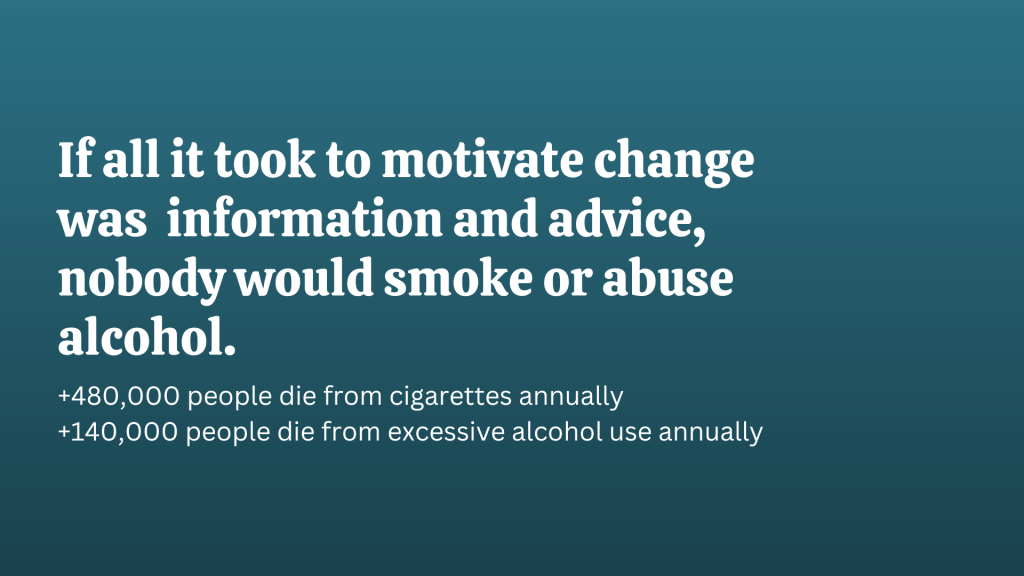
For privacy, names and identifying details have been changed in this article.

See Our Guide To Parenting A Child With An Eating Disorder

Posted on Leave a comment

How to stop nagging and negotiating with your kid who has an eating disorder

Get your kid with an eating disorder to eat without nagging and negotiating

If your kid has an eating disorder, then thereโ€™s a good chance you are constantly nagging and negotiating with them to eat. How many reminders have you given your child this week? A certain level of reminding is to be expected. But if it feels constant and never-ending, then itโ€™s probably time to make a change. This is because of two things: 

  1. Constantly reminding your child to do things is exhausting, especially when youโ€™ve already explained why itโ€™s important a thousand times. Reminding your kid to do something as essential as eating is a huge burden on you that will lead to burnout.
  1. When you nag and negotiate with your child to eat, you are essentially โ€œowningโ€ their food and eating, meaning they are not taking responsibility for their own nourishment and recovery. While this helps for short-term problems, itโ€™s ineffective for long-term issues.

Maybe you lean more towards negotiation: “Eat just one more bite and then you can be finished.” Or “If you eat this, you donโ€™t have to eat that.” 

Or perhaps you find yourself nagging: “Did you remember to eat?” “Please remember to eat!” Or “You have to eat fat and carbs!”

Either way, if you feel as if youโ€™re in an endless loop of negotiation and nagging, it doesn’t mean you’re not trying hard enough. It’s just a sign your current system isnโ€™t working.

Changing exactly how you ask your child to do something might help a little bit in the short term, but often the issue is a lot more complicated and relates to how eating disorders work and how our best intentions can sometimes get in the way of recovery.

If you find yourself exhausted by the constant nagging and reminding, here are some ideas to get you and your child to a different level.

SPACE treatment for eating disorders

The SPACE treatment stands for Supportive Parenting for Anxious Childhood Emotions. Itโ€™s a research-backed program to help parents stop accommodating or enabling eating disorder behaviors and start making it really uncomfortable for them.

Iโ€™ve adapted SPACE for eating disorders (BED, EDNOS, bulimia, anorexia, and ARFID) because of two things. First, anxiety drives most eating disorder behaviors. People who have eating disorders are often genetically predisposed to be highly-reactive, and therefore more sensitive to anxiety. Food restriction, rejection, and rituals are powerful coping mechanisms for anxiety and distress. Second, parental accommodation, which includes nagging and negotiating, has been identified as a maintaining factor in eating disorders. It has been associated with greater symptom severity and caregiver burden. SPACE addresses both your child’s anxiety and parental accommodation.

Beyond getting your child into treatment and feeding them regularly, eliminating parental accommodation is one of the most powerful actions you can take to stop the eating disorder. The best part is that removing parental accommodation does not require the child to be engaged or motivated to change. It’s entirely up to you.

In this article, Iโ€™ll take a look at some ways parents can use the SPACE approach to stop accommodating eating disorder behaviors.

1. See nagging for what it is 

When there’s an eating disorder you probably have spent time nagging and negotiating about food and eating. Over time, this is exhausting for parents and can actually make kids more (not less) resistant to eating.

Most parents who nag and negotiate believe that if they just say the right thing a switch will go off in their kidsโ€™ heads and theyโ€™ll start to eat. These parents are trying valiantly to convince their children that eating is good and healthy and that the kid should do it. 

But if you have any experience with this, then you know that it rarely works.

Nagging and negotiating about eating and food are a sign that your system is not working. Youโ€™re tired, and your kid isnโ€™t changing. Itโ€™s not that you arenโ€™t trying hard enough. Or that you havenโ€™t said the right thing yet. Itโ€™s that youโ€™re using the wrong approach.    

In SPACE for eating Disorders treatment, we work on stopping the endless loop of nagging and negotiating. Parents learn to create clear interpersonal boundaries and attend to the underlying drivers and beneath-the-surface communication thatโ€™s going on every time you and your kid start to butt heads.

2. Make whatโ€™s unseen, seen

An eating disorder loves the shadows. All it really wants is to be able to exist and flourish without a lot of talk or disruption. It believes that itโ€™s got things under control and that your involvement is threatening and unnecessary. But the last thing you want to do is adhere to an eating disorderโ€™s demands for secrecy. In fact, you want to do the opposite: bring disordered behaviors into the light and talk about them openly.

Of course, itโ€™s very important to not be critical or threatening toward the eating disorder. Thereโ€™s a huge difference between criticism and observation, and they are mortal enemies. You want to be respectful of the eating disorder while calmly observing what’s going on. 

โ€œOh, it seems like youโ€™re feeling upset about eating right now. I get that it’s hard, but I’m 100% confident you can do this.โ€ 

Thatโ€™s very different from โ€œStop trying to hide food under your napkin! I can see what youโ€™re doing!โ€

The former is supportive. The latter is threatening.

In SPACE for Eating Disorders treatment, we work on isolating a single behavior and figuring out exactly how parents will respond differently when it shows up. Then we write a letter to the child calmly and compassionately explaining the behavior and how the parents will respond from now on. This is an essential step in overcoming the eating disorder’s demands for secrecy and privacy.

3. Donโ€™t wait for them to get on board

One of the hardest things about having a child with an eating disorder is the persistent belief that the child must be โ€œon boardโ€ in order for them to recover. And of course, your child will need to own recovery for themself. You canโ€™t do that for them.

But that doesnโ€™t mean you have to wait for your kid to get on board in order for you to make changes. You can start making changes today that will impact your childโ€™s likelihood of considering and ultimately embracing recovery. 

Without parental changes, itโ€™s much less likely that the child will even consider eating disorder recovery. Because as hard as it is to have an eating disorder, the idea of living without one is so terrifying that most people remain stuck in the loop of eating disorder behaviors. 

In SPACE for Eating Disorders treatment, parents make unilateral changes in their behavior. This means we determine the ways in which you are accommodating the eating disorder and you learn how to stop doing that. These changes are about your motivation and commitment. They do not require your child to change; only you. 

5. Donโ€™t just say it, show it

Nagging and negotiation are all about what you say. But eating disorder behavior works on a much deeper level. In fact, anxiety-driven behavior barely responds to language. Itโ€™s a deep, animalistic instinct. It responds to action. 

This is why nagging and negotiating rarely change the course of an eating disorder. The drivers of the eating disorder are much deeper and more primitive than language. And the eating disorder actually enjoys pushing back against nagging and negotiating because itโ€™s a great distraction from whatโ€™s really going on.

In SPACE for Eating Disorders treatment, parents learn to show how they want their child to behave rather than ask for compliance. This means parents stop talking so much and instead show calm, compassionate confidence even in the most violent emotional storm.ย 

6. Practice, not perfect

One of the biggest impediments to lasting change is when we think itโ€™s an event instead of a process. Eating disorder recovery is not a single-day event. Itโ€™s something that your child will need to practice in some form for the rest of their life.

Many parents feel some success if they need to nag and negotiate a bit less. They may think the eating disorder is in remission. But then something happens and it looks like their child is suddenly right back to where they were before. This should not be a surprise. Remember that eating disorder behaviors are a response to stress, so every time there is a stressor, you can probably count on the eating disorder showing up again in some way. 

In SPACE for Eating Disorders, parents learn to anticipate kidsโ€™ behavioral cycles and respond consistently and calmly no matter whatโ€™s coming up. This means parents have learned not just a script or a single response, but an entirely new system for responding to eating disorder behaviors. 


Ginny Jones is the founder of More-Love.org, and a Parent Coach who helps parents who have kids with eating disorders.

See Our Eating Disorder Treatment Guide For Parents

Posted on Leave a comment

How to talk to your child with an eating disorder without yelling & screaming

How to talk to your child with an eating disorder without yelling & screaming

Many parents who have kids with an eating disorder tiptoe around difficult conversations because so many of them turn into screaming or yelling matches. 

Parents who are facing an eating disorder naturally want to create a healing environment and try to avoid screaming and yelling. But an unfortunate side effect is that parents often feel they are constantly walking on eggshells. They avoid difficult conversations because they are afraid of triggering eating disorder behaviors. This makes perfect sense. But when we avoid difficult conversations we almost always make the situation worse, not better

Because avoiding hard conversations separates us from the people we love. Also, avoiding tough conversations makes screaming and yelling more likely (not less) because complaints and disagreements get pent up and then inevitably erupt in unhelpful ways. This is a very common pattern that we frequently see in families with eating disorders.

The solution to avoiding yelling and screaming during eating disorder recovery is not to avoid difficult conversations, but to have difficult conversations more often, in a better way.

The cycle of repression 

If youโ€™re like most parents, then your child does stuff that drives you crazy, and you want to avoid yelling and screaming. So you find yourself avoiding conversations. 

Hereโ€™s how it typically goes. You feel angry and you want them to stop whatever they’re doing or start doing something else. But you hold your tongue because you donโ€™t want to risk triggering the eating disorder. 

Everything feels so charged, and your child seems too fragile. So instead of talking about it you may raise your eyebrows or make a big huffing sound, but you donโ€™t actually address the negative behavior.

The next day, your child does it again โ€ฆ or does something else that drives you crazy. Again, you hold your tongue, but you start having angry conversations with them in your head. 

They are so irresponsible! They are so selfish! Just because they have an eating disorder doesnโ€™t mean they get to treat you this way!

And then it happens again.They do something irritating and you repress your irritation to โ€œkeep the peace.โ€  

The pressure builds

Your anger is growing, but you feel you canโ€™t express it. You repress your feelings. But inside youโ€™re boiling. You blame your child for the fact that you canโ€™t express yourself openly and honestly. You call your friend and tell her your child is โ€œdriving you crazy.โ€ You say things like โ€œthe truth is that Iโ€™m afraid of my own kid. Theyโ€™re like a ticking time bomb. I live in fear.โ€

And itโ€™s true. You are living in fear. And you are getting angrier and angrier.

Every time your kid does something you donโ€™t like, the pressure builds inside of you. Your eyebrow raises, snarky comments, and unpleasantness spread like a virus through your house. Everyone feels it. And you blame your child for the nastiness because youโ€™re repressing your feelings to protect their feelings. To keep them safe from their eating disorder and avoid yelling and screaming.

This is a very unhealthy place to be in a relationship. You are repressing your feelings in an effort to protect your childโ€™s feelings. But the impact is that your child feels worse, you feel worse, and everyone feels worse. Because feelings canโ€™t be repressed forever. They inevitably leak out or, sometimes, explode into yelling and screaming. 

The good news is that thereโ€™s a very good solution to this problem. You just need to start having difficult conversations more frequently. And you need to learn how to have better difficult conversations.

How to have difficult conversations

Difficult conversations take time, energy, and a lot of practice. When you first begin this practice, you may be exhausted by how often you need to have difficult conversations. And they may be very, very difficult. They may include yelling and screaming – the very thing you’re trying to avoid. You may worry that itโ€™s not working, and you may slip back into avoiding difficult conversations.

But when you commit yourself to having difficult conversations frequently, you will notice a steady improvement over time. Soon, difficult conversations will be much less difficult for everyone. There will be less yelling and screaming. With practice and the right strategy, difficult conversations get much, much easier.

With practice you will reach a place in which you are respectful and honest about what you want and need. And your child will feel respected because you are not avoiding hard conversations to protect their feelings. Parents who commit to the practice of having difficult conversations can transform their relationship with their children.

Hereโ€™s how to handle difficult conversations: 

1. Identify how you feel

What do you notice inside of yourself? Sure, you may think your child is the problem, but look deeper. Itโ€™s OK to start at the point of blaming your child for your feelings, but donโ€™t stay there. You need to keep digging. Identify what you are feeling, and claim your own feelings.

Feelings of anger and rage towards our children usually indicate that we are feeling insecure about something. Anger and rage frequently disguise feelings like fear, nervousness, disgust, discomfort, guilt, and shame. 

These are all serious and valid feelings that you can claim as your own. Your child may be the person who is triggering your feelings, but they are never responsible for your feelings. Your feelings are always are yours to handle.

Until you claim your own feelings, you risk blaming your child for how you feel, and thatโ€™s typically when difficult conversations go awry.

2. Make a simple and direct statement 

Often when we start a difficult conversation we overcomplicate things. We believe we have to get the other person to see things our way and agree with us. But this is not a useful way to begin a difficult conversation because the other person immediately feels manipulated and controlled. This is where yelling and screaming often begin.

Another mistake we make is criticizing or blaming the person for their behavior rather than making a direct request for what we want.

Start the conversation by making soft eye contact, using a gentle tone of voice, relaxed body language and voice, and make your intent crystal clear. Some examples: 

Old version: You never take the trash out, and I always have to ask you. Itโ€™s so disrespectful! I donโ€™t understand why we have to go over this again and again. You say you’re going to do it and then you don’t, and it feels like you just don’t care about me or this family that has given you so much.

New version: I’d like you to take the trash out by 8 p.m. each night without me asking.

Old version: Partying won’t get you anywhere in life. Aren’t you interested in doing better? What even happens at those parties anyway? I bet there’s drinking, and you know that’s not OK with us! I mean, come on! I bet Sarah’s parents won’t even be there! And doesn’t her brother use drugs?

New version: I get it that you want to go to the party. But I’m not OK with you going.

When we claim our own feelings and make the conversation about what we want, not about their character or bad manners, we get off to a much better start.

3. Listen

If you have already had this conversation in your head ten thousand times, you are going to need to work really hard not to assume your childโ€™s answer. Itโ€™s critical to stop talking and really listen to their answers.

Hold this statement in your mind: I am a parent who loves my kid, and listening is loving. 

Itโ€™s true: a person who feels listened to feels respected and loved. They are much more likely to do what weโ€™re asking when they feel heard, understood, and loved.

Sometimes yelling and screaming is for a good reason: the person doing the yelling and screaming is literally trying to make you hear them. You can bring the volume down by listening before it hits high volumes.

Listen with the intent to understand, not respond. And be careful not to respond with something about them, like โ€œyou always/never do this.โ€ Remember to claim your own feelings in this situation rather than blaming your child for how you feel.

Be willing and confident to dive as deeply as you need to in order to uncover whatโ€™s really going on for your child. Donโ€™t assume you already know why theyโ€™re doing the irritating thing. All negative behavior comes from some unmet emotional need. They are rarely intentional or designed to hurt us. When parents seek to identify and address the emotional need, kidsโ€™ negative behaviors typically recede and get much easier to handle.

4. Prepare to repeat yourself 

As the conversation progresses, simply share again how you would like things to be. Donโ€™t try to convince them of your perspective. But do look for common ground, and build on areas of agreement. Then pause and listen.

Listening more than you speak is almost always the best advice when having a difficult conversation with your child. If youโ€™re asking them to do something they donโ€™t want to do, then just say what it is and then listen. Then say it again and listen some more. Keep it simple and direct.

You may have to say the thing you want many times. The key is to know that this is part of parenting. It doesnโ€™t mean your child is bad or you are bad. It just means youโ€™re two different people. Youโ€™re asking them to do something and they donโ€™t want to. Thatโ€™s OK. Ask again!

Itโ€™s deceptively simple. You donโ€™t have to try and convince them or get them to agree with you. Your goal is to communicate your wishes clearly and directly and make your child feel respected and heard in the process. 

Your child does not need to agree with or like your boundaries in order for you to set them! 

More conversations, less yelling & screaming

The important takeaway here is that to avoid yelling and screaming when there’s an eating disorder we don’t want to avoid difficult conversations. Instead, we want to have more difficult conversations and do them better. Parenting a child with an eating disorder is hard – you’re doing great!


Ginny Jones is the founder of More-Love.org, and a Parent Coach who helps parents who have kids with eating disorders.

See Our Guide To Parenting A Child With An Eating Disorder

Posted on Leave a comment

Changing family traditions when thereโ€™s an eating disorder

Changing family traditions when thereโ€™s an eating disorder

This is an interview in which Ginny Jones, founder of More-Love.org, shares her thoughts on how families can cope with family traditions when thereโ€™s an eating disorder in the family.

1. Why might the winter holidays be particularly difficult for individuals affected by eating disorders? What types of challenges might arise in the next few months?

I think the biggest issue is that many families focus on food-based activities for the holidays. And I get it: it makes sense to do things like sip hot cocoa, bake cookies, and gather around a meal. A lot of family traditions focus on food, but that can be hard when there’s an eating disorder in the family.

So I would look carefully at all the family traditions that weโ€™re used to and consider whether there are ways we can make adjustments for the eating disorder. I like to focus on building connections and belonging without food being the central actor. 

When a person has an eating disorder, food-centered activities can be unpleasant. So rethink: can we switch things up? Maybe instead of making cookies, you can play a game. Instead of talking about food, you can talk about what you’re grateful for.

2. What are some factors that families should consider as they think about to what extent they should participate in different traditions and celebrations this year?

I think you really need to plan ahead and think carefully about what you usually do and the state of your family right now. If someone is facing an eating disorder, that means they are in a tough place. And you probably are, too. So I would ask: what are the essentials? What will bring us together? What will feel good? And I would be willing to let things go if they arenโ€™t feeling right this year. 

Just because weโ€™ve done something for a few years or even a few decades doesnโ€™t mean we have to keep doing them. The only thing we really need to keep doing is finding ways to learn and grow together. And this often means trying new things and taking novel approaches to how we belong together.

One of the seldom-discussed but essential elements of recovery is belonging. And I can think of no greater place to belong but in our own families. Yet many people who have eating disorders donโ€™t feel like they belong in their families. 

So this year is a great time to think carefully about that and make sure the priority is focused on belonging rather than food, presents, or other more superficial aspects of the holidays. When families learn to build belonging with a child who is struggling with an eating disorder, they can make a significant impact on that childโ€™s recovery.

3. How can families address unsolicited comments and questions from extended family members? How can families set healthy boundaries?

My first advice is to sit down and devote some time thinking through what is most likely to happen. Youโ€™ve known your family a long time, so you probably donโ€™t need to be surprised. Sometimes when weโ€™re afraid of something, we avoid thinking about it, or we think about it unproductively. 

So take some time and actually write down the characters and situations in your family that could be triggering. 

Then think through whether and how you should approach them before the event to kindly let them know if you have any requests. Basically, youโ€™re keeping it very specific and short. And youโ€™re usually going to want to sandwich it with comments like โ€œI know how much you love us,โ€ and โ€œwe canโ€™t wait to see you.โ€ 

This gives the person the reminder that you know them and love them. And it takes some of the sting out of any requests youโ€™re making.

Remember that hard conversations are, of course, hard. But relationships are living, growing things. They become superficial when we avoid depth and meaning. They falter when we only talk about the good and easy things. Facing hard conversations with family members is challenging. But itโ€™s a healthy challenge to take on, and you will find that even if your family responds poorly to your boundaries, you will still learn and grow and strengthen your own communication skills in the process of talking to them.

4. If someone does notice that a loved one may need a little extra support or is showing symptoms of an eating disorder/relapse, what should/can they do?

My main advice is to stay really tuned into your childโ€™s emotional state at all times, but especially during the holidays. 

By the time youโ€™re seeing behaviors, it may be a bit too late to head them off. So youโ€™re going to want to try and sense how your child is feeling. Often weโ€™ll sense stress, overwhelm, and flooding before, during, and after big family events. So I want parents to tap into those sensations and respond to their child by seeing whatโ€™s going on and soothing them before it gets too bad. 

But if you miss the early signs of distress – and of course that happens – just respond as quickly as you can. When we see symptoms of the eating disorder, we want to avoid shame or judgment and respond with compassion. I would say something like โ€œIโ€™m guessing that you feel a bit stressed with everything that’s going on. It makes sense to me that youโ€™re having a hard time. Iโ€™m here for you.โ€ 

If you sense your child is distressed during an event, I would immediately take some time away from the group to connect with them and help them feel soothed. The last thing I want a child who has an eating disorder to do is to push down or numb their discomfort, so I teach parents to attend to their kidsโ€™ discomfort and help them cope in the safety of their relationship.

Sometimes this makes parents very uncomfortable because it means, in some ways, that they must choose between the comfort of their own parents and their childโ€™s comfort. I understand that it can be terrifying to overcome your own patterns of behavior in your family of origin. However, itโ€™s best if you prioritize your role as a parent and care for your childโ€™s needs. Your parents are grownups; your child is your child. This may feel uncomfortable, but I think when you sit back and think through your values, youโ€™ll see that it makes sense to be the parent your child needs you to be.

5. How might families adapt their existing traditions to be more recovery-friendly? Or how might families create completely new traditions? 

I think the main thing is to reimagine what the holidays would be like with more connection and belonging and less of an emphasis on food. Itโ€™s not that you canโ€™t enjoy food, but I think itโ€™s helpful to de-center it. 

This may be a big shift for some people. For some families, the only way they connect with each other is over food. But I think itโ€™s OK to challenge that assumption – that the only way we connect is through food – and find new ways to connect. You may find that you open up new avenues for belonging and connection, and that is a beautiful thing.

Additionally, you may need to set some boundaries about diet talk and body bashing. If your family has been connecting over this for decades, itโ€™s going to be a hard habit to change. But just because something is hard doesnโ€™t mean itโ€™s wrong. And you donโ€™t have to do this perfectly to get started. 

Start having the tough conversations with your family of origin about how we talk about bodies. You can be the change-maker. Youโ€™re allowed to do this, and while it may be hard, it may ultimately open up new avenues for connection and belonging for you and your family members. 

When you have a child who has an eating disorder it can be an opportunity to review your values and determine what you want to continue doing, stop doing, and start doing. This is an amazing chance to see the world through new eyes and try new things. And the work you do on behalf of your child will positively impact you, too! Family traditions can continue with an eating disorder – it’s really just about being thoughtful and planning ahead.

Holidays with an eating disorder can be challenging, but I wish you all the best and hope you and your family have the best time possible.


Ginny Jones is the founder of More-Love.org, and a Parent Coach who helps parents who have kids with eating disorders.

See Our Parent’s Guide To Holidays With An Eating Disorder

Posted on Leave a comment

Influence of Culture & Media on Teen Body Image

Influence of Culture & Media on Teen Body Image

By Alejandra Sandomirskiy, high school sophomore

How do peers, cultural messages, and the media impact a personโ€™s body image? How do you think people should handle the impact of peers, cultural messages, and the media?

As I scroll on social media, I often come across body shaming and misleading advice. While we may encounter judgement, becoming aware of the toxicity can impact the way we process its message.

When exposed to the negativity of peers, cultural messages, and the media, we start to focus entirely on our insecurities, disregarding our best qualities. However, understanding the inaccuracy of these portrayals can remind us of our individuality and improve our body image.

Cultural messages

With the rise of technology, cultural messages have become intertwined with the world of social media. The posts we see contribute to our desire for the โ€œperfectโ€ lifestyle and body, perhaps explaining the correlation between time spent on social media and a personโ€™s self worth.

In a study researching the effects of Facebook on college students, those who spent more time on the app were โ€œmore likely to link their self-worth to their looksโ€ (Simmons).

However, most of what we see on both social and print media is fake: pictures are posed and the use of filters and photoshop can be undetectable. It is unrealistic to compare our natural bodies to those of influencers and peers when we only see selective images of them.

If we distance ourselves from toxic magazines, television shows, and social media, we can form healthy habits and explore new interests without the opinions of strangers.

Online beauty contests

Additionally, critics of social media compare it to a beauty contest. On platforms where images of ourselves are aesthetically displayed, competition is bound to happen.

As people strive to obtain โ€œlikesโ€ on their posts, the โ€œline between a โ€˜likeโ€™ and feeling ranked becomes blurredโ€ (Simmons).

As a result, people may take risky measures to achieve the body they long for. Skipping a meal occasionally may seem harmless, but this mindset can lead to eating disorders and lifelong body image problems.

Striving for peer validation can worsen peopleโ€™s body image by linking popularity to appearance.

Peer comparison

We may find ourselves jealous of our peersโ€™ bodies, or even frustrated as to why we cannot obtain their figure. Comparing ourselves to someone our age may convince us we are unhealthy or doing something wrong.

At the same time, we fail to consider that no matter what lifestyle choices we make, our bodies are genetically different.

Moreover, the lifestyle category of social media consists of a โ€œdisproportionate number of imagesโ€ that โ€œreinforce a thin idealโ€ (Mecca).

Influencers promoting restrictive eating can cause eating disorders and feed into the cultural message that โ€œthin equals healthy.โ€ Similarly, people with no knowledge of nutrition often promote unhealthy eating habits while guaranteeing inaccurate results.

Fighting back

To combat the impact of peers, cultural messages, and the media, we must understand the intent of cyberbullies and credibility of content.

When people body shame others for their entertainment, it is our responsibility to report hateful comments. In conversation, calling out others on their use of harmful language can make them reconsider their actions.

Doing research rather than listening to strangers or peers can give us more accurate information on how to care for ourselves. Likewise, following creators who promote body positivity and healthy lifestyles can make social media a more positive influence.

In order to create a community of support and self-love, we must embrace our body and those of others. In our lifetime, our bodies will allow us to travel, visit loved ones, make new friends, and create lasting memories.

The human body is a complex yet unique system that makes these opportunities possible, and it is our responsibility to love and care for ours.


About Alejandra

Alejandra Sandomirskiy is a sophomore at Thomas S. Wootton High School in Rockville, Maryland. Sheโ€™s a member of the Student Eating Disorder Awareness Association (SEDAA), which is dedicated to raising awareness about eating disorders and helping to build positive self-esteem among boys and girls. In her free time, Alejandra enjoys exercising, playing the piano, and hanging out with friends and family. She also enjoys camping and going on hikes.

See Our Guide For Parenting a Teenager With An Eating Disorder


References

Mecca, Allison. “The Impact of Media, the Thin Ideal, and the Power of You.” Eating Disorder Hope, 7 July 2020, http://www.eatingdisorderhope.com/blog/impact-media-thin-ideal-power-of-you. Accessed 6 Apr. 2021.

Simmons, Rachel. “How Social Media Is a Toxic Mirror.” Time Magazine, 19 Aug. 2016, http://www.time.com/4459153/social-media-body-image/. Accessed 6 Apr. 2021.

Posted on Leave a comment

How to validate kids with eating disorders

How to validate kids with eating disorders

When your child is struggling with an eating disorder, itโ€™s natural to want to fix things, to offer solutions, reassurance, or even tough love. But one of the most powerful tools you have as a parent is something simpler and often overlooked: validation.

Learning how to truly listen and acknowledge your childโ€™s thoughts and feelings, even when you donโ€™t agree or fully understand, can make a profound difference in their recovery. This parent guide will show you what validation looks like, why it matters, and how to use it to strengthen your connection and support your childโ€™s healing.

Validating kids with eating disorders

When parents learn how to validate their kids’ feelings, kids become less defiant and more pleasant to be around. And for kids who have an eating disorder, validation can support the recovery process.

Validating a child’s feelings is incredibly simple, but it’s not natural for many of us. Most parents were raised in emotionally-distant households. Few of us experienced being validated as children, which is why we’re not likely to do it naturally for our own kids.

Luckily, it’s easy to learn how to validate our kids’ feelings, and the benefits are often spectacular.

Why validation is a powerful parenting strategy

When parents validate kids’ feelings, they create conditions that build:

  • Emotional Regulation: Children who believe their feelings are valid and important are able to regulate their emotions more easily. This means they aren’t subject to constant mood shifts and emotional outbursts. Additionally, when they do experience these, they can recover faster.
  • Emotional Resilience: Parents who validate their kids raise children who feel accepted and worthy of love. This makes them emotionally resilient and less vulnerable to addiction and mental disorders.
  • Stronger Relationships: Parents who validate their kids build a stronger relationship with them. Validation makes your kids feel more connected to you, and you also feel more connected to them.
  • Easier Kids: Kids who feel emotionally validated by their parents are easier to parent. They feel safe and secure in the relationship. Therefore they are more likely to trust that parents have their best interests at heart.

How to validate your kids’ feelings

Any parent can learn how to validate their kids’ feelings. It just takes some patience and practice. Here’s what to do:

  • Notice: You can’t validate a feeling unless you recognize that your child is having a feeling. Often feelings make us uncomfortable, so we try to dismiss or ignore them. Instead, notice that a feeling is happening.
  • Regulate Yourself: It’s likely that you have feelings about your child’s feelings. So take a moment to calm yourself down. It’s very hard to validate your child if you’re upset. Try the following steps:
    • Name: It helps to give a name to the feeling you think your child is having. Start with the big 3: anger, fear, and sadness. Then go beyond these feelings with additional words like disgust, shame, and jealousy. Giving a name to the feelings can help contain them so they don’t feel quite so overwhelming.
    • Source: Try to identify the source of the feelings. It may be obvious – maybe you said they can’t attend a party. But try to think through additional sources. For example, maybe they told their friends they were going to the party. Now they feel embarrassed that they can’t go.
    • Center: Now that you know the name of the feeling and the likely sources of the feeling, take a deep breath and center yourself. Only then should you provide validation.
  • Validate: Provide a statement that shows you understand and accept the feelings. Here are some examples:
    • It makes sense that you feel that way.
    • I can understand why you feel that way.
    • I’m here for you.
    • I bet you’re frustrated!
    • I hear you.
    • I’m sorry that you’re frustrated with me.
    • I imagine this is really hard for you.
    • Thank you for telling me how you feel.
    • Your emotions make sense.

Getting started

You may feel very strange making validating statements at first. And your child may be surprised when you do it for the first time. But stick with it. Over time, it will feel natural and normal, but it takes practice! Just try to find a validating statement that feels authentic in the moment. Remember that you’re not judging the feeling as good or bad; you’re just accepting the fact that the feeling exists.

3 validations for kids who have eating disorders

If you have a child who has an eating disorder, then learning to validate your kids’ feelings is even more valuable. Here are three validations that are helpful for kids who have eating disorders.

1. You are loved

All of us long to be loved and to feel worthy of love just for the simple fact that we exist in the world. And the most foundational love of all comes from our parents. Our parents should love us for the simple reason that we are their children.

Many of us grew up in families that assumed love was implied, but it was rarely explicitly spoken. But children long to hear words about how loved and special they are. There is no risk of over-loving our kids. We don’t need to hold off on telling them we love them for any reason. 

Here are some validating phrases to say to children to express your love:

  • I love you just as you are.
  • You are worthy of my time and interest, and I’m happy to support you.
  • I am here for you. 
  • I know who you are and I accept you as you are.
  • Your emotions are not too much for me; they make sense to me.
  • I am here, you’re safe, I won’t go away no matter how big your feelings get.

2. You don’t have to be perfect

Some parents believe that their children should look a certain way or get certain grades or play a certain sport. To reinforce achievement goals, these parents may withdraw affection or criticize their children when they do not perform well. These parents are not monsters – they are operating under the assumption that we must push and drive our children to succeed. 

However, children cannot separate their performance from who they are as people. As a result, children who believe they must perform a certain way to gain their parents’ love tend to become perfectionists, which sets them up for eating disorders and can ironically hold them back from achieving. The more a child fears letting a parent down, the fewer risks that child will take. This negatively impacts their ability to achieve in life.

Here are some validating phrases to say to children to express your acceptance:

  • Mistakes are just a sign that you’re trying. They are not a sign that you can’t do it!
  • Screwing up is OK and doesn’t make you less lovable.
  • It’s OK not to be perfect, it doesn’t affect how I feel about you.
  • I will never be ashamed of you for trying something difficult.
  • I’m proud of you for taking that risk.
  • You acted out because you were in so much pain, not because you’re a bad person.
  • I love you no matter what โ€ฆ it isn’t contingent on making good grades or doing things “right.”

3. Your body is fine

Some parents believe that “good parents” should control and manage their children’s food and bodies. Our society, driven by diet culture, has sent many messages to parents suggesting that they are “bad” parents if they don’t worry about and try to influence their child’s weight. Parents worry they will be criticized if a child gains weight or lives on the higher end of the weight scale.

Children cannot separate their body from who they believe they are as a person. Parents who focus on their child’s appearance and criticize or feel badly about their children’s bodies pass along a deep sense of unease and discomfort that is fertile ground for eating disorders. Even if the parent never says anything out loud, children can sense parental disapproval and will feel bad about their bodies and themselves.

Here are some validating phrases to say to children to express that you accept their body as it is:

  • I trust your body to grow exactly as it needs to grow.
  • Your body is good the way it is.
  • I love you exactly as you are.
  • You are worthy of love regardless of the shape of your body.
  • Your weight doesn’t determine the love you receive. 
  • You can pursue health at any size.
  • What you eat does not determine your worth.
  • You don’t need to change your body to be loved.
  • Your body has to gain weight to grow, especially during puberty. It is not a sign that something is wrong.

Validation is good parenting

Validating our kids is soothing to their souls, and can help them grow strong and healthy – emotionally and physically. It may feel awkward, but remember to keep trying. Parenting a child with an eating disorder is hard, but validation helps a lot!


Ginny Jones is the founder of More-Love.org, and a Parent Coach who helps parents who have kids with eating disorders.

See Our Guide To Parenting A Child With An Eating Disorder

Posted on Leave a comment

How to stay married when your child has an eating disorder

How to stay married when your child has an eating disorder

When your child has an eating disorder, your entire world can feel like itโ€™s been turned upside down, including your marriage. Stress runs high, emotions are raw, and itโ€™s easy for partners to fall out of sync while trying to manage the crisis.

You may find yourselves arguing more, withdrawing from each other, or simply running on empty. This guide is here to help you protect your relationship while supporting your child. Because staying connected as a couple isnโ€™t just good for you, itโ€™s also a powerful part of your childโ€™s support system and recovery.

Staying married when your child has an eating disorder

Couples can take active steps to stay married when their child has an eating disorder. An eating disorder is a major stressor in a marriage, and can lead to distance and even divorce.

Eating disorders, like other mental health diagnoses, can turn a family upside down. And even parents who felt their marriage was relatively stable may now feel at odds with each other. Deciding about treatment, acceptable behavior, and the day-to-day management of a child in crisis is exhausting. Thatโ€™s why itโ€™s so important to make a commitment to your marriage right from the start.

The most common reasons that married couples risk divorce when a child has an eating disorder are:

  1. Disagreements about treatment
  2. Not prioritizing your marriage
  3. Trying to be strong
  4. One person does more than the other
  5. Blaming self and/or spouse for the problem
  6. Looking elsewhere for comfort

All of these risks can be managed – it is very possible to stay married and even to deepen your relationship when your child has an eating disorder. We’ve detailed some ideas below.

1. Disagreements about treatment

Most parents know very little about eating disorders. This, combined with a lack of evidence-based treatment paths, leaves parents wondering exactly how to manage the eating disorder and get their child healthy again.

Typically, one partner will take the eating disorder more seriously than the other one. This partner may be the person who is sounding the alarm, taking the child to the doctor, and pleading with the child to eat normally again. The other partner may dismiss the eating disorder or think they can tell the child to eat more and everything will be fine.

Many parents find themselves on opposite ends of the spectrum regarding whether to get treatment for their childโ€™s eating disorder. One thing we know is that eating disorders rarely go away by themselves. Also, eating disorders are best dealt with quickly rather than left to fester and grow. Early, thorough treatment is best. But that doesnโ€™t mean itโ€™s easy for both people in the marriage to agree on exactly what makes up thorough treatment.

If you and your partner are disagreeing about whether to treat your child or how to treat your child, schedule a consultation with an eating disorder professional. They can help you discuss your shared goals and define where you disagree. They can also provide insight into treatment options and help you find common ground. This will help you gain clarity about the disorder your child faces and get you talking about common goals. By facing the challenge together, you can actually strengthen your married bond during eating disorder recovery.

2. Not prioritizing your marriage

Most parents are already juggling plenty of tasks. When a child develops an eating disorder, it can seem impossible to find time to get everything done. Now, on top of all your regular responsibilities, you also have to get them back and forth for doctorโ€™s and therapist appointments while also creating a home environment that supports recovery.

If you are both working and have other children, getting everything done is a massive undertaking. As soon as possible, sit down and have a โ€œstate of our marriageโ€ discussion. Talk to each other about your priorities and discuss how you can keep your marriage on the list.

You may need to cut down on some of your couple activities to accommodate your childโ€™s eating disorder treatment. But donโ€™t ignore your marriage or set it aside during this time. Itโ€™s OK to take date nights. You may even consider a brief vacation or getaway together. Check with your childโ€™s treatment team, but usually they will support couples who invest in each other. The couples that stay married through an eating disorder make their marriage a priority.

3. Trying to be strong

Itโ€™s normal for parents facing an eating disorder to feel scared and even angry. Lots of people think that eating disorders are a symptom of bad parenting. The stigma of an eating disorder can make parents feel isolated and ashamed. Eating disorders are also difficult and expensive to treat. Eating disorders are stressful for parents and the entire family. This is not the time to clam up and turn away from each other. Instead, have open, vulnerable conversations about how the eating disorder is affecting each of you.

Be intentional about talking to each other about what youโ€™re struggling with. Sometimes you need to complain about a situation brought about by a childโ€™s illness. Because not talking about it can create caverns of isolation that keep you each trapped in your own pain and suffering.

Itโ€™s important to realize that while your child has the diagnosis, everyone in the family will feel the impact of the eating disorder. You deserve help and support during this time.

This is not the time to be strong, but a time to open up to each other and trusted friends, family members, and professionals who can share your burden. Trying to be strong or do this alone will add to the strain on your marriage and make it vulnerable.

4. One person does more than the other

Most couples have to balance the requirements of family life with their careers, friendships, and hobbies. In most couples, women take on more of the family labor than men. This includes housework, cooking, taking kids to doctorโ€™s appointments, and more.

If you have a child with an eating disorder, the family labor requirements can double or triple. If you already have an imbalance of family labor in your marriage, then the eating disorder diagnosis could completely overwhelm one partner (often the mother). Taking children to treatment sessions, monitoring food, exercise, and eating habits, and other day-to-day management activities are intense.

Itโ€™s important to talk to your partner about the labor involved in running the household and also managing a sick child. It makes sense that each of you will need to increase family labor. This could mean a decrease in your time for work, friendships, and hobbies. Make sure youโ€™re talking to each other about how the eating disorder is being managed amongst other household tasks, or one partner could end up feeling resentful and burned out.

The eating disorder diagnosis will exacerbate any existing inequality in the marriage, so itโ€™s best to stay on top of this conversation throughout treatment.

5. Blaming self and/or spouse for the problem

It is normal to want to place blame when something goes wrong. And when a child is sick, we naturally want to find someone on which to place the blame. Eating disorders are complex, biopsychosocial disorders. This means they arise from a combination of biological, psychological, and social conditions. No single person, event, or condition causes an eating disorder. No parent is ever responsible for an eating disorder.

But that doesnโ€™t stop couples from blaming either themselves or each other. When we blame ourselves, we believe that our actions or beliefs caused the eating disorder. And while parents often change their beliefs and behavior when there is an eating diagnosis, that doesnโ€™t mean itโ€™s their fault.

Likewise, itโ€™s unhelpful to blame a partner for a childโ€™s eating disorder. Parents who are seeking to blame others for the eating disorder have less energy to invest in their childโ€™s recovery from an eating disorder.

The best thing is to work together to address any beliefs and behaviors that may contribute to the eating disorder. Take action to provide a safe and healthy environment for your childโ€™s recovery rather than blaming anyone for its existence.

6. Looking elsewhere for comfort

Sometimes the pressure of a childโ€™s eating disorder feels like itโ€™s too much for the couple to handle. One or both partners may turn to people and things outside of the marriage for comfort. For example, some partners will increase behaviors like drinking, shopping, or gambling. These behaviors are an attempt to avoid the pain and struggle of having a child with an eating disorder. But they will drive a wedge between the person and their family, and put the marriage at risk.

Other times, partners will seek other people for comfort. Infidelity can become much more attractive when a partner feels ignored, angry, or scared at home. A childโ€™s eating disorder can make an affair seem like the only pleasure available in life. But, of course, having an affair will only make life harder for everyone in the family.

If you notice that the gap between you and your partner is growing, take steps now to repair and come together. The more you can face the eating disorder as a team, the greater your chances of success. And the good news is that parents who maintain and deepen their relationships can help their child recover from an eating disorder. This is because a healthy family makes recovery easier and safer for the child.

Your marriage can survive this

Parenting a child with an eating disorder is hard, but marriages can survive a childโ€™s eating disorder. In fact, some people find that having a child go through eating disorder recovery strengthens their families and marriages. The key is to recognize the potential pitfalls and working to turn towards each other rather than away. When a couple works together to support a child in eating disorder recovery, they can survive.


Ginny Jones is the founder of More-Love.org, and a Parent Coach who helps parents who have kids with eating disorders.

See Our Guide To Parenting A Child With An Eating Disorder