
Posted on Leave a comment

How to stop dieting if your child has an eating disorder

How to stop dieting if your child has an eating disorder

If your child is struggling with an eating disorder, continuing to diet yourself can unintentionally send confusing and harmful messages about food and body image. As a parent, your actions and attitudes deeply influence your childโ€™s recovery journey.

Stopping dieting is a crucial step toward creating a healthy, supportive environment that fosters healing and body acceptance. In this article, weโ€™ll explore why quitting dieting matters, how it impacts your childโ€™s recovery, and practical strategies to shift toward a balanced, nurturing approach to food for the whole family.

A healthy step

Yes, you really do need to stop dieting if your child has an eating disorder. Why? Because diet behaviors are eating disorder behaviors.

Let’s start by defining the word dieting, because it’s gotten a bit confusing. Dieting is the behavior of restricting intake with the goal of controlling weight. You can call it a heathy lifestyle or trying to get “back on track,” but if the basic behavior is limiting food intake with a stated or implied outcome of controlling or reducing reduce weight, then it’s a diet.

And I get it: all of us were raised in a culture that promotes dieting everywhere. We’re told by parents, friends, doctors, educators, and self-help gurus that weight control through dietary restriction is both necessary and healthy.

What they don’t tell us is the very clear evidence that restricting food with the goal of weight control almost always results in weight cycling. This results in weight regain, often plus more. It also negatively impacts cardiometabolic health and increases the risk of eating disorders.

I understand the desire to diet and lose weight. But we really must overcome the endless cycle of dietary restriction that is neither sustainable or healthy.

There is a very good chance that you, like many parents, are engaging in regular cycles of dieting followed by binge eating to various degrees. It is an ingrained part of our culture, and there is nothing to be ashamed of. Nonetheless, when your child has an eating disorder it’s an urgent opportunity to get off the diet cycle and adopt a healthier approach to food.

3 reasons why parents need to stop dieting when they have a child in recovery for an eating disorder:

1. Dieting is eating disorder behavior. Parents who continue to diet during eating disorder recovery are modeling the very behavior their child is trying to recover from.

2. Dieting is dangerous. There is no level at which food restriction is safe or healthy for a person who has/had an eating disorder. It’s hard/impossible to stay safe in a household in which other people are dieting.

3. Dieting is fatphobic. Eating disorder recovery requires a person to release their fear and judgment of fat. This will be hard/impossible to do in a household in which people are dieting and therefore fatphobic.

Ways of eating

I’m going to introduce three ways of eating. The first two probably feel familiar. The third one may feel unreasonable or impossible to you. But if you have a child with an eating disorder, then it’s time to stop dieting. Learning responsive or intuitive eating is the healthiest path forward for you and your child.

Dieting/Restricting

When dieting or restricting, we cut down on food intake. Most of us automatically think in terms of the calorie-counting diets we grew up with. But those were our mothers’ diets. Today there are hundreds of ways to restrict intake without counting a single calorie.

We can cut out food groups like meat, dairy, fat, and carbs. Or we can cut out any “processed” foods. This is really code for foods like chips and ice cream, since every food is technically processed in some way before we eat it. And, of course, we can cut out sugar.

There can be a lot of spoken reasons for cutting these foods out, usually the pursuit of health. But the hidden reason and desperate hope of all diets is to lose weight. The basic formula of a diet is that we rely on external measurements such as time of day, food, calories, weight, etc. to tell us when to eat, how much to eat, and what to eat.

Today, it is a cultural expectation and assumption that we cannot trust our bodies and must dominate and control them with restrictive diets. And there is a $72 billion industry that profits off our addiction to dieting.

Binge eating

The most common outcome of dieting and restricting is binge eating. You have probably noticed that the more you restrict, the more you crave high-fat, high-carb foods. That’s just your body doing what it’s supposed to do. The body seeks homeostasis (a steady state) constantly. This means that when we attempt to change its weight, it will fight back. This is a biological process.

Far from so-called “emotional eating,” binge eating often begins with a biological demand for food. And this biological demand is driven by dietary restriction. This is something that few people talk about.

Usually when someone binge eats we assume they have no self-control. But in fact what has happened is that in some way they have been restricted, and their body drives them to eat the food they need to achieve homeostasis. Often these binges can become larger than simple caloric replacement because we became over-hungry and the body, being smart, wants to eat a bit more to protect us from future scarcity.

For decades diet companies have vilified binge eating as a weak-willed, pathological problem. They have told us the answer is greater willpower and more rigid restriction. Their solution to this problem is yet another restrictive diet that they promise will finally work. Hint: it won’t. The actual cure for binge eating is eating enough food.

Responsive/Intuitive eating

The body is wise, and its purpose is to keep us in a state of homeostasis. To do this, it wants enough food. The body has a natural and intuitive sense of how much food it needs to stay in a steady state. The body’s demand for food has been pathologized, but it is in fact healthy.

It is hard to imagine going from restrictive diets and binge eating to responsive eating. We must begin by removing all imagined control over the scale and trust our bodies to find the weight at which they are healthy (not some arbitrary number determined by insurance companies).

This first step can be the hardest and most important. As long as we hold onto the illusion that we can and should control our weight and pursue a number on the scale, we set ourselves up to return to dieting and binge eating.

Once we release weight as a goal, now we can begin to eat from a place of food freedom. A lot of people misinterpret this as a free-for-all. But that’s not intuitive at all. A person who is in tune with their body tends to eat a varied, healthy diet. They provide good structure and nutrition for their body because that’s what it wants. All foods are allowed, and the body gets enough of what it needs.

This concept is terrifying for many, since we’ve been taught to dominate our bodies and follow rigid diets that have us counting and measuring food. We are taught that the body, unrestricted, will always want too much. But that’s a lie.

Responsive or intuitive eating teaches us to allow all foods and pay attention to our bodies rather than dominate and control them. It’s a major mindset shift that has a proven track record for being healthier for both our bodies and our minds.

How to stop dieting

We are all learning and growing all the time. When a child has an eating disorder, there is room to grow and develop new skills. Not dieting is a new skill that, like all skills, can be learned.

Start by learning more about the non-diet approach and Health at Every Size. Diet culture and eating disorders almost always show up together. When parents stop dieting, their kids may find it easier to recover from an eating disorder. And that alone makes it worth it.


Ginny Jones is the founder of More-Love.org, and a Parent Coach who helps parents who have kids with eating disorders.
See Our Parent’s Guide To Diet Culture And Eating Disorders

Posted on Leave a comment

How to understand maladaptive coping behaviors and eating disorders

How to understand maladaptive coping behaviors and eating disorders

Eating disorders often develop as maladaptive coping behaviors, ways individuals try to manage overwhelming emotions, stress, or trauma that feel unmanageable otherwise. Understanding these coping mechanisms is crucial for recognizing the deeper struggles behind disordered eating and providing effective support.

Maladaptive behaviors might include restrictive eating, bingeing, purging, or excessive exercise, all serving as unhealthy tools to cope with pain or anxiety. In this article, weโ€™ll explore how these behaviors connect to eating disorders and offer insights to help parents help their children move toward healthier coping strategies and healing.

What is a maladaptive coping behavior?

A maladaptive coping behavior is a behavior that we utilize to soothe ourselves when we feel anxious. Mildly avoidant coping behaviors may look like frequently avoiding using the elevator because you feel a bit anxious in elevators and stairs are easily accessible.

But sometimes coping behaviors can overwhelm our ability to live a “normal” life. For example, a fear of elevators may mean refusing to ever ride in an elevator, spending excessive energy and time researching stair access in buildings, using the stairs even when it adds significant hardship, and refusing to go places that don’t have reasonable stair access (e.g. an office on Floor 10 or above). At this point, when a coping behavior interferes with normal life, it may be called “maladaptive.”

It’s important to note that maladaptive coping behaviors start out as a good solution to an emotional problem. But when they interfere with life they become disordered. Nobody is “bad” for having a maladaptive coping behavior. But we do have ways of treating maladaptive coping behaviors, also known as disordered behaviors. This is what recovery is. Even them most deeply-entrenched maladaptive coping behaviors can be overcome, but it takes tremendous effort and support. The most-recognized method for recovering from maladaptive coping behaviors is to build emotional regulation skills and healthy coping strategies.

Maladaptive coping behaviors are a response to anxiety

Maladaptive coping behaviors usually start small, such as avoiding the elevator when it’s convenient. But they can also grow over time and take over our lives. This is because the problem is rooted in anxiety. Anxiety impacts us both psychologically and physically. Some symptoms of anxiety include:

  • Racing thoughts
  • Uncontrollable fear
  • Rage
  • Asking the same question over and over again
  • Wanting to run away
  • Extreme chest pain
  • Crying or screaming
  • Jittering or shaking
  • Nausea or heartburn
  • Fainting or physically shutting down

Obviously, when we feel these awful symptoms of anxiety, we want them to stop. We need them to go away! So we reach for coping behaviors to feel better. Coping mechanisms can be mild or severe. They typically make us feel better temporarily, but increase anxiety and maladaptive coping in the long run.

Maladaptive coping behaviors help in the short term but hurt in the long term. They may have physical, emotional, and social side effects that are even worse than the anxiety itself. They also tend to make anxiety get worse over time. Healthy coping behaviors will help in the short- and long-term, and they reduce anxiety over time.

โญโญโญโญโญ

Free Guide: How Parents Can Help A Child With An Eating Disorder

Master the secrets to supporting a child with an eating disorder. Thousands of families like yours are stronger today because of these six vital lessons drawn from lived experience, best practices, andย extensive study.

Common maladaptive coping behaviors include:

Anxiety disorders are common, and thus maladaptive coping behaviors are also fairly common. Some maladaptive coping behaviors include:

  • Eating disorders
  • Shoplifting/Kleptomania
  • Overspending/Shopping addiction
  • Promiscuous sex/Sex addiction
  • Substance abuse/Alcohol abuse
  • Self-harm
  • Compulsive lying

It is very common for a person to develop more than one maladaptive coping behavior or mechanism. Another thing that often happens is we will overcome one maladaptive coping behavior only to replace it with a different one. For example, someone who had an eating disorder may develop a substance abuse problem.

What’s the reason for maladaptive coping behaviors?

At their core, maladaptive coping behaviors like eating disorders are attempting to help us. They seem like a great idea because they immediately seem to solve a distressing emotional state.

Here are some examples of people using maladaptive coping behaviors:

  • Jane feels stressed and unloved when she visits with family. After family events, phone calls, and even emails she shops compulsively and has racked up thousands of dollars in credit card debt.
  • Michael divorced his partner and feels lonely. Every night he comes home to an empty house and eats bags of potato chips and cartons of ice cream, then gets a stomachache and feels ashamed of himself for having no control.
  • Sarah suffered sexual trauma as a child and now has PTSD. Several nights each week she finds herself at bars picking up on strangers and sleeping with them. She wishes she wouldn’t do this, and doesn’t understand why it keeps happening.
  • Jamal’s parents were both incarcerated and used substances heavily. He always swore that he wouldn’t get mixed up in that and became a successful lawyer with a family. But he has fallen into the habit of drinking a bottle of wine every night, sometimes more.

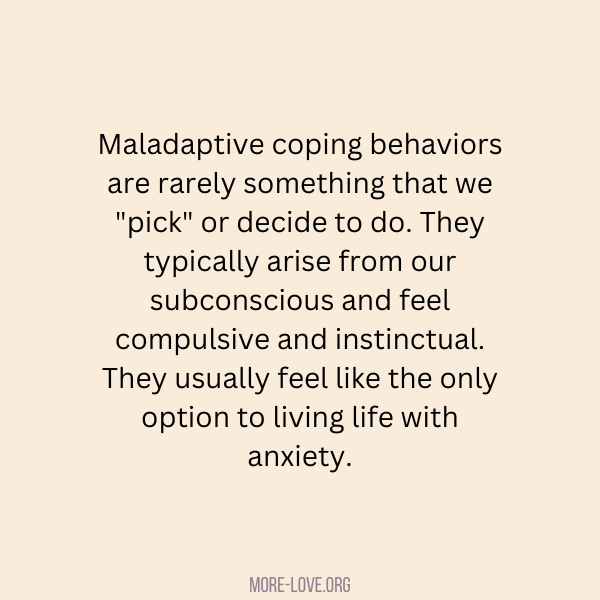
Maladaptive coping behaviors are rarely something that we “pick” or decide to do. They typically arise from our subconscious and feel compulsive and instinctual. They usually feel like the only option to living life with anxiety.

How to understand maladaptive coping behaviors and eating disorders

When a behavior becomes maladaptive

Most people can relate to at least one of the coping behaviors we listed. That’s because everyone uses coping behaviors, and they aren’t always maladaptive. For example, most people have used shopping, alcohol, food, and other maladaptive coping behaviors occasionally to cope with stress.

It’s important to recognize the difference between using something occasionally and feeling better and using something compulsively. A person who is stuck in a maladaptive coping behavior may notice that they feel:

  1. Compelled to use the behavior even if they don’t want to
  2. Ashamed of themselves for using the behavior
  3. Notice that they need the behavior more often and/or need a higher dose over time

These three elements can signal that someone is becoming dependent on a maladaptive coping behavior.

How can we stop maladaptive coping behaviors?

The most important thing to recognize when dealing with maladaptive coping mechanisms is that they are there to help. While they may look obviously destructive to other people, the person who is using them feels soothed and better when using the behavior.

This is why saying that someone needs to stop the maladaptive coping behavior “cold turkey” can backfire. Unless we replace the maladaptive coping behavior with healthy coping behaviors, we can cause more harm than good.

If we want a child or someone we love to stop using maladaptive coping behaviors like eating disorders, we need to help them uncover the stress they are trying to cope with. Then we need to help them build healthy coping behaviors so they can replace one with the other.

If we try to rip the maladaptive coping behavior away without recognizing the purpose the behavior is serving, we risk driving it underground or morphing into another form because we have not actually addressed the core problem.

Healthy coping behaviors include:

  • Self-compassion
  • Mindful meditation
  • Exercise or movement
  • Pursuing passions, hobbies, and crafts
  • Processing feelings mindfully, not automatically
  • Actively seeking care and attention from loved ones
  • Developing some distraction “tricks” to get through an anxious state, such as making a list of fruits and vegetables, naming all of the car manufacturers, or seeking a specific color in the environment.
  • Reaching out to a friend or family member for help
  • Getting professional therapy, counseling, or coaching
  • Participating in and feeling as if you belong to a community

We created this short video to illustrate maladaptive coping mechanisms.

How we feel feelings

When we are in a normal state, various feelings circulate in and out of our minds rapidly. However, when we have depression or anxiety, our feelings begin to get stuck in our orbit. Then, negative feelings become larger, while positive feelings become smaller.

At this point, some of us engage maladaptive coping mechanisms in an attempt to protect ourselves from these negative emotions. Unfortunately, when we use these coping mechanisms, we minimize and keep out positive emotions even more than before.

Feeling better in the short-term

Maladaptive coping mechanisms are behaviors that make us feel better in the short term, but in the long-term, they are very harmful. They are part of the psychology of eating disorders, self-harm, alcohol & substance abuse, sexual promiscuity, shoplifting, risk-taking behavior and compulsive lying.

Once we become dependent on our maladaptive coping mechanisms, we become emotionally weaker, and even less able to withstand negative emotions. But our maladaptive coping mechanisms convince us that they are the solution to our pain.

Even as our maladaptive coping mechanisms bring us to our knees, we are unable to see how they are perpetuating the pain we are trying to avoid.

โญโญโญโญโญ

Free Guide: How Parents Can Help A Child With An Eating Disorder

Master the secrets to supporting a child with an eating disorder. Thousands of families like yours are stronger today because of these six vital lessons drawn from lived experience, best practices, andย extensive study.

Adaptive coping mechanisms

Adaptive, or healthy coping mechanisms, are skills that we must learn in order to overcome our maladaptive coping mechanisms. If we try to stop our maladaptive behavior without learning healthy skills, we are unlikely to succeed. Healthy coping skills include learning to process emotions, learning to care for ourselves, and being assertive about our needs.

As we slowly learn these skills, we gain strength against the maladaptive coping behavior, slowly integrating our new tools for managing negative emotions. As we do this, positive feelings become more present in our lives. Over time, our feelings begin to circulate again. Even as this happens, and even as we begin to feel positive emotions again, we must be vigilant about practicing our healthy skills to ensure we can make a full transition and become truly recovered.

Recovery from maladaptive coping behaviors

People can and do recover from maladaptive coping behaviors like eating disorders. The key is to learn to “urge surf” or allow the urge to arise but respond with adaptive coping mechanisms.

Recovery means that we can live in the world and experience a broad variety of positive and negative emotions. We no longer need to rely on our maladaptive coping behavior to feel safe and secure.


Ginny Jones is the founder of More-Love.org, and a Parent Coach who helps parents who have kids with eating disorders.
See Our Parent’s Guide To Mental Health And Eating Disorders

Posted on Leave a comment

How to help your daughter inherit your negative body image

How to help your daughter inherit your negative body image

It might sound shocking, but the ways we talk about our own bodies and handle body image can deeply shape how our daughters see themselves. Without realizing it, many mothers unintentionally pass down negative body image attitudes that can shadow their daughtersโ€™ self-esteem for years.

Understanding these patterns is the first step toward breaking the cycle and fostering a healthier, more empowering body image for the next generation. In this article, we explore how negative body messages are inherited and how to stop them in their tracks.

Isn’t she perfect?

When Julia’s baby girl was handed to her, it began. “Is she perfect?” Julia asks. Of course, of course, she tells herself.

She checks each of her fingers and toes, strokes her head, and hopes for a future in which she will be happy and … well, to be honest, she hopes she will be thin. Because life is just easier for girls who are thin, she thinks. Because I want what’s best for her (and what’s best is to be thin), she thinks.

Thus begins a story of mothers, daughters, and body image.

At the playground, Julia watches her daughter and compares her body to the other children. She assesses: is she fatter than the others? Thinner?

Julia carefully observes all of the body types on the playground. Some are fatter, and some are thinner. Some are tall, and some are short. Is her daughter going to be “normal?” she wonders. Because normal is good. Normal is thin. And Julia wants what’s best for her baby girl.

All the right things

Julia makes sure to watch what her daughter eats. She’s careful about feeding her lots of fruits and vegetables. She prepares healthy whole foods and feels good about limiting sugar and snacks. When the doctor asks what she’s feeding her daughter, Julia feels proud and successful. She’s doing this right.

As she enters puberty, her daughter’s hips and thighs and belly and breasts get pudgy. Julia panics and worries, “is she going to get fat? That would be terrible! I need to help her avoid weight gain! It’s for her health! It’s for her future!”

Her daughter’s body grows and changes. Julia is very uncomfortable because now she sees a woman emerging. If she is not a thin woman, Julia believes she will suffer. She thinks that being thin is what we all want for our daughters, right?

Mothers and daughters typically have a shared body image. How Julia feels about her own body affects how she feels about her daughter’s body.

But something is wrong

Julia is not mean or bad. She hopes that her daughter has a socially acceptable body so she can avoid being teased, bullied, and discriminated against. She wants her to look great in photos and swimsuits. Julia hopes that when her daughter goes to the doctor, she’ll be told she’s healthy and well.

But Julia’s daughter is not healthy and well. Something’s wrong. Her mother’s careful attention to her body has interacted with a society that is cruel and dominating towards women’s bodies. She grew up in classrooms that taught some foods are good, and others are bad.

Julia’s daughter was weighed at school with her classmates and learned that weight is very, very important. She watched shows and movies where the heroines were thin, and the bad guys were fat. TikTok tells her that tiny waists and bare, tight midriffs are best.

In middle school, her friends start dieting, so she does too. Julia thinks it’s good that her daughter is taking responsibility for her health and making healthy choices.

At an early age, Julia’s daughter recognized the tremendous societal pressure to be thin. She internalized those beliefs. Now she believes that she is only worthy and can only be successful if she is thin.

An eating disorder

Julia’s daughter develops an eating disorder. Eating disorders are based on many factors. But it’s impossible to ignore the role of a very messed up social environment that tells females that to be successful, loved, and “good,” they must maintain small bodies.

It is impossible to ignore the relationship between mothers and daughters, body image and eating disorders. But eating disorders are not a mother’s fault. They are not a daughter’s fault.

Julia’s daughter’s eating disorder is not her fault. Her concern for her daughter’s weight makes perfect sense in our society. She has been doing the very best she could based on all the best information about how to raise a healthy child. But her well-meaning beliefs about fat and control interacted with our toxic culture, and now her daughter needs help.

A legacy of control

Julia grew up in the same diet culture as her daughter. And, of course, she couldn’t help but believe that raising a thin daughter is best. Being thin makes life easier. Being thin means her daughter will fall in love with someone wonderful. It means having an amazing career. if her daughter’s body is thin, it will never hold her back from living the life Julia dreams of for her.

And Julia has spent her life worrying about her own body. She doesn’t know another way. Julia sensed her own mother’s fear that she would be fat.

She spent her life watching her mother and every other woman she knew to watch her weight to fit the body ideal. Julia used Kate Moss, Monica Geller, and Ally McBeal for inspiration. She drank Slim-Fast and Diet Coke and did workout videos with Suzanne Sommers. Julia knows that to be successful and loved and worthy in this world means she must be thin.

Time to change

But now Julia sees now that it’s time to stop this madness. It’s time to realize that her daughter (and she herself) is worthy at any weight. That society’s messages about women, weight, and health are seriously messed up.

The problem is not Julia’s body or her daughter’s body; it is a society that tells women that they must stay tiny to be loved. It is a society that keeps half the population starving while simultaneously keeping us down, underpaid, and undervalued.

“No more!” says Julia.

Julia and her daughter decide that rather than try to control their bodies, they will accept themselves and each other. Rather than accept that their bodies need to be controlled and dominated and tiny, they’re going to love themselves and their bodies, no matter what they weigh or look like. Because they are more than bodies, and it’s time to start claiming their birthright and behaving like that’s true!


Ginny Jones is the founder of More-Love.org, and a Parent Coach who helps parents who have kids with eating disorders.

See Our Parent’s Guide To Body Image And Eating Disorders

Posted on Leave a comment

How to Talk to Kids About Advertising and Unrealistic Body Images

How to Talk to Kids About Advertising and Unrealistic Body Images

In todayโ€™s media-saturated world, children are constantly exposed to advertising that often promotes unrealistic and unattainable body images. These distorted portrayals can negatively impact kidsโ€™ self-esteem, body confidence, and relationship with food, factors that increase the risk of developing eating disorders.

As parents and caregivers, having open and age-appropriate conversations about advertisingโ€™s influence is a powerful way to help children develop critical thinking skills and a healthy body image. In this guide, weโ€™ll share practical tips on how to talk to kids about media messages, challenge unrealistic beauty standards, and empower them to embrace their unique selves.

Advertising is a danger to kids’ self-esteem and body image. And since advertising is everywhere, this impact is deep-reaching and serious. When we were kids advertisements were on TV, billboards, magazines, and buses. But today we also get served advertisements on social media. And since teens spend an average of eight hours and 39 minutes per week, that’s serious.

Self-objectification and advertising

Self-objectification is the practice of comparing yourself to other people and, importantly, media and advertising images of people. Self-objectifying behavior looks like comparing your own body to those of your friends, strangers, family members, and, of course, models, actors, and social media influencers. It’s basing how you feel about yourself on whether someone else is better or worse than you due to their physical appearance.

Ralph lauren advertising-2
Our children (and we) are bombarded with unrealistic and dangerous advertisements everywhere we go.

We can’t protect our children from these images and messages. But we can speak up and let them know how dangerous these images and concepts are. Objectifying images are dangerous to everyone. Unrealistic advertising hurts our kids, and it hurts us. It is not benign.

Nobody admits they are impacted by advertising. But in fact, we are all susceptible to its subconscious power to influence what we think is “normal” and beautiful. This leads to unrealistic expectations for ourselves and our children.

WTF?
This app is advertised on Instagram as a way to make this beautiful teen’s face unrecognizable.

Self-objectification and eating disorders

Almost all eating disorders are based on the desire to be thinner. Thus, most people who have eating disorders are engaging in self-objectification. Self-objectification is defined as looking at yourself as an object as if you are a third-party observer. When self-objectifying, most people are judging themselves as worthy or unworthy based on their physical appearance. This is particularly pervasive in girls and women due to the sexual objectification perpetuated in the media and advertising.

Fredrickson and Roberts identified self-objectification as “the first psychological consequence to emerge among girls and women as a result of living in a sexually objectifying cultural milieu.” Rather than valuing themselves based on how they feel or what they can do, someone who self-objectifies judges themselves based on how they appear to themselves as a third-party observer.

“An objectified body is a malleable, measureable, and controllable body. By viewing and treating themselves as sexual objects, it is argued that girls and women act as their own first surveyors in anticipation of being evaluated by others. Thus, the body becomes the site of reparative action and vigilant monitoring to manage the sexual objectification. When girls and women view themselves through this self-objectified lens, they take a peculiar stance on their own bodies that is fundamentally disruptive to the selfโ€“body relationship.”

Encyclopedia of Body Image and Human Appearance, Volume 2

Eating disorders are usually an attempt to control the body and make it appear more socially acceptable. When kids get stuck in eating disorder thoughts, we must consider how advertising has impacted them and whether self-objectification is a contributor to their eating disorder.

Talk about advertising

No matter how smart you are, and no matter how smart you think your children are, don’t be silent when it comes to advertising images and messages. Make sure you speak up every single time you see something that suggests impossible beauty standards or Photoshops away individual character.

Talk to your kids about how Photoshop has completely overtaken media, and that nobody can possibly look as good as the models do. Even “real people” on social media use apps to adjust themselves. They whiten their skin, remove “extra fat,” and slenderize themselves beyond recognition.

Our children deserve to feel good about themselves regardless of the size of their waist or color of their skin. They deserve to be more than a Photoshopped rendition of themselves.

Here’s a great TED Talk by Jean Kilbourne about the dangers of advertising and how it impacts us as a society.

How to respond to the danger of advertising on kids’ self-esteem

Parents must respond to the danger of advertising on kids’ self-esteem often. It’s not enough to have this conversation once or even twice. Given the huge quantity of media they are consuming on their phones, our kids need a lot of guidance on this topic. Here are seven things parents need to talk about to counteract the danger of advertising on kids’ self-esteem:

  1. Establish a firm household policy of body respect
  2. Don’t allow body bashing
  3. Don’t allow dieting or intentional weight-loss efforts
  4. Point out that most media images are “fake news.” Those people don’t really look like that – they are using filters, poses, lighting, makeup, and other techniques to look like that
  5. Talk about sexual objectification and how bodies are used to sell products and make money for corporations
  6. Discuss the extreme measures actors and models go to in order to look like that, including starving, steroids, and over-exercise
  7. Educate about the power of images and the impact of images on our brains. We must actively counteract the powerful media images to avoid the worst of negative body image and eating disorders

Ginny Jones is the founder of More-Love.org, and a Parent Coach who helps parents who have kids with eating disorders.

See Our Parent’s Guide To Body Image And Eating Disorders

Posted on Leave a comment

How to talk to your teen about stretch marks

How to talk to your teen about stretch marks

Stretch marks are a natural part of growing up, yet many teenagers feel self-conscious or embarrassed about them. As a parent, itโ€™s important to create a safe space where your teen can openly discuss body changes without shame or judgment.

Having honest conversations about stretch marks helps normalize these common skin changes and supports your teenโ€™s body confidence during a time of rapid growth and development. In this guide, weโ€™ll share effective ways to talk about stretch marks with empathy and reassurance, helping your teen embrace their bodyโ€™s natural story.

Rapid growth spurts

Teenagers experience rapidย growth spurts in new areas of their bodies during puberty. This rapid growth often leads to stretch marks. We still remember being surprised when our skin erupted in red lines and being terrified that they would never go away.

It’s around this time of puberty that many teens become self-conscious about their bodies and begin to feel as if they should hide the rounder parts of themselves, which they may believe are messy, big, and ugly. This can beย the beginning of disordered body image and bad-body thoughts that can lead to a lifetime of body shame. Negative body image and eating disorders are also strongly linked.

Protect your sweet child from this fateย by talking to her about stretch marks as a natural part of growth. Most stretch marks fade with time into silvery streaks, but even if they don’t, they are just a part of life. They don’t make them a freak of nature – they make them entirely natural and totally normal. Don’t hide your own stretch marks, and look for ways to normalize their development in non-hateful ways.

Remind your child thatย this is their body for life. No matter what goes on outside, they need to learn to love themselves inside, and body shame is hateful and means towards the self.

I was doing some research earlier on why we demonize stretch marks. I couldn’t find much so, I decided to type into Google “how to get rid of stretch marks” and I was absolutely appalled by what came up. First of all there were a total of 1.650.000 results telling how to get rid of them (ha. is it any wonder why we are unable to accept them) and secondly almost all of the articles stated “No woman WOULD or SHOULD like to have stretch marks on her skin” and “use potato juice and egg whites to get rid of them”.

Seriously who comes up with this stuff, it’s ludicrous – were constantly being told were not allowed to accept that we have them, nor love them. So in a desperate attempt to get rid of them we have to go and buy over a kg of potatoes and juice them ๐Ÿ˜ž

Not buying it

The truth is, there is absolutely nothing wrong with stretch marks and no cream, eggs whites or potato juice is going to get rid of them – they are normal, they indicate that your body has grown or is growing, changing and evolving.

I have them on both sides of my hips, I have them all over the sides of my bum and the tops of my thighs. The reality is, we all have or will get stretch marks, so there’s no need to shame them, or photoshop them or try to get rid of them

You see, stretch marks are just like freckles, tattoos, bruises, birthmarks, and scars, which are the coolest things ever – because hey, we started with an almost blank canvas and now look, these marks are like little bits of evidence that demonstrate that we have lived

We can’t stop them and we can’t nor should we “fix” them, so let’s normalize them and accept them as a part of who we are


Ginny Jones is the founder of More-Love.org, and a Parent Coach who helps parents who have kids with eating disorders.

See Our Parent’s Guide To Body Image And Eating Disorders

Posted on Leave a comment

How to respond (and what not to say) if you’re worried about your daughter’s weight gain

How to respond (and what not to say) if you're worried about your daughter's weight gain

Noticing changes in your daughterโ€™s weight can be a sensitive and worrying experience for any parent. How you respond to these concerns can deeply impact her emotional well-being and your relationship.

Itโ€™s important to approach the conversation with care, avoiding comments that may unintentionally cause shame, anxiety, or trigger disordered eating behaviors.

In this guide, weโ€™ll help you understand the best ways to express your worries with compassion and support, while highlighting what to avoid saying to foster a positive, open dialogue that prioritizes your daughterโ€™s health and self-esteem.

Responding with care

As she grows up, there will be times when you are worried about your daughter’s weight gain. It is very important that you think carefully before you say anything about this.

We live in a society that preaches that women’s bodies need to be thin and small, so it’s not surprising that parents often watch daughters’ bodies anxiously to monitor how well they will fit into the ideal body image. Many parents worry, based on harmful societal messages, that if a daughter is chubby or fat, she is unhealthy and will have fewer opportunities for success and happiness.

These worries make sense in our fatphobic society, but they are also incorrect and harmful. Your beliefs about women’s bodies and fat need to change if you want to raise a strong, healthy daughter. Because society is toxic to women, particularly fat women, but your home should be a safe place where her body is accepted and honored at any size.

A word about the word “fat”

The word fat can be used as a negative or a neutral descriptor. In its neutral form, saying fat is the same as saying thin, tall, or brown-eyed. Other words for fat bodies, such as overweight and obese, are currently considered to be stigmatizing. Many fat justice leaders have reclaimed the word fat as the preferred neutral descriptor for their bodies. As such, I typically use the word fat when referring to body weight as a physical feature.

However, due to our culture’s terrible history of weight-shaming, we should not call an individual fat unless we 1) are doing so kindly 2) have zero thoughts that they should lose weight; and 3) clearly have their permission to do so. And nobody should ever use fat as an insult. It’s always best to let people who live in marginalized bodies to define themselves rather than assuming a label on their behalf. And never tell a person in a larger body that they are not fat or should be proud to be fat. It’s their body and their choice to define themselves on their own terms.

Worrying leads to weight gain

Worrying about your daughter gaining weight will not stop her from being fat. And in fact, parents who worry about their kids gaining weight actually increase their child’s lifetime weight. That’s right: just being worried about your daughter’s weight gain could lead to a higher weight for her in life.

This is because weight is complex and dynamic. It’s not a simple formula as we’ve been told, and it’s mostly out of our conscious control. In fact, one of the best predictors of weight gain is intentional weight loss.

So before we talk about what you should say when you are worried about your daughter’s weight gain, we first need to address what you think about your daughter’s weight.

Girls are Biologically Coded to Gain Weight

During adolescence, girls become biologically prepared to make a baby. And making a baby requires body fat. As her hormones change, your daughter might go through remarkable body fat changes. Her body at 10 years old may not be anything like what she will look like at 16 and 20. Girls’ and women’s bodies are meant to change as they age.

Weight is in our Genes

The set-point theory of weight says that people are genetically pre-destined to weigh a certain amount. Identical twins raised separately to adulthood have startling similar body weights, regardless of their lifestyle, diet, or activity level. To think that you can change your set weight is like thinking that you can change your height or the length of your fingers. You just can’t.

Fat is not Proven to Cause Disease

There is no scientific proof that any disease is CAUSED by being at a higher weight. There is correlative evidence that diseases co-occur with severe obesity, but correlation is not the same as causation. The fact is that we don’t know enough about the complexity of the human body to determine how these correlations work.

Diets Don’t Work

There is no proven way to reduce a person’s weight for life. Of the millions of diets that work in the short term for millions of people, only 2-5% of people keep the weight off for life. At least 95% of everyone who diets returns to their former weight, often with a few extra pounds added on. Worse, dieting has been shown to lead to a loss of health, weight gain, and is heavily correlated with eating disorders.

Weight is a Feminist Issue

Ever since women have been rising in power, the focus on becoming smaller and thinner has risen as well. A woman’s weight is a major distraction from the impact she can make in the world. Attempting to maintain a low number on the scale is not where our daughters should be investing their intelligence.

Parental Criticism is Deeply Damaging

Eating disorders are complex and have no single cause. But many studies have observed a strong correlation between parental criticism and eating disorders. Children can’t separate their bodies from their sense of self, so if you criticize her body, you are criticizing her very being.

OK – So What Do I Say?

All right, so now that you know all that, what do you say when you notice that your daughter is gaining weight? Nothing. You say nothing about your daughter’s weight gain.

Don’t focus on her body. Never talk about reducing calories or the size of her body.

If she brings up her body as a negative thing, then learn how to respond to body bashing without making it worse. Here are some articles to help you get started:

Instead of talking about weight gain, talk to her about her emotional state. If she has signs of anxiety or depression, seek professional help immediately. Both can lead to weight changes and are strongly correlated with eating disorders.

Find out how she is feeling about life and her body. Support her in learning to eat intuitively and to tune into what her body wants and needs in terms of nutrition and movement.

Your daughter’s body is not the issue at all. It is her heart and her mind that you should be concerned about. If you believe she may have an eating disorder, get her evaluated. The sooner you help her, the better her chances are for recovery.

Being free of an eating disorder is a much better indicator of success and happiness in life than the number on the scale. 


Ginny Jones is the founder of More-Love.org, and a Parent Coach who helps parents who have kids with eating disorders.