Posted on Leave a comment

How do toxic cognitive distortions drive eating disorders?

How do toxic cognitive distortions drive eating disorders?

At the heart of many eating disorders are toxic cognitive distortions: rigid, negative thought patterns that distort reality and feed harmful behaviors. These thoughts, like โ€œIโ€™m not good enoughโ€ or โ€œI donโ€™t deserve to eat,โ€ can quietly take root, reinforcing shame, fear, and a desperate need for control. Understanding how these mental traps operate is key to breaking the cycle of disordered eating and beginning true healing. In this article, weโ€™ll explore the most common cognitive distortions that fuel eating disorders and how to start challenging them.

People who have eating disorders often exhibit 10 common cognitive distortions that are well known in psychology. Cognitive distortions are a hallmark of anxiety, depression, eating disorders, and many other mental disorders. The good news is that cognitive therapy is very effective, and parents can do a lot at home. Counteracting cognitive distortions can help people gradually replace distorted thinking with healthy, adaptive thinking.

The 10 cognitive distortions and eating disorders

The cognitive model was developed by Aaron Beck in the 1960s. The theory suggests that individuals’ perceptions of their experiences impact their emotional, behavioral, and physiological responses. By addressing and correcting these misperceptions, as well as modifying unhelpful thoughts and behaviors, individuals can experience improved reactions. This is the foundation of Cognitive Behavioral Therapy (CBT).

Cognitive distortions refer to negative or irrational thinking patterns that can have detrimental effects on motivation, self-esteem, and contribute to issues such as anxiety, depression, eating disorders, and substance abuse. Here are some examples of how the 10 cognitive distortions can impact an eating disorder. These are common eating disorder thoughts that are addressed during treatment.

1. All-or-nothing Thinking

Someone who has an eating disorder often has what is commonly called “black-or-white” thinking. Nothing in nature is only one way or another. We all exist in the gray areas in between.

Eating disorders are based on the concept that food and weight are black and white issues. For example, a child might think “I’m fat” if they have even an ounce of fat on their bodies. This is despite the fact that all bodies must have some fat in order to be alive. They think “I ate too much” if they have stomach fullness. But feelings of fullness and satiety are perfectly natural biological feedback. They think “sugar is bad” even though sugar is just a food and is part of a normal diet.

Try this: If you see your child suffering from all-or-nothing thinking, intentionally talk about the gray area. If you’re watching a TV show together and the characters believe there are only two options, talk about how there are always many options. Notice when you make statements that support all-or-nothing thinking and correct yourself out loud in front of your child. If your child shares all-or-nothing thinking like “if I start eating I’ll never stop,” respond with something like “I know it can feel that way, but I don’t think your only options are either eat nothing or eat everything. There’s so much space in between.”
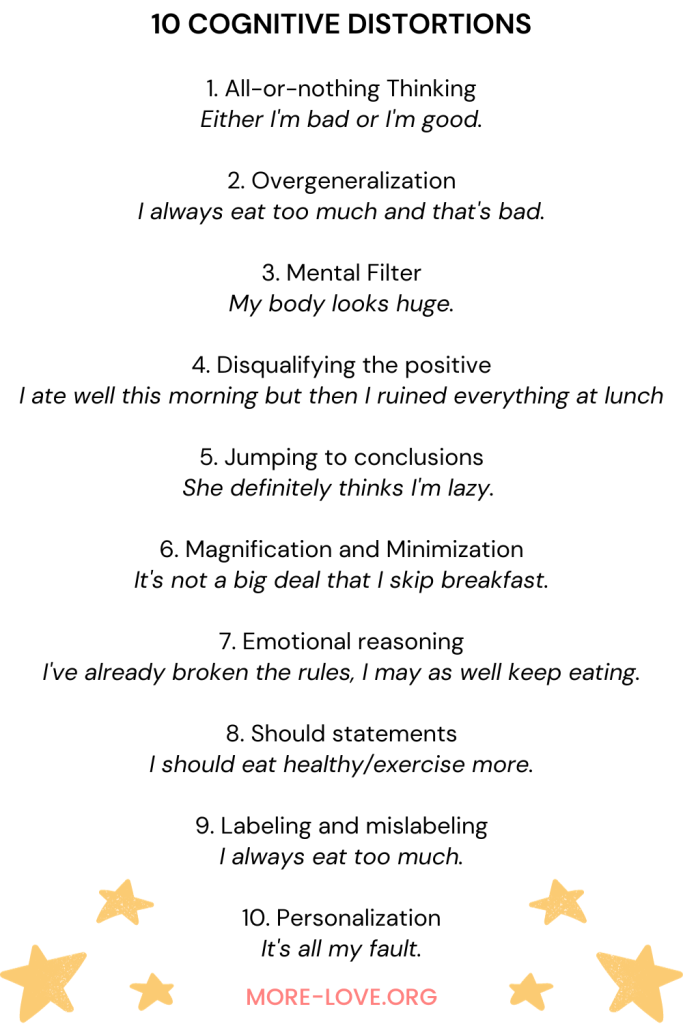
10 cognitive distortions that support eating disorders

2. Overgeneralization

Someone who has an eating disorder tends to take note of negative experiences. They conclude that if they happen once, they will happen over and over again.

For example, they may think “I always overeat, and that’s why I’m fat.” This is even if they barely eat anything most of the time and then, to compensate, occasionally binge eat. If they fail to meet an arbitrary weight goal, they think “I’m never going to lose weight and will be lonely and miserable my whole life.” Overgeneralization feels like the absolute truth. This is despite the fact that many people may tell them in specific terms that they are incorrect.

Try this: Notice when people make sweeping statements that overgeneralize the human experience. For example, if you’re talking about a neighbor who “never mows his lawn,” correct yourself and say “actually, that’s not true. He mows it, but just not as frequently as I’d like him to. If your child makes an overgeneralization like “Nobody recovers from eating disorders,” say something like “I know it can seem like an impossible task, but lots of people do recover.”

3. Mental Filter

When a child has an eating disorder, they tend to create an inaccurate mental filter of how they appear and who they are. They see themselves as if through a distorted fun-house mirror.

This is seen in body dysmorphia, which commonly occurs with eating disorders. They literally see their bodies in a way that they do not exist. They may see bulges and bumps that are not there to any but their own eyes. Over time, they find it almost impossible to view themselves in any other way. This happens even when others objectively and authoritatively tell them that they are incorrect.

Try this: The next time your child tells you their body is imperfect, don’t automatically tell them they are beautiful and perfect. Instead, let them know that you understand they see a distorted view in the mirror. Just like those warnings on car mirrors, “objects in mirror are closer than they appear,” the mirror is not an accurate representation of reality. If they are struggling to see themselves, tell them that you see their beauty – inside and out – and will hold that for them until they can do the same.

โญโญโญโญโญ

Free Guide: How Parents Can Help A Child With An Eating Disorder

Master the secrets to supporting a child with an eating disorder. Thousands of families like yours are stronger today because of these six vital lessons drawn from lived experience, best practices, andย extensive study.

4. Disqualifying the positive

People who have an eating disorder have an amazing ability to take neutral or positive feedback and turn it into something that reflects negatively upon themselves.

For example, if someone tells them they look nice, they may say they gained weight. If someone tells them they’ve lost weight, they may say that it’s not enough – they still have more to go. If someone tells them they are a healthy eater, they tell them they are far from perfect and need to be better.

This becomes compulsive. They are unable to accept a neutral or positive comment without washing it away with something self-deprecating. The belief behind the disqualification is typically some “fatal flaw” or belief of being “less than.”

Try this: Rather than debate with your child when they disqualify the positive in themselves, let them know that you see it. You don’t have to convince them of their positive elements, but you can tell them that you hold them in your heart and mind. Tell them your vision of them is multifaceted and dynamic, and you will continue to hold that no matter what they say or do.

5. Jumping to conclusions

Many who have eating disorders believe they can read other people’s minds, especially when it comes to negative feelings towards themselves. They may “know” that someone thinks they’re fat and ugly, stupid and lazy, or any other negative belief.

Their mind-reading efforts are almost limitless. They will read the minds of people who are actually not even aware of their presence. And they can obsess about what a person who passed them in a hallway was thinking about them even when the other person actually had no thoughts at all! Sometimes they take mind-reading to epic proportions and confront people about their supposed thoughts with no evidence.

This can have disastrous effects and result in a self-fulfilling prophecy. They begin to shape the way people see them.

Try this: Listen for when your child jumps to conclusions about what other people think and believe. Say “I can understand why you think that, but I also believe we can’t read other people’s minds. Often when we think one thing, it turns out that we are wrong.” You don’t need to get into a debate about the validity of what you’ve just said. That will only weaken its power. Just let it stand.

6. Magnification and Minimization

This is a habit in which a person who has an eating disorder magnifies their perceived flaws while simultaneously minimizing the idea that there is a problem with how they perceive themselves.

For example, they may think “I’m so disgusting, nobody will ever love me, and I’m going to be sad and alone forever.” If they actually say this out loud, a loved one may become concerned and urge them to seek treatment.

At that point, they will switch to minimizing the problem. They may say “everyone feels like this, I’m nothing special. Life is just hard.” Minimization is partly how they deny the severity of an eating disorder. It gives them the belief that they are not sick enough to warrant treatment.

Try this: It’s important for parents to neither over- nor under-react to these situations. The more you can stay steady and calm in the face of magnification and minimization, the greater your chances of showing your child that there is always a middle ground. No, they may not be the sickest person ever, but they may still have some concerning behaviors that you believe deserve care and attention.

7. Emotional reasoning

When a person has an eating disorder, they take their emotions and emotional thoughts as evidence of the “truth.” This means that if they think they are fat, they must be fat. If they think they eat too much, they must eat too much.

This can also be seen in binge eating mentality, which can begin with “I’ve already broken the rules, I may as well keep eating.” Emotional reasoning is dangerous because thoughts and beliefs are not usually facts. In fact, usually the first, easiest thought that comes to mind is a societally-driven, conditioned thought.

This is classically experienced as “I feel fat.” In our society, “fat” is a euphemism for any number of emotions. These emotions include depressed, lonely, sad, angry, scared, etc. When someone gets stuck in emotional reasoning, they forget to look deeper at their thoughts. They take them at face value rather than utilizing them as signals pointing them towards what is really upsetting.

Try this: Talk to your child about the idea of having a first thought and a second thought. The first thought is a knee-jerk reaction based on our societal conditioning. We need to tap into our conscious thought and look for the second thought, which is almost always much more nuanced and realistic.

8. Should statements

Maintaining an eating disorder is often based on “shoulds.” The most common shoulds are “I should lose weight,” and “I should eat healthy/exercise more.” These shoulds come directly from our society. They are reinforced in almost every aspect of life until they become so pronounced that people notice them as the problematic beliefs they are.

The trouble with should statements is the shame that accompanies them. People inevitably break their shoulds. Our behavior will inevitably fall short of our expectations when we are should-ing all over ourselves.

When a person succeeds in meeting their shoulds, they may feel a temporary sense of self-righteousness. But this is always followed by the terrible fall into bitterness and shame when they inevitably fail something else.

Try this: When your child says “should,” gently remind them that they always have options, and there is rarely a single right solution to any problem. Encourage them to think more deeply about why they believe they “should” do something and help them loosen up those beliefs that are holding them hostage.

9. Labeling and mislabeling

The deeper a person gets into an eating disorder, the more they feel they need to label ourselves, and ultimately it comes down to whether they are “good” or “bad.”

They don’t say “I ate a big meal at lunch today.” Instead they say “I always eat too much.” They don’t say “I carry my body weight in my hips.” Instead they say “My hips are huge.”

These big labels help them feel we have some measure of control over their bodies. This is a false belief because except in very extreme cases our bodies will find a way to achieve the genetic blueprint that largely determines our weight and shape.

A person who has an eating disorder often mixes up who they are as a person with how they appear in their body. A person is not a body – we is infinitely more flexible, adaptable, and interesting. When we define ourselves based on our bodies, we suffer tremendously and deny the world of a bright mind and unique self.

Try this: When your child labels their whole self as some version of “good” or “bad,” talk to them about the idea of “parts of self.” All of us are multifaceted and dynamic. We are not a single monolithic being that can be labeled. If your child says “I’m angry,” say “it sounds like there’s a part of you that is angry right now.” This is a crucial reframing that takes them from a monolithic view to a parts-based, temporary view.

โญโญโญโญโญ

Free Guide: How Parents Can Help A Child With An Eating Disorder

Master the secrets to supporting a child with an eating disorder. Thousands of families like yours are stronger today because of these six vital lessons drawn from lived experience, best practices, andย extensive study.

10. Personalization

Many people who have eating disorders take things very personally. They believe that they are personally responsible for other people’s feelings and actions. This means they carry a heavy emotional load that does not help anybody.

Personalization is a terrible situation in which a person gets stuck pointing our fingers at themself, no matter what happens. If they don’t lose weight because their body’s metabolism slowed down, it’s their fault. They also believe that the size of their bodies is responsible for how other people feel.

They may believe that if they maintain a thin body, their parents will feel good and other people will like them more.

Of course, this is not true. If people have any feelings about the weight of another person’s body, that is because they have weight stigma. It has nothing to do with the other person’s body, and everything to do with them. Other people are completely responsible for their own choices, beliefs, and behaviors. While we have influence in relationships, we are never responsible for another personโ€™s feelings.

Try this: Remind your child that they are not personally responsible for anyone’s feelings and behavior except their own. When other people behave badly, that is their reaction to external factors. We do not control other people’s reactions. It’s important to model this in your parent-child relationship. Instead of saying “you make me so mad!” say “I’m feeling very mad right now, and I need a minute to settle myself down.” This way you show them that you are responsible for your feelings and for responding to them appropriately.

Parents can help reduce cognitive distortions

While food and weight issues are the symptoms, cognitive distortions are part of the psychology of eating disorders. The eating disorder behavior is an attempt to manage the cognitive distortions. When parents know to look behind the behaviors to the root causes, they can help their child recover. The more we understand and tend to our child’s emotional health, the better.

FAQs about cognitive distortions and eating disorders

What does “cognitive” mean?

Cognition is defined as thinking, knowing, remembering, judging, and problem-solving.

What are “cognitions”

Cognitions are typically defined as thoughts, beliefs, judgments, and opinions.

What is a “cognitive distortion?”

Cognitive distortions are often distorted thoughts and thinking patterns that get in the way of feeling good about oneself and others.

How are cognitive distortions related to eating disorders?

Cognitive distortions both cause eating disorders and are a symptom of an eating disorder. That’s why changing cognitive distortions is a key part of treating eating disorders. There are 10 cognitive distortions that often lie beneath the surface of eating disorder behaviors. These cognitive distortions may linger after eating disorders have otherwise receded. It is a good idea to be aware of these cognitive distortions and continue your child’s therapy as long as these distortions are present.

What are the most common cognitive distortions with an eating disorder?

Common cognitive distortions for people with an eating disorder include believing that they have to be thin to be loved, that losing weight is a requirement of being accepted, and that controlling food and weight will result in a better life. With these cognitions in place, a person might use eating disorder behaviors like food restriction, over-exercise, and purging. These behaviors will lead to binge eating for some, but not others.


Ginny Jones is the founder of More-Love.org, and a Parent Coach who helps parents who have kids with eating disorders.

See Our Parent’s Guide To Mental Health And Eating Disorders


Posted on Leave a comment

Why It’s Perfectly Safe And Totally Fine To Eat Candy

Why it's perfectly safe and totally fine to eat candy

Halloween doesnโ€™t have to be haunted by fear, especially not fear of candy. While diet culture loves to sound the alarm about sugar, the truth is that enjoying Halloween candy is not only safe, itโ€™s a normal and joyful part of childhood.

Restricting or moralizing candy can actually do more harm than good, especially for kids who are building their relationship with food. When we let children eat candy without shame, we teach them trust, balance, and body respect. This Halloween, it’s time to tune out the fear-mongers and remember: candy is just candy, and food freedom is far sweeter.

Let kids eat candy

It’s tough because right now candy is everywhere. Every store, every desk, and every place we go seems to be offering up tiny bites of sweetness. If you’re like many people, you studiously forbid yourself from succumbing to the temptation of candy … most of the time. But there are probably days when you just can’t resist, and then you binge, feel horribly guilty, and pretty sick.

You say things like:

“I love candy so much, but I mustn’t eat it! I’ll ruin my diet!”

“I love chocolate, but once I start, I just can’t stop.”

“I ate an entire bag of candy yesterday – I don’t know what’s wrong with me!”

And if you see your kids eating candy you feel like a bad parent. You worry that you’ll permanently damage their health if you allow them to eat Halloween candy. There are lots of articles out there teaching parents how to restrict Halloween candy, but this article is different. In this article, I want to encourage you to eat the Halloween candy … and let your kids eat it, too!

You think it’s you

Maybe you think you or your kids are addicted to candy. That you have some fatal flaw that removes your self-control and forces you to consume massive amounts of candy. You probably think your kids have this flaw, too. You’ve seen them inhale an entire bowl of M&Ms in one sitting. It’s bad! It’s not right! Sugar is evil! You have to stop them!

Sugar is the nutritional bad guy right now. Many people say that sugar is addictive. If you consume popular media, then you probably believe that sugar is terrible and that you and your kids are addicted. And there’s only one place for people who give into their sugar cravings, and it’s a shame-filled room where you stand up and introduce yourself as someone who is “An Addict.”

Here’s the truth

You’re not alone in this. Your kids aren’t, either. But there’s a crazy secret that you don’t know yet. You are giving the candy way too much power over your life. Maybe you think that you have to avoid candy because once you start eating it, you can’t stop. You think that it’s impossible for anyone to have self-control around candy. You have been told that eating candy will instantly add inches to your waist and can even give you diabetes. And you believe you have to control your kids’ candy consumption for the same reason.

But it’s not true!

Too many people live in fear of candy and other foods that we consider “off limits.” We can develop symptoms of anxiety just being in the presence of foods that we have decided are scary. Fear of food is a symptom of disordered eating. If you or your child is afraid to eat candy, or if you are afraid that your child eats too much candy, then it is time to get some help and put candy in its place.

Life may be scary on many levels, but none of us need to live in fear of a food item.

Here’s the secret

Your body only wants a whole bag of candy right now because you’ve been giving candy power by denying your body for so long. Your body hates being restricted, so it acts out, like a stubborn toddler. It sulks and complains, and then, when you aren’t watching, it sneaks out of the house and does things to get back at you for trying to control it.

When you restrict the candy, you turn yourself into a dictator over your body, and your body will rebel. You will consider yourself “good” and “perfect” until one day something snaps, and you end up with candy wrappers everywhere and a very bad stomachache. You think this is further proof that you should never, ever eat candy. But that’s not true. The problem is that you restricted candy in the first place.

The solution is to eat Halloween candy!

Eat the candy, but enjoy the candy openly and honestly. Give yourself and your kids permission to eat candy whenever you want candy. Give up the diet mentality that you must control all foods, and trust that your body doesn’t actually want to live on candy alone. It’s true. It really doesn’t.

You are not unique. It has been consistently shown that, given unlimited food choices, most people will naturally even out their intake to provide a healthy balance for their individual bodies. Researchers who study Intuitive Eating don’t get as many book deals as the people who tell us to be afraid of food. But we have known for decades that the more you restrict “forbidden” foods, the greater the likelihood that you are also binging on those foods.

And the same is true for our kids. If we don’t let our kids eat Halloween candy, we set them up for restriction and binge eating. And that’s much less healthy than a little sugar now and then.

Try this instead

Instead of trying to resist candy, slow down and pay attention to your cravings and the candy. Bring candy out of the closet. Bring mindfulness to your food, and you will find your relationship with it transformed. Instead of criticizing yourself and the candy, try asking:

“Do I want the candy?”

“How does this candy taste?”

“Would I prefer a different candy to this one?”

“Do I want to eat more candy right now?”

When we approach candy (and all food) with curiosity instead of judgment, the candy becomes “just food,” instead of the forbidden fruit. Now we can figure out if we even actually like candy. When we take this approach, it’s definitely OK to eat Halloween candy. If we like it, then we should sit down and enjoy it, just like we would an apple or a kale salad. We shouldn’t eat it in secret or with any sense of shame. When we stop feeling shame about our food, it loses power over us.

The same goes for our kids. If we have restricted them, then they are likely gorging on candy when given the opportunity. When we give them food freedom while asking curious questions and expecting all food to be eaten peacefully and without hiding, our kids will stop sneaking forbidden candy, and will naturally find a candy intake that makes sense for their individual bodies.

Trust your body

When we treat our bodies and our kids’ bodies with respect and trust, they honestly don’t want to eat a whole bag of candy. It’s OK to eat as much Halloween candy as feels good for your body. And you may be surprised that, once you remove the restrictions on candy, you can actually pay attention to how it feels in your body. The fewer limits you put on the candy, the less power it has over you.

And then you start to notice that you have preferences about the type of candy, when you actually want it, and how you want to eat it. Over time, candy gets a normal place in your life. You realize that it’s OK to let yourself and your kids eat candy, not just at Halloween, but anytime!

It doesn’t matter how much candy you eat, as long as it’s your body that’s making the decision, and not your diet-ridden, shame-filled brain. The key is to listen to your body’s feedback rather than trying to circumvent its intelligence and tell it what to do.

Trust your kids’ bodies

Most importantly, trust your kids’ bodies. You don’t have to control their candy intake. Their bodies will do it for them. Honestly. Speak with anyone who has read and implemented books from Ellyn Satter and you will hear surprise and awe about their experience with trusting their toddlers’ bodies to self-regulate.

“We were constantly fighting over candy and I was driving myself crazy, forcing veggies on my 3-year-old,” said one parent. “A year later, after I started following Ellyn Satter’s advice, my kid was still eating candy, but then she would go to the fridge and get herself some carrots and hummus. She was actually balancing her diet without any input (or nagging!) from me! I was amazed and humbled.”

Diet culture is dead wrong

It’s not easy in our society, because we are all taught the diet culture from birth, which is that if we don’t control what we eat, we are bad. And guess who is there to save us from ourselves? The diet industry! All the diet books assure us that if we restrict certain food groups, certain nutrients, certain fats, and overall calorie intake, we will maintain a slim body and, most importantly, be worthy of admiration.

We are told that we can’t follow our body’s cravings, because then we will all turn into couch potatoes who provide zero value to society.

It’s a big, fat lie. The documented truth is that 95% of people who lose weight because of food restriction (diets) regain all the weight they lost plus more within one to five years, and the vast majority have regained it within two years (UCLA). The multi-billion dollar diet industry is an industry that preys on our insecurities. It lies to us.

Enjoy the candy

Don’t restrict and boss around your body anymore. Let it be. Eat candy at Halloween or anytime. When you trust it, your body will become a healthy ally, and you will be significantly happier and healthier than someone who chronically restricts their food intake. And the same goes for your kids.

Let your kids enjoy candy

Even if you can’t do it for yourself, please don’t restrict your kids. Our kids’ bodies are precious. They deserve to grow up being trusted and believed in. We need to normalize all foods (including candy!) and all body sizes, and we need to let go of fear-based food restrictions, which are so very harmful and can directly lead to disordered eating behavior and full-blown eating disorders.


Ginny Jones is the founder of More-Love.org, and a Parent Coach who helps parents who have kids with eating disorders.

See Our Parent’s Guide To Holidays With An Eating Disorder

Posted on Leave a comment

How to be a good co-parent when your child has an eating disorder

How to be a good co-parent when your child has an eating disorder

When your child is struggling with an eating disorder, co-parenting takes on a whole new level of urgency and complexity. Whether youโ€™re married, divorced, or navigating a blended family, the way you and your co-parent communicate, support each other, and respond to your childโ€™s needs can significantly impact their recovery.

Eating disorders thrive in secrecy and conflict, but healing grows in safety, consistency, and connection. Even if you and your co-parent donโ€™t always agree, learning how to work as a team can make all the difference. This guide offers practical, compassionate advice for showing up as steady, united caregivers during one of the hardest times your family may face.

1. Let go of the guilt

Let’s begin by addressing the elephant in the room: your divorce. You may worry that your divorce has negatively impacted your child. You may even secretly wonder whether your divorce directly led to your child’s eating disorder. But let’s be absolutely clear: you made a decision and did what was best for you. Nobody chooses divorce because it’s easy. You chose divorce because you had to. For whatever reason, divorce was the path your marriage had to take.

And yes, divorce does impact our kids, but the impact doesn’t have to be disastrous. Even a divorce that went really badly can still turn out to be OK with your kids. The first thing you have to do is lose your guilt about the divorce because we simply can’t parent effectively from a place of guilt.  Accept that your divorce is a part of your kids’ life, and work from that place.

2. Accept your ex

This may be the hardest part of co-parenting after divorce. The fact is, you chose to divorce your ex, and there’s a good chance that if you hadn’t had kids together, you wouldn’t choose to spend time with your ex. Being required to find a way to work with someone whom you chose to divorce is asking a lot. Let’s acknowledge that, and do it anyway.

The only way you can effectively co-parent with your ex is if you learn to accept your ex’s strengths and weaknesses. You simply won’t be a good co-parent if you’re constantly seething about your ex. This may seem insurmountable since those weaknesses are probably the very things that drove you out of the marriage.

But here’s the good news: you’re not married anymore. You don’t have to agree with your spouse – you just have to accept them. There’s a huge difference, and it’s in the difference between agreement and acceptance that we can find the key to co-parenting.

3. Agree on some basic values

When you have a child who has an eating disorder you are parenting in a crisis. There is a lot to figure out, and somehow you have to get on the same page. One way to do this is to agree upon some basic recovery values that you’re both going to follow. For example:

  • We value our child’s health and are willing to learn new things that challenge our beliefs to accommodate our child’s recovery.
  • We value treatment and will share the expenses and travel burden and attend therapy together if recommended.
  • We value respectful relationships and will work to accept our differences, avoid drama, and treat each other with respect.

Agree on just a few values that you can both easily agree are important. Write them down, and keep them nearby. Whenever a problem arises between you regarding parenting, reference your shared values, and use them to guide your co-parenting efforts instead of relying on emotion.

4. Agree on some basic rules

Rules differ from values in that they are firm and don’t invite discussion. Values may shift, and we may engage in debate to determine how the best fit a situation, but rules should be clear-cut and definitive. For example, some family rules when a child has an eating disorder may include:

  • No dieting: this means that absolutely no weight loss efforts should be taking place in the entire household.
  • No body talk: this means that nobody should engage in fat-talk, fat-shaming, or any body-oriented talk about themselves or anyone else.
  • No tracking apps: fitness trackers can be a real challenge for anyone who has an eating disorder. Nobody should wear them.
  • No scales in the house: scales can drive eating disorder behaviors and derail eating disorder recovery. You should remove all scales from the house.

It’s important to know that most of us will make mistakes and struggle to meet rules like this. Try not to come down too hard if your ex has trouble maintaining these rules. However, do write them down, agree to them, and discuss them regularly. Check in with your ex to make sure they are maintaining these rules in their household.

5. Think about what’s best for your child

It’s normal to want to hold your child close during eating disorder recovery. But make sure that if you suggest making any changes to custody and visitation agreements you are acting legally and in your child’s best interest. Custody is tricky, and there is no best answer.

It may be that in early recovery your child may benefit from staying in a single household. It may be that one parent has more flexibility and thus can take a more active role in your child’s treatment. But never ignore the fact that community and family connections are a tremendous asset in eating disorder recovery. If your child has deep roots and gains fulfillment from spending time with your ex’s family and is a part of their community, then find ways to maintain those elements in their life throughout treatment.

If your child asks for a change in custody or visitation during treatment, try to approach it with an open mind. Work with your ex to try and remove your emotional response to such a change, and seek the solution that works best for your child right now. Work with a therapist or coach for guidance on this topic.

6. Speak up

If your ex is unable to meet you in the middle – if you’ve really tried to set values and put your child first, but it’s just not working – then it may be time for you to speak up more assertively. Your child’s recovery from an eating disorder must be your first priority. If your ex is threatening your child’s recovery by enabling eating disorder behaviors, you may need to get some legal support and protect your child. Be very, very careful with your actions, however, as they can backfire and have unintended consequences.

Consult an expert, and seek the truth inside of yourself to identify whether you are advocating for your child or responding to your own pain and suffering from the divorce. There’s nothing wrong with the fact that you find it hard to co-parent with your ex, but it’s not OK to sacrifice your child’s health because you are not able to rise above and parent from a place of maturity.

Co-parenting with an eating disorder adds complexity, but it’s well worth working towards shared goals as your child recovers.


Ginny Jones is the founder of More-Love.org, and a Parent Coach who helps parents who have kids with eating disorders.

See Our Guide To Parenting A Child With An Eating Disorder

Posted on 2 Comments

How To Talk To Your Adult Daughter About Her Weight

How to talk to your adult daughter about her weight

Itโ€™s natural to worry about your daughterโ€™s well-being, but when it comes to weight, even the most well-intentioned comments can cause deep harm. If youโ€™re considering talking to your adult daughter about her body, itโ€™s important to pause and reflect on the potential impact of your words.

In a culture steeped in weight stigma and unrealistic beauty standards, conversations about weight often trigger shame, damage trust, and strain parent-child relationships. Below, I respond to a worried mom who wants to do the right thing, helping her take a compassionate, respectful approach that prioritizes emotional safety, body autonomy, and lasting connection over appearance-based concerns.

Dear Ginny, 

I really want to talk to my adult daughter about her weight, which keeps going up. When I get together with her, she binge eats a lot of unhealthy food. When she was growing up, she was always on the chubby side, but she dieted a lot and generally kept her weight under control until she got to college. I always taught her to watch her weight, how to count calories, and tried to model healthy behavior. Now she is 28 years old and she’s gained so much weight. I see her eating all sorts of foods like cupcakes, chips, soda, and french fries. What can I do when I see my grown daughter binge eat like that? Can I tell her I’m concerned about her weight? Should I ask her if she has binge eating disorder? How can I help her lose weight without offending her?

Signed, Worried Mom


Dear Worried Mom,

I can understand why you are concerned, and I can hear how much you love your daughter. But she’s an adult. That means a few things. First, she is responsible for her own health now. You can support her, but advice can be tricky. Listen more than you advise. Focus on being curious rather than making recommendations.

Second, as a larger woman, she is absolutely aware of her weight already. A lot of times people think larger people need to be informed of their weight and the dangers of living in a larger body. Trust me on this: she’s heard it all. Any attempt to talk to your daughter about her weight that assumes she’s not aware of her size will infantilize her and inflict weight stigma. It will not help her and it could damage your relationship.

Unpack your assumptions about weight and health

In our culture, we make a lot of assumptions about food and weight, and when a person is larger we tend to blame that on their eating habits, forgetting that almost all people, including thin people, eat a variety of food, including cupcakes, chips, soda, and french fries. The assumptions you make about her weight and eating habits can get in the way of truly caring for your adult daughter and having a positive impact on her health.

First, regarding weight. You say that your child was on the chubby side. It’s hard to live in a larger body in our society. I would imagine that she was criticized for her weight. This might have led her to start dieting and controlling her weight, which might have seemed like a good thing at the time. But actually, this worked against her. Dieting is a risk factor for both weight gain and eating disorders.

In almost all cases (+95%) when a person intentionally loses weight, they will experience weight cycling. They regain all the weight they lost, often plus a little more. Weight cycling creates metabolic changes that can remain indefinitely. In other words, dieting to lose weight creates weight gain in almost all cases.

Dieting is the No. 1 predictor of weight gain and eating disorders.

I’m telling you this because I know that you are very concerned about her health, and I know you want to talk to your daughter about her weight, but focusing on her weight is counterproductive. We live in a society that blames and shames people for their weight.

But true health is not achieved by trying to control weight but by healing a person’s relationship with food and their body. Your job is not to help your daughter to control her weight, but to help her accept and love herself for who she is.

Don’t talk to your daughter if your message is that she needs to lose weight

People like your daughter feel the weight of our society’s blame and shame. The problem may look like it’s the number on the scale, but the real problem is that she’s been blamed and shamed for living in a body that doesn’t fit into narrow societal expectations. I know you want to help your daughter, so I’ll be blunt: if you talk to her about her weight, you will likely make things worse for her health and your relationship.

You mean well, but based on the things you said in your letter, it’s going to be hard for you to have a positive, productive conversation with her about weight right now.

I’d like you to consider your daughter’s eating patterns as if she were a thin person. If your grown daughter were thin, would you worry that she binge eats cake, fries, and other fun foods? Most people eat these foods, but we are conditioned to notice it more and criticize people who are living in larger bodies because we assume that they are larger because of the way they eat.

This is a false assumption. In fact, people who are in larger bodies often consume the same or fewer calories and eat a diet equal to that of many people who are in smaller bodies. A larger body is genetically primed to have a slower metabolism and be more efficient in extracting nutrition. And if a person has dieted, they have further reduced their metabolic rate. These factors are out of your daughter’s control. You cannot change her genes or past weight cycling.

So, really think about how your daughter eats in light of this common bias. Is she really eating “too much” or are you assuming she eats too much because her body is large? Are you sure you are seeing a “binge,” or just your grown daughter in a larger body eating food?

Is it binge eating disorder or just eating?

Binge eating disorder is the most common eating disorder, but it is also terribly misunderstood and frequently mistreated by loved ones, healthcare providers, and even eating disorder treatment providers. This is due to weight stigma and diet culture.

So we want to unpack your assumptions before jumping to the conclusion that she has binge eating disorder. At the same time, if she does have an eating disorder, then your support can help her find healing. Here are the symptoms of binge eating disorder:

  • Feeling a sense of being out of control while eating substantial quantities of food
  • Skipping meals in an attempt to “make up” for binge eating episodes
  • Going on diets and trying new ways to lose weight
  • Eating rapidly and/or until uncomfortably full
  • Eating in secret due to embarrassment
  • Feeling disgusted, ashamed, and guilty about eating

If your adult child has an eating disorder, then she is in a lot of pain. And this pain goes beyond eating. Here are some of the signs of an eating disorder that have nothing to do with eating:

  • Avoiding social situations due to fear of being seen as “fat” and/or not wanting to be seen eating
  • Exhibiting signs of body shame like hiding her body in large clothing, trying to make her body appear as small as possible in social situations, etc.
  • Withdrawing from and avoiding close relationships
  • Seeking comfort with behaviors like drinking, gambling, shopping, etc.

If you suspect she may have an eating disorder, consider the following actions:

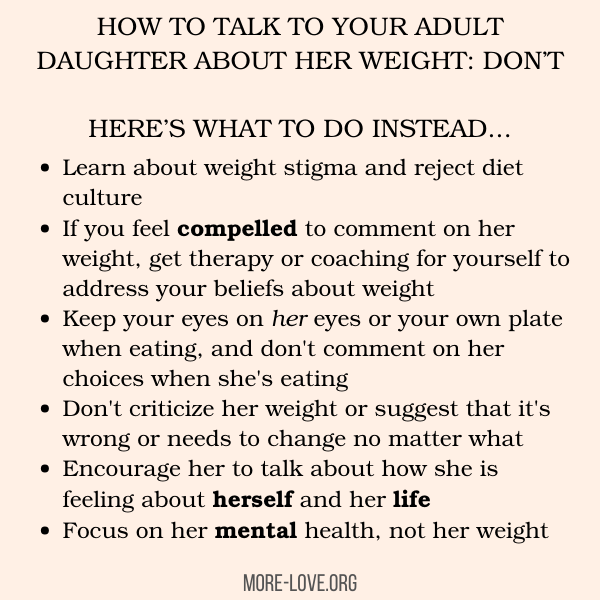
  • Learn about weight stigma and reject diet culture
  • If you feel compelled to comment on her weight, get therapy or coaching for yourself to address your beliefs about weight
  • Keep your eyes on her eyes or your own plate when eating, and don’t comment on her choices when she’s eating
  • Don’t criticize her weight or suggest that it’s wrong or needs to change no matter what
  • Encourage her to talk about how she is feeling about herself and her life
  • Focus on her mental health, not her weight

Your focus should be entirely on how she feels emotionally. Is she happy? Confident? Living in a black hole of shame? Traumatized by years of believing her body is wrong?

How to talk to your adult daughter about her weight

Your focus as a mother should be to give her compassion and acceptance and to recognize the stigma she faces living in her body in a society that is cruel to bodies like hers. If she expresses shame and guilt about either her body or the way that she eats, then mention that she may want to seek support from a non-diet dietitian or therapist, who will be able to help her find peace and will recognize and treat an eating disorder if one exists.

It is hard to parent in a culture obsessed with weight and food, but when we learn more about the stigma our kids live in, we are better able to help them find health and healing.

Sending Love … Ginny


Ginny Jones is the founder of More-Love.org, and a Parent Coach who helps parents who have kids with eating disorders.

See Our Guide To Parenting An Adult Child With An Eating Disorder

Posted on Leave a comment

What parents need to know about diet culture and disordered eating

What parents need to know about diet culture and disordered eating

Diet culture is everywhere, from school lunch tables to social media feeds, and it sends harmful messages that can shape the way kids think about food, weight, and self-worth. For parents, understanding how diet culture operates is essential to protecting your childโ€™s mental and physical health.

Disordered eating often begins with seemingly innocent habits like skipping meals, cutting out food groups, or praising weight loss. This guide breaks down what every parent needs to know about the toxic influence of diet culture, how it contributes to disordered eating, and what you can do to raise confident, well-nourished kids in a world obsessed with thinness.

What is diet culture?

Diet culture promotes the idea that weight loss is a meaningful, good and healthy pursuit in life. This belief can be deeply dangerous for anyone at risk of an eating disorder. Diet culture promotes disordered eating behaviors. To heal from disordered eating, we must reject diet culture. This is hard because diet culture is absolutely everywhere.

It’s impossible to separate disordered eating behavior from diet culture. Diet culture reinforces our sense of worthlessness. It tells us we can be a better person if we restrict food and follow food rules. Recovering from disordered eating requires waking up to diet culture. We must see it for the evil liar that it is.

Dieting all the time

At any given time, about one-third of Americans are on a diet. [1] Despite its promises, diet culture has absolutely not lowered our body weights. In fact, it likely contributes to weight gain. Diet culture and eating disorders are linked. It is also a serious barrier to eating disorder recovery.

Diet culture begins with recommendations such as “eat less and move more.” But these simplistic directions do not result in weight loss for most people. The promise is that the problem is never the diet, but the person who is failing to follow the rules correctly.

Diet culture absolutely surrounds us. It is impossible to live in our society and not be immersed in diet culture. It is perpetrated on billboards, television, and social media. We are not free of diet culture anywhere. It’s in doctor’s offices, classrooms, places of worship, playing fields, workplaces, and, worst of all, in people’s homes. Surveys of higher-weight adults find that their worst experiences of discrimination come from their own families. [3]

Here are is a definition of diet culture:

1. Diet culture tells us that there is an ideal body type and that everyone can achieve that body type if they try hard enough.

Diet culture blatantly ignores the fact that bodies are naturally diverse. Two people can eat the exact same foods and weigh drastically different amounts.

It is simply unscientific to suggest that all bodies can follow a particular diet and weigh the same amount.

When everyone believes they can and should have the same body size, regardless of their genetic blueprint and starting weight, we create a fertile breeding ground for eating disorders.

2. Diet culture tells us that people who are fat are fat because they don’t control what they eat.

Most people assume that larger bodies are created with a simple problem of eating too much and eating the wrong things.

But in fact the most likely cause of weight gain is repeated dieting.

Since 1959, numerous studies have shown that 95% to 98% of all intentional weight loss efforts result in weight gain, plus extra. This is due to our biology, as just a 3% loss of body weight results in a 17% reduction in the body’s metabolic rate.

Many people who are in larger bodies are actually very accomplished dieters. They have lost significant amounts of weight numerous times in their lifetime. It’s just a side effect that every time they lose weight, they become fatter.

No, they did not fail the diet. Their bodies responded to dieting as expected: by gaining weight.

3. Diet culture tells us that people who are thin are smarter and morally superior to those who are not.

Diet culture relies on the idea that anyone can avoid being fat relatively easily. It says that if they simply apply individual discipline and moral conduct. they will lose weight.

Virtually every diet book, blog, and influencer screams some variation of โ€œI did it, and you can do it too!โ€

The suggestion is that people who are fat just aren’t trying hard enough. The promise is if they just had the willpower and moral fortitude, they could be thin. This is a very harmful lie.

Morality and inner strength have nothing to do with weight. The belief that they do is a core driver of many eating disorders.

4. Diet culture equates being thin with being healthy.

In diet culture we assume that a person who is thin is healthier than a person who is fat. However, this is not supported by research.

It turns out that the largest indicators of health are health behaviors – and body weight is not a behavior. Healthy people can be fat or thin, and unhealthy people can be fat or thin.

The difference lies largely in what they do, and exercise, healthful eating, avoiding alcohol, and reducing stress are all much stronger predictors of health than weight.

The continued assumption by diet culture that thin = healthy causes incredible damage. People living in larger bodies experience weight stigma that decreases their chances of being healthy. They seek medical advice less frequently, receive biased medical advice for non-weight-based medical conditions, feel ashamed when they exercise, and seek comfort in food more frequently.

It’s very likely that the true risk of having a larger body is weight stigma, not the weight itself.

What diet culture means for disordered eating recovery

Many people who have eating disorders are believers of diet culture.

It’s all too easy to believe diet culture’s lies because they are everywhere. Eating disorders are complex and go beyond food and weight. But they often begin with diet culture lies.

To recover from disordered eating, we must reject diet culture. To free ourselves, we must repeatedly assure ourselves that diet culture is a liar based on completely faulty evidence.

We must remind ourselves that our bodies can pursue health at any size. Slowly, we can establish a truce with our bodies. We may never achieve full love for our bodies, but we can definitely achieve acceptance. This will be much easier for us if our parents and families join us in rejecting diet culture.


Ginny Jones is the founder of More-Love.org, and a Parent Coach who helps parents who have kids with eating disorders.

See Our Parent’s Guide To Diet Culture And Eating Disorders


[1] International Food Information Council Foundation, 2018

[2] National Health and Nutrition Examination Survey, 2017

[3] Everything You Know About Obesity is Wrong, Michael Hobbes, Huffington Post, Sept 19, 2018

Posted on Leave a comment

Why emotional withdrawal is a big red flag for eating disorders and what you can do

Why emotional withdrawal is a big red flag for eating disorders and what you can do

When a child begins to pull away emotionally, becoming distant, irritable, or shut down, itโ€™s easy to chalk it up to stress, adolescence, or a bad mood. But emotional withdrawal can be one of the earliest and most overlooked warning signs of an eating disorder.

Long before food behaviors become obvious, many kids retreat inward, hiding their struggles in silence and shame. As a parent, noticing this shift is crucial. This guide will help you recognize the emotional red flags, understand why they matter, and take supportive steps to gently reconnect and guide your child toward healing.

Emotional withdrawal as a warning sign of eating disorders

Have you noticed that your child has become emotionally withdrawn? Are they spending less time with you, and not sharing their life with you? When a child is emotionally withdrawn, it is often a sign that their parents need to learn some new parenting skills. Emotional withdrawal in the parent-child relationship can be a red flag for eating disorders and other dangerous behaviors.

The most powerful emotional shield our children utilize when they are suffering is emotional withdrawal. They may withdraw slowly or abruptly. The overall goal of the withdrawal is to protect themselves from perceived danger in their relationship with us, their parents.

How does a child emotionally withdraw?

A child can become emotionally withdrawn using many different barriers, including:

  • Physical isolation (e.g. always in a different room, behind a closed door, etc.)
  • Emotional isolation (not sharing emotional intimacy with family members)
  • Over-committing to outside interests such as friends, activities, and school
  • Angry outbursts, verbal attacks, and abuse
  • Stonewalling and being uncommunicative
  • Sarcasm, eye rolling, slammed doors, etc.
  • Crying
  • Hiding behind electronic screens (e.g. social media, gaming, etc.)
  • Saying “I’m fine” when it’s obvious they are not fine

Withdrawal is a very common tactic used by children who are experiencing emotional disruption. This includes when they have or are developing an eating disorder. A child who is protected by withdrawal is less likely to be “caught.” Thus the eating disorder is at lower risk of exposure.

Why withdraw?

Withdrawal is an emotional tactic used by people who are afraid they will not get their needs met in their most important relationships. Rather than confronting this fear, they shut down and pull away from the people who love them. Emotional withdrawal is the execution of the thought “I’ll dump you before you can dump me.” The person who is withdrawing desperately wants connection. But they are deeply convinced that the person from whom they are withdrawing is unable to love them completely as-is. They may be afraid that:

  • If you knew the real me (all of me), you wouldn’t love me
  • You don’t really love me
  • You don’t understand or respect me

It is important for parents to understand this. Typically when a child withdraws, the parent experiences the withdrawal as a rejection. But in fact withdrawal is a desperate cry for attention.

Many times when our kids withdraw from a relationship with us, we feel the sting of rejection. We think things like:

  • My child doesn’t respect me
  • My child doesn’t need me anymore
  • If my child wanted me around, they would treat me differently
  • I can’t do anything right with my child
  • My child gets everything they need from their friends

Unfortunately, this causes us to withdraw from our kids, which creates a self-perpetuating loop

  • The child is afraid their parent won’t understand, so they withdraw.
  • The parent feels rejected, so they withdraw or begin clinging.
  • The child feels justified in believing their parent can’t understand them or meet their needs.

The result is that the child and parent both end up feeling unloved, hurt, abandoned, and uncared for. It’s deeply painful for both sides.

When withdrawal gets dangerous

There is a difference between healthy independence and emotional withdrawal. Our children seek healthy independence by gradually doing more and more on their own without seeking our prior opinion or approval. Healthy independent children do not feel ashamed of what they are doing and are not avoiding talking to their parents about these activities. In most cases, healthy independent children will share their explorations into independence in at least general terms with their parents.

When a child is withdrawing, they often have a sense of shame and sneaking while doing things outside of their parent’s view. This is especially true of a child who is exploring eating disorder behaviors, self-harm behaviors, drug and alcohol use, shoplifting, and promiscuous sexual activity.

They feel uneasy while doing these things because they believe that their parents would not approve or could not understand. These activities provide short-term relief for their suffering. And the only way they can see to continue pursuing is to erect a wall between themselves and their parents.

Not all kids who withdraw are doing the dangerous things listed above. But withdrawal from the family is a requirement for most people who engage in these behaviors. This is why withdrawal should be taken very seriously.

Reconnecting after withdrawal

Emotional withdrawal erodes the trust and security that underlies a healthy relationship. Our children require a connection with us in order to feel safe and secure as independent individuals. All kids long to feel loved, cared about, respected, and valued by their parents. When a child withdraws, it is usually a sign that they need their parents to learn some new parenting skills. 

If you sense that your child is withdrawing, take some time to think critically about the withdrawal patterns. Consider and write down:

  • What behaviors am I noticing that suggest my child is withdrawing from me?
  • How do I know that this is withdrawal and not healthy independence?
  • How is my child most often relating to me, and how is it different from 6 months ago?
  • Has anything changed in our family lately that may explain the withdrawal?
  • Has anything changed in my child’s life lately that may explain the withdrawal?
  • How am I responding to my child’s withdrawal? Am I doing things like crying, walking away, yelling, etc.?
  • How does my child’s withdrawal make me feel?
  • Are there times when my child is more open to me? When is my child least open to me? What patterns are there in the withdrawal behavior?
  • What are we fighting about most? OR What is the “elephant in the room” that we are avoiding?

Getting help when a child emotionally withdraws

When a child is emotionally withdrawn, parents struggle. Everything is harder. If possible, find a therapist, counselor, coach, friend, or partner who can help. You need to talk and process your feelings about your child’s emotional withdrawal.

Your feelings are valid and important. Your feelings need space and you need to heal. Look especially closely at your reactive emotions to your child’s withdrawal. It hurts. Be there for yourself and care for your deep, vulnerable, primary emotions that are being hurt by your child’s withdrawal.

Process all of this with another adult before you address it with your child. The best way for you to help your child is to recognize that withdrawal is not a rejection of you, but an invitation to find another way of relating to your child. This situation requires you to tap into your parent side instead of your childlike, reactionary side. Your child needs you to be strong and stable for them.

What your child needs to hear

Your child needs to hear things like:

  • I value your opinion
  • I respect you
  • I am willing to talk about hard things with you
  • I care about you
  • I’m not going to get critical like I have been in the past
  • I’m going to stay right here. I’m not going to leave you like I have been doing when things get hard
  • I’m going to hang in here and fight for our relationship
  • I’m going to interrupt our pattern of withdrawal from each other

It may take a while for this to work. You are trying to break a pattern to which you have both become accustomed. It’s scary to get vulnerable after withdrawal. As parents, we need to keep showing up in a soft yet strong way. We need to continually show our child that we are fighting for our relationship with them. We have to prove – with anti-withdrawal behavior – that we are committed to them no matter what they say or do. Over time, we can replace the withdrawal cycle with supportive, loving, and nurturing parenting.

Getting help with withdrawal

It is often very difficult and sometimes impossible for a parent to reconnect with a withdrawn child without help. Don’t hesitate to seek professional support from a therapist, counselor, or coach. You should definitely seek professional help in the following cases:

  • Your child refuses to engage with you and keeps you at arm’s length.
  • You learn your child was or is currently engaging in dangerous behaviors. This may include an eating disorder, drug and alcohol use, shoplifting, self-harm, etc.
  • You suspect your child was or may be engaging in dangerous behaviors. These may include an eating disorder, drug and alcohol use, shoplifting, self-harm, etc.
  • You are unable to engage with your child without yelling, crying, shutting down and/or leaving during difficult conversations.
  • After engaging with your child, you feel like you acted like a child.

An emotionally withdrawn child is harder to parent and harder to love. Emotions are linked to eating disorders, so emotional withdrawal can be considered both a risk factor and a symptom.


Ginny Jones is the founder of More-Love.org, and a Parent Coach who helps parents who have kids with eating disorders.

See Our Guide to Emotions And Eating Disorders

Posted on 8 Comments

Our 13-year-old daughterโ€™s powerful anorexia story

Our 13-year-old daughterโ€™s powerful anorexia story

This is a story about a 13-year-old teenager who developed anorexia and how her family worked to overcome the eating disorder with Family Based Treatment, or FBT. This is an evidence-based treatment for anorexia that is both challenging and effective. Here’s one family’s story of how FBT helped their teenager recover from anorexia:

By Anonymous

My daughter had a brain tumor at age two. It caused morning vomiting through age 6.* She survived due to early intervention. This included craniotomies and physical therapy.

She was diagnosed with social anxiety at age 6. She refused to drink water at school because she did not want to use the bathroom at school. I remember her telling me about a teacher who commented negatively on her snack of a cupcake. She also had a paraeducator telling her that sugar is as addictive as cocaine.

These are some of the memories I have that help me make sense of the anorexia. It seemed to develop in a matter of weeks.

โญโญโญโญโญ

Free Guide: How Parents Can Help A Child With An Eating Disorder

Master the secrets to supporting a child with an eating disorder. Thousands of families like yours are stronger today because of these six vital lessons drawn from lived experience, best practices, andย extensive study.

We compiled a list for the doctor:

  • Changes in diet (wonโ€™t eat whipped cream, butter, regular cheese, ham)
  • Cooks, but doesnโ€™t eat what she makes
  • Eats really slowly and seems to play with food more than eat. After she eats, it looks like a mess (food all over the place)
  • Eats really small portions
  • Feels guilty after eating (cries)
  • Fascinated by cooking shows and recipes, but doesnโ€™t eat
  • Does jumping jacks after eating
  • Smells like fingernail polish remover
  • Moody and Emotional
  • Seems cold and wears big jackets all the time
  • Sleeps a lot
  • Wants me to take her to the gym all the time
  • When she takes off her big sweatshirt, Iโ€™m shocked because sheโ€™s very thin

My husband and I met with the doctor first. He asked us if we have a scale in the house. We do. He told us to take it out of the house. Once itโ€™s gone, she notices it is missing and I say itโ€™s broken. It has been โ€œbrokenโ€ ever since.

Visiting the doctor when your teen has anorexia

That night, I tell my daughter that we are going to see the doctor. When I check her phone I find that she has visited a website that tells her how to โ€œcheat the doctor.โ€ Iโ€™m devastated. Iโ€™m angry. She just got the phone a few weeks ago, and this is what sheโ€™s looking up? This is the moment I am certain that my daughter has an eating disorder.

The doctor meets with my daughter and evaluates her. He tells her she needs to gain weight. At home, she spends hours crying. He calls later and says she needs blood work and an EKG. He gets her admitted to the hospital. We feel relief. The childrenโ€™s hospital doctors tell me that my daughter is very ill. She must be hospitalized for at least 5 days, but maybe a few weeks. She is told she must eat or she will get an NG tube. There is no negotiating or pleading, this is just the way it is.

Our story of using family based treatment for our teen’s anorexia

Anorexia nervosa is a monster and it has a stronghold on my daughter. It also has a 20% mortality rate (often suicide). This is the highest for any mental illness, so Iโ€™m scared to death of it taking my daughterโ€™s life.

She’s 13. The best chance of recovery from anorexia is Family Based Treatment, or FBT. This includes intensive meal support, and we parents oversee three meals and three snacks daily. I check for hidden food (sleeves, cheeks, pockets, trash can, etc). I check that food is eaten and swallowed (mouth check before leaving the table).

After leaving the table, she has to sit with the family and play a game, watch TV or do homework. She is not allowed to use the bathroom (for fear of purging or flushing food she somehow hid). We can’t let her go to her room, because she does jumping jacks to compensate for the meal she just ate.

About FBT for a teen with anorexia

Family-based treatment (FBT), also referred to as the Maudsley method or Maudsley approach, is widely regarded as the preferred treatment for adolescents with anorexia. FBT is a structured outpatient therapy aimed at helping adolescents recover with the active involvement of their parents. The central objective of FBT is to facilitate weight restoration, making it a feasible alternative to residential treatment. Research shows that Family-based treatment (FBT) is an effective intervention for adolescents diagnosed with anorexia nervosa, but it requires strenuous action by parents and is best done with support from a trained therapist, RD, or coach.

So much sadness

Our daughter is suffering and there is a lot of crying and sadness.

We have to encourage her to eat at a decent pace (ideally less than 30 minutes). She wants to cut her food in tiny pieces. She’ll move it around her plate and let it fall to the floor. We make her eat it at a swift pace. She is not allowed to plate her food and must eat everything on her plate. In fact, everyone at the table has to clean their plate.

We band together as a family, my husband, myself and my 10 year old. We fight the monster (anorexia) that wants to starve my child. My child who has anorexia can not help with grocery shopping or food preparation. I black out the calorie content of any prepared package food I serve to her.

She tells me about low fat alternatives and wants to eat vegan. We do not allow this, but we allow her to choose 3 foods that she can refuse to eat. The food she chooses to reject are tomatoes, bananas and eggs.

Pulling together as a family

Every week, we attend family based therapy. At the beginning of each session my daughter is weighed. If she puts on 1-2 pounds, we parents are applauded, and my daughter cries the rest of the session. If she does not put on weight, she smiles and we work with the counselor to develop new strategies.

โญโญโญโญโญ

Free Guide: How Parents Can Help A Child With An Eating Disorder

Master the secrets to supporting a child with an eating disorder. Thousands of families like yours are stronger today because of these six vital lessons drawn from lived experience, best practices, andย extensive study.

I learn that is difficult for an adolescent to put on weight. So I buy high calorie snacks and nutritional drinks to help with the weight gain. The counselor tells us that we cannot only serve โ€œsafeโ€ foods (pop-chips, salad, whole wheat pasta with lean chicken). We must also serve โ€œfearโ€ foods (caramel, chocolate, soda pop and pizza). We give her fear foods when we are feeling strong enough to take on the monster. Sometimes I trembled after those meals.

The impact of family based treatment for anorexia

My younger daughter misses eating pizza and ice cream with her older sister. She seems sad as her older sisterโ€™s personality changes for the worse. At one time, my younger child told me she wished she could die. I realize it is really important to get her out of the house away from the disease. Trouble is, she doesnโ€™t want to leave. Perhaps she is scared of losing her sister?

Our 13-year-old daughterโ€™s powerful anorexia story

What I wish I knew before my teenager developed anorexia

The stress gets to me and I see a counselor for anxiety. I see a medical doctor for anxiety medication and an occupational therapist. I developed Irritable Bowel Syndrome and suffer from frequent back aches.

The only part of my life that is a break from the disease, my job, is something I felt forced to resign from. There were so many appointments (individual counseling, nutrition therapy, family counseling and medical). And my manager felt I wasnโ€™t pulling my share of the weight at work. FMLA would have protected my job during this period of intense caregiving. But before I knew of the illness, I switched jobs. I was still on probation when she was diagnosed.

After eight months of FBT, the family counselor thought it best for the me to send my daughter away for therapy full time. I felt some relief at the thought of a break, but my daughter started gaining weight after we talked about โ€œsending her awayโ€.

Sometimes I find moldy food hidden in slippers or spit in trash cans and I cry. Will the anorexia take my childโ€™s life?

We share very little about the disease with friends, for fear of adding to my daughterโ€™s stress. Our goal is to avoid exposing her to the potential stigma associated with mental illness. We feel very isolated.

โญโญโญโญโญ

Free Guide: How Parents Can Help A Child With An Eating Disorder

Master the secrets to supporting a child with an eating disorder. Thousands of families like yours are stronger today because of these six vital lessons drawn from lived experience, best practices, andย extensive study.

The story of recovery from anorexia for our teenager

We sign up to be volunteers at the local food bank. She enjoys volunteering and we make it a routine. She wants to play volleyball, go to the gym, or play softball. As she gains weight, she is allowed to practice softball for an hour a week. Hours are added back based on her recovery.

Eventually, 13 months in, she hits her fear weight and she doesnโ€™t cry. She asks us to buy her candy. The monster seems to be gone.

At a healthy weight

Now it is 17 months later and my daughter is much better. At her last medical visit she was a very healthy weight. Her fear foods are no longer and we donโ€™t supervise every meal. She can play softball everyday after school and she can participate in PE class.

She still has problems making and keeping friends. Recently, when she broke with a good friend, we caught her drinking from our hard alcohol. Now we lock our alcohol in a safe. We have made contact with a counselor at school who would love to help her. She is refusing further counseling, so we decide to limit her freedoms instead.

I cringe at every mention of โ€œcleanโ€ or โ€œhealthyโ€ food or trendy diets. I just wish we, as a society,  could focus on teaching our children to enjoy food and love their bodies. Iโ€™m tired of this anti-obesity campaign. It could kill my child.

References

* A recent study conducted by USC found that pediatric brain tumor patients face increased risk of interpersonal and emotional distress.

  • 25% of respondents reported that the patient had trouble making and keeping friends
  • 20% reported that the patient feels isolated and alone.

Interpersonal and emotional distress has been correlated with teenagers with eating disorders. So while this child’s childhood illness is not a stand-alone “cause,” it is an important part of this family’s anorexia story.


Ginny Jones is the founder of More-Love.org, and a Parent Coach who helps parents who have kids with eating disorders.

See Our Collection of Eating Disorder Recovery Stories

Posted on Leave a comment

The surprising reasons people purge and how to help

The surprising reasons we purge and how to help

If youโ€™ve discovered or suspect that your child is purging, it can be deeply alarming and confusing. You may be wondering: Why would they do this?

Purging, whether through vomiting, laxatives, or excessive exercise, often signals distress and can be part of a serious eating disorder. But itโ€™s important to know that purging isnโ€™t always about vanity or appearance. Some kids purge to relieve intense physical discomfort, others to cope with overwhelming emotions, and some because theyโ€™ve internalized harmful social messages about food and bodies.

Understanding the emotional and physical reasons behind purging can help you respond with empathy, open the door to meaningful conversation, and guide your child toward healing.

โญโญโญโญโญ

Free Guide: How Parents Can Help A Child With An Eating Disorder

Master the secrets to supporting a child with an eating disorder. Thousands of families like yours are stronger today because of these six vital lessons drawn from lived experience, best practices, andย extensive study.

In this article we will review the four major reasons for purge behavior:

  1. Socialized purges: these are socially accepted purge behaviors that are openly discussed in society
  2. Bonding purges: teens and young adults may engage in bonding with friends by purging together
  3. Weight-loss purges: purging can seem like an easy way to lose weight, especially after eating more than the person perceives is appropriate and/or binge eating
  4. Soothing purges: some people experience a positive soothing quality when purging

Types of purging behavior

Purging behavior includes:

  • Self-induced vomiting
  • Laxatives, diuretics and weight-loss medication
  • Compensatory exercise

The majority of serious purging is based on the idea of reducing calories in the body based on the mistaken assumption that weight is directly based on calories digested. But it is important to understand that purging can serve a variety of purposes in our lives.

Purging behavior is often not as โ€œabhorrentโ€ or โ€œdisgustingโ€ as it may seem. Most of the reasons for a purge make a sort of senseโ€”they can serve a very real purpose in a personโ€™s life. It is only when a person can understand the behavior that they are able to replace it with more adaptive ones.

โญโญโญโญโญ

Free Guide: How Parents Can Help A Child With An Eating Disorder

Master the secrets to supporting a child with an eating disorder. Thousands of families like yours are stronger today because of these six vital lessons drawn from lived experience, best practices, andย extensive study.

Purging and eating disorders

Purging behavior is not limited to Bulimia Nervosa. It can also be seen with Anorexia Nervosa, Binge Eating Disorder, OSFED, and many subclinical eating disorders. Purging behavior can even be a stand-alone disorder.

Itโ€™s important to know that purging to control weight rarely โ€œworks.โ€ The body is very efficient and can adjust to purging behavior in order to maintain weight status. Thus, many people who attempt to use purging to reduce weight find themselves frustrated because it doesnโ€™t โ€œwork.โ€

Purging of all types, at any level, has been correlated with other risky behaviors. These include smoking, binge drinking, and drug use. One recent finding showed that 13% of North American girls reported purging behaviors in mid-adolescence.

Reasons we purge

There are four main reasons for using purge behavior. The goal is to help you understand why someone you love is purging and how you can help them find alternative coping mechanisms. Purging doesnโ€™t come from nowhereโ€”there is a reason it โ€œworks.โ€ 

The drive to purge typically involves biological, physiological, psychological, and/or social reasons. The most common reasons for purge behavior boil down to physical and/or psychological distress, often due to social pressure from diet culture to stay thin. 

When viewed through this lens, itโ€™s easier to bring compassion and understanding to purge behavior and help the person find new coping methods. 

Purging, like all eating disorder behaviors, should be approached with understanding and compassion. This will result in better success in supporting recovery.

1. Socialized purges

Socialized purges are socially accepted purge behaviors that are openly discussed in society. The most common example takes place at large meals like Thanksgiving. Many people will talk about engaging in vigorous exercise before or after Thanksgiving dinner. They attempt to โ€œwork offโ€ the calories from the meal.

Many family tables feature one or more parents mentioning that they will take a little less food. They say they didnโ€™t exercise that day, and need to compensate. Or they may take a little more food because they โ€œwere good.โ€ They say they can eat more because they exercised or restricted food earlier in the day. This is called โ€œcompensatory behaviorโ€ and is a form of calculation in which food is โ€œearnedโ€ with the appropriate behavior.

People regularly say things like:

  • Iโ€™m going to have to put in some extra miles tomorrow after all these cookies
  • I shouldnโ€™t be eating this, but Iโ€™ll go to the gym to make up for it
  • I skipped breakfast so that I could indulge tonight
  • Iโ€™ll have to skip breakfast tomorrow to make up for this meal
  • I can eat this cupcake because I burned 500 calories on the treadmill today
  • Iโ€™m off to burn 500 calories in spinning class so that I can enjoy dessert tonight.

This is socially normalized behavior, but it is also eating disorder behavior. Parents should be aware that when socialized purges are normalized, we open the door to eating disorders.

We should eliminate socialized purges and any form of food or exercise compensatory behavior from our childrenโ€™s lives. Food should never be โ€œearnedโ€ or โ€œworked off.โ€ It should be enjoyed and appreciated as a critical element of life.

2. Bonding purges

It is not uncommon for teens and young adults to engage in bonding with friends by purging. This may involve group vomiting, drinking laxative teas, skipping meals, and exercising after eating a meal.

Friendships are often the places where people first engage in purging behaviors. They become normalized and attractive as a result. Through friendships, people feel a sense of critical belonging and understanding. When purging becomes a part of a friendship it can become a โ€œstickyโ€ behavior that is done together and can spread to other friendships or become a solo practice.

The most common social example of this is sororities. Large groups of sorority sisters will share purge behaviors and โ€œsecretsโ€ about how to purge. Many will stop doing these purge behaviors once they leave the social circle. But the baseline behavior is already normalized and reinforced, and some inevitably continue to use purging after they graduate. Socialized purges leave a person vulnerable to future mental health conditions including depression and anxiety.

Additionally, even โ€œmildโ€ purging behavior is correlated with high-risk behaviors including binge drinking, smoking, and drug use.

If a person is engaging in bonding purges, they may not have a diagnosable eating disorder. But all purging behavior is still a significant concern. A percentage of people who engage in bonding purges may develop additional eating disorder symptoms and behaviors.

Early intervention can make a significant impact. If you believe your child is engaging in social purges, get some coaching and support to find out how you can help them stop.

Four reasons we purge

3. Weight-loss purges

We live in a society that is best described as Diet Culture. This means we have normalized and encouraged dieting for generations. But dieting is linked to higher lifetime body weight and significant health complication, including eating disorders.

Purge behavior can seem like an easy way to lose weight without cutting down on food eaten. However, purging, like all forms of weight control, does not benefit health and carries significant complications.

The desire to achieve a lower body weight is pervasive. It is especially pernicious among teenage girls, the population most vulnerable to developing eating disorders. Dieting is the most powerful predictor of an eating disorder.

Diet culture as a reason we purge

Diet culture promotes low body weight at any cost. There are countless diet programs available to support people who want to pursue intentional weight loss. But our bodies are finely tuned to maintain their own healthy body weight. This is regardless of what we would like that weight to be. Any restriction causes a healthy and intense hunger response. This often results in binge eating or eating beyond the point of physical comfort.

Often when a person is binge eating, they are driven by extreme bodily needs. In fact, restricting food is the No. 1 reason for binge eating. When binge eating, people enter a state of emotional disconnection. Itโ€™s as if the body turns the mind off so that it can take over and get what it needs.

While binge eating, a person is typically not aware of how much they are eating. Nor are they able to stop themselves. Once a person has โ€œsuccumbedโ€ to their natural biology and eaten food in response to their hunger, they may turn to purge behaviors to compensate. This can relieve both the physical discomfort and the emotional distress of โ€œoverโ€ eating.

Even people who maintain very restricted diets and eat very little food may engage in purging. They believe it is necessary to maintain their diet and/or low weight. In this way, purging can become a part of maintaining a diet. It may occur even without binge-eating episodes.

For example, someone who is on a calorie-restricted diet may eat very little but still purge. They want to โ€œget ridโ€ of any calories that they believe put them over their daily goal. Someone who is on a carb-restricted diet may attempt to purge after a carb-laden meal. But they will not necessarily purge after a no-carb meal.

โญโญโญโญโญ

Free Guide: How Parents Can Help A Child With An Eating Disorder

Master the secrets to supporting a child with an eating disorder. Thousands of families like yours are stronger today because of these six vital lessons drawn from lived experience, best practices, andย extensive study.

Purging for weight loss

Purging for weight loss can seem like a โ€œsmartโ€ way to manage the pressures of maintaining low body weight. It appears to solve problems for the strict dieter who occasionally or often goes beyond the boundaries of their diet.

Purge behaviors can become dangerously compulsive. They often coexist with Binge Eating Disorder, Anorexia Nervosa, and OSFED, or become chronic in the form of Bulimia Nervosa.

When a person is engaging in purge behavior they need intensive care. Ideally, they need providers who understand the dangers of diet culture and work from a non-diet perspective.

Providers should not be weight-conscious or promise that a person will not gain weight in eating disorder recovery. They should definitely not promise weight loss. These approaches are outdated and often deepen the underlying reasons for purge behavior.

4. Soothing purges

This may surprise you. Many people who develop chronic purging behaviors experience a positive soothing quality to the action of purging. Eating disorders, especially Bulimia Nervosa, can be described as Maladaptive Coping Mechanisms, which are subconscious methods to soothe anxious feelings.

Bulimia has been linked to underlying problems with impulsivity. This can be defined as urgency, sensation seeking, lack of premeditation, and lack of perseverance.

Lacking self-soothing tools

People who develop Bulimia tend to lack the ability to self-soothe or calm themselves when upset. To compensate, they seek external behaviors such as purging, substance use, and self-harm. These behaviors are sought on a subconscious and incredibly urgent basis. This is why purging behavior can sometimes be described as โ€œaddictive,โ€ since it engages a response similar to addictive substances.

People who have Bulimia are more likely to engage in self-harm behavior. They harm at rates between 25 and 75 percent reported in various studies. Just like Bulimia, self-harm may seem like a strange way to soothe oneself. But they are both surprisingly consistent as coping behaviors. 

If you believe your child is using purging to self-soothe, itโ€™s best to get some support and coaching. Most parents benefit from strategic ideas that will increase their childโ€™s motivation for recovery. Aggressive approaches with someone who is using purge behavior to self-soothe typically backfire. 

โญโญโญโญโญ

Free Guide: How Parents Can Help A Child With An Eating Disorder

Master the secrets to supporting a child with an eating disorder. Thousands of families like yours are stronger today because of these six vital lessons drawn from lived experience, best practices, andย extensive study.

Treatment for purging behavior

The reasons for purge behavior are different for everyone. But all people who purge will benefit from professional support so they can build adaptive coping mechanisms. These adaptive methods will help them process discomfort, pain, anxiety, and fear without purging.

They offer new ways of emotional soothing that donโ€™t involve using external agents like food, alcohol, and drugs. Recovery typically involves learning new skills and developing a social network that supports ongoing treatment.

Treatment for soothing purges should come from a place of compassion and acceptance. A person in recovery should feel supported as they explore the reasons behind their purge behavior. Only then can they begin the process of replacing their eating disorder behavior with more adaptive coping methods.


Ginny Jones is the founder of More-Love.org, and a Parent Coach who helps parents who have kids with eating disorders.

See Our Parent’s Guide To The Different Eating Disorder Behaviors

Posted on Leave a comment

Why are schools still teaching diet culture to children when we know it’s bad?

Why are schools still teaching diet culture to children when we know it's bad?

Despite growing awareness about the dangers of diet culture, many schools continue to promote harmful messages about weight, food, and body image. From outdated health curricula to well-meaning but misguided lessons on “healthy eating,” kids are still being taught that thinner is better and that food should be morally labeled as โ€œgoodโ€ or โ€œbad.โ€

This can lay the groundwork for disordered eating and body shame, especially in vulnerable children. So why are we still allowing these messages into our classrooms? In this article, weโ€™ll unpack how diet culture sneaks into school systems and why itโ€™s so damaging.

Diet culture at school

Well-meaning teachers can make a positive impact if they stop teaching dieting and weight loss at school. This includes making statements and putting up posters saying things like “eat less & move more,” and “eat healthy foods.” Such statements are problematic from a scientific, nutrition, health, eating disorder, and social justice standpoint.

You may think you’re being helpful, but children as young as 6 years old have reported dieting. And 80% of US girls have been on a diet by age 10. Intentional weight loss of any type is correlated with higher adult weight [1] and life-threatening eating disorders. [2]

We can all agree that the goal of schools is to educate our children. And yet one thing teachers need to stop teaching is dieting and weight loss.

But what about the “obesity epidemic?!”

Most schools that institute nutrition and exercise programs have the goal of reducing “overweight” children. They are doing this based on the “fact” that kids are getting fatter. And the belief is that weight gain will result in significant lifelong health consequences. This concept is supported by popular belief systems. It’s reinforced by media and health and wellness companies. However, it is not supported by scientific research.

Dont weigh my child at school cards

Donโ€™t Weigh My Child at School Cards

You can give these cards to your school administration, your child’s teacher, or have your child keep them in their backpack to prevent at-school weigh-ins. Being weighed at school is a choice, not an obligation.

1. BMI is a terrible measurement of health

The “obesity epidemic” was founded on BMI standards. These were developed in the 1800s and have been proven to be a terrible measurement of both adult [4] and childhood [5] health. The BMI standards used to define “overweight” and “obese” were adjusted for children in 2000. This changed “overweight” from 95% to 85%. As a result, there was an immediate increase in the number of “overweight” children with no change in the actual weight-to-height ratio. Thus, the “epidemic” is exposed as a simple change in how statistical data is crunched.

BMI is a poor indicator of health. A better way to determine whether we have a true “obesity epidemic” is to look at their average weights. And there have been no significant changes. “This can be taken as evidence that there has been no โ€˜epidemicโ€™ of weight gain since an epidemic would certainly have affected average weights.โ€ [6]

2. Fat children face no more risk of disease

Even if we were facing an “epidemic” of weight gain, in a review of 17 studies, children who remained fat from childhood to adulthood had no more risk of disease than adults who had never been fat. In fact, women who maintained high weights from childhood to adulthood actually enjoyed lower levels of triglycerides and total cholesterol. [7]

3. It’s not as simple as overeating and under-exercising

There is no evidence to support the assumption that our kids’ weights are directly based on an energy imbalance. That is, we can’t say that kids are eating too much and exercising too little. Kids have shown a decrease in calorie intake [8], and an increase in activity rates [9]. It is incorrect to believe that “overweight” kids are a function of simple calories in and calories out.

4. Weight loss is an unethical prescription

It is unethical to prescribe any form of weight reduction in children. The vast majority of all people who intentionally lose weight regain everything they lost and then some within three years. Weight cycling is worse for health than living in a larger body without weight cycling.

But isn’t it good advice to “eat healthy?”

Many educators may agree that children should not “diet.” Yet they still teach poorly-understood concepts of “healthy” eating. For example, many educators tell children they should limit sugar. However, there is very little evidence that sugar intake is linked to obesity. [5] Even sugary sodas, commonly believed to be nothing but “bad,” have no direct link to weight gain. And in fact, one study even found that teenagers who drank the most soda were thinner than their peers who avoided soda. [11]

Similarly, fast food has not been associated with greater obesity. Some of the heaviest populations in the world have no access to fast food. [12] What children eat certainly plays a role in their health. However, blaming weight on particular foods and food groups is simply not supported by scientific evidence. [13]

Many teachers think that saying something like “eat healthy!” is at best positive and at worst neutral. However, they are incorrect. โ€œNegative messages such as sugar and fat are โ€œbad,โ€ and the use of the term โ€œjunk foodโ€ contributes to the underlying fear of food, dietary fat, and weight gain, which precedes body image concerns and eating problems.โ€ [14]

Should schools fight obesity?

An alarming number of schools have decided to take on preventing “childhood obesity” as part of their mission. However, the data shows it’s not helpful. The Child Adolescent Trial for Cardiovascular Health (CATCH), sponsored by the National Institutes of Health, is one of the largest school-based prevention programs.

In CATCH, schools modified school food service, increased physical education programs, and introduced health curriculum and family nutritional education. Despite three years of well-intentioned efforts, participating schools did not reduce the rate of “overweight.” Nor did they achieve decreased blood pressure or cholesterol levels. [15]

โ€œThere is little evidence so far that school-based programs have had a major or lasting impact on BMI or body adiposity.โ€ [16]

“Many studies over the last few decades show that when adults try to regulate or control what children eat, the children ate more, not less, and are likely to end up with weight, body image, and eating-related problems.” [3]

Controlled experiments have shown that “trying to encourage, pressure, or even reward children to eat certain foods actually turns them off to those foods and makes it less likely that they will eat them. Conversely, if children are deprived of certain foods, they become more interested in those foods and are more likely to overeat them when they get the opportunity.” [18]

Dont weigh my child at school cards

Donโ€™t Weigh My Child at School Cards

You can give these cards to your school administration, your child’s teacher, or have your child keep them in their backpack to prevent at-school weigh-ins. Being weighed at school is a choice, not an obligation.

School programs put kids at risk

Schools mean well when they put weight loss programs in place. However, school-based programs have no evidence of success. [16]

One study looked at which teachers were most involved and passionate about a school’s childhood obesity prevention programs. Unfortunately, they found that these teachers had a very low level of nutrition knowledge. They also had very high levels of personal body dissatisfaction and eating disorders. [19]

These teachers were passionate about but not qualified to teach nutrition or weight science. Additionally, they were at risk of passing along dangerous beliefs about body weight and disordered eating behaviors.

The majority (85%) of the teachers studied reported that they recommended strict, calorie-reduced diets despite the fact that there is no evidence to support the viability of such efforts. there is also no evidence that dietary restriction positively impacts health. [16, 20]

Prevent weight stigma! (not obesity)

It would be great if teachers could stop teaching dieting. But what about health? Well, the good news is that teaching students Health at Every Sizeโ“‡ (HAESโ“‡). This approach focuses on self-acceptance, positive body image, and intuitive eating and movement.

Anti-obesity programs have shown no success in improving health. Yet Health at Every Size has shown “statistically and clinically relevant improvements in physiological measures (e.g., blood pressure, blood lipids), health behaviors (e.g., eating and activity habits, dietary quality), and psychosocial outcomes (such as self-esteem and body image), and that HAES achieves these health outcomes more successfully than weight loss treatment and without the contraindications associated with a weight focus.” [21]

Diet culture and eating disorders are strongly linked. When teachers stop teaching dieting and adopt a HAES perspective they will help kids be healthy.


Ginny Jones is the founder of More-Love.org, and a Parent Coach who helps parents who have kids with eating disorders.

See Our Parent’s Guide To Diet Culture And Eating Disorders


References

[1] Pietilainen, Does dieting make you fat? A twin study, International Journal of Obesity, 2012

[2] Striegel-Moore RH, Bulik CM. Risk factors for eating disorders. Am Psychol. 2007

[3] J. Robison, Helping With Harming: Kids, Eating, Weight & Health, Absolute Advantage 7, 2007

[4] Franzosi, M.G. Should we continue to use BMI as a cardiovascular risk factor? Lancet, 2006

[5] Ellis JK, Abrams SA, Wong WW. Monitoring childhood obesity: assessment of the BMI index. Am J Epidemiol, 1999

[6] Obesity and the Facts: An Analysis of Data from The Health Survey of England 2003. Social Issues Research Centre, February 2005.

[7] Serdula, M.K., Ivery, D., Coates, R.J. et al., Do Obese Children Become Obese Adults? A Review of the Literature. Preventive Medicine 1993

[8] Cavadini, C., Siega-Riz, A.M., Popkin, B.M. โ€œUS Adolescentโ€™s Food Intake Trends From 1965-1996.โ€ Archives of Disease in Childhood, 2000

[9] NSW Schools Physical Activity and Nutrition Survey (SPANS) 2004

[10] Tracy L. Tylka, et al, The Weight-Inclusive versus Weight-Normative Approach to Health: Evaluating the Evidence for Prioritizing Well-Being over Weight Loss, Journal of Obesity, 2014

[11] Storey ML, Forshee RA, Weaver AR, Sansalone WR, Demographic and Lifestyle factors associated with body mass index among children and adolescents, International Journal of Food Sciences and Nutrition, 2003

[12] Simmons D., McKenzie, A., Eaton, S., et al, Choice and availability of takeaway and restaurant food is not related to the prevalence of adult obesity in rural communities in Australia. International Journal of Obesity 2005

[13] De Onis, M. & Blossner, M. Prevalence and trends of overweight among preschool children in developing countries. American Journal of Clinical Nutrition, 2000

[14] Oโ€™Dea J. The New Self-Esteem Approach for the Prevention of Body Image and Eating Problems in Children and Adolescents. Healthy Weight Journal 2002

[15] Luepker RV, Perry CL, McKinlay SM, et al. Outcomes of a field trial to improve childrenโ€™s dietary patterns and physical activity. The Child and Adolescent Trial
for Cardiovascular Health. CATCH collaborative group. Journal of the American Medical Association, 1996

[16] Ritchie L, Ivey S, Masch M, et al. Pediatric Overweight: A Review of The Literature. California Center of Weight and Health College of Natural Resources, University of California โ€“Berkeley, June 2001

[17] Birch LL. et al. The variability of young childrenโ€™s energy intake. NEJM 1991; Drucker RR. et al. Can mothers influence their childโ€™s eating behavior? J Developmental Behavior Pediatrics 1999; Fischer JO, Birch LL. Restricting access to foods and childrenโ€™s eating. Appetite, 1999

[18] Birch, L.L., Johnson, S.L., Fisher, J.O. Childrenโ€™s Eating: The Development of Food-Acceptance Patterns. Young Children 50, no. 2, 1995

[19] Oโ€™Dea, J, Abraham, S. Knowledge, Beliefs, Attitudes and Behaviours related to weight control, eating disorders and body image in Australian trainee home economics and physical education teachers. Journal of Nutrition Education 2001

[20] Tomiyama, A.J., Ahlstrom, B., & Mann, T., Long-term effects of dieting: Is weight loss related to health? Social and Personality Psychology Compass, 2013

[21] L. Bacon, L. Aphramor, Weight Science: Evaluating the Evidence for a Paradigm Shift, Nutrition Journal, 2011

Posted on 2 Comments

How to help your child cope with weight gain in eating disorder treatment

How to help your child cope with weight gain in eating disorder treatment

One of the most emotionally challenging parts of eating disorder recovery, especially for kids and teens, is weight gain. While itโ€™s a critical part of healing the body and brain, it can also trigger deep distress, fear, and resistance. As a parent, watching your child struggle with these changes can be heartbreaking and confusing.

You may wonder what to say, how to respond, and how to support them without reinforcing harmful beliefs. In this article, weโ€™ll guide you through practical, compassionate ways to help your child cope with weight gain during treatment and build the emotional resilience they need for long-term recovery.

On shaky ground

Stephanie’s daughter Nova had been doing well in eating disorder recovery … until she started to gain more weight than she expected and was struggling to cope. “I feel like weight gain has thrown everything off,” says Stephanie. “I’m terrified we’re going straight back to where we started.”

It’s quite common for your child to gain weight in eating disorder recovery, and it’s often difficult to cope with. Regardless of your child’s diagnosis or their current or previous weight, eating disorder treatment can result in weight gain. In fact, for many people, weight gain is a requirement of recovery. Until the brain is nourished consistently it’s very hard to overcome the cognitive distortions that keep an eating disorder alive and well.

But while weight gain is normal and often necessary in eating disorder recovery, it can be undeniably difficult to cope with. Most people who have an eating disorder are terrified of weight gain. And while they may accept weight gain intellectually, at some point they may balk at expected, healthy weight gain in eating disorder recovery. This can slow down or even interrupt treatment and recovery, so it’s important for parents to help as much as they can.

Normalize weight gain in eating disorder recovery

Weight gain is expected in eating disorder recovery, as is a negative reaction and struggling to cope with weight gain. While eating disorders go much deeper than weight, weight stigma and fear of fat are a critical symptom.

When a child gains weight in eating disorder recovery, they may believe the treatment they’re receiving is bad or wrong. These complaints can throw off even the most dedicated parents. During treatment and recovery, your child may repeatedly try on clothes that seem to have become too small overnight. Their reactions to this inevitability may feel out of control and beyond what you would expect.

Your ability to stay calm, confident, and unafraid when your child has these big reactions will make all the difference. Don’t join your child in the fear; allow them to feel the fear in your presence. The more you can emotionally regulate yourself while your child is freaking out, the more safe and secure they will feel. You can’t prevent their fear of weight gain, but you can help them cope by being a calm, steady presence in their life.

Your child’s brain may continue to return to disordered thought patterns about weight for at least a year after they’ve gained the weight they need to gain to recover. But your brain is healthy and adaptable, so work on your own feelings about weight and diet and release any lingering weight stigma you have.

Here are a few tips for parents who are supporting a child who gains weight in eating disorder recovery.

1. Regulate yourself first

You can’t help your child cope with their feelings if you’re emotionally dysregulated. This means that no matter how badly your child is feeling, you need to feel calm, confident, and engaged. This takes practice and effort. If you struggle to stay calm when your child is freaking out, please seek professional support so you can learn to calm your nervous system as quickly as possible. A therapist or parent coach can help you learn to feel your feelings without being triggered and becoming dysregulated when your child is upset.

Make no mistake: almost nothing else will have as big an impact on your child’s health as your ability to be the calm in their storm. Investing in your ability to regulate your emotions will have a significant impact on their lifelong health and well-being.

2. Accept your child’s weight

You may be surprised by how much weight your child gains in eating disorder recovery. You may even be shocked and uncomfortable with it. Some people fluctuate up and down dramatically during eating disorder recovery. You may worry that your child is swinging too far.

We live in a fatphobic society, and your concerns about your child’s weight are understandable under these circumstances. But your concerns will not help your child heal from an eating disorder. It is very important that you accept your child’s body at every size throughout recovery and beyond. Take some time to learn about a non-diet approach to health, which can help put your fears to rest. The health impacts of “too much” weight gain are insignificant compared to the devastating health impacts of an eating disorder.

Your child will sense if you are uncomfortable with their body. Even if you say nothing out loud, they know. This is an unfortunate fact of parenting. But it’s something we can work on. Notice every time you have a negative thought about your child’s weight, and change your mind.

Practice: first thought/second thought

You will probably have negative thoughts about your child’s body size. When that happens, notice the thought, and then change your mind.

For example, your first thought might be about how they look: โ€œShe looks bad in those shorts!โ€ Notice that thought, and replace it with something positive about how your child feels. โ€œIโ€™m so glad sheโ€™s feeling strong and healthy.โ€ Alternatively, replace it with something positive about what their body does. “Her body is getting stronger every day.” This takes practice, but it’s essential in helping your child heal.

3. Trust your child’s body

Someone who has an eating disorder has learned to ignore feelings of hunger and satiety. An eating disorder requires a disconnection from the instinct to feed and move the body in healthy ways.

Eating disorder recovery includes reconnecting the mind and body. It involves building mind-body communication pathways. Someone in recovery must learn to trust a body that they have previously determined to be untrustworthy. This is hard.

Intuitive eating can be very helpful, but it is an advanced concept. Intuitive eating requires listening to the body and giving it what it needs. This is something that takes time to develop, especially for someone with an eating disorder.

As your child learns to trust their body, you can help by trusting their body. This goes against the cultural messages that tell us bodies must be controlled. However, controlling their body led to an eating disorder for your child. It’s time to try something different.

Parents must trust their kids’ bodies, even (especially) when their kids believe their bodies are betraying them. We must trust even when we are scared that our kids will get “too fat.” We can’t know whether they will fully recover, but we can trust that their bodies will try to survive.

How to help your child cope with weight gain in eating disorder recovery

Body trust-building statements

Here are some trust-building statements to say out loud to yourself, other family members, and your child:

  • If we listen to our bodies, they find balance.
  • Our bodies are naturally self-regulating.
  • It takes time to tune into how our bodies feel and what they want, and we’re working on it.
  • We were born knowing how to eat, when to eat, how much to eat, and what to eat. Sometimes our thoughts get in the way of this inborn knowledge. But, with practice, we can reconnect with our intuitive body wisdom.

4. Validate feelings of anger, fear, and sadness while holding boundaries and treatment plans

While eating disorders are about much more than food and body size, food and body size are massive triggers for someone who has an eating disorder. When bodies gain weight in recovery, alarm bells ring. Eating disorders tell us that weight gain is very, very wrong. Your child will have to face weight gain to succeed in recovery. It’s not easy, since our society insists that weight gain is always bad. Be patient, and be prepared for messiness.

Your child may rage and scream. They may cry and mourn. The body has become your child’s expression of self-worth. As their body changes, your child may feel worthless and unlovable.

These feelings are not over-dramatized or exaggerated. Your child is truly hurting and mourning the loss of the eating disorderโ€™s role in their life. The eating disorder was a valuable and important coping mechanism, and losing that coping mechanism is difficult. We can have compassion for our child’s struggles to adapt to life without an eating disorder even as we hold boundaries around eating disorder behavior.

It is hard to see our children suffer. It is hard not to want them to calm down and stop feeling angry and sad. But our children must receive the space they need to express the very real panic, fear, and despair that comes with losing an eating disorder and gaining weight.

When the fallout comes, and it may come all day, every day for a while, take a deep breath and remember that it’s real, and it needs space.

How to help your child cope with weight gain in eating disorder recovery

Feel the feelings

When your child gains weight during eating disorder recovery, they will have a lot of feelings. Don’t try to minimize their pain. Don’t try to take it away or tell them it’s overblown. Listen to your child every time they want to talk about this. Let the pain come. It will pass. Help your child feel their feelings. The best thing a parent can do is to be present and supportive of their childโ€™s feelings. Your ability to tolerate feelings will help your child learn to tolerate feelings.

Stephanie was relieved to realize how normal Nova’s reaction was. “I’m still scared, but now I feel like I know what I can do to help her. And I’m going to talk to her eating disorder treatment team to see if there’s anything in particular they want us to work on at home.”

Navigating eating disorder recovery is challenging, but Stephanie’s got the right attitude, and she’s doing great!


Ginny Jones is the founder of More-Love.org, and a Parent Coach who helps parents who have kids with eating disorders.

See Our Eating Disorder Treatment Guide For Parents

Posted on 2 Comments

How to handle it when your child refuses to get eating disorder treatment

How to handle it when your child refuses to get eating disorder treatment

Few things are more frightening than knowing your child has an eating disorder and watching them refuse the help they desperately need. Denial, fear of weight gain, or a deep sense of shame can make treatment feel unbearable for them, even when their health is at serious risk.

As a parent, itโ€™s gut-wrenching to feel powerless while your child resists the very thing that could save their life. In this article, weโ€™ll explore why kids and teens often reject eating disorder treatment, whatโ€™s really going on beneath the surface, and how you can respond with empathy, firmness, and hope.

Eating disorder treatment refusal

It seems obvious that when a child has an eating disorder they should get treatment, and yet many parents have a kid who refuses to go. You may find yourself in frustrating arguments, going around and around, trying to convince your child to do something that seems so incredibly necessary. You’re desperate to make a change, but forcing treatment on your child is simply not working. What’s going on?

First, many people who have eating disorders don’t think it’s a serious problem. In fact, a symptom of the disorder is a distorted view of what “healthy” is. Therefore, it can be hard for them to actually see that what they are doing is a problem. Trying to convince someone with an eating disorder that their eating disorder is “bad enough” to deserve treatment can be an uphill battle.

Next, eating disorders are coping mechanisms that your child has discovered make them feel better. Even though it may seem terrible to you, the eating disorder is serving a purpose in your child’s life, and they may not be able to tolerate living without it right now. Trying to force a child to give up their coping mechanism without giving them new ones can be counterproductive.

โญโญโญโญโญ

Free Guide: How Parents Can Help A Child With An Eating Disorder

Master the secrets to supporting a child with an eating disorder. Thousands of families like yours are stronger today because of these six vital lessons drawn from lived experience, best practices, andย extensive study.

Finally, you may have accidentally gotten into a power struggle over eating disorder treatment. In a desperate attempt to take good care of their kids, many parents find themselves trapped in power struggles that feel impossible to overcome. You haven’t done anything wrong, but if your child refuses eating disorder treatment, then understanding the power dynamics at play can help you succeed.

Here are seven things parents can do when a child refuses treatment for their eating disorder:

1. Get professional support

Someone with an eating disorder needs support to recover. But of course if your child refuses treatment for their eating disorder, that’s meaningless advice. Keep in mind that a child who refuses treatment for an eating disorder is saying they won’t do it right now, but circumstances change all the time. This isn’t hopeless, and you can make a difference!

The first thing to know is that even if it feels like there is, the truth is that there’s no silver bullet of eating disorder recovery. Each person has a unique recovery story. We’re never stuck with just one option.

If your child absolutely refuses professional support, you can still make progress by getting help for yourself. Parents are essential to and can actually lead eating disorder recovery. That said, most parents need professional support to do this.

If your child won’t go to therapy, you can go to therapy or get coaching to find out what you can do to help them. When a child won’t see a dietitian, you can see a dietitian and get advice about how and what to feed your child with an eating disorder. In other words, even if your child refuses eating disorder treatment right now, that doesn’t mean you’re powerless. Take the action you can right now. It will add up.

2. Set mini-goals

Most parents are anxious for their child to achieve full recovery from an eating disorder. Of course that’s what we want! But often this dream gets in the way of the day-to-day struggle of recovery. Breaking your big goal down into mini-goals will help you maintain motivation and support your child through the ups and downs of treatment.

The biggest benefit of having small goals is that your child might refuse a big idea like TREATMENT but they’re willing to go to a therapy appointment this afternoon. They might refuse a big idea like EAT ALL YOUR FOOD but they’re willing to try one more bite right now.

โญโญโญโญโญ

Free Guide: How Parents Can Help A Child With An Eating Disorder

Master the secrets to supporting a child with an eating disorder. Thousands of families like yours are stronger today because of these six vital lessons drawn from lived experience, best practices, andย extensive study.

In other words, rather than trying to commit your child to a big goal, work with them on getting to small yesses minute by minute, day by day. Eventually, these small yesses will add up and you’ll find yourself surprised by all the progress you’ve made.

Whenever possible, make your goals SMART, an acronym that stands for โ€œspecific,โ€ โ€œmeasurable,โ€ โ€œattainable,โ€ โ€œrelevant,โ€ and โ€œtime-bound.โ€ SMART goals can help you maintain motivation throughout treatment.

Read more: SMART goals parents can set in eating disorder recovery

3. Don’t engage in debates or power plays

Power struggles are really common when your child has an eating disorder. It’s natural and understandable if you’re desperate to make your child see that they have a problem and accept treatment. However, even when your motivation makes perfect sense, power struggles are counterproductive in eating disorder treatment.

Usually power struggles mean a parent is using methods like dominance, control, negotiation, and manipulation to achieve their goals. Unfortunately, power struggles are counterproductive because they increase disconnection and resistance between you and your child. Kids whose parents use power plays feel powerlessness, inadequate, and frustrated, all of which increase eating disorder symptoms.

Instead of power plays, seek to influence, motivate, and collaborate with your child while holding firm boundaries about what you will and will not do. For example, you can serve food consistently, refuse to change the content, structure, and plan for meals, and consistently show up with a calm, confident approach to feeding your child. This approach is extremely effective, much more so than power plays.

Read More: How to stop nagging and negotiating with your kid who has an eating disorder and How to motivate recovery from an eating disorder

How to handle it when your teen refuses to get eating disorder treatment

4. Set clear expectations

Most parents think theyโ€™re being crystal clear when setting expectations with their kids. However, many of us get stuck in unhelpful power struggles because weโ€™re not communicating our expectations effectively. 

Setting good expectations with our kids involves four things: 

  1. Clarity: we must clearly state exactly the behavior weโ€™re asking our child to do. For example, “Please be in the car at 4:30 p.m. on Tuesday to go to your doctorโ€™s appointment.”
  2. Repetition: we must repeat our expectations and remind our kids that we have them. For example, on Tuesday morning you will remind your child that you expect them in the car at 4:30 p.m. for their doctorโ€™s appointment. Then at 4 p.m. you will give them another reminder. You’ll keep your repeated requests simple, polite and respectful, which will minimize (but not eliminate) pushback.
  3. Avoid Arguments: avoid arguing about and defending your expectations. For example, imagine itโ€™s 4:30 and your child isnโ€™t in the car. Donโ€™t fall for it when they want to debate whether 4:30 is a reasonable time to leave. Simply repeat your expectation, โ€œI understand you have a different opinion, but I asked you to be in the car at 4:30, and I’d like to get going now.โ€ Remember, keep it simple, polite, and respectful. Your child can’t be more emotionally regulated than you are.
  4. Review: when our expectations arenโ€™t met, many of us feel disrespected and throw up our hands in despair. Instead, take time to review your behavior. Were you clear? Did you repeat your requests respectfully? Did you avoid arguments? If not, make adjustments in your own behavior next time. If you did all these things, then review the situation with your child simply, respectfully, and non-defensively. โ€œBuddy, Iโ€™m curious why it was so hard to get in the car at 4:30 as planned. What can we do next time to make this easier for both of us?โ€ Remember: donโ€™t debate your opinion. Just listen respectfully to your childโ€™s opinions and seek to find a solution you can both agree to.

Setting clear, consistent behavioral expectations with a child in eating disorder recovery is essential and will make a big difference.

Read More: Emotional Regulation And Eating Disorders

5. Hold boundaries around what you will do

Instead of engaging in power plays, set boundaries around your own behavior. Your own beliefs and behavior are within your control. On the other hand, your child’s beliefs and behavior are not within your control. You want to hold your own boundaries while respecting that your child disagrees. Your child doesn’t have to agree with you for you to succeed.

For example, let’s say your child is refusing to go to therapy. She says that therapy is a waste of time and tells you that she will not talk if she goes and it’s a waste of money for you to take her. In response, you argue with her about the value of therapy. Maybe you present evidence that therapy is good and necessary to eating disorder treatment. You might insist that she go to therapy and talk to the therapist if she wants to keep her phone privileges.

While this approach makes perfect common sense, it gets you into power play territory because you’re trying to control your child’s beliefs and behavior in therapy. When you’re dealing with an eating disorder, common sense can backfire dramatically.

Instead, if you believe therapy is necessary and helpful, you simply hold your belief while listening to her say stuff that’s intended to pull you back into a power play. Instead of engaging in arguments, you simply say what you will do.

Imagine it’s the morning before a therapy appointment and she says “Therapy’s stupid. You’re wasting your money.”

You take a deep breath and say “I get it. You don’t like going to therapy. Your appointment today is at 2, and I’ll pick you up from school at 1:30.”

I know, this is completely different from anything you’ve done before. You’re switching from a power play to holding your own boundaries.

Her eyes will spark, because she’s used to the power play dynamic. She wants to have an argument about therapy because sometimes it means she doesn’t have to go. Your daughter feels powerful when she gets to debate you about the value of therapy. She will poke and prod and attempt you to go back to the familiar dance of arguing with her.

But instead you hold steady with your boundary. She gets to have her thoughts and feelings about therapy, and you get to have yours. You will hold your ground and be at school at 1:30, then take her to therapy. That’s what is within your control. Convincing her to like it is not.

You might be thinking this will not work, but science shows this does in fact work. They key is that you are consistent and follow through. Once you set a boundary, you must hold onto it. It may take a few repetitions, but it will work.

Read more: How to set healthy boundaries when your child has an eating disorder

6. Attend family therapy

Your child is the one with an eating disorder, but usually family dynamics are involved in maintaining an eating disorder. It’s nobody’s fault; it’s just how humans work. Understanding how family dynamics affect your child with an eating disorder is one of the most powerful things parents can do to support recovery.

While it’s tempting to approach family therapy with the goal of getting your child to embrace recovery, that can backfire. If your child believes the family therapy is because you think they’re the problem, they will refuse to go. If your child believes the family therapy is meant to “fix” their eating disorder, they will refuse to go. So be very clear that family therapy is about improving your family dynamics. It’s for everyone.

How to handle it when your teen refuses to get eating disorder treatment

The purpose of family therapy is for you to build a stronger connection with your child, to gain some parenting skills, and to help them express themselves fully to you in a safe space. You will learn new communication skills and work on expressing yourself authoritatively and compassionately while unconditionally accepting your child exactly as they are.

Read more: Family therapy when your child has an eating disorder

7. Enjoy your child

You may think that enjoying time with your child while they refuse to get eating disorder treatment is enabling the eating disorder. But that’s simply not true. Eating disorders are complex, and they take time and patience to treat. While that’s happening, make sure you’re enjoying your child.

Our kids see themselves reflected in our eyes. If all we can see is a problem we need to solve, they feel worse about themselves. A good rule of thumb is that you should balance every negative interaction with your child with five positives. Does that sound like a lot? Well science shows that a 5:1 ratio is the minimum we need to maintain positive relationships. I know this is so hard right now, but keep sight of the fact that your child needs to feel as if you to love and accept them exactly as they are right now.

Most people who have eating disorders can and do recover. Taking the steps outlined above, embracing your potential to change, and improving your parenting techniques will help make that happen. The happy side effect of all of these steps is that your family will become more bonded and stronger in every way. And hopefully, your improved relationship will help your child accept eating disorder treatment.


Ginny Jones is the founder of More-Love.org, and a Parent Coach who helps parents who have kids with eating disorders.

See Our Eating Disorder Treatment Guide For Parents


Posted on 1 Comment

Weight stigma and your child: what parents need to know

Parents need to know the dangers of weight stigma because it impacts everyone. And whether your child is thin, fat*, or in between, their health is impacted by weight stigma.

A word about the word “fat”

The word fat can be used as a negative or a neutral descriptor. In its neutral form, saying fat is the same as saying thin, tall, or brown-eyed. Other words for fat bodies, such as overweight and obese, are currently considered to be stigmatizing. Many fat justice leaders have reclaimed the word fat as the preferred neutral descriptor for their bodies. As such, I typically use the word fat when referring to body weight as a physical feature.

However, due to our culture’s terrible history of weight-shaming, we should not call an individual fat unless we 1) are doing so kindly 2) have zero thoughts that they should lose weight; and 3) clearly have their permission to do so. And nobody should ever use fat as an insult. It’s always best to let people who live in marginalized bodies to define themselves rather than assuming a label on their behalf. And never tell a person in a larger body that they are not fat or should be proud to be fat. It’s their body and their choice to define themselves on their own terms.

Popular media and healthcare providers scream about the dangers of fat. But the real danger is weight stigma and weight discrimination. Weight stigma contributes to physical and mental health complications. These include weight cycling (a natural and expected physiological response to dieting) and eating disorders. Therefore we need to tackle weight stigma in order to reduce these risks to our kids’ health.

What is weight stigma?

Weight stigma is discrimination or stereotyping based on a person’s weight. It reflects internalized societal attitudes toward body size and impacts how we treat each other. Therefore understanding and counteracting weight stigma will help your child avoid body hate, disordered eating, and eating disorders.

Weight stigma is damaging for people who are larger. But it’s also bigotry that impacts people of all body sizes. Ask just about anyone walking down the street today and they are likely carrying internalized weight stigma and body loathing. This impacts their feelings about their body and themselves. There is no benefit to weight stigma, and there are many downsides.

The media and weight stigma

Media and entertainment outlets frequently portray strongly biased views of people who live in larger bodies. They promote weight stigma constantly by depicting fat people in dehumanizing and stigmatizing images. These include newspapers, magazines, books, movies, documentaries, videos, photographs, social media accounts, and more.

The media shows fat people eating fattening foods, sitting, and wearing tight, ill-fitting clothing. But it shows thin people eating colorful salads, exercising, and looking stylish.

The media portrays fat people as lazy, weak-willed, self-indulgent, and a drain on the nationโ€™s resources. This is an ignorant and bigoted presentation. It has solidified the strong belief that fat is bad and thin is good. It’s important to note that the media’s revenue comes from advertising. It’s undeniable that the +$70 billion weight loss industry supports the very existence of our media outlets.

Healthcare and weight stigma

The second leading source of weight stigma is people in the medical and healthcare professions. This creates a significant barrier to healthcare for anyone who lives in a larger body. No visit to the doctor, regardless of the purpose, begins without an attempt to weigh the body.

Anyone in the “overweight” and above categories is lectured about their weight. This is regardless of why they came for a visit. It is also based only on weight, not health behaviors. Many receive lectures about weight reduction. This is despite the fact that there is no proven, safe, and effective method for reducing weight.

Weight stigma in healthcare often results in delayed diagnosis and treatment for many people who have serious medical conditions. Doctors are notoriously fat-phobic. Surveys show the majority of doctors actively dislike larger patients. And this is a major problem considering that more than 60% of their patient population is plus-size.

The playground and weight stigma

Our kids grow up in an ecosystem that is full of weight stigma. As early as preschool, children prefer thin ๏ฌgures in drawings and stories [1]. By elementary school, larger children report unsatisfactory peer relations, including social rejection [2].

Children who are larger are at increased risk for being targets of weight-related teasing [3]. And they also experience more non-weight-related teasing and bullying [4], and other forms of victimization such as physical aggression [5].

As early as the first grade, fat kids are treated differently by their peers. They are more likely to be treated poorly and be disliked. They often struggle with loneliness and friendships. Larger children are more likely to be rejected, made fun of, teased, picked on, and disliked [6].

This is the trickle-down effect of parents, teachers, doctors, and the media actively promoting weight stigma. Children are ostracized, bullied, and discriminated against. And this trauma has lifelong consequences that are much more serious than adipose tissue.

Weight stigma leads to poor health and eating disorders

The “War on Obesity” has failed to reduce the national weight. It has, however, succeeded in increasing weight stigma, which many researchers say is deeply health-damaging. Some people suggest that weight shaming is good because it encourages kids to lose weight. But weight teasing and bullying in adolescence leads to higher (not lower) weight 15 years later.

This means that the “War on Obesity” is actually causing people to gain weight. People who are exposed to weight stigma are also more likely to exhibit eating disorder behaviors including extreme dieting and self-induced vomiting [7].

In cultures with fat stigma, we see more young women who express dissatisfaction or disgust with their bodies, which is an essential precursor (and continuing accompaniment) of eating disorders. [8]. 

There is a strong relationship between the โ€œobesity epidemicโ€ and the proliferation of eating disorders. โ€œIf fat bodies were accepted and not hated in our culture, fat people would not embark on restrictive eating or disordered eating in order to lose weight, and the majority would not develop eating disorders.โ€ [9]

You may think it’s healthy to put your child on a diet. But diets have serious consequences. Instead, parents should help them manage the impact and reduce kids’ exposure to weight stigma.

What you can do at home

How you treat your child at home can be an important way to reduce their risk of eating disorders. A home that rejects weight stigma and dieting is safer for your child’s body and mind. And it’s also the right thing to do. No other marginalized community is as openly ridiculed and hated as fat people, and that’s simply unacceptable.

Here are a few basic rules to implement at home. Enforce these rules across all family members and anyone who enters your home without exception. Your child needs to know that bigotry and discrimination are not allowed or acceptable, no matter what.

1. No diets

Nobody in the home should even go on a restrictive diet with the purpose of losing weight. Read why

2. Stop food policing

A wide variety of food should be available to everyone in the home without restriction or monitoring. Read why

3. Don’t fat shame

Don’t allow anyone to tease or criticize another person’s body. This applies to anyone in the family, outside of the family, a celebrity, a stranger, etc. Read why

4. Avoid glorifying body-types

Everyone should learn to avoid making comments about “perfect bodies” and glorifying any particular body type. Don’t praise people for weight loss, discuss methods to achieve weight loss or a “perfect butt,” “washboard abs,” etc.

5. No scales

There is no reason to keep a scale in the home. Throw it away.

6. Health at Every Sizeโ“‡ philosophy

Learn about and embrace the HAES approach to health. Read why

What you can do at school

School is the place in which your child is most at risk of fat stigma. Approximately 43% of larger adolescents reported being teased by peers [10]. Therefore to help your child avoid weight stigma, you must advocate for unbiased schools and classrooms. Here are a few goals for your child’s school environment:

1. Language

Health should not be linked to body weight. Dieting of any kind should never be promoted.

2. Dress codes

Dress codes disproportionately impact people who are larger. Make sure your school is fighting weight stigma by eliminating dress codes. Or at least be sure to enforce them consistently across all body sizes.

3. Weighing

Children should not be weighed at school. There is no educational justification for weighing children at school. School weigh-ins perpetuate weight stigma and have no value. Read why

It may be tricky to advocate for your child’s safety at school, but it is essential. Want ideas? Read Lindo Bacon’s guide for teachers and administrators. 

What you can do at the doctor’s office

Weight stigma in the healthcare setting is pervasive and leads to lifetime health impacts. People who experience weight stigma attend fewer doctors visits, screenings, immunizations, and more. Help your child learn to navigate the health system by doing the following:

1. Don’t talk about weight

Doctors have been advised by their pediatric association not to discuss weight with children. There are many good reasons for this. The pediatric association knows that weight stigma is a problem. And although many doctors still bring up weight in front of children, parents can confidently interrupt and stop such conversations.

2. Don’t tell my child to “watch” their weight

Tell your doctor not to suggest weight loss – even the seemingly benign “move more/eat less,” which is entirely unhelpful. Additionally, the term “watch your weight” was coined by Weight Watchers, a multi-billion dollar company that profits off weight stigma. There is no medical evidence that “watching” weight is health-promoting. And it can lead to dangerous preoccupation and obsession with weight.

3. Treat my child without bias

Weight bias is unconscious, which is why it’s so damaging in the healthcare setting. Bring it to the forefront by stating openly that you are dedicated to fighting weight bias. By making it open and conscious, you reduce your child’s exposure through thoughtless comments.

You may feel intimidated and uncomfortable advocating for your child in this way, but you simply must. If your child’s doctor is not open to having these discussions with you, then you must find a different doctor. Period.

Fight the good fight

Our children need to learn anti-discrimination practices. These include fighting for the unbiased treatment of people who have marginalized race, sexuality, gender and gender identity, and weight. Since weight stigma is openly promoted in our culture, this is a revolutionary but much-needed act.


Ginny Jones is the founder of More-Love.org, and a Parent Coach who helps parents who have kids with eating disorders.



References

[1] Su & Aurelia, Preschool childrenโ€™s perceptions of overweight peers, Journal of Early Childhood Research, 2011

[2] Gable, Krull, & Chang, Implications of Overweight Onset and Persistence for Social and Behavioral Development Between Kindergarten Entry and Third Grade, Applied Developmental Science, 2009

[3] Gray, Kahhan, & Janicke, Implications of Overweight Onset and Persistence for Social and Behavioral Development Between Kindergarten Entry and Third Grade, 2009

[4] Gunnarsdottir, Njardvik, et al., Teasing and social rejection among obese children enrolling in family-based behavioural treatment: Effects on psychological adjustment and academic competencies, International Journal of Obesity 2012

[5] Hayden-Wade et al., Prevalence, characteristics, and correlates of teasing experiences among overweight children vs. non-overweight peers, Obesity Research, 2005

[6] AW Harrist, TM Swindle, et al, The Social and Emotional Lives of Overweight, Obese, and Severely Obese Children, Child Development, 2016

[7] Puhl, et al., The Role of Stigma in Weight Loss Maintenance Among U.S. Adults, Annals of Behavioral Medicine, 2017

[8] Polivy and Herman, Causes of Eating Disorders, Annual Review of Psychology, 2002

[9] Watkins P., Hugmever A. D., Teaching about eating disorders from a Fat Studies perspective, Transformations, 2012

[10] Van den Berg, Neumark-Sztainer, et al, Racial/ethnic differences in weight-related teasing in adolescents, Obesity, 2008

[11] Reiter-Purtill, Ridel, et al, The benefits of reciprocated friendships for treatment-seeking obese youth, Journal of Pediatric Psychology, 2010

Posted on Leave a comment

My adult child hid her eating disorder for years

My adult child hid her eating disorder for years

by Anonymous

I thought I had a strong, well-adjusted child, until I found out that she hid an eating disorder from me for years. I’m still struggling with my guilt that I did not know. I did the best I could; I know this. She got the best care I was able to give. But the fact remains that she was hurting, and I can see that there are signs I missed and steps I could have taken to help her.

Today, I see more clearly the things I could have done differently for my daughter. When I found out about her eating disorder, I was faced with two choices: bury my guilt or examine my role. The funny thing is, burying my guilt, which I did for a while, was actually more painful than shining a bright light on my parenting and allowing my past mistakes to inform my behavior today. I’ve found peace in giving myself compassion even as I learn more about our past and intentionally build our future. I can’t say it’s easy, but I am much happier today than I was when I was trying to avoid looking at my role in my child’s eating disorder.

She was hurting, and I didn’t know what to do. I can say this with self-compassion and without shame because my daughter is still here. There is still time for me to be the parent she needs.

Here are the lessons I’ve learned in hindsight and the things I’m doing to help my adult daughter recover from her eating disorder.

1. Hold her closer

My daughter seemed happy and well-adjusted in elementary school. When she entered puberty, she changed. She seemed angry and secretive and started to pull back from me. The truth of the matter is that I had a lot going on at the time, and I was both hurt and relieved when she seemed to need less of me. I allowed myself to believe that all teenage daughters are “difficult,” which protected me from the hurt I felt every time she lashed out at me or ignored me.

Now I can see that my daughter desperately needed me to be an active parent, but I behaved like a hurt child. I’ve learned that my own parents set the stage for how I handled my daughter during adolescence, and it was with a 10 foot pole! My sweet girl needed me to hold her closer, but I sort of just held my breath, hoping we could emerge intact when she “got through” her teens.

Today my child is an adult, and we did get through her teens. But it came at a cost to her health and our relationship. I can’t go backward and re-do her adolescence or take away her eating disorder, but I am talking to her while she’s recovering, and I know that I can still help her. I’ll keep learning what I can, showing up, asking her questions, and reflecting on my behavior as she navigates eating disorder recovery. I look carefully at my automatic, defensive responses when something she says or does triggers me. And I do the best I can today with what I know now.

2. Listen, don’t lecture

When she was a teenager, my daughter was infuriating to me. She was sometimes sneaky and lied. I knew she was doing something “wrong,” but I didn’t really know what. I spent a lot of time lecturing her about morality and good behavior. She sat silently through my lectures with a smirk, which just enraged me further.

Now I know that my daughter was actually lying and sneaking around – with her eating disorder. Yes, there were other things she was doing, but her most fundamental “crime” as a child was her eating disorder, which she hid with great skill. I’ve learned that people who have eating disorders hide what they are doing, but that doesn’t mean they don’t want to be discovered, especially by their mothers. I didn’t realize this at the time, but by lecturing instead of listening I missed the opportunity to catch the hints she gave me along the way. My lectures just drove the eating disorder deeper into hiding. My child hid her eating disorder because she didn’t know what else to do.

Today I’m learning to listen. I’ll be honest – it’s hard. I feel compelled to give my daughter advice to help her navigate her recovery faster so that she can feel all better. I keep reading about eating disorders, and I really want to give her advice and information about what I’ve learned. But I’ve been practicing mindfulness, and instead of saying everything that comes to mind, I watch thoughts go through my mind and stick to listening instead of lecturing. I am not always successful, but I’ve noticed that the more I listen, the more my daughter relaxes with me, and the more she speaks up about how she feels. I know that her being able to speak to me about her feelings is an excellent sign that she is recovering from her eating disorder.

3. Learn about myself

When my daughter went into teenage rages or sulks, I often shut down emotionally. I just didn’t know how to handle the slamming doors, the tears, and the painful silences. In my family, my own mother ignored us when we “acted up,” and I learned quickly to never express how I felt, especially “bad” feelings like anger. I learned to hide how I felt when I was a child, and so when my own child “acted up,” I didn’t know what else to do than to shut myself down. Sometimes I would yell back or tell her that I didn’t like what she was doing, but more often, in the heat of the moment, I just disappeared inside of myself when she was doing something that made me emotionally uncomfortable. Now I can see that my child did the same thing to me when she hid her eating disorder.

I now know that a mother’s withdrawal from her child’s emotional expression is experienced by the child as abandonment. It feels brutal to me to think that my daughter felt I was abandoning her because of course, that’s not what I was trying to do. I was just doing the best I could and trying to get through the day. And yet, this emotional abandonment impacted her relationship with me and with herself.

Today I’m learning about my own emotional landscape. I’m learning that my defense mechanisms didn’t come out of nowhere, and they impacted my child, whose happiness drives my own happiness. Luckily our children always crave unconditional acceptance from their mothers, and so I still have a chance to be better and to give her what she needs. While she’s in recovery for her eating disorder, I frequently feel emotionally uncomfortable. I desperately want to withdraw and hide. But I’m staying with her, compassionately reminding myself that we can both tolerate feelings, no matter how big and terrifying they seem.

My adult daughter with an eating disorder has been in recovery for a while now, and I am enjoying the new aspects of her personality that are being uncovered. What I thought at first was just an “eating problem” I now see was a problem with her sense of self and her ability to express herself. I’m proud of her, and I’m also proud of myself for being able to face my own fears during this process.

Thank you for your anonymous submission. Keep going – you’re doing great! Sending Love … Ginny

See Our Collection of Eating Disorder Recovery Stories

Posted on Leave a comment

An eating disorder is more than a weight-based illness

by Therese Roeser

I was raised in a home where there seemed to exist a great deal of permission around food.  There was a large variety of food available in our pantry and refrigerator. Friends would flock to our house to eat โ€œsugaryโ€ cereal and โ€œjunkโ€ food.  In addition, appealing, balanced meals were served on a predictable schedule.

However, my mother was at times on a diet or โ€œwatching it.โ€  When she plated our dinners, she served herself noticeably less food than the rest of us. At lunch, she would sometimes eat โ€œdietโ€ food typical of the 80s: grapefruit, cottage cheese, canned tuna, rye krisp crackers and diet shakes.  One of my older sisters would also diet from time to time. It was not discouraged. My father ate pretty erratically and, after dinner, would spend a lot of time eating snacks while standing in front of our pantry. He had a larger body and believed strongly in fasting.

So there was this idea that young children had permission to be normal eaters and to just exist in their bodies but all bets were off for adults. They needed to control what they ate.

The summer before I began high school, I experienced my first episode of depression and, for the first time, experienced a significant loss of appetite. It felt like a funny blessing…this state, this apathy toward eating, that my family members had been trying to achieve just sort of fell into my lap.  So, I began to hone it by โ€œhealthying upโ€ my diet. At the same time, my depressive symptoms began to lift as I became more engrossed in my restriction.

As my weight changed, my size became an important part of my self-esteem. I was becoming a skinny girl! This was something new I could be good at!

My family was not overly concerned. I think that my parents normalized my restrictive behavior as a โ€œphase girls go throughโ€ or just normal initiation into womanhood. In my family, as in many, a slender body was admirable and preferred.

My body continued to noticeably change and it became my primary focus. It was apparent to the few friends I had that I was not just dieting. I became reluctant to socialize because I did not want to be pressured to eat or for my behaviors around food to be scrutinized. I grew more irritable and sensitive. I needed my behaviors; I relied on them to assure me of my attractiveness, likeability, and success, essentially my worth as a person. They defined me.

My days became a series of rigid eating and exercise rituals. My skills, passions, and dreams dwindled in favor of my behaviors. My parents vacillated between denial and alarm. My father insisted that I was merely โ€œathleticโ€ and had remarked that it was better for me โ€œto be underweight than the alternative.โ€  My mother, on the other hand, expressed genuine concern over my body, which was now โ€œclinicallyโ€ anorexic. She took me to the pediatrician who was dismissive.

On the one hand, I felt that I had safely slipped under the radar. Another part of me, however, desperately wanted someone else to take over and rescue me.

The August following my freshman year in high school, I reached my lowest weight. It was a number much lower than I had ever anticipated reaching. On the one hand, I felt a rush and, on the other, I was terrified by how far this had gone.

My sister confronted me about my behaviors as well as the state of my health. She comforted and reassured me, and she talked with my mom about my eating disorder since I was not ready to do so. Later that month, I began outpatient therapy and nutritional counseling.

Over the course of this initial recovery period, my mother accompanied me to a weekly eating disorders support and psycho-education group for several weeks.  She even took me to listen to a lecture by Joan Jacobs Brumberg.

My family always supported my eating during recovery. However, I wish my parents knew that fatphobia, which continued in our family, was a huge barrier to recovery.

During this recovery period, I began to binge. Biologically and psychologically, this made some real sense. My body and brain were starved. My family, therapist, and dietician were overjoyed that I was eating again. However, I was still trapped by my feelings about weight and food.

I wish my parents had known that an eating disorder was more than a weight-based illness.  After I reached my โ€œtarget weight,โ€ my treatment stopped. My underlying anxiety and depression were never recognized or treated.

For the next several years, my weight fluctuated greatly and much of my eating remained compulsive albeit at a less severe level. What remained constant and unresolved was the sense that I was deprived and could never get enough. The eating disorder served a larger purpose in my life and now there was a void.

While away at college, I yearned to be โ€œnormal.โ€ I hoped to recover the untainted relationships I once had with my body and food before the onset of my disorder. I started a recovery group, and we all believed the solution to our problems lay in being able to change how we viewed and used food or how we felt about our bodies. What we didnโ€™t consider was the why in the equation. Why did we maintain our behaviors? How did they serve us and what did they represent?

During my senior year of college, I sought the help of a therapist and a dietician again. I was no longer clinically ill but I still didnโ€™t exactly feel comfortable in my own skin and eating would, at times, cause me to feel guilt, shame or self-reproach. This period of therapy gave me more stability, and I went on to complete a Masters degree in Social Work.

My first year out of graduate school, I suffered from my second episode of depression. With the help of a psychiatrist over a period of several years, I started to understand more of the “why” in my eating disorder. I discovered that I used my behaviors to manage my depression, stress, and anxiety. When circumstances or emotions became seemingly unmanageable, my eating disorder provided constancy and refuge.

Through therapy, I slowly started to see myself as much more than a jumble of pathology and failures. I came to witness my strength, competence, and value as a human being. I started to trust myself again.

I stayed well through the pregnancies and births of my two children. When my son was diagnosed with autism, I felt terrified, powerless and as though I had failed in life. Once again, I slipped back into some of my old behaviors. I channeled all of my pain and exhaustion into destructive eating patterns. This went on for about 6 months when I began to see a psychologist and registered dietitian that specialized in eating disorders.  

They encouraged me to uncover my faulty thinking and challenge it. They helped me to find my voice again, to state my needs, to ask for help and establish my boundaries.  Mostly, they taught me the incredible value of self-care. I cannot nourish and nurture others if my own well is depleted.

I used to imagine how things might have been different for me if my family was different, if I werenโ€™t so driven or if I wasnโ€™t a woman.  As I began to understand myself more clearly, I accepted that the development of the eating disorder was part of my life history. It is a mental illness that I work to keep in remission. I donโ€™t blame myself for its having existed much like one would not blame oneself for having had cancer or asthma.

In the beginning, the function of the eating disorder was to comfort and soothe myself. It relieved a lot of the stress and anxiety in my life. For me, the eating disorder was a compass giving me direction while bypassing the difficulties of the present. It also gave me a false sense of success. My behaviors became my automatic โ€œgo-toโ€ anytime I experienced a difficult emotion and needed to retreat. They were coping mechanisms.

For a long time, I strove to be โ€œcuredโ€ because I was so ashamed of ever having had an eating disorder. Learning to see recovery as a process and treat myself more gently and less critically has helped me maintain forward momentum.

The loving support of my husband, my family, and my very closest friends truly help me to remain grounded.  My two children are my main reason to be well. I strive to have energy and a love of life that I can share with them. I have discovered joyful movement in a variety of way: walks, yoga, swimming, dancing and lifting weights. I do not abide by any exercise routine or schedule, though.  I fully embrace intuitive eating. I take medication to treat my mood disorder and I still see a psychiatrist and therapist in addition to my general practitioner. I also make a lot of irreverent and fun artwork.

As a parent, I feel itโ€™s important to eat with your children and enjoy the same foods together.  So my kids see me eating pizza, ice cream, hamburgers, etc. I follow the Ellyn Satter philosophy on eating: parents decide what is served at a meal and the time of the meal while the individual child determines what and how much of each food they will eat.  We also talk about how bodies change as we get older and we all grow at different rates and have unique bodies. One of my favorite books to read is โ€œAmandaโ€™s Big Dream.โ€

Recovery for me is about trying my best to stay truly engaged in life, all the while learning more about myself.


You can see Therese Roeser’s recovery artwork on her Instagram account, @healingcrayons

Screen Shot 2018-05-25 at 8.18.00 AM

See Our Collection of Eating Disorder Recovery Stories

Posted on Leave a comment

Does my child have an eating disorder quiz

Does my child have an eating disorder quiz

This quiz will help you find out if your child has an eating disorder. While eating disorders have a lot to do with eating and weight (obviously!), they are mental disorders. This means that the diagnosis really requires behavioral and mood symptoms that go beyond eating and weight. In fact, the significant majority of people who have eating disorders hide in plain sight. Additionally, many eating disorders can look “healthy” according to popular opinion about how people “should” eat. The fastest-rising type of eating disorder is Orthorexia, which is an obsession with “healthy” food.

Take the quiz: Does my child have an eating disorder quiz

Maybe you have noticed that your child has been behaving differently around food lately. Maybe you’ve noticed changes in how your child eats. Or maybe you just have a sneaking suspicion that your child is keeping something secret from you. The bottom line is that if you have landed on this page, then you have some concerns about your child’s eating patterns. That’s a significant reason to be concerned and take some action.

โญโญโญโญโญ

Free Guide: How Parents Can Help A Child With An Eating Disorder

Master the secrets to supporting a child with an eating disorder. Thousands of families like yours are stronger today because of these six vital lessons drawn from lived experience, best practices, andย extensive study.

Does my child have an eating disorder quiz

This quiz will help you hone in on your concerns about whether your child has an eating disorder. This quiz cannot take the place of a medical and psychological evaluation. It’s only designed to help a parent whose “spidey senses” are tingling to determine the next course of action.

No online quiz can take the place of a parent’s intuition that something is wrong. So even if you don’t get a clear result, an evaluation could be helpful. It may not be an eating disorder. It may be something entirely different. But you should listen closely to your instincts that something is going on with your child. Please seek help from someone who is qualified to help you figure out what it is.

Take the quiz: Does my child have an eating disorder quiz

What type of eating disorder does my child have?

Although there are technically five distinct eating disorder diagnoses, it is important to note that many cases do not neatly fit into a single diagnostic category. In fact, different types of eating disorders share many behavioral and psychological characteristics.

Your child may receive a more straightforward diagnosis such as anorexia or bulimia. Alternatively, they may fall into one of the various subtypes that fall under the umbrella of Other Specified Feeding or Eating Disorders (OSFED). OSFED encompasses a range of variations including over-exercise disorders, anorexia at a higher weight, purging disorder, and orthorexia.

Regardless of your child’s specific diagnosis, it is crucial to remember that treatment can be beneficial. Your child will need to learn how to live a life free from their eating disorder, and the support of parents and family can make a significant difference in the recovery process.

The distribution of eating disorders among individuals is as follows:

Does my child have OSFED?

47% of cases fall under Other Specified Feeding and Eating Disorder (OSFED). This category applies when the behaviors associated with an eating disorder do not meet the specific criteria for other established types. It is essential to note that OSFED is equally severe and dangerous, despite its classification.

Does my child have Binge Eating Disorder?

22% of cases involve Binge Eating Disorder (BED). This disorder typically involves a cycle of restriction and binge eating, where an individual limits food intake and then engages in episodes of excessive eating.

Does my child have Bulimia?

19% of cases are classified as Bulimia (BN). Bulimia is characterized by a cycle of restriction, binge eating, and purging behaviors, which may include vomiting, laxative use, and over-exercise. Trauma is often closely linked with bulimia.

Does my child have Anorexia?

8% of cases are diagnosed with Anorexia (AN). This eating disorder is characterized by significant weight loss, restriction of food intake, and a low body mass index (BMI). However, if an individual exhibits all the symptoms of anorexia but does not meet the criteria for a low BMI, they will be diagnosed as OSFED.

Does my child have ARFID?

5% of cases are categorized as Avoidant Restrictive Food Intake Disorder (ARFID). Unlike other eating disorders, ARFID is not primarily associated with body image concerns or a desire to lose weight. Instead, it involves food avoidance and restriction, often due to sensory issues.

Common signs of an eating disorder

As I mentioned, there are many types of eating disorders, and they may include some or all of the following behaviors:

  • Restricting food
  • Binge-eating food
  • Purging food using vomiting, laxatives or exercise
  • Intense fear of gaining weight
  • Inaccurate self-image in terms of body weight and shape

How this quiz can help you spot the signs of an eating disorder

Sometimes a parent can recognize these obvious signs in a child. However, more often, the signs are subtle and hard to spot for three main reasons:

  1. Secrecy: It is common for a child who has an eating disorder to hide their major symptoms. Parents are often not aware they exist.
  2. Diet Culture: Our society applauds weight loss and efforts to control the body through food restriction. Parents can miss critical eating disorder behaviors because they fall under socially-acceptable dieting behavior.
  3. Denial: Both people with eating disorders and the people who loved them can get stuck in a denial trap. None of us wants to see our child suffer, and mental disorders, especially eating disorders, carry a lot of stigma that can get in the way of diagnosis and treatment.

Ginny Jones is the founder of More-Love.org, and a Parent Coach who helps parents who have kids with eating disorders.


LEGAL DISCLAIMER: The information on this website is not intended or implied to be a substitute for professional medical advice, diagnosis or treatment. All content, including text, graphics, images, and information, contained on or available through this website is for general information purposes only.

See Our Parent’s Guide To The Different Eating Disorder Behaviors